
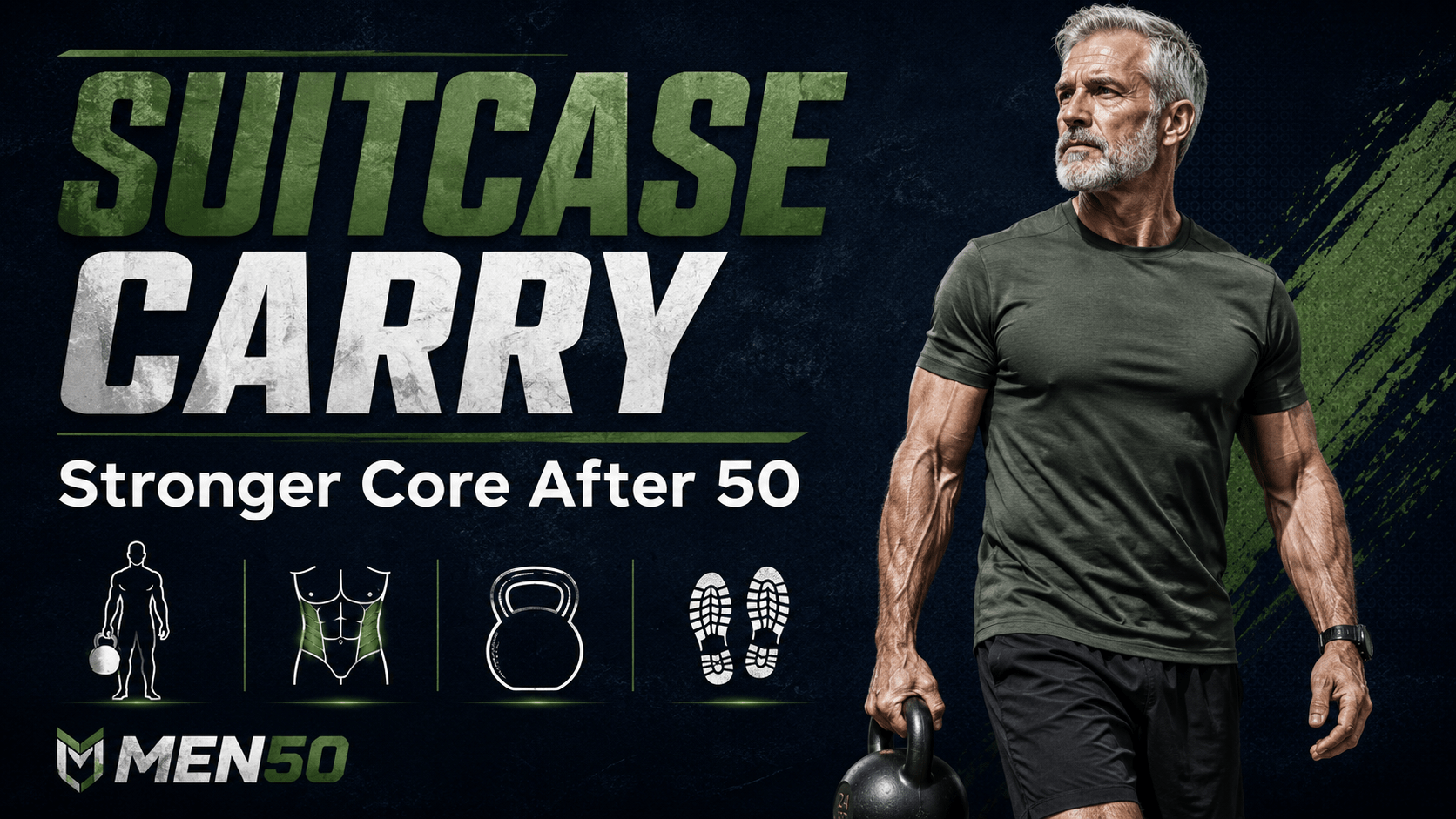
The suitcase carry is the single-arm version of the farmer’s carry — and it does something the bilateral version can’t. By loading only one side, it forces the body to resist sideways bending (anti-lateral-flexion) with every step. This trains the obliques and quadratus lumborum in a real-world functional pattern — the same pattern your body uses every time you carry a heavy shopping bag, briefcase, or toolbox in one hand. Most men over 50 do this asymmetric carrying with terrible form daily, contributing to chronic low-grade back issues. The suitcase carry trains the right pattern.
Part of the Build Muscle After 50 pillar — strength training for men over 50.
Key Takeaways
- The suitcase carry is the single-arm version of the farmer’s carry — same walking pattern, asymmetric load.
- Trains anti-lateral-flexion — the body’s ability to resist sideways bending under load. This is one of the most important real-world core patterns for men over 50.
- Programming: 2–4 sets of 20–40 steps per side (or 20–40 meters), 2–3 times per week. Rest 45–90 seconds between sets.
- Stand tall, don’t lean, walk with control. A simple carry that builds a rock-solid core, better posture, stronger grip, and real-world strength.
- Like every unilateral exercise in the matrix, it exposes and corrects left-right asymmetry — and it’s part of Stuart McGill’s evidence-based spine stability framework.
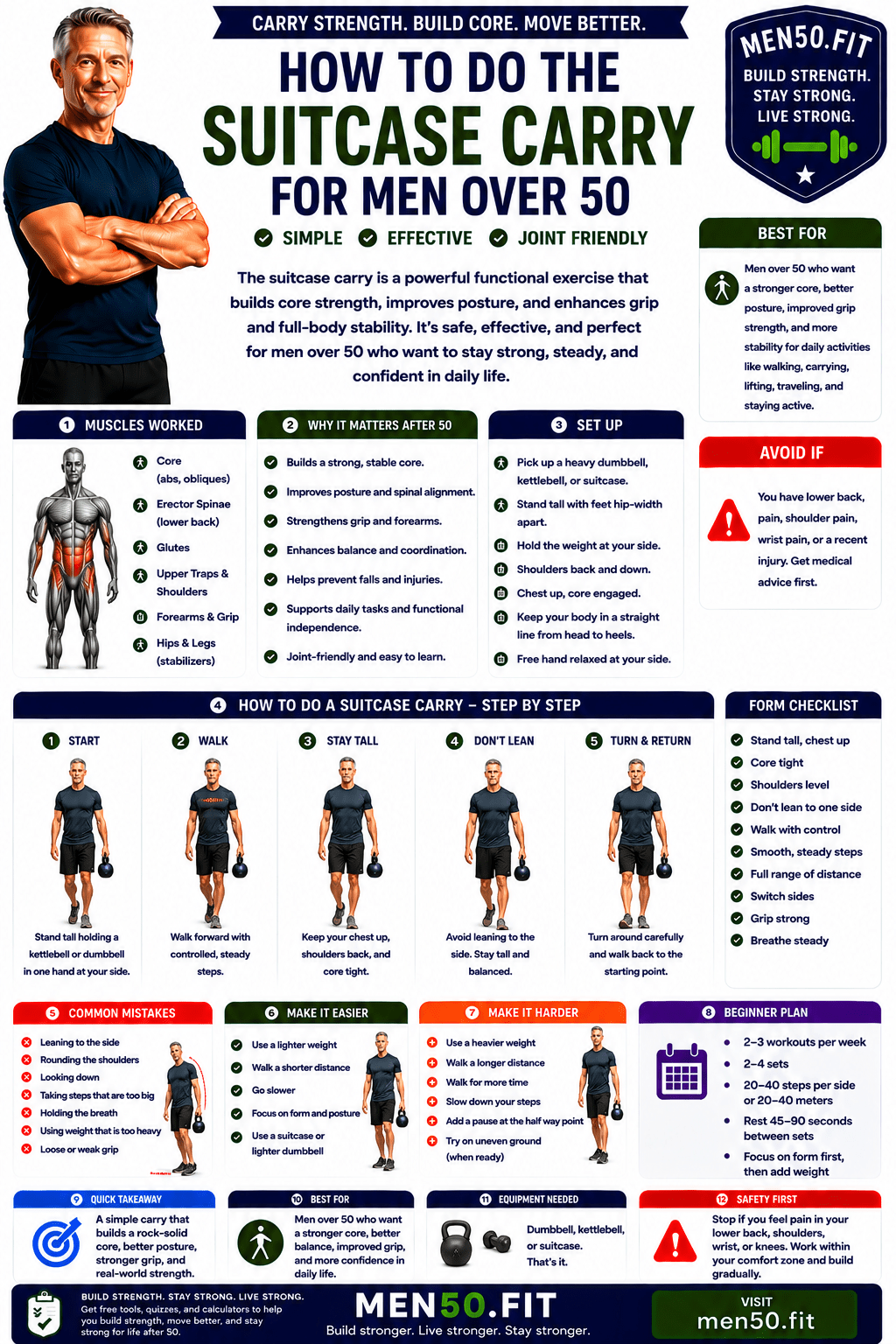
How to Perform the Suitcase Carry
Set up first:
- Pick up a heavy dumbbell, kettlebell, or actual suitcase in one hand.
- Stand tall with feet hip-width apart.
- Hold the weight at your side, arm straight down.
- Shoulders back and down — not shrugged toward the ear on the carrying side.
- Chest up, core engaged.
- Body in a straight line from head to heels — no leaning toward the loaded side.
- Free hand relaxed at your side.
Then the movement:
- Start. Stand tall holding the kettlebell or dumbbell in one hand at your side. Posture upright, shoulders level, core braced. Take a moment to feel the position before walking.
- Walk. Walk forward with controlled, steady steps. Steps shorter than your normal stride — about 60–70% of normal step length is right.
- Stay tall. Keep your chest up, shoulders back, and core tight throughout. The carrying side wants to lean toward the weight; the body has to actively resist that pull.
- Don’t lean. Avoid leaning to the side. Stay tall and balanced. Imagine a string from the top of your head pulling you straight up. If you look in a mirror or a window reflection while walking, the shoulders should look level — not tilted toward the loaded side.
- Turn & return. Turn around carefully (slow, controlled, no spin) and walk back to the starting point. Switch hands and repeat the same number of steps on the other side.
The cue that matters most: shoulders level — don’t let the loaded side dip down or the unloaded side hike up. The body’s natural response to one-sided load is to either tip sideways toward the weight (lateral flexion on the loaded side) or hike the opposite shoulder up to compensate. Both are wrong. The shoulders stay level, the spine stays neutral, and the obliques + quadratus lumborum do the work of keeping it that way.
Why the Suitcase Carry Matters After 50
The carry trains a core function that most fitness programmes ignore entirely: anti-lateral-flexion — the ability to resist sideways bending of the spine under load. Most core training focuses on flexion (crunches), extension (back extensions), or rotation (twisting work). The suitcase carry trains the fourth direction that the spine can fail in — and it’s the one most relevant to daily life.
The Real-World Connection
Think about how often men over 50 carry things one-handed in normal life:
- Shopping bag in one hand
- Briefcase or laptop bag
- Toolbox at work
- Bucket of water/cleaning supplies
- Heavy book or stack of papers
- One side of a large bag through an airport
- Pet carrier in one hand
- Single grocery bag from car to house
Each of these is a suitcase carry pattern. And most men over 50 do them with poor form — leaning sideways, shoulder hiking, head tilting — over and over, dozens of times per week. The cumulative effect is chronic low-grade lower-back stress and asymmetric postural patterns that contribute to back pain.
Training the suitcase carry deliberately fixes this. The exercise grooves the right pattern: tall, level, braced. Once that pattern is ingrained, the body automatically uses it during real-world one-handed carrying, even without conscious thought.
The Stuart McGill Connection
The recurring authority on spine stability across this matrix is Stuart McGill, whose research underpins the dead bug, bird dog, glute bridge, Romanian deadlift, hip hinge, and single-leg glute bridge articles. McGill’s framework identifies three core stability patterns that need training:
| Pattern | Direction | Example Exercises |
|---|---|---|
| Anti-flexion | Resist forward bending | Glute bridge, hip hinge |
| Anti-extension | Resist backward bending | Dead bug, plank |
| Anti-lateral-flexion | Resist sideways bending | Suitcase carry, side plank |
| Anti-rotation | Resist twisting | Bird dog, single-leg bridge |
The suitcase carry covers the anti-lateral-flexion pattern that most core programmes miss entirely. Combined with the other core exercises in the matrix, it produces comprehensive spine stability training.
The Grip Strength Connection
The single-handed load also doubles down on grip strength — the longevity marker we’ve cited repeatedly across the matrix from Leong and colleagues’ 2015 PURE study in The Lancet. The 140,000-person study found that grip strength was a stronger predictor of all-cause mortality and cardiovascular events than systolic blood pressure. The suitcase carry produces a sustained single-handed grip challenge under heavier load than the farmer’s carry (because one hand is carrying what two hands shared), making it particularly effective for grip strength development.
Asymmetry Detection
Like every unilateral exercise in the matrix (one-arm dumbbell row, single-leg glute bridge, supported split squat, single-leg calf raise), the suitcase carry exposes left-right strength and stability asymmetry. Many men over 50 find that their dominant side handles the load much better than the non-dominant side — they’re stronger, more stable, and stay more upright. The non-dominant side is where the body wants to lean, shoulder hike, or struggle. Training both sides equally corrects this over weeks.
Sets and Reps
Carries are usually measured in distance or time, not reps. The infographic recommends 20–40 steps per side or 20–40 meters per set.
| Stage | Distance | Sets per Side | Frequency | Load Guide |
|---|---|---|---|---|
| Beginner | 20 steps / 20m | 2 | 2× per week | Light (15–25 lbs / 7–11 kg) |
| Novice | 30 steps / 30m | 2–3 | 2–3× per week | Working (25–35 lbs / 11–16 kg) |
| Intermediate | 30–40 steps / 30–40m | 3 | 2–3× per week | Moderate (35–50 lbs / 16–23 kg) |
| Advanced | 40+ steps / 40+m | 3–4 | 2–3× per week | Heavy (50+ lbs / 23+ kg) |
Rest 45–90 seconds between sets. Pick a weight where you can complete the distance with: shoulders level (no leaning), upright posture, smooth controlled steps, no shoulder shrugging on the loaded side.
A practical note: most men over 50 should use about 25–50% of their bodyweight in one hand for working sets. A 180-lb man might carry 45–90 lbs (20–40 kg) on each side once form is solid. Start lighter than ego suggests — the form challenge of one-sided loading is harder than it looks. Better to use 25 lbs with perfect upright posture than 50 lbs with sideways lean.
Always start with your weaker side, as established across the matrix’s unilateral progressions. Whatever distance the weaker side can manage with clean form is the cap; match it on the stronger side.
Common Mistakes
The seven errors that turn a great core exercise into a back strain:
- Leaning to the side. The single most common mistake. The body wants to tip toward the loaded weight to reduce the work the obliques do. Stay perfectly upright — actively resist the sideways pull. If you can’t stay upright, the weight is too heavy.
- Rounding the shoulders. As fatigue sets in, the shoulders want to round forward. Shoulders back and down — chest up throughout the walk.
- Looking down. Looking at your feet hyperflexes the cervical spine and makes the carry feel harder. Look forward, eyes on the horizon or about 10 feet ahead.
- Taking steps that are too big. Long strides destabilise the carry. Use shorter, controlled steps — about 60–70% of your normal stride length.
- Holding the breath. Breath-holding under exertion raises blood pressure unnecessarily and limits the number of meters you can walk. Breathe smoothly throughout — exhale steadily, inhale steadily.
- Using weight that is too heavy. Heavy weights force compensation — leaning, shoulder hiking, shorter range, broken form. Drop a size if you can’t maintain upright posture. The exercise rewards form, not weight.
- Loose or weak grip. A loose grip means the weight wobbles and threatens to slip — which makes the body brace less effectively. Grip firmly throughout the carry; the grip itself is part of the training stimulus.
Make It Easier or Harder
If standard suitcase carries are too challenging:
- Use a lighter weight — 10–15 lbs (4.5–7 kg) is fine for beginners. The exercise is harder than it looks.
- Walk a shorter distance — 10–15 steps per side as you build endurance.
- Go slower — slow steps give you more time to focus on form and posture.
- Focus on form and posture — clean technique with light weight trains the right pattern.
- Use a suitcase or lighter dumbbell instead of a kettlebell — gentler on the wrist for some men.
To make it harder once form is solid:
- Use a heavier weight — but only when the lighter weight produces clean upright form.
- Walk a longer distance — extend to 40–50+ steps per side.
- Walk for more time — use a timer instead of step count (60–90 seconds per side).
- Slow down your steps — slower walking increases time-under-tension.
- Add a pause at the halfway point — stop, stand tall for 5 seconds, continue. Tests static stability mid-carry.
- Try on uneven ground (when ready) — grass, gravel, a soft path. Significantly more demanding on stability.
For variety, alternate the suitcase carry with the farmer’s carry — same fundamental movement, different load distribution. Most men over 50 benefit from both: farmer’s carry for total grip and bilateral loading, suitcase carry for unilateral anti-lateral-flexion stability.
Safety Note
Avoid the suitcase carry if you have lower back pain, shoulder pain, wrist pain, or a recent injury affecting these areas. Get medical advice first.
Lower back pain during this exercise usually means the body is leaning toward the loaded side instead of staying upright. Fix the form first before continuing. If pain persists with clean upright form, drop back to the bilateral farmer’s carry (symmetric load is less back-demanding) and rebuild over weeks.
Shoulder pain on the carrying side, particularly at the upper trap area, usually means the shoulder is shrugging up. Pull the shoulder down and back — the shoulder blade should sit in a neutral position, not hiked up toward the ear. If pain persists, the weight is too heavy.
Wrist pain during the carry usually comes from gripping with the wrist bent rather than straight. Keep wrists neutral — in line with the forearm — throughout. Thicker handles (or wrapping a towel around a dumbbell handle) can help men with wrist arthritis.
Don’t carry weights that you can’t safely lower at the end of the set. Many lifting injuries happen at the end of carries when men drop or lower weights with bad form. Plan your route so you finish near a place to set the weight down with clean hip hinge form (not by stooping over).
If you feel sharp pain anywhere during the walk, stop, set the weight down carefully, and rest. Mild muscular fatigue in the obliques or forearms is normal; sharp pain is not.
Build Your Personal Training Plan
The suitcase carry is one piece of a complete core and functional training programme. Get a personalised exercise plan based on your current strength, goals, and any limitations.
Take the Free Fitness Profiler →
FAQs
Suitcase carry vs farmer’s carry — which is better?
Different exercises that serve different purposes. The farmer’s carry (both hands carrying weights) is the bilateral version — trains grip, posture, and walking stability with symmetric load. The suitcase carry is the unilateral version — trains the same things plus anti-lateral-flexion core strength because the body has to resist the sideways pull of single-side loading. For most men over 50, doing both gives the best results. The farmer’s carry handles total grip and bilateral loading; the suitcase carry handles oblique/QL training and unilateral stability. A simple programme: farmer’s carry one workout per week, suitcase carry on another. Or alternate them within a single workout (one set of each). Neither is “better” — they’re complementary.
How heavy should the weight be?
Heavier than ego suggests is wrong here — but lighter than you’d think is also wrong. Start with about 25% of your bodyweight in one hand. A 180-lb man starts with 35–45 lbs (16–20 kg). After 2–3 months, many progress to 40–50% of bodyweight (a 180-lb man at 70–90 lbs / 30–40 kg). The right weight lets you complete the distance with: upright posture, shoulders level, smooth steps, no leaning, firm grip throughout. If you can’t stay upright, drop the weight. The exercise rewards form, not heroic loads. Better to use 30 lbs with perfect upright posture than 60 lbs with visible sideways lean.
Why is this called a “suitcase” carry?
Because the carrying position mimics how you’d carry a heavy suitcase: one hand at your side, weight pulling downward, walking forward while staying upright. The name describes the everyday real-world equivalent of the exercise. It’s also a useful mental cue — when you’re doing the carry, you can imagine you’re walking with a heavy suitcase through an airport. Stay tall, don’t lean, walk with purpose.
How do I know if I’m leaning?
Three checks. (1) Mirror or window reflection — if you can walk past one during your carry, check whether the shoulders appear level. (2) Phone video — set up your phone to record a carry, watch it back. Most men are surprised at how much they lean even when they think they’re upright. (3) Touch test — briefly touch each side of your ribs during the carry. The distance from each rib to your hip should feel the same. If the loaded side feels compressed (shorter rib-to-hip distance), you’re leaning toward the weight; if it feels stretched (longer), you’re leaning away. Both are wrong. The torso should be perfectly symmetric.
How is this different from regular carrying?
Mostly intention and form. Regular daily carrying is unconscious and usually involves leaning, shoulder hiking, looking down, and rushing. The suitcase carry is deliberate practice of the right form: tall, level, smooth steps, controlled breathing. Over weeks of training the right pattern, the body starts to use it automatically during real-world carrying — which means daily one-handed tasks (shopping, briefcase, etc.) become spine-protective rather than spine-stressing. This is one of the most directly functional exercises in the matrix — what you train translates almost identically to daily life.
References
- McGill SM. Low Back Disorders: Evidence-Based Prevention and Rehabilitation. 3rd ed. Champaign, IL: Human Kinetics; 2016.
- Leong DP, Teo KK, Rangarajan S, et al. Prognostic value of grip strength: findings from the Prospective Urban Rural Epidemiology (PURE) study. The Lancet. 2015;386(9990):266-273.
- American College of Sports Medicine. Resistance Training for Older Adults Position Stand. acsm.org
Disclaimer: This article is for educational purposes only and is not medical advice. Consult a qualified healthcare professional before starting any new exercise programme, especially if you have existing back, shoulder, or wrist conditions.