
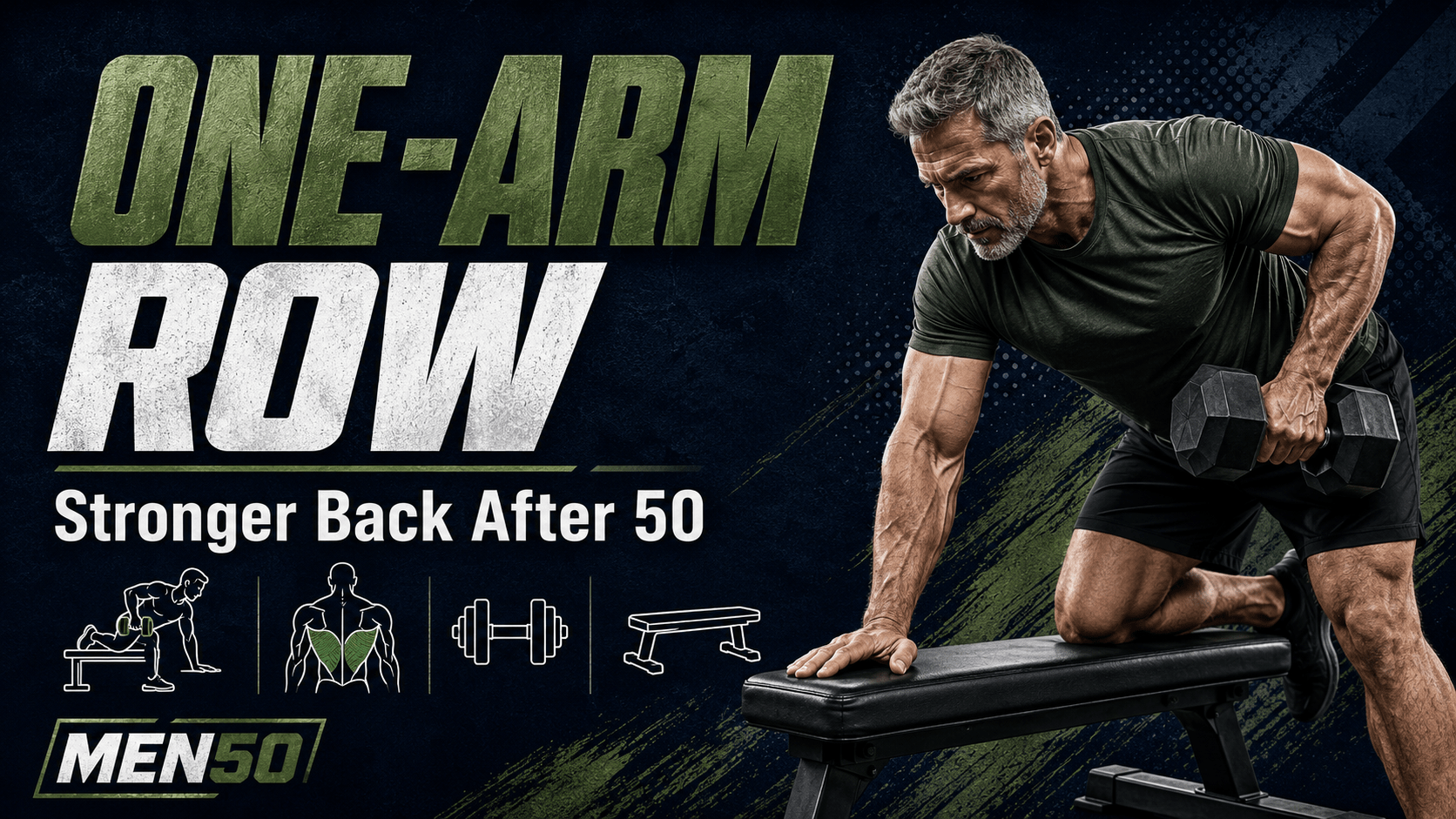
The one-arm dumbbell row is the classic gym back exercise for good reason — it solves three problems at once that make most rowing exercises harder than they need to be for men over 50. The bench-supported position takes the lower back almost entirely out of the equation. Each side trains independently, which exposes the left-right back asymmetry that bilateral rowing hides. And the single-arm setup allows heavier loading per arm than bilateral variations because you’re not splitting capacity across two sides. For men over 50 with a bench and a single decent dumbbell, this is one of the most efficient back exercises in existence.
Part of the Build Muscle After 50 pillar — strength training for men over 50.
Key Takeaways
- The one-arm dumbbell row trains the same primary muscles as the bilateral dumbbell row (lats, rhomboids, traps, rear delts) — but with bench support that eliminates lower-back demand.
- Each side trains independently, which exposes and corrects left-right asymmetry that bilateral rowing hides.
- Allows heavier loading per arm than bilateral rowing (often 20–40% heavier) because you’re not splitting load across two sides.
- Programming: 2–4 sets of 8–12 reps per side, 2–3 times per week. Rest 45–75 seconds between sets.
- Row with control, not momentum. Strong back muscles improve posture, protect your spine, and make daily life easier.
How to Perform the One-Arm Dumbbell Row
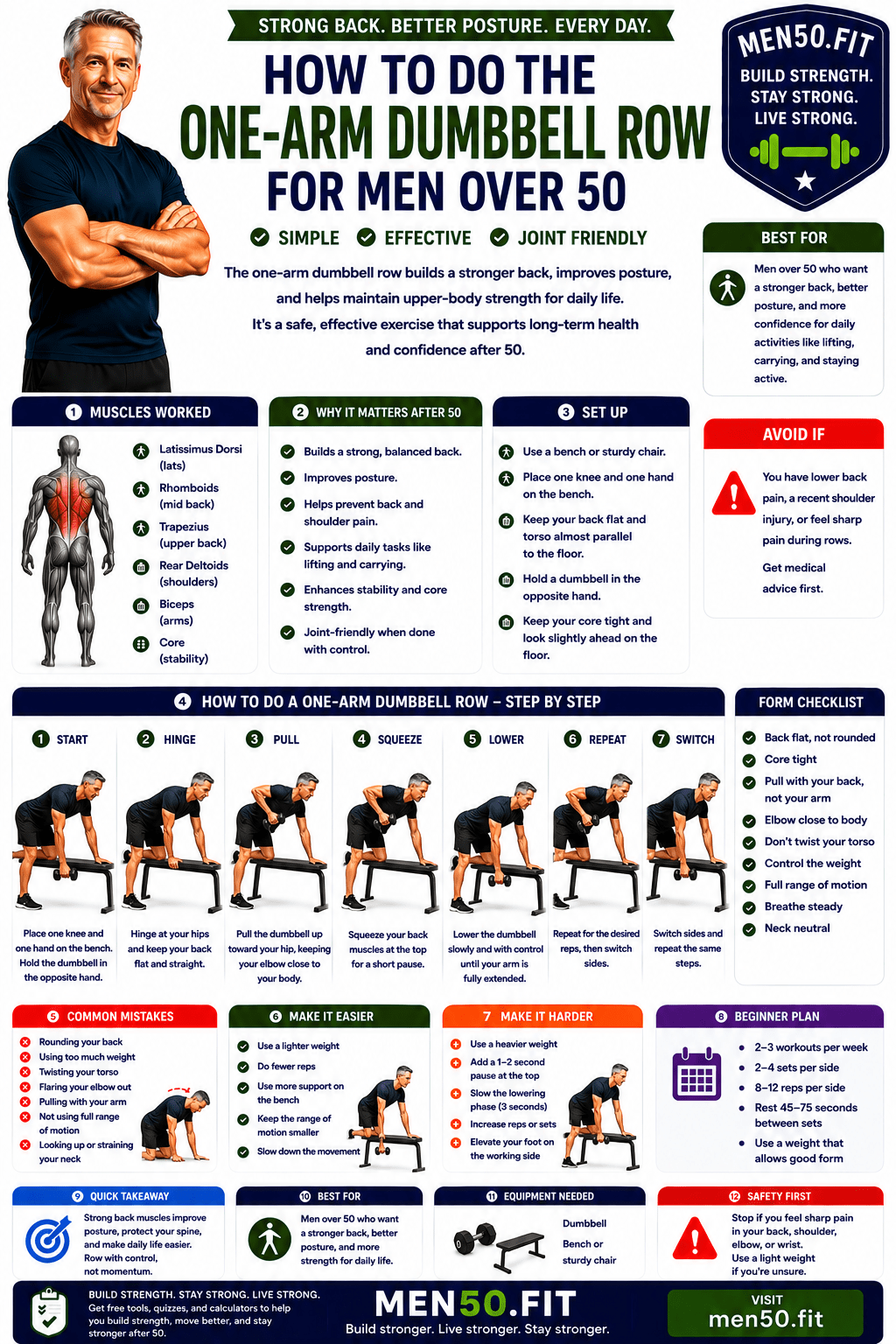
Set up first:
- Use a bench or sturdy chair that won’t slide or tip.
- Place one knee and one hand on the bench — opposite side from the working arm. (Working with the right arm? Left knee and left hand on the bench.)
- Keep your back flat and torso almost parallel to the floor.
- Hold a dumbbell in the opposite hand, arm hanging straight down.
- Keep your core tight and look slightly ahead on the floor — neck in line with spine.
Then the movement:
- Start. One knee and one hand on the bench. Torso parallel to the floor. Back flat. Dumbbell hanging straight down in the working hand.
- Hinge. Hinge at your hips and keep your back flat and straight throughout the rep. Hips and shoulders square to the floor — don’t let the body twist.
- Pull. Pull the dumbbell up toward your hip (not toward your shoulder), keeping your elbow close to your body. Lead with the elbow, not the hand. Take 1–2 seconds to pull up.
- Squeeze. Squeeze your back muscles at the top for a short pause. The dumbbell ends near your hip; your elbow ends higher than your back.
- Lower. Lower the dumbbell slowly and with control until your arm is fully extended. Take 2–3 seconds on the way down. Don’t drop the weight — control every rep.
- Repeat. Complete the reps on one side, maintaining clean form. Quality over weight always.
- Switch. Switch sides — swap which knee/hand is on the bench, switch the dumbbell to the other hand, and repeat the same number of reps.
The cue that matters most: pull with your back, not your arm. The thought “lead with the elbow toward the ceiling” usually works better than “lift the dumbbell.” When you lead with the elbow, the lats and upper back muscles do the work. When you focus on the hand, the biceps takes over and the back barely fires.
Why the One-Arm Dumbbell Row Matters After 50
The back is one of the most under-trained muscle groups in men over 50, and the consequences show up everywhere: rounded shoulders, forward head posture, weak pulling capacity, increased shoulder injury risk, and chronic low-grade upper-back tightness. Decades of seated work, driving, and screen time create what Czech physiotherapist Vladimir Janda called upper crossed syndrome — the pattern of tight chest, weak upper back, weak rear shoulders, and weak external rotators. Back training is the strength-building half of fixing this pattern (the doorway chest stretch is the lengthening half).
The one-arm dumbbell row trains the entire back posterior chain with one efficient movement:
| Muscle | Role |
|---|---|
| Latissimus dorsi (lats) | The large back muscle running from spine to upper arm — primary mover |
| Rhomboids | Pull the shoulder blades together — postural correction |
| Trapezius (mid + lower) | Stabilise the shoulder blades during pulling |
| Rear deltoids | Extension of the shoulder, complement the rear-delt-isolated work |
| Biceps | Assists by bending the elbow (secondary, not primary) |
| Core | Resists rotation — must brace through every rep |
The exercise hits all of these muscles every rep, on each side independently.
Why the Single-Arm Setup Specifically
The one-arm dumbbell row solves three problems at once that other rowing exercises don’t:
1. Bench support eliminates lower-back demand. The bilateral dumbbell row requires you to hold a hinged-over position throughout every set, which loads the spinal erectors and lower back. For men over 50 with any lower-back history, this is often the limiting factor — not back strength. The one-arm version puts a knee and hand on the bench, transferring most of the bracing demand to the bench itself. The lower back gets a near-rest while the upper back works.
2. Single-arm training exposes asymmetry. Just like the lower body, the upper body usually has meaningful left-right strength asymmetry — typically because men over 50 favour their dominant side for years of one-handed tasks. Bilateral rowing hides this; the stronger side compensates for the weaker. Single-arm rowing exposes the imbalance immediately. You’ll usually feel which side is weaker by the second set. Over weeks of training, the weaker side catches up.
3. Heavier loading per arm. Because you’re only working one arm at a time, you can use significantly heavier weight than in bilateral rowing. Most men over 50 can use 20–40% heavier dumbbells in one-arm rows than in bilateral rows. This means progressive overload (essential for building strength) is easier to apply.
The Row Family in the Matrix
This exercise completes the four-piece rowing cluster for men over 50:
| Exercise | Setup | Best For |
|---|---|---|
| Dumbbell Row | Standing, hinged, both arms | Compound back work, full-body bracing |
| Chest-Supported Row | Chest on incline bench, both arms | Back-friendly, ego-free form |
| Resistance Band Row | Standing or seated, band | Home/travel, no dumbbells |
| One-Arm Dumbbell Row | Knee on bench, single arm | Asymmetry correction, heavier load |
Together with band lat pulldown (vertical pulling), this gives the most comprehensive back training set in the matrix.
Sets and Reps
Progressive loading is the goal. The single-arm setup lets you push harder than bilateral rowing.
| Stage | Sets × Reps per Side | Frequency | Load Guide |
|---|---|---|---|
| Beginner | 2 × 8–10 | 2× per week | Light (10–15 lbs / 4.5–7 kg) |
| Novice | 2–3 × 8–12 | 2–3× per week | Working weight (15–25 lbs / 7–11 kg) |
| Intermediate | 3 × 8–12 | 2–3× per week | Moderate (25–35 lbs / 11–16 kg) |
| Advanced | 3–4 × 8–12 | 2–3× per week | Moderate-heavy + pause at top + slow lowering |
Rest 45–75 seconds between sets (not between sides — pause briefly between sides, take the full rest between supersets). Pick a weight where the last 2–3 reps on the weaker side feel clearly challenging but maintainable with clean form.
A practical note on load: most men over 50 are surprised they can row significantly heavier in this position than in any other variation. After 3–6 months of training, many can use 30–45 lb (14–20 kg) dumbbells per arm for working sets. Use whatever progresses your strength while maintaining clean form. The single-arm setup tolerates heavier loading better than other rowing variations.
Always start with your weaker side. This is important. If you start with the stronger side and do 12 reps, you’ll force yourself to match that on the weaker side — even if the weaker side can really only handle 8 clean reps. Start with the weaker side, do as many clean reps as that side can manage, then match that number on the stronger side. This naturally trains the asymmetry toward balance.
Common Mistakes
The seven errors that turn a great back exercise into a back or shoulder problem:
- Rounding your back. The single most dangerous mistake. As fatigue sets in, the lower back wants to round to make the lift easier. This is the same pattern that causes lifting-related back injuries. Keep the back flat throughout — chest up, core braced, hips hinged. If the back wants to round, the set is over.
- Using too much weight. Heavy weights force compensation — swinging, twisting, rounding, half reps. Drop a size. The back is a large muscle group that responds to controlled loading, not max-effort heaving.
- Twisting your torso. As you pull the dumbbell up, the body wants to twist toward the working side to recruit more muscles. This loads the spine asymmetrically and is a common cause of low-back strain. Keep hips and shoulders square to the floor throughout the rep. No rotation.
- Flaring your elbow out. If the elbow drifts out to the side at 90 degrees from your body during the row, the work shifts to the rear delts and upper traps — not where you want it. Keep the elbow close to your body throughout, leading the pull toward the hip (not the chest).
- Pulling with your arm. The single most common technical error. When you focus on lifting the dumbbell with the arm, the biceps takes over and the back barely fires. Lead with the elbow, not the hand. Think “elbow toward the ceiling” instead of “lift the dumbbell.”
- Not using full range of motion. Half-reps that don’t bring the dumbbell up to the hip or don’t extend the arm fully at the bottom skip part of the working range. Full extension at the bottom, full pull to the hip at the top.
- Looking up or straining your neck. Looking up during the row hyperextends the cervical spine. Look slightly ahead on the floor — neck in line with the spine throughout.
Make It Easier or Harder
If standard one-arm dumbbell rows are too challenging:
- Use a lighter weight — 5–10 lbs (2–4.5 kg) is fine for beginners. The back develops over months, not weeks.
- Do fewer reps — start with 2 sets of 6–8 per side and build up.
- Use more support on the bench — both forearm and knee on the bench (a more deeply seated position) reduces demand.
- Keep the range of motion smaller — pull only 70–80% of the way up while you build strength.
- Slow down the movement — clean tempo with light weight trains the pattern.
To make it harder once form is solid:
- Use a heavier weight — but only when the lighter weight feels easy with clean form. The single-arm setup tolerates progressive overload well.
- Add a 1–2 second pause at the top with the elbow high and back muscles squeezed.
- Slow the lowering phase to 3 seconds per rep — significantly more demanding than it sounds.
- Increase reps or sets — extend to 12–15 per side before adding weight.
- Elevate your foot on the working side — place the foot of the working leg on a small block or step. Subtle change, but increases the demand on the side body.
For variety, try the standing one-arm dumbbell row (with the non-working hand on a wall or sturdy surface for support) once a week — same exercise, different position, more core demand because the spine has to brace standing.
Safety Note
Avoid the one-arm dumbbell row if you have acute lower back pain, recent shoulder injury, or sharp pain during rows. Get medical advice first.
Lower back pain during this exercise usually means: the back is rounding (most common), the weight is too heavy, or the hips and shoulders aren’t square (you’re twisting). The bench-supported position should largely protect the lower back — if it’s still painful, check form before continuing.
Shoulder pain at the front of the shoulder during the lowering phase usually means the dumbbell is too heavy, or the arm is being allowed to hang too freely at the bottom. Control the descent; keep mild tension throughout.
Wrist pain can occur if you grip the dumbbell too tightly or let the wrist bend backward at the top. Keep wrists straight and grip firm but not crushing.
If you feel sharp pain anywhere during the rep, stop. Mild muscular fatigue in the back is normal; sharp joint pain is not.
Build Your Personal Training Plan
The one-arm dumbbell row is one piece of a complete upper body programme. Get a personalised exercise plan based on your current strength, goals, and any limitations.
Take the Free Fitness Profiler →
FAQs
One-arm dumbbell row vs standard dumbbell row — which is better?
For most men over 50, the one-arm version has three real advantages: the bench support eliminates lower-back demand, the single-arm setup exposes left-right asymmetry, and you can use heavier weight per arm. The bilateral dumbbell row requires more total-body bracing (and trains it), gets through the work faster, and doesn’t require a bench. Most men over 50 benefit from doing both — the one-arm version 1–2 times per week for primary back work, the bilateral version occasionally for variety and total-body bracing practice. Neither is “better” — they’re complementary. If you can only pick one, the one-arm version is the safer default for back-conscious training.
Why use a bench for support?
Three specific reasons. (1) It eliminates lower-back demand. Holding a hinged-over position for multiple sets puts continuous load on the spinal erectors and lower back — for men over 50 with any back history, this is often the limiting factor. The bench transfers that demand to the bench itself. (2) It stabilises the body. With one knee and hand on the bench, you can’t easily twist or swing — the form correction is built into the setup. (3) It allows heavier loading. Because the body is stable, you can pull more weight than in standing variations. If you don’t have a bench, a sturdy chair, sofa, or coffee table works just as well — anything that won’t tip and holds your weight at hip height.
How heavy should the dumbbell be?
Heavier than you’d expect — and definitely heavier than for bilateral rows. For most men over 50 starting out, 15–25 lbs (7–11 kg) per arm. After 3–6 months of training, many progress to 25–40 lbs (11–18 kg) for working sets. The one-arm position tolerates heavier loading better than any other rowing variation because the body is stable and the lower back isn’t fighting the position. The right weight lets you complete the rep range with: back flat, no twisting, elbow close to the body, controlled tempo. If you can rip through 12 reps without effort, go heavier. If form breaks down at 6 reps, go lighter.
Can I do this without a bench?
You can do variations without a bench, but the proper one-arm dumbbell row requires a stable surface to support the knee and hand. If you don’t have a bench, alternatives include: a sturdy chair turned sideways (use the seat), a sofa edge, a coffee table, a low desk, or a kitchen counter (with one hand only, standing). For travel or home setups without a bench, the resistance band row is often a more practical alternative — same back muscles, no bench needed.
Should I do this if I have lower back issues?
Yes — usually. The bench-supported position is specifically designed to minimise lower-back demand, which makes the one-arm dumbbell row one of the best rowing options for men with lower-back history. Get clearance from a physiotherapist if your back issues are recent or acute. Once cleared, start with very light weight (5–10 lbs / 2–4.5 kg) and focus on maintaining a flat back throughout every rep. Avoid the bilateral dumbbell row (which requires hinged-over bracing) and stick with this one-arm version or the chest-supported row. If back pain occurs during the rep, stop. The bench should protect the lower back almost entirely — if it doesn’t, something’s wrong with form.
References
- Janda V. Muscles, Central Nervous Motor Regulation and Back Problems. In: Korr IM (ed). The Neurobiologic Mechanisms in Manipulative Therapy. Plenum Press; 1978. (Upper Crossed Syndrome framework.)
- Kibler WB, Sciascia A. Current concepts: scapular dyskinesis. British Journal of Sports Medicine. 2010;44(5):300-305.
- American College of Sports Medicine. Resistance Training for Older Adults Position Stand. acsm.org
Disclaimer: This article is for educational purposes only and is not medical advice. Consult a qualified healthcare professional before starting any new exercise programme, especially if you have existing back, shoulder, or elbow conditions.