
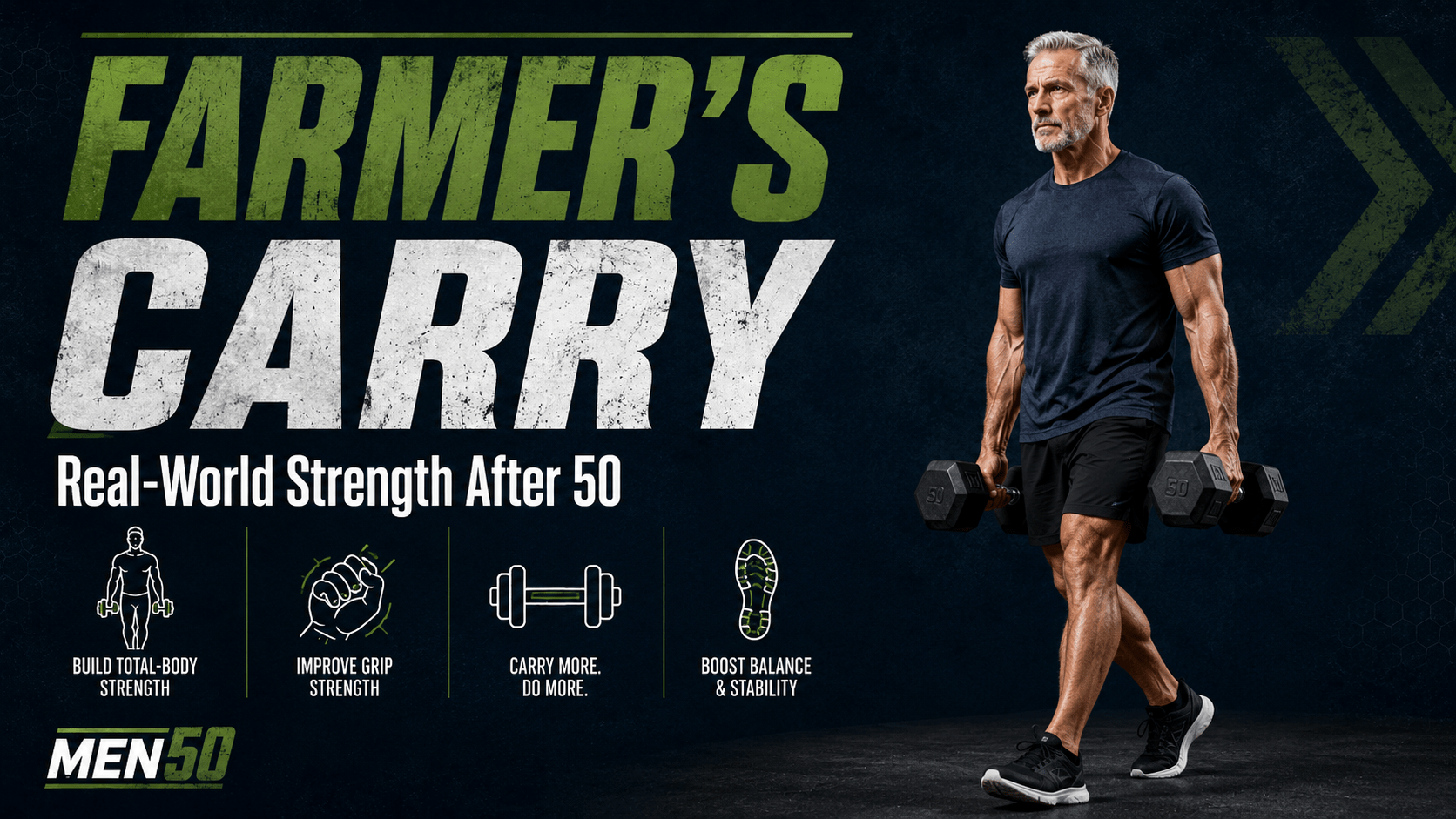
The farmer’s carry is as close to “training for real life” as any exercise gets. Pick up something heavy in each hand, walk with it, set it down. That single pattern trains grip strength, core stability, shoulder posture, and leg endurance simultaneously — and it’s the exact thing you do every time you carry groceries from the car, lug suitcases through an airport, or move a toolbox across the garage. For men over 50, this is one of the highest-return exercises in the matrix.
Part of the Build Muscle After 50 pillar — strength training for men over 50.
Key Takeaways
- The farmer’s carry trains grip, forearms, traps, shoulders, core, and legs in one integrated movement.
- Grip strength is one of the strongest single predictors of all-cause mortality and cardiovascular events in adults — stronger than systolic blood pressure in the PURE study of 140,000 people.
- Programming: 3–5 carries of 20–40 seconds, 2–3 times per week. Start lighter than you think and build from there.
- Walk like you’re trying to look strong. Stand tall, shoulders down and back, core tight, gaze forward.
- The weights should challenge your grip but never compromise your posture. If you start to lean or shrug, the load is too heavy.
How to Perform the Farmer’s Carry
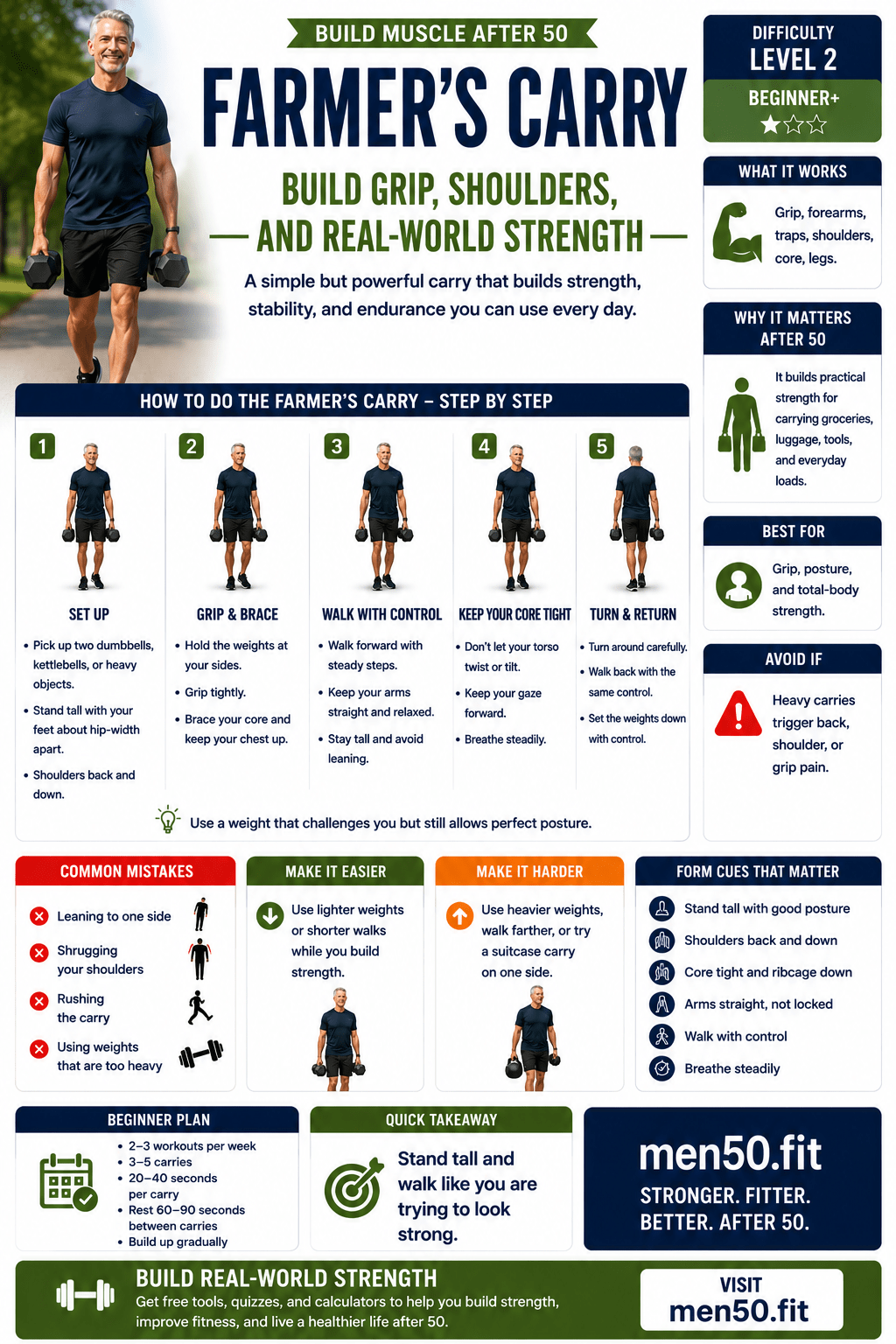
- Set up. Pick up two dumbbells, kettlebells, or heavy objects — one in each hand. Stand tall with feet hip-width apart, shoulders back and down. Make sure the floor is clear of obstacles.
- Grip and brace. Hold the weights at your sides with a tight grip. Brace your core as if someone were about to gently push you in the stomach. Chest up. Ribcage down (not flared out).
- Walk with control. Step forward with steady, deliberate strides. Keep your arms straight (not locked), shoulders pulled down away from your ears, and your body tall. Don’t lean to either side as you walk.
- Keep the core tight. Don’t let your torso twist or tilt with each step. Keep your gaze forward, breathing steady. Short, controlled steps are better than long, sloppy ones.
- Turn and return. When you reach the end of your walking space, turn around carefully — the weights have momentum, so don’t whip around. Walk back with the same posture and control. Set the weights down with intention, not by dropping them.
The cue that matters most: stand tall and walk like you’re trying to look strong. Posture is the exercise. The moment you lean, shrug, or hunch, the carry stops working as designed.
Why the Farmer’s Carry Matters After 50
Grip strength is one of the most strongly studied predictors of healthspan in men over 50. The PURE study — a 4-year prospective study of 140,000 adults across 17 countries published in The Lancet in 2015 by Leong and colleagues — found that lower grip strength was a stronger predictor of all-cause mortality and cardiovascular events than systolic blood pressure. Every 5 kg decrease in grip strength was associated with a 17% increased risk of cardiovascular death. This isn’t because grip itself causes heart disease — it’s that grip strength is a proxy for total muscular strength, and total muscular strength tracks closely with longevity.
Beyond grip, the farmer’s carry trains nearly everything the body uses to function in daily life. The traps and upper back hold the shoulders in place against gravity, the deep core stabilises the spine against the asymmetrical load on each step, and the legs and hips do the walking. It’s a total-body exercise wrapped in a one-minute movement, with no specialised equipment beyond a pair of dumbbells.
The functional carryover is the best argument for it. Carrying shopping bags from the car, lifting and moving a suitcase, hauling a toolbox or a grandchild — these are all variations of the farmer’s carry pattern. Train it deliberately and the everyday versions become easier and safer, which matters more after 50 than at any earlier point in life.
It also pairs naturally with brisk walking. The carry adds load and grip demand to a movement pattern your body already knows how to do, which makes it one of the lowest-skill, highest-return strength exercises available.
Sets and Reps
Start lighter than you think. Posture is the exercise — if posture breaks, the load is wrong.
| Stage | Load (per hand) | Distance / Time | Carries | Frequency |
|---|---|---|---|---|
| Beginner | 10–25% of bodyweight | 20–30 seconds | 3 | 2× per week |
| Novice | 25–35% of bodyweight | 30–40 seconds | 3–4 | 2–3× per week |
| Intermediate | 35–45% of bodyweight | 40–60 seconds | 4–5 | 2–3× per week |
| Advanced | 50%+ of bodyweight | 60+ seconds | 4–5 | 2–3× per week |
Rest 60–90 seconds between carries. Time-based carries are easier to manage at home than measured distances — set a timer on your phone and walk back and forth across the largest room or hallway you have.
For a 180 lb (82 kg) man, beginner load works out to roughly 20–45 lbs (9–20 kg) per hand. Most men over 50 starting out will use 15–25 lb dumbbells. There’s no glory in starting heavy — there’s only quicker form breakdown.
Common Mistakes
The four errors that turn a great functional exercise into a back or shoulder problem:
- Leaning to one side. Means one hand has more load than it can manage, or one side of the core isn’t bracing properly. Stop, reset posture, reduce load if needed. Walking 20 metres with a 3-degree lean is how lower backs get tweaked.
- Shrugging the shoulders. The weights pull the shoulders up toward the ears as fatigue sets in. Make a conscious effort to pin the shoulders down and back the entire carry. If you can’t hold them down for 20 seconds, the load is too heavy.
- Rushing the carry. Walking fast turns the carry into cardio with weights — useful occasionally, but it’s not what the exercise is designed for. Steady, deliberate steps build the postural strength the carry is meant to develop.
- Using weights that are too heavy. The most common mistake by far. Ego picks up heavier dumbbells than the body can carry with clean posture. If your grip fails before 20 seconds, your shoulders shrug, or your back arches, the load is wrong — drop one size and try again.
Make It Easier or Harder
If full farmer’s carries feel too challenging, use lighter weights or shorter walks while you build strength. Even 10 lb (4.5 kg) dumbbells for 15 seconds per carry is useful work for a man returning to training. Build duration before adding load.
To make it harder once basic form is solid: increase the load, walk longer distances, or progress to the suitcase carry — a single-arm carry with weight on one side only. The suitcase carry is more demanding on the core because you have to resist the side-to-side pull of an asymmetrical load. Use 30–50% lighter weight than a standard farmer’s carry to start, walk equal time on both sides.
Other variations once you’ve mastered the basic version: the rack carry (kettlebells held at shoulder height — heavier core demand), the overhead carry (most advanced, not suitable for men with shoulder issues), and the mixed carry (one weight at the side, one overhead). Stick to the basic farmer’s carry for at least 8–12 weeks before exploring variations.
Safety Note
Avoid the farmer’s carry if you have an acute grip injury, wrist strain, shoulder impingement, or recent lower back flare-up. Heavy asymmetrical loads aggravate these conditions. Keep the weights even in both hands unless you’re deliberately training the suitcase carry variation.
If you feel lower back pain during the carry, stop and reduce the load. Brace your core more firmly before the next set. Pain in the wrists or fingers usually means the load is too heavy for current grip strength — drop a size and build up.
Make sure the floor is clear, non-slip, and free of tripping hazards. Heavy weights make small obstacles much more dangerous than usual.
Build Your Personal Training Plan
The farmer’s carry is one piece of a complete strength programme. Get a personalised exercise plan based on your current strength, goals, and any limitations.
Take the Free Fitness Profiler →
FAQs
How heavy should the weights be for a farmer’s carry?
Start at roughly 10–25% of your bodyweight per hand. For a 180 lb (82 kg) man, that’s 18–45 lbs (8–20 kg) per dumbbell. Most men over 50 starting out should use 15–25 lb dumbbells. The right weight is the one that challenges your grip and posture at 20–30 seconds but doesn’t break your form before then. If you can’t hold the weights with shoulders down and core braced, they’re too heavy.
Can I do farmer’s carries with grocery bags?
For practical strength training, yes — and many men over 50 should. A 10 kg (22 lb) shopping bag in each hand carried from car to kitchen is a real-world farmer’s carry. Add a longer route around the kitchen island or down the hallway to extend the duration. It’s not as adjustable as dumbbells, but it builds the same patterns in the same body.
Why does my grip fail before my legs?
Because grip strength is usually the weakest link in the chain — particularly in men over 50 who haven’t done grip-specific work in years. This is the exercise doing its job. Grip will improve fastest in the first 4–6 weeks of consistent farmer’s carries, then continue to build more slowly. If grip fails at 10 seconds, drop one weight size; aim to have grip last to at least 20–30 seconds before progressing.
How is the farmer’s carry different from just walking with weights?
It’s not — that’s the point. The farmer’s carry takes a movement pattern (walking) you already do every day and adds load to it. The difference is in the deliberate focus on posture, grip, and core bracing during the carry. Walking with weights while slouching is just slouched walking with extra load on your joints. The farmer’s carry is walking with weights while standing tall and bracing properly.
Should I do farmer’s carries before or after other exercises?
Either works, depending on the goal. Done early in a session, the carry can serve as a postural warm-up before heavier lifts. Done at the end, it’s a finisher that taxes the grip and core after they’ve already been pre-fatigued. Most men over 50 get good results doing carries as a standalone strength element 2–3 times per week, either at the start or end of a session.
References
- Leong DP, Teo KK, Rangarajan S, et al. Prognostic value of grip strength: findings from the Prospective Urban Rural Epidemiology (PURE) study. The Lancet. 2015;386(9990):266-273.
- American College of Sports Medicine. Resistance Training for Older Adults Position Stand. acsm.org
- National Institute on Aging. Sarcopenia and Muscle Strength in Older Adults. nia.nih.gov
Disclaimer: This article is for educational purposes only and is not medical advice. Consult a qualified healthcare professional before starting any new exercise programme, especially if you have existing grip, wrist, shoulder, or back conditions.