
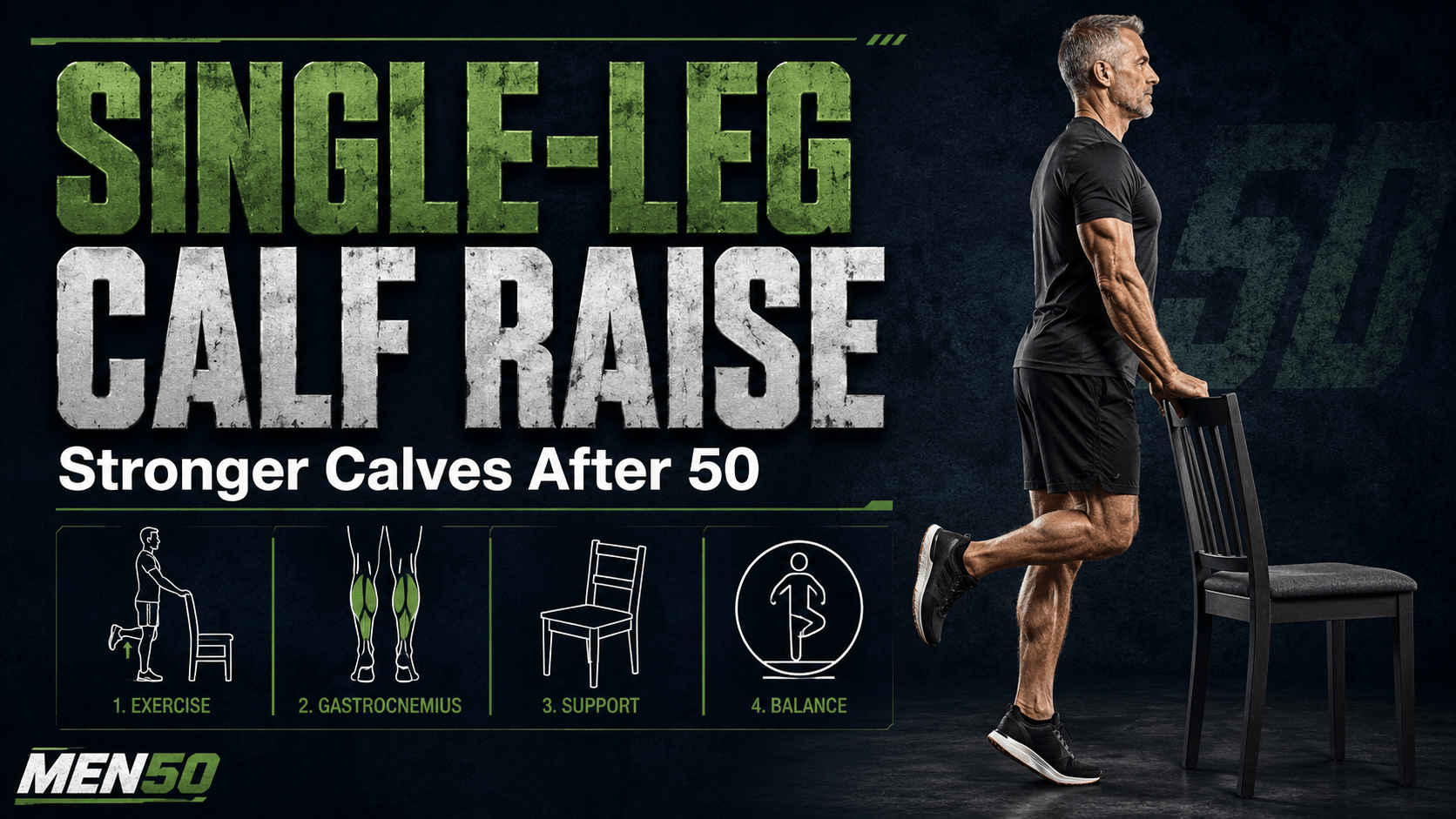
The single-leg calf raise is the natural progression beyond the standard bilateral calf raise — and like every unilateral progression in the matrix (one-arm dumbbell row, single-leg glute bridge, supported split squat), it does something the bilateral version can’t. It exposes the left-right calf asymmetry that bilateral training hides. Most men over 50 have meaningful calf strength imbalance, usually because they favour one side during walking or have an old ankle injury. That asymmetry contributes to walking gait issues, ankle instability, and increased fall risk. The single-leg version reveals and corrects it.
Part of the Build Muscle After 50 pillar — strength training for men over 50.
Key Takeaways
- The single-leg calf raise trains the same primary muscles as the bilateral version (gastrocnemius, soleus, Achilles tendon) — but on one leg, with significantly more load per side.
- Exposes and corrects left-right calf asymmetry that bilateral training hides.
- Programming: 2–4 sets of 8–15 reps per leg, 2–3 times per week. Rest 30–60 seconds between sets.
- Lift heel as high as possible, lower with control, allow a full stretch at the bottom. Small steps, big impact.
- This is the unilateral version of the Alfredson protocol approach for Achilles tendon health — one of the most evidence-supported treatments for Achilles tendinopathy in older adults.
How to Perform the Single-Leg Calf Raise
Set up first:
- Use a wall, chair, or railing for balance — both hands at first, fingertip touch as you progress.
- Stand on one foot with the standing foot flat and stable on the floor.
- Lift the other foot off the floor — keep that knee slightly bent so the working leg does all the work.
- Stand tall with good posture, chest up, core engaged.
- Standing knee slightly bent — not locked straight.
Then the movement:
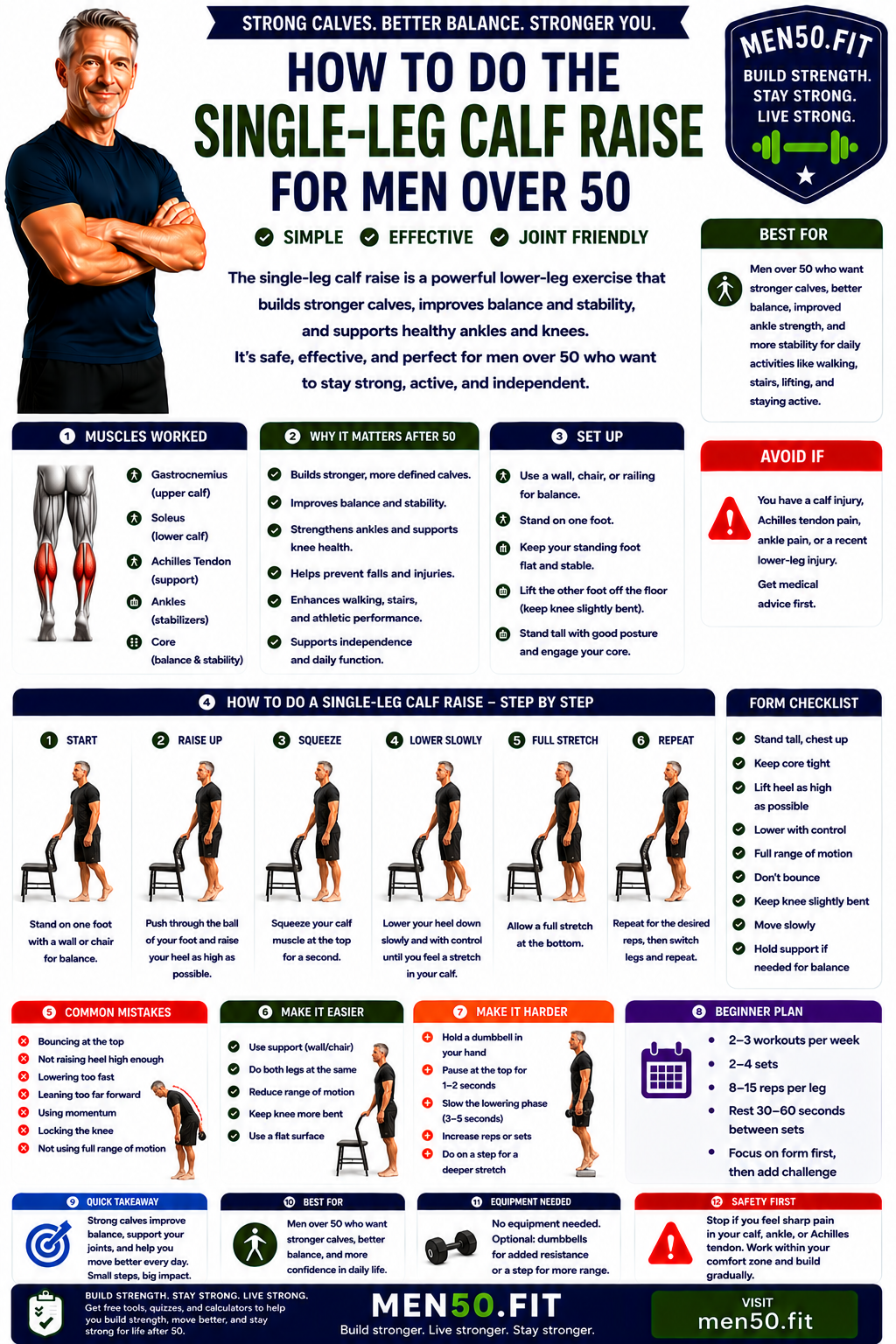
- Start. Stand on one foot with a wall or chair for balance. Body upright, core engaged.
- Raise up. Push through the ball of your foot and raise your heel as high as possible. Take 1–2 seconds to lift. Lift heel as high as you can — full range of motion is important.
- Squeeze. Squeeze your calf muscle hard at the top and hold for a second. Feel the muscle work on the back of your lower leg.
- Lower slowly. Lower your heel down slowly and with control until you feel a stretch in your calf. Take 2–3 seconds on the way down. Don’t drop the heel — control every rep.
- Full stretch. Allow a full stretch at the bottom — heel slightly below the foot level if you’re standing on a step, or fully flat on the floor if standing on a flat surface.
- Repeat. Complete the reps on one leg, then switch. Maintain clean form on every rep — quality over quantity.
The cue that matters most: lift heel as high as possible, lower slowly to a full stretch. Most men over 50 do partial-range calf raises — heel barely lifting, no stretch at the bottom — and wonder why their calves never develop. Full range of motion is the entire exercise. A clean rep should produce a visible heel lift at the top and a real stretch at the bottom.
Why the Single-Leg Calf Raise Matters After 50
The calf complex (gastrocnemius, soleus, Achilles tendon) is one of the most under-trained muscle groups in men over 50 — and one of the most consequential. The calves do critical work in daily life: every step you take pushes off through the calf, climbing stairs depends on calf strength, getting up onto tiptoes for high cupboards uses the calves, and balance during single-leg moments (every step is technically single-legged) depends on the calf’s ability to stabilise the ankle.
The bilateral calf raise is the foundational exercise. The single-leg version adds three specific things the bilateral version can’t:
1. Asymmetry Detection and Correction
Bilateral calf raises hide left-right strength imbalance — the stronger calf automatically compensates for the weaker one. Single-leg raises expose it immediately. You’ll usually feel which side is weaker by the second set, and you’ll often be able to do significantly more reps on the stronger side. This asymmetry is common in men over 50 because:
- Years of favouring the dominant leg in daily activities
- Old ankle injuries that healed with residual weakness
- One-side-dominant sports (golf, racquet sports)
- Habitual postures (always standing with weight on one leg)
Over weeks of training the single-leg version, the weaker side catches up. The bilateral version improves as a result.
2. Significantly Greater Load per Side
The single-leg version isn’t just “harder than bilateral.” It’s specifically harder because one calf has to support the entire bodyweight that two were sharing. This produces roughly double the load per side, which means real progressive overload becomes possible without needing dumbbells. For most men over 50, bodyweight single-leg calf raises are challenging enough that they don’t need additional load for months.
3. Balance and Ankle Stability
Standing on one foot while raising the heel is genuinely a balance exercise — not just a strength exercise. The ankle stabilisers (peroneal muscles, posterior tibialis, intrinsic foot muscles) all have to work to keep you upright. This is fall-prevention training built directly into the strength work. The CDC’s STEADI fall prevention programme emphasises this kind of unilateral lower-body work for exactly this reason.
The Alfredson Protocol Connection
The Alfredson protocol — developed by Swedish researcher Håkan Alfredson — is one of the most evidence-supported treatments for chronic Achilles tendinopathy. It involves eccentric (slow lowering) single-leg calf raises performed on a step, with the heel descending below foot level. The protocol calls for 3 sets of 15 reps twice daily for 12 weeks.
For men over 50 dealing with mild Achilles tendinopathy or aiming to prevent it, the standard single-leg calf raise (especially when done on a step with slow lowering) is essentially the Alfredson protocol. This is one of the few exercises in the matrix that has direct evidence for both strength building AND tendon health.
The Lower-Body Pattern
This exercise completes the unilateral lower-body progression in the matrix:
| Exercise | Body Part | Pattern |
|---|---|---|
| Single-Leg Stand | Whole body | Pure balance |
| Standing Hip Abduction | Glute medius | Hip stability |
| Supported Split Squat | Legs | Single-leg strength |
| Single-Leg Glute Bridge | Glutes | Single-leg hip extension |
| Standing Hamstring Curl | Hamstrings | Knee flexion |
| Single-Leg Calf Raise (this article) | Calves | Single-leg ankle plantarflexion |
Six unilateral exercises covering every major lower-body joint and muscle group. Comprehensive single-leg training for men over 50.
Sets and Reps
This exercise rewards consistency. Daily light practice produces measurable improvements in 4–6 weeks.
| Stage | Variation | Sets × Reps per Leg | Frequency |
|---|---|---|---|
| Beginner | Bodyweight, flat surface, two hands on support | 2 × 8–10 | 2–3× per week |
| Novice | Bodyweight, flat surface, fingertip support | 2–3 × 10–15 | 2–3× per week |
| Intermediate | Bodyweight on a step, full range | 3 × 10–15 | 2–3× per week |
| Advanced | On a step + dumbbell in hand + slow lowering | 3 × 10–15 | 2–3× per week |
Rest 30–60 seconds between sets. Pick a variation where the last 2–3 reps still maintain clean form — heel lifting high, controlled descent, no bouncing.
Daily mini-doses work well. The calves tolerate frequent practice at bodyweight load — and they respond to it. One set of 10–15 per leg every morning while brushing teeth or making coffee adds up to real calf strength over weeks. The Alfredson protocol specifically prescribes daily practice for tendinopathy management.
Always start with your weaker side. Do the weaker side first, use that rep count as the cap, then match the same number on the stronger side. This trains the asymmetry toward balance over weeks.
Common Mistakes
The seven errors that turn a useful calf exercise into a half-effective one:
- Bouncing at the top. Quick reps with elastic recoil don’t train the calf well. Pause at the top for 1–2 seconds before lowering. The slow tempo is the exercise.
- Not raising heel high enough. Partial range of motion skips the productive top portion of the rep. Lift heel as high as possible on every rep. If you can’t get full height, the working calf may be too weak — drop to a more supported variation or do fewer reps with full range.
- Lowering too fast. Dropping the heel quickly skips the eccentric phase — which is where most calf strength and tendon adaptation actually happens. Take 2–3 seconds on the way down, every rep.
- Leaning too far forward. As fatigue sets in, the body wants to lean forward into the chair or wall for support. This shifts work away from the calf and toward the supporting hand/arm. Stay upright — use the support for balance only, not for weight bearing.
- Using momentum. Bouncy, quick reps look productive but train little. Move slowly throughout — 1–2 seconds up, brief pause, 2–3 seconds down.
- Locking the knee. As the standing leg fatigues, it wants to lock straight to bear the load passively. Locked knees stress the joint. Keep a slight bend in the standing knee throughout.
- Not using full range of motion. Stopping with the heel just barely off the floor (top) or not allowing the stretch at the bottom skips half the productive work. Full range every rep — high heel, full stretch.
Make It Easier or Harder
If standard single-leg calf raises are too challenging:
- Use both hands on the support (wall, chair, or railing) — significantly reduces balance demand.
- Do bilateral calf raises for another 2–4 weeks to build the foundation. Most men should do 3 sets of 20 clean bilateral reps comfortably before attempting single-leg.
- Reduce range of motion — lift only 70–80% of the way up while building strength.
- Keep knee more bent on the working leg — slightly easier on the calf at the bottom.
- Use a flat surface rather than a step — eliminates the additional bottom stretch demand.
To make it harder once form is solid:
- Hold a dumbbell in your hand — usually in the same hand as the working leg, or in the hand opposite to the supporting hand. Start with 5–10 lbs (2–4.5 kg).
- Pause at the top for 1–2 seconds with the calf squeezed hard.
- Slow the lowering phase to 3–5 seconds per rep — significantly more demanding.
- Increase reps or sets — extend to 15–20 per leg before adding load.
- Do on a step for a deeper stretch — the heel can descend below foot level at the bottom, increasing range of motion and Achilles loading. This is the Alfredson protocol position — particularly valuable for Achilles tendon health.
For variety, try the seated single-leg calf raise (sitting on a chair, knee bent at 90 degrees, heel rises) once a week — emphasises the soleus muscle (the lower calf, deeper to the gastrocnemius) more than the standing version. Useful for complete calf development.
Safety Note
Avoid the single-leg calf raise if you have acute calf injury, current Achilles tendon pain, ankle pain, or a recent lower-leg injury. Get medical advice first.
Achilles tendon pain during this exercise needs careful attention. Mild discomfort at the start of the working set that fades as the muscle warms up is usually normal (and indicates the tendon may benefit from the eccentric loading the Alfredson protocol uses). Sharp pain that worsens during the exercise is not normal — stop and consult a physiotherapist.
If you have diagnosed Achilles tendinopathy, the single-leg calf raise on a step (with slow lowering) is actually one of the most evidence-supported rehabilitation exercises. But work with a physiotherapist for the initial loading — the protocol is specific and progress depends on managing irritation carefully.
Ankle pain that occurs during the rep usually means the ankle stabilisers are weak. Drop back to bilateral calf raises to build foundational ankle strength, and add single-leg stands for ankle stability work.
Balance issues during the exercise are normal at first. Use as much support as you genuinely need — both hands on a chair is fine. Progress to fingertip support over weeks. Don’t skip support to look fit; the safety margin matters.
If you feel sharp pain anywhere during the rep, stop. Mild calf muscle fatigue is normal; sharp tendon pain is not.
Build Your Personal Training Plan
The single-leg calf raise is one piece of a complete lower-body and balance programme. Get a personalised exercise plan based on your current strength, mobility, and any limitations.
Take the Free Fitness Profiler →
FAQs
Single-leg calf raise vs bilateral calf raise — which is better?
Different stages of the same exercise. The bilateral calf raise is the foundational version — easier, both feet sharing the load, the right starting point. The single-leg version is the progression — exposes asymmetry, adds balance demand, doubles the load per side. Most men over 50 should master the bilateral version first (3 sets of 20 clean reps comfortably) before progressing to single-leg. Both belong in a complete programme. Many men alternate — bilateral some sessions for total calf volume, single-leg other sessions for asymmetry correction. Neither is “better” — they serve different purposes at different stages.
How is this different from regular calf raises?
Two changes: (1) Load per side — the single-leg version puts roughly double the bodyweight load on each calf (one leg supports what two legs were sharing). (2) Balance demand — standing on one foot adds real ankle stability and overall balance work. Both changes make the single-leg version significantly harder than the bilateral version, even for the same range of motion and rep count. Most men over 50 can do 20+ bilateral calf raises but struggle to manage 10 clean single-leg reps initially. That’s normal — the exercise is genuinely harder.
Should I use a step to increase range of motion?
For most men, yes — once form is solid on a flat surface. Doing single-leg calf raises with the ball of the foot on a step (and the heel free to descend below foot level) significantly increases the range of motion at the bottom and produces more Achilles tendon stretch. This is the position used in the Alfredson protocol for Achilles tendinopathy management — and it’s also what produces the most calf development for healthy men. The progression: master flat-surface single-leg calf raises first (2–4 weeks), then move to the step. Use a sturdy step (at least 4 inches tall) and a railing/wall for balance.
Why does my Achilles tendon hurt during this exercise?
It depends on the type of discomfort. Mild stretching sensation at the bottom of the rep is normal — that’s the Achilles tendon being loaded eccentrically. Mild discomfort at the start of the working set that fades as you warm up can indicate early tendinopathy, and the eccentric loading is actually one of the most effective treatments (Alfredson protocol). Sharp pain that worsens during the set, or pain that lingers for hours after is not normal — stop the exercise and see a physiotherapist. If you have diagnosed Achilles tendinopathy, get professional guidance on loading progression rather than self-managing.
Can I do this every day?
Yes — at bodyweight load. The calves respond well to frequent practice. One set of 10–15 per leg every morning is a sustainable habit that builds calf strength over weeks. The Alfredson protocol specifically prescribes daily practice (3 sets of 15, twice per day) for Achilles tendinopathy management. Heavier work (with dumbbells) needs 48 hours of recovery between sessions. Most men over 50 benefit from bodyweight calf raises most days plus 2 loaded sessions per week.
References
- Alfredson H, Pietilä T, Jonsson P, Lorentzon R. Heavy-load eccentric calf muscle training for the treatment of chronic Achilles tendinosis. The American Journal of Sports Medicine. 1998;26(3):360-366.
- American College of Sports Medicine. Resistance Training for Older Adults Position Stand. acsm.org
- Centers for Disease Control and Prevention. STEADI: Stopping Elderly Accidents, Deaths & Injuries. cdc.gov
Disclaimer: This article is for educational purposes only and is not medical advice. Consult a qualified healthcare professional before starting any new exercise programme, especially if you have existing calf, Achilles, or ankle conditions.