
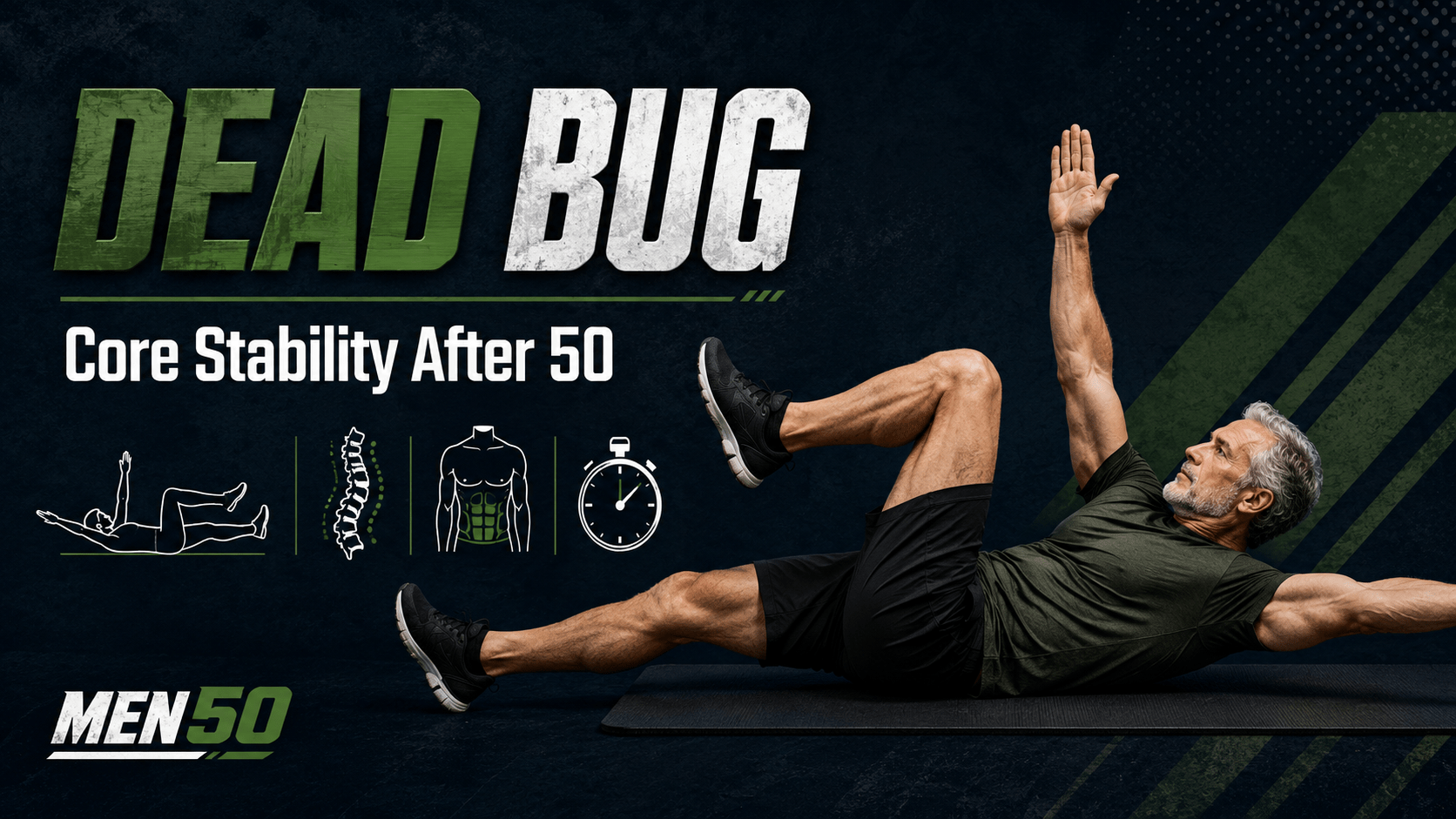
The dead bug is one of the safest and most effective core exercises you can do after 50. Physiotherapists rate it highly because it builds deep core stability without compressing the lumbar spine — the opposite of what crunches and sit-ups do. If you train around lower back issues or want to prevent them, the dead bug belongs in every core session.
Part of the Build Muscle After 50 pillar — strength training for men over 50.
Key Takeaways
- The dead bug trains deep core stability — the transverse abdominis and multifidus — without loading the spine.
- The whole exercise is self-correcting: the moment your lower back lifts off the floor, you’ve gone too far. Pull back.
- Programming: 2–3 sets of 6–10 reps per side, 2–3 times per week. Slow tempo beats high reps.
- Use the regression (one limb at a time) until you can keep your lower back pressed to the floor through every rep.
- The dead bug is one of Stuart McGill’s “Big 3” core exercises for protecting and rehabilitating the lower back.
How to Perform the Dead Bug
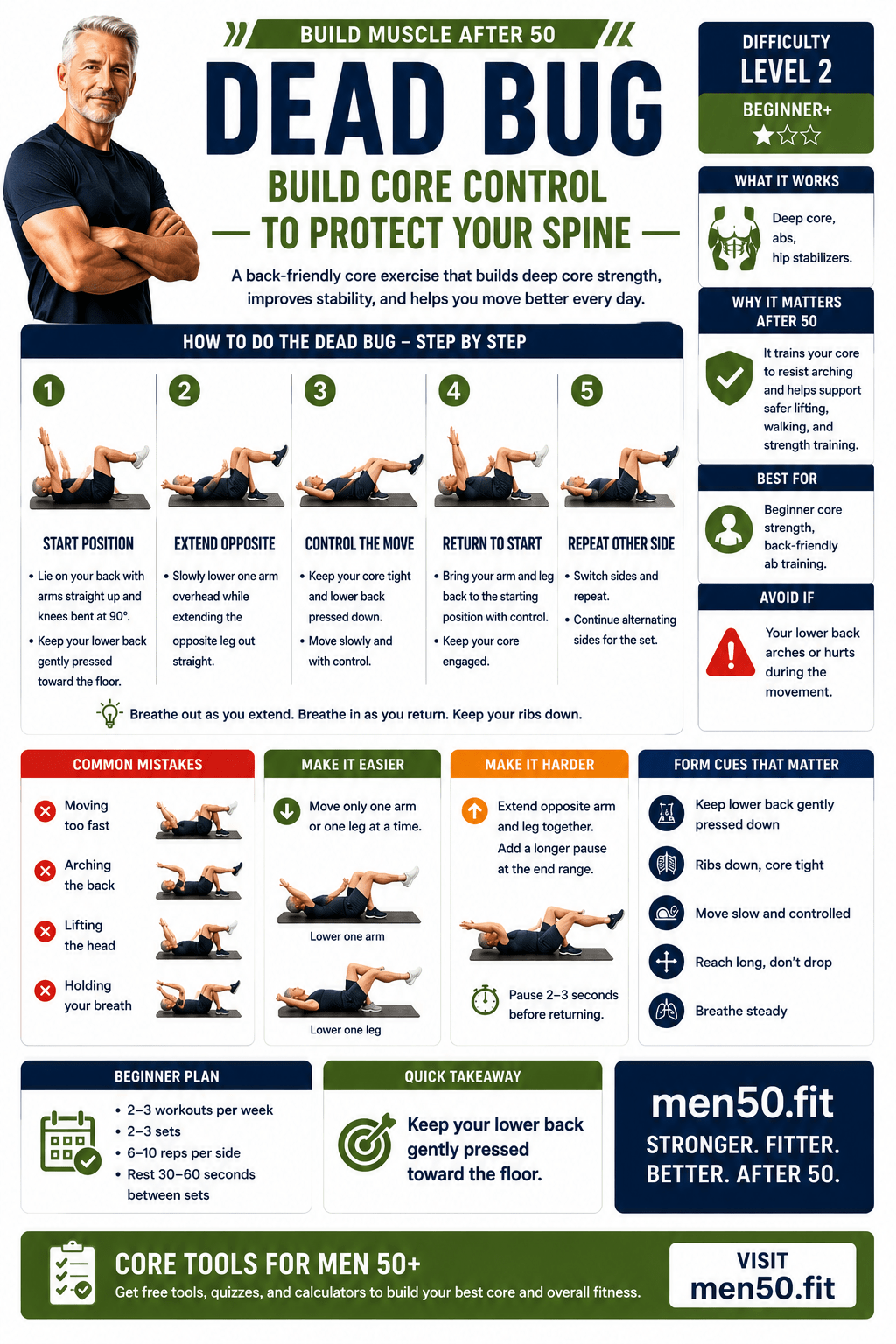
- Lie on your back with your arms pointing straight up toward the ceiling and your knees bent at 90 degrees, shins parallel to the floor.
- Press your lower back firmly into the floor — this is the key position you maintain through every rep.
- Take a breath in, then exhale slowly as you simultaneously lower your right arm overhead and extend your left leg toward the floor.
- Lower both limbs until they are just above the floor — without letting your lower back arch up.
- Return both limbs to the start position with control.
- Repeat on the opposite side: left arm overhead, right leg extended.
Move slowly. The full rep should take 3–4 seconds per side. Quality matters far more than speed.
Why the Dead Bug Matters After 50
Lower back pain affects roughly 4 in 5 adults at some point, and the rate climbs sharply after 50. One of the biggest contributors is weakness in the deep core muscles — specifically the transverse abdominis and multifidus — which act like an internal corset supporting the lumbar spine. When these muscles are weak, the load shifts onto the lumbar discs and ligaments. That’s how everyday tasks like lifting a suitcase or twisting to grab something from the back seat suddenly become injuries.
The dead bug trains these deep stabilisers in a position where you can’t really cheat. The moment your lower back lifts off the floor, you’ve exceeded your current core capacity — which means the movement is self-correcting in a way most ab exercises aren’t. Crunches and sit-ups, by contrast, can be ground out with poor form for hundreds of reps and still teach your spine the wrong patterns.
The dead bug is also one of three exercises (alongside the bird dog and side plank) recommended by Stuart McGill, the leading spine biomechanist, for protecting and rehabilitating the lower back. His research has shown these movements build the spinal stability needed to lift, walk, and train safely — without aggravating existing back issues.
Sets and Reps
Start with the regression and progress to the full version only once your lower back stays glued to the floor every rep.
| Stage | Variation | Sets × Reps | Frequency | Goal |
|---|---|---|---|---|
| Beginner | One arm OR one leg at a time | 2 × 6–8 per side | 2–3× per week | Keep lower back pressed to floor |
| Intermediate | Opposite arm AND leg together | 2–3 × 8–10 per side | 2–3× per week | Full range, controlled tempo |
| Advanced | Opposite arm and leg + 2–3 second pause at the bottom | 3 × 8–10 per side | 2–3× per week | Hold position without back arching |
Rest 30–60 seconds between sets. The dead bug is one exercise where doing fewer perfect reps is genuinely better than doing more sloppy ones — your lower back doesn’t get a vote on this.
Common Mistakes
The four errors that turn a great back-safe exercise into a wasted one:
- Moving too fast. Speed hides poor control. The dead bug should look almost slow-motion — 3–4 seconds per side. If it feels rushed, slow it down.
- Arching the back. The single most important fault to correct. The moment your lower back lifts off the floor, the deep core has switched off. Reduce range of motion until you can stay flat.
- Lifting the head off the floor. Strains the neck and tells you the core isn’t doing the work. Rest your head down and look straight up at the ceiling.
- Holding your breath. Breathe out as you extend the limbs, in as you return. Holding your breath spikes pressure in the abdomen and reduces the deep-core activation you’re trying to train.
Make It Easier or Harder
If you can’t keep your lower back pressed flat during the full version, drop to the regression: move only one arm OR one leg at a time, not both together. This cuts the load in half and lets you focus on maintaining lower back contact. Do this for 2–3 weeks before attempting the full version.
To make it harder once form is solid: add a 2–3 second pause at the bottom of each rep when both limbs are extended. This is brutal for the deep core in the best way. Once that’s easy, hold light dumbbells in the hands or wear ankle weights — but only after you can do 3 sets of 10 perfect reps without load.
Safety Note
The dead bug is one of the safer exercises in any programme, but the back-arching rule isn’t optional. The moment your lower back lifts from the floor, you’ve exceeded your current core stability — reduce the range of motion rather than letting the back arch. Pushing through poor form here doesn’t build strength, it loads the lumbar discs in exactly the way you’re trying to avoid.
If you have an existing lower back diagnosis (herniated disc, spondylolisthesis, severe stenosis), check with your physiotherapist before starting any new core programme. The dead bug is back-friendly for most conditions, but individual cases vary.
Build Your Personal Training Plan
The dead bug is one piece of a complete core programme. Get a personalised exercise plan based on your current strength, goals, and any back history.
Take the Free Fitness Profiler →
FAQs
Is the dead bug safe for men with lower back pain?
For most men over 50 with non-specific lower back pain, yes — it’s one of the most commonly prescribed exercises by physiotherapists for exactly this reason. It strengthens the deep stabilisers without compressing the lumbar spine. That said, if you have a diagnosed condition like a recent disc herniation or spinal stenosis, check with your physio before starting.
How often should I do dead bugs?
Two or three times per week is the sweet spot. The deep core responds well to frequent, low-intensity work — you can do dead bugs on most training days, including upper-body days. Pair them with glute bridges and a back-friendly movement like the bird dog for a complete back-protection routine.
Why does my back keep arching during the exercise?
Two possible causes. Either your range of motion is currently too big — reduce it until you can stay flat — or your deep core hasn’t yet developed enough to handle the full movement. Drop back to the one-limb regression for 2–3 weeks and the issue usually resolves on its own.
Can the dead bug replace planks?
It’s a complement, not a replacement. Planks train static isometric core endurance — holding a rigid position. The dead bug trains anti-extension core stability while the limbs move, which is closer to how the core actually works during walking, lifting, and most strength training. Most well-designed core programmes include both.
How long until I see results from the dead bug?
Most men feel improved core control within 2–3 weeks of consistent training (2–3 sessions per week). Reductions in everyday lower back stiffness or pain often follow within 4–6 weeks. Visible changes in midsection appearance take much longer and depend more on body composition than on core training alone — the dead bug is a function exercise, not a six-pack exercise.
References
- McGill SM. Low Back Disorders: Evidence-Based Prevention and Rehabilitation (3rd ed.). Human Kinetics. The “Big 3” core stability exercises framework.
- Centers for Disease Control and Prevention. Chronic Back Pain Prevalence and Trends. cdc.gov
- American College of Sports Medicine. Core Strength and Stability Training Position. acsm.org
Disclaimer: This article is for educational purposes only and is not medical advice. Consult a qualified healthcare professional before starting any new exercise programme, especially if you have existing back, neck, or hip conditions.