
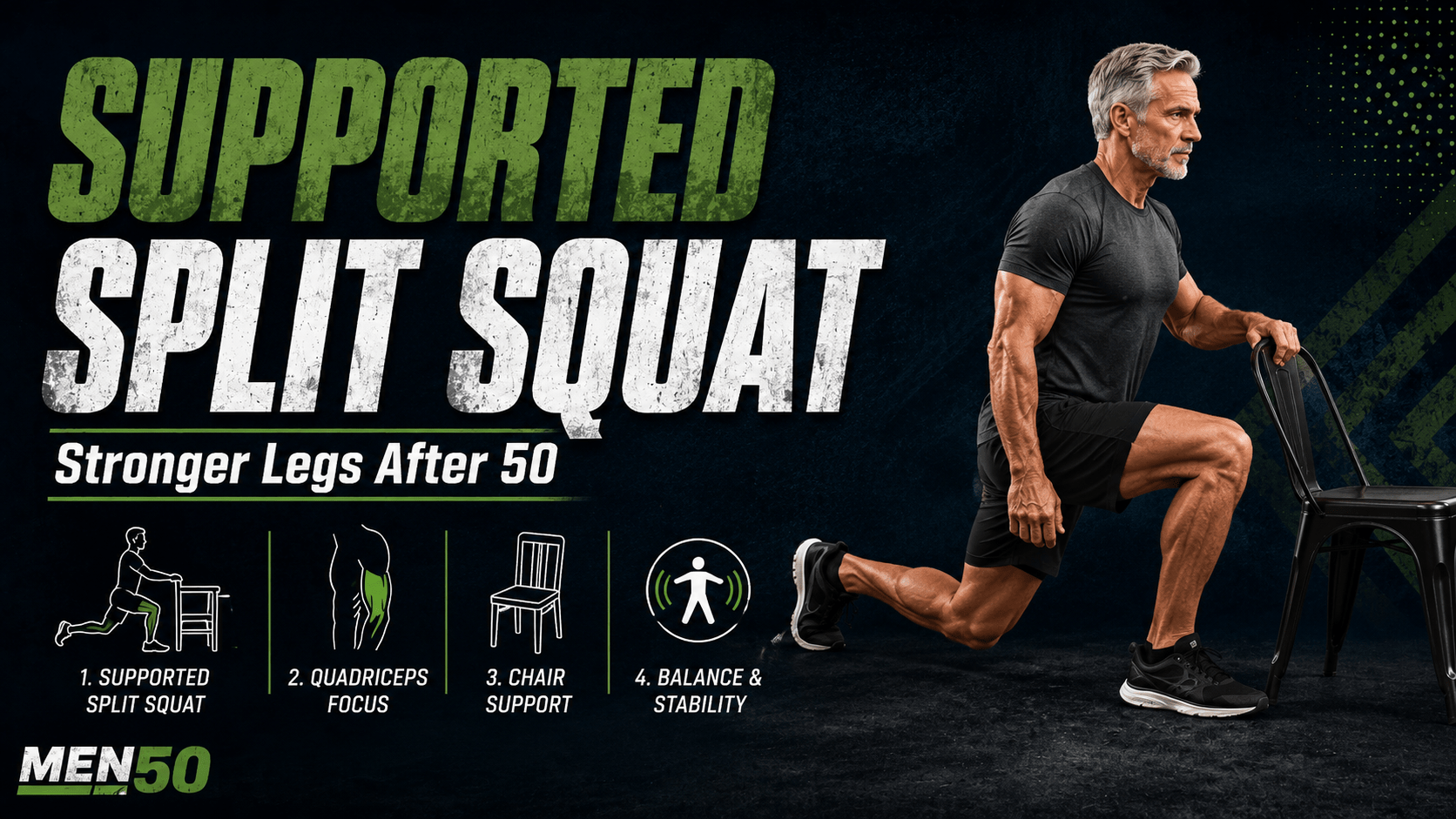
The supported split squat is the right starting point for single-leg training in men over 50. It’s the bridge between bilateral exercises like the chair squat (where both legs share the load) and demanding unilateral exercises like the reverse lunge (which combine single-leg strength with balance and dynamic movement). The chair or wall support removes the balance demand so the legs can actually do their job — building real strength on each side independently — without the fall risk that stops many men over 50 from attempting unsupported single-leg work at all.
Part of the Build Muscle After 50 pillar — strength training for men over 50.
Key Takeaways
- The supported split squat trains each leg independently with a chair, wall, or sturdy support handling the balance demand.
- It’s the bridge exercise between bilateral squats and the more demanding reverse lunge. Most men over 50 should learn this pattern before progressing to dynamic unsupported lunges.
- Programming: 2–4 sets of 8–12 reps per leg, 2–3 times per week. Rest 45–75 seconds between sets.
- Use support, move slow, and control every rep. Stronger legs and better balance help you move confidently every day.
- Single-leg work like this is a CDC STEADI–relevant fall prevention exercise — directly addresses the asymmetric strength and stability that contributes to falls.
How to Perform the Supported Split Squat
Set up first:
- Use a chair, wall, or sturdy surface for support. The chair should be heavy enough to bear weight without tipping.
- Stand tall, holding the back of the chair (or with your hand against the wall).
- Step one foot back into a split stance — far enough that both knees can bend comfortably to about 90 degrees.
- Torso upright, core tight, looking forward (not down).
Then the movement:
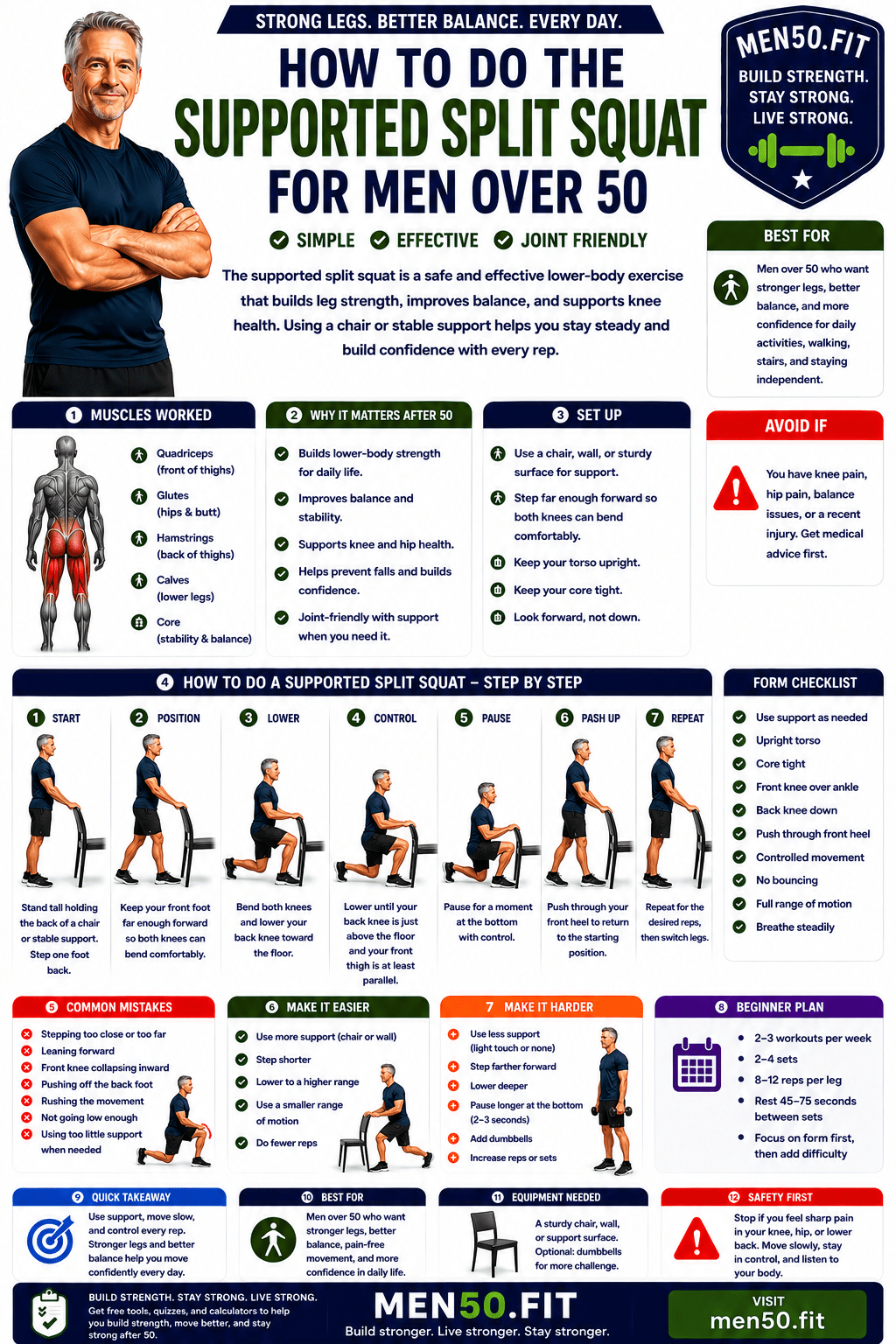
- Start. Stand tall holding the back of a chair or stable support. Step one foot back into a split stance.
- Position. Keep your front foot far enough forward so both knees can bend comfortably. Most men land at about 2–3 foot lengths of distance between feet. Too close = front knee dives forward. Too far = back leg can’t bend properly.
- Lower. Bend both knees and lower your back knee toward the floor. The front knee bends; the back knee descends straight down (not forward or back).
- Control. Lower until your back knee is just above the floor and your front thigh is at least parallel to the floor. Both knees should be at about 90 degrees.
- Pause. Pause for a moment at the bottom with control. Stay tight throughout — no resting at the bottom, no losing the position.
- Push up. Push through your front heel (not your toes) to return to the starting position. The front leg does most of the work.
- Repeat. Complete the reps on one leg, then switch sides. Maintain clean form on every rep.
The cue that matters most: push through your front heel, with both knees bending equally. Pushing through the heel keeps the front-leg work centred on the quadriceps and glutes. Letting the weight shift forward to the toes shifts work to the knee joint itself. And both knees bending equally — front and back — is what makes this a split squat rather than a forward lunge or a step-back movement.
Why the Supported Split Squat Matters After 50
The supported split squat solves a real problem in men over 50: bilateral leg strength can mask significant single-leg weakness. When you do a bodyweight squat, both legs work together — and the stronger leg automatically compensates for the weaker one. Most men over 50 have meaningful left-right strength asymmetry that they never know about because their bilateral exercises hide it. Single-leg work exposes the imbalance and trains it.
Why does asymmetry matter? Two specific reasons relevant to men over 50:
1. Daily-life movement is single-legged. Every step you take is essentially a single-leg moment. Climbing stairs, walking on uneven ground, getting up from the floor on one knee — all single-leg patterns. If your right leg is significantly weaker than your left, your gait gets asymmetric, your balance worsens on one side, and fall risk concentrates on the weaker side. Bilateral squats don’t fix this. Single-leg work does.
2. Fall prevention specifically targets unilateral patterns. The CDC’s STEADI fall prevention programme emphasises unilateral lower-body work because falls almost always happen during single-leg moments — losing balance while stepping onto a curb, missing a stair, catching a foot on something. Training one leg at a time builds the strength to recover in exactly the moments that fall risk concentrates.
Why the Supported Version Specifically
Most men over 50 who want to do single-leg work hit a wall: the unsupported reverse lunge requires both strength and balance simultaneously. If either is the limiting factor, the exercise can’t be done well. The supported version solves this by eliminating the balance demand, allowing all the energy to focus on building strength on each leg. Once strength is established, the support gets reduced (light touch only, then fingertips, then none) and balance becomes the next progression.
| Single-Leg Progression | What It Tests |
|---|---|
| Supported Split Squat (this article) | Single-leg strength, no balance demand |
| Single-leg balance (touch support) | Strength + light balance |
| Reverse Lunge | Strength + dynamic balance |
| Single-Leg Stand | Pure balance |
This progression covers the entire spectrum — from “can’t yet balance on one foot” to “comfortable with unsupported dynamic single-leg work.” Most men over 50 benefit from spending 4–8 weeks at each stage before progressing.
Split Squat vs Reverse Lunge — They’re Different Exercises
The technical distinction matters because the two exercises feel similar but train slightly different things:
| Pattern | Setup | What It Trains |
|---|---|---|
| Split Squat | Both feet stay in place; you lower and rise | Pure single-leg strength |
| Reverse Lunge | Step backward, then return to standing | Strength + dynamic balance |
The split squat is more stable (feet don’t move) and more isolated (you can focus on the working leg without managing balance during foot transitions). The reverse lunge is more functional (mimics walking and stepping) but more demanding. Both belong in a complete programme. The supported split squat is the right place to start.
Sets and Reps
This is a strength-and-balance exercise — moderate reps with progressive support reduction.
| Stage | Support Level | Sets × Reps per Leg | Frequency |
|---|---|---|---|
| Beginner | Both hands on chair, small range | 2 × 8–10 | 2× per week |
| Novice | Both hands on chair, full range | 2–3 × 8–12 | 2–3× per week |
| Intermediate | One hand fingertip touch | 3 × 8–12 | 2–3× per week |
| Advanced | No support + light dumbbells held at sides | 3 × 8–12 | 2–3× per week |
Rest 45–75 seconds between sets. Pick a support level where the last 2–3 reps still maintain clean form — torso upright, both knees bending equally, controlled tempo.
A practical note on progression: the goal isn’t to rush off the support. Each support level should feel clearly mastered before reducing it. Most men over 50 spend 3–6 months at full chair support before moving to fingertip touch. That’s appropriate. The strength gains are the same; the balance progresses as the strength catches up.
Common Mistakes
The seven errors that turn a useful exercise into a knee or back problem:
- Stepping too close or too far. If the feet are too close, the front knee dives forward over the toes — knee stress. If the feet are too far apart, the back leg can’t bend properly and the hip flexor takes load. Test the right distance: lower into the bottom position — both knees should be at about 90 degrees. Adjust foot position until this works.
- Leaning forward. As fatigue sets in, the torso wants to lean forward to shift weight onto the front leg. Keep the torso upright throughout — chest up, shoulders back. Leaning forward shifts work to the lower back and reduces leg engagement.
- Front knee collapsing inward. When the glute medius is weak (common in men over 50), the front knee wants to drift inward toward the midline as you descend. This is knee valgus — the position associated with anterior knee pain. Track the front knee over the middle toes throughout the rep. If it won’t stay aligned, add side-lying leg raises or standing hip abductions to strengthen the glute medius.
- Pushing off the back foot. The back foot is for balance only — most of the work should come from the front leg. If you push off the back toes to rise, the back leg’s hip flexor takes load it shouldn’t. Push through the front heel to rise.
- Rushing the movement. Quick reps use elastic recoil and skip the eccentric phase. Use 2–3 seconds down, brief pause at the bottom, 1–2 seconds up. The slow tempo is the exercise.
- Not going low enough. Going only halfway down skips the productive range of motion. The back knee should descend until it’s just above the floor (about 1–2 inches). The front thigh should be at least parallel to the floor.
- Using too little support when needed. Some men try to skip the chair to look fit. If you can’t maintain clean form without significant support, use more support. The exercise is just as effective with full chair support — and the safety margin matters.
Make It Easier or Harder
If standard supported split squats are too challenging:
- Use more support — both hands on the chair removes balance demand entirely.
- Step shorter — reduces the demand on the back-leg hip flexor and makes the position easier to hold.
- Lower to a higher range — only go halfway down at first; build range over weeks.
- Use a smaller range of motion — lower 50–70% of the way down while you build leg strength.
- Do fewer reps — start with 2 sets of 5–8 per leg.
To make it harder once form is solid:
- Use less support — progress from both hands → one hand → fingertip touch → no support.
- Step farther forward — increases the demand on the front leg.
- Lower deeper — only if you can maintain knee tracking and torso position.
- Pause longer at the bottom for 2–3 seconds at full depth.
- Add dumbbells held at the sides — 5–10 lbs (2–4.5 kg) per hand adds load without disrupting balance.
- Increase reps or sets — extend to 3 sets of 12–15 per leg before adding load.
For variety once form is solid, try the rear-foot-elevated split squat (back foot on a low step or sofa edge) once a week — significantly more demanding on the front leg, more like a Bulgarian split squat lite. Useful as an advanced progression but not for beginners.
Safety Note
Avoid the supported split squat if you have knee pain, hip pain, balance issues, or a recent injury that affects single-leg loading. Get medical advice first.
If you feel sharp pain in your knee, hip, or lower back during the movement, stop. Mild muscular fatigue is normal; sharp joint pain is not. Adjust your foot position, reduce the range of motion, or add more support.
Knee pain in the front leg is usually one of two things: foot position too close (front knee diving forward), or knee valgus (front knee collapsing inward). Both are correctable. Adjust foot position and consciously track the front knee over the middle toes. If pain persists, drop back to chair squats or sit-to-stand work.
Back-leg hip flexor tightness is common in men over 50 (from sitting) and can make the back leg position uncomfortable. Add the hip flexor stretch as part of your routine; the position will improve over weeks.
Use as much support as you genuinely need. The exercise is just as effective with full chair support as with no support — and the safety margin matters. Don’t skip support to look tough.
Build Your Personal Training Plan
The supported split squat is one piece of a complete lower-body and balance programme. Get a personalised exercise plan based on your current strength, mobility, and any limitations.
Take the Free Fitness Profiler →
FAQs
Supported split squat vs reverse lunge — which is better?
Different exercises that serve different purposes. The supported split squat is static (feet stay in place) and uses support — it trains pure single-leg strength without balance demand. The reverse lunge is dynamic (you step backward and return) and unsupported — it trains strength plus balance plus the transitional foot movement. For most men over 50, the supported split squat is the right starting point because it builds the strength foundation first. Once you can do clean supported split squats with fingertip support only, the reverse lunge becomes the natural next progression. Both belong in the matrix — different stages of the same progression.
Why split squat instead of regular squat?
Because the regular squat is bilateral (both legs working together) while the split squat is unilateral (one leg primary). Bilateral squats can mask significant left-right asymmetry — your stronger leg compensates for the weaker one and you never know. Single-leg work like the split squat exposes the imbalance and trains it. Daily life is also full of single-leg moments (every step you take, climbing stairs, getting up from the floor) — training unilaterally builds the strength to handle these moments better. Most men over 50 benefit from both bilateral squats (for total leg loading) and single-leg work (for asymmetry correction and functional carryover).
How is this different from a lunge?
Two technical differences: (1) A split squat keeps both feet in place throughout the rep — you just lower and rise from a stationary split stance. A lunge (forward, reverse, or walking) involves stepping at the start and end of each rep — the feet move. (2) A split squat is more isolated and stable because the feet don’t transition. A lunge has more dynamic balance demand and is closer to walking mechanics. Most men over 50 should master the supported split squat before progressing to reverse lunges (which add the stepping component) and then to forward lunges (which are even more demanding).
When should I stop using support?
When you can complete 3 sets of 10–12 clean reps per leg with both hands resting only lightly on the chair (no actual weight pressed through them), drop to one-hand fingertip touch. Spend another 4–8 weeks at that level. When you can complete the same volume with only fingertip touch, drop to no support. The progression should feel obvious — each level should feel mastered before the next. If you find yourself wobbling at any level, go back one step. Most men over 50 take 6–12 months to progress from full chair support to no support. That’s appropriate. The strength gains are happening throughout; the balance just takes time to catch up.
Should I do this if I have knee pain?
It depends on the cause. If knee pain comes from the front of the knee (anterior pain, often related to the kneecap), the split squat may aggravate it — start with chair squats or sit-to-stand work first to build foundational quad strength. If knee pain comes from knee instability (the joint feeling unstable), the supported split squat is often part of the solution — it builds the hip and quad strength that stabilises the knee joint. Get a physiotherapist’s opinion if pain persists. Don’t push through sharp pain regardless of the cause.
References
- American College of Sports Medicine. Resistance Training for Older Adults Position Stand. acsm.org
- Centers for Disease Control and Prevention. STEADI: Stopping Elderly Accidents, Deaths & Injuries. cdc.gov
- National Institute on Aging. Exercise & Physical Activity: Your Everyday Guide. nia.nih.gov
Disclaimer: This article is for educational purposes only and is not medical advice. Consult a qualified healthcare professional before starting any new exercise programme, especially if you have existing knee, hip, or back conditions.