
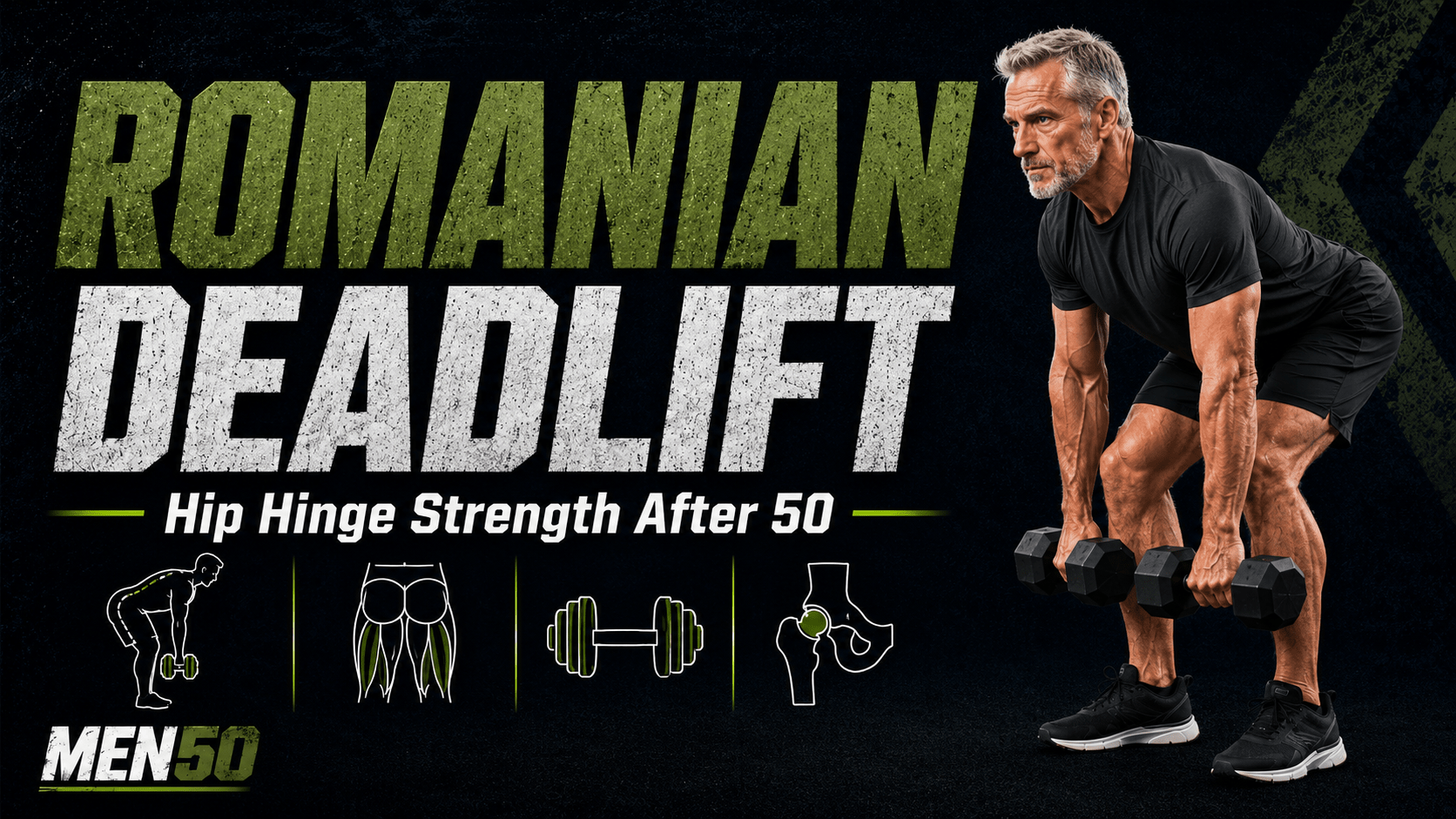
The dumbbell Romanian deadlift — the RDL — is the single most important exercise in the matrix for protecting your lower back for life. It trains the hip hinge pattern: the foundational movement you use every time you bend over to pick up something from the floor, lift a suitcase, or get a heavy bag out of the boot of the car. Get this pattern right under controlled load, and your real-world lifting becomes safer. Get it wrong — or never train it at all — and you join the very large group of men over 50 who tweak their backs picking up something they shouldn’t have.
Part of the Build Muscle After 50 pillar — strength training for men over 50.
Key Takeaways
- The dumbbell RDL trains the hamstrings, glutes, lower-back erectors, core, and upper-back stabilisers — the entire posterior chain in one exercise.
- It teaches the hip hinge pattern — the most important movement pattern to train for lifelong back health.
- Programming: 2–4 sets of 8–12 reps, 2–3 times per week. Rest 60–90 seconds between sets.
- Hinge at your hips, keep your back flat, and control the movement. Strong hamstrings and glutes help you move better and stay independent after 50.
- This is the hip-dominant counterpart to the goblet squat (knee-dominant). Both belong in a complete lower-body programme.
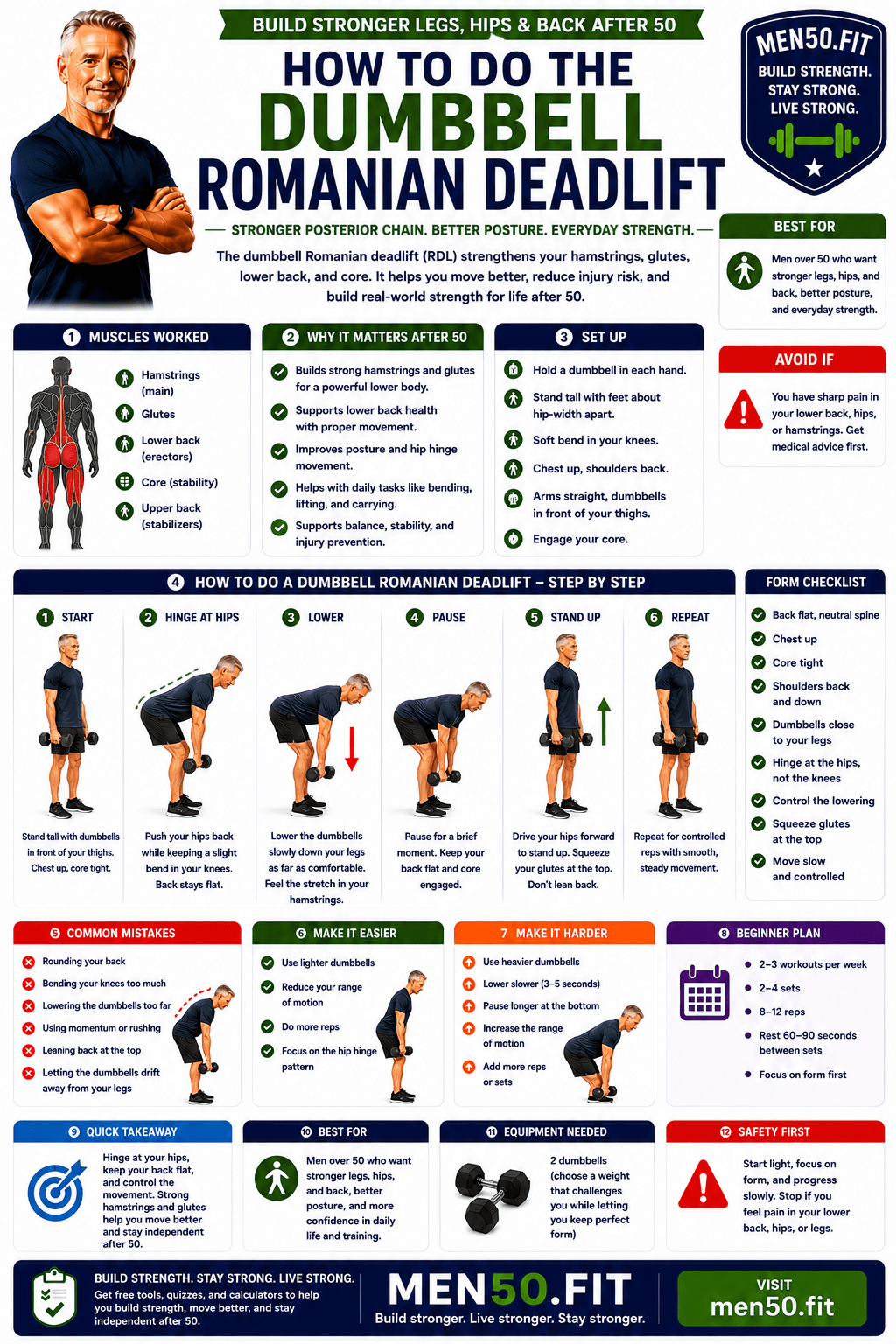
How to Perform the Dumbbell Romanian Deadlift
Set up first:
- Hold a dumbbell in each hand, arms straight, dumbbells resting in front of your thighs.
- Stand tall with feet about hip-width apart.
- Soft bend in your knees — they’re slightly bent and stay slightly bent throughout. They don’t bend more as you lower.
- Chest up, shoulders back and down, core engaged.
Then the movement:
- Start. Stand tall with dumbbells in front of your thighs. Chest up, core tight, soft bend in the knees. Take a moment to set the position before the first rep.
- Hinge at hips. Push your hips back like you’re closing a car door with your bum. The knees stay in the same slightly-bent position — they don’t bend further. Your torso angles forward as the hips travel backward. Back stays flat.
- Lower. Lower the dumbbells slowly down your legs as far as your flexibility allows while keeping the back flat. Take 2–3 seconds on the way down. The dumbbells stay close to your legs the whole time — almost grazing them.
- Pause. Pause briefly at the bottom of your range — typically just below the knee or mid-shin level. Back flat, core engaged, feel the stretch in your hamstrings.
- Stand up. Drive your hips forward to stand back up. Squeeze your glutes at the top. Don’t lean back or hyperextend.
- Repeat. Maintain clean form on every rep. Controlled tempo, dumbbells close to legs, back flat throughout.
The cue that matters most: hinge at the hips, not the knees. This is the entire difference between an RDL and a squat. In an RDL, the hips travel backward; the knees stay nearly in the same position. If the knees bend significantly more as you lower, you’re doing a squat with a hinge wrapped around it — not the same exercise.
Why the Dumbbell Romanian Deadlift Matters After 50
The hip hinge is one of the most important movement patterns in your life. You use it every time you:
- Pick something up from the floor
- Bend over the kitchen sink
- Lift a suitcase from the floor or boot of a car
- Reach into a low cupboard or bottom drawer
- Pick up a grandchild
- Move furniture or load groceries
Men who hinge well — keeping the back flat and letting the hips do the work — rarely hurt their backs during these tasks. Men who don’t hinge — who round their backs to reach the floor — accumulate small spinal injuries over years until something breaks. The vast majority of “I just bent over and my back went” incidents in men over 50 are hip hinge failures.
Stuart McGill, one of the world’s leading spine researchers (and a recurring authority across this matrix — his work also underpins the dead bug, bird dog, and glute bridge articles), has spent decades showing that the hip hinge is the most important movement pattern to train for back health. People who can hinge well, with strong hamstrings and glutes doing the work, protect their spines for life. People who can’t, don’t.
There’s also a sarcopenia angle. The hamstrings and glutes — your posterior chain — are among the muscles that decline fastest after 50 if not trained, partly because most daily activities don’t load them much. Sitting all day shortens the hamstrings but doesn’t strengthen them. Walking trains the calves and quads more than the glutes. The RDL is one of the most efficient exercises for directly loading and strengthening this whole posterior chain.
The dumbbell version is the right starting point for most men over 50. The barbell RDL is more advanced — heavier load, more spinal compression, less forgiving on form. Two moderate dumbbells let you train the hip hinge pattern at a useful load, with the option to bail out safely if a rep goes wrong (just set the dumbbells down). For 6–12 months of consistent training, the dumbbell RDL covers the hinge pattern beautifully without the barbell’s complications.
Sets and Reps
Moderate load, perfect form, controlled tempo. The RDL is one of the few exercises where chasing heavy weight at the cost of form regularly produces injury.
| Stage | Variation | Sets × Reps | Frequency | Load Guide |
|---|---|---|---|---|
| Beginner | Light dumbbells, partial range | 2 × 8–10 | 2× per week | 10–15 lbs (4.5–7 kg) per hand |
| Novice | Moderate weight, mid-shin range | 2–3 × 8–12 | 2–3× per week | 15–25 lbs (7–11 kg) per hand |
| Intermediate | Working weight, slow lowering | 3 × 8–12 | 2–3× per week | 25–35 lbs (11–16 kg) per hand |
| Advanced | Heavier weight, pause at bottom | 3–4 × 6–10 | 2–3× per week | 35–50 lbs (16–23 kg) per hand |
Rest 60–90 seconds between sets. Pick a weight where the last 2–3 reps feel clearly challenging but you can complete them with: flat back, dumbbells close to legs, controlled tempo, no rounding at the bottom.
A practical starting load: most men over 50 begin with 10–20 lb (4.5–9 kg) dumbbells per hand. After 3–6 months, many men progress to 25–40 lbs (11–18 kg) per hand. The strongest 1% might reach 50+ lbs per hand, but the point of this exercise isn’t a heavy weight — it’s groove the hinge pattern. A 25 lb RDL done perfectly does more for your back than a 50 lb RDL done with a rounded back.
Common Mistakes
The six errors that turn a back-protection exercise into a back injury waiting to happen:
- Rounding your back. The single most dangerous mistake. The lumbar spine flexing forward under load is the mechanism that causes most lifting-related back injuries. Stop the rep immediately if the back rounds. Reduce your range, or use lighter dumbbells, until the back stays flat throughout.
- Bending your knees too much. The RDL is hip-dominant. Knees stay slightly bent — they don’t bend more as you lower. Bending the knees more turns the RDL into a squat hybrid, which moves the work to the quads and away from the hamstrings.
- Lowering the dumbbells too far. Going below your hamstring flexibility allows is what causes the back to round. Most men over 50 have a working range of “just below the knee” to “mid-shin” — going lower forces the back to round to make up for the hamstring restriction. Stay in the range your back can stay flat.
- Using momentum or rushing. Quick, bouncy reps use elastic recoil to bounce the dumbbells back up. The muscles barely fire. Use 2–3 seconds down, brief pause at the bottom, 1–2 seconds up. The slow tempo is the exercise.
- Leaning back at the top. Some men hyperextend the lower back at the top of the rep to “finish” it, especially when the weight is heavy. Stand tall, squeeze the glutes, keep the spine neutral. There’s no benefit to leaning back beyond neutral.
- Letting the dumbbells drift away from your legs. As you lower, the dumbbells should travel close to your shins — almost grazing your legs. Letting them drift forward increases the load on the lower back significantly. Keep them close throughout every rep.
Make It Easier or Harder
If standard RDLs are too challenging:
- Use lighter dumbbells — 8–12 lbs (3.5–5.5 kg) is fine to start. The pattern matters more than the load.
- Reduce your range of motion — lower only to mid-thigh while you build hamstring flexibility and strength.
- Do more reps with the same lighter weight to build endurance and the motor pattern.
- Focus on the hip hinge pattern — practice the movement with no weight at all, using a wall behind you. Hinge until your bum touches the wall, then stand up. Master the pattern first, then add load.
To make RDLs harder once form is solid:
- Use heavier dumbbells — but only when the lighter weight feels easy with clean form.
- Lower slower to 3–5 seconds per rep — significantly more demanding than it sounds, and excellent for hamstring development.
- Pause longer at the bottom for 2–3 seconds at the deepest part of your range.
- Increase the range of motion — only if your hamstring flexibility lets you go deeper with the back staying flat.
- Add more reps or sets — many men over 50 progress better through volume than through heavier weight.
For variety, try the single-leg dumbbell RDL (one leg lifted behind you, balancing on the other) once a week — exposes left-right imbalances and adds a major balance challenge. Start with very light dumbbells; the balance demand is significantly higher.
Safety Note
Avoid the RDL if you have sharp pain in your lower back, hips, or hamstrings. The hip hinge under load is genuinely demanding on these tissues, and existing injuries or chronic conditions need to be addressed before adding the RDL. Get medical advice first if any of these apply.
Stop the rep immediately if the back starts to round. This is the rule that protects you. A few reps with a rounded back, especially under heavier load, is how RDLs end men’s training careers. The moment you feel the lower back start to flex forward, set the dumbbells down and reassess.
Start light, focus on form, and progress slowly. This is one exercise where rushing the load actively hurts you. Most men over 50 should spend 4–8 weeks at very light dumbbells just learning the pattern before adding meaningful load. The patience pays off — men who learn the RDL correctly use it safely for decades.
If you have a history of disc issues, herniations, or any diagnosed lower-back condition, get clearance from a physiotherapist or physician before adding RDLs to your routine.
Build Your Personal Training Plan
The dumbbell Romanian deadlift is one piece of a complete lower-body programme. Get a personalised exercise plan based on your current strength, mobility, and any limitations.
Take the Free Fitness Profiler →
FAQs
Romanian deadlift vs conventional deadlift — which is better?
For men over 50, the Romanian deadlift is almost always the better choice. The conventional deadlift (pulling a barbell from the floor) requires more mobility, more spinal loading, and is less forgiving on form. The RDL starts from standing (less risky setup), trains the same posterior chain muscles, and the dumbbell version lets you bail out safely if a rep goes wrong. Many men over 50 use the dumbbell RDL as their primary hinge exercise for years and never need the conventional deadlift. If you do progress to conventional deadlifts eventually, the RDL is the foundation that makes it safe.
How heavy should the dumbbells be?
Heavy enough that the last 2–3 reps feel clearly challenging, but light enough that you can complete the set with a perfectly flat back. For most men over 50 starting out, that’s 10–20 lbs (4.5–9 kg) per hand. After 3–6 months, many men progress to 25–40 lbs (11–18 kg) per hand. The right load is the one your form can handle for 8–12 clean reps. Form failure is the limit, not muscle failure — the moment the back starts rounding, the set is over, regardless of how many reps you’d planned.
Why does my lower back hurt during this exercise?
Usually one of three causes. Rounding the back — even a small amount of lumbar flexion under load irritates the lower back. Check that the back is staying flat at every point in the rep, especially at the bottom. Going too deep — lowering past your hamstring flexibility forces the back to round to make up the distance. Reduce your range until the back can stay flat. Hyperextending at the top — leaning back at the top loads the lower back. Stand tall, neutral spine, no lean. If pain persists after fixing all three, drop the weight to very light and rebuild from the pattern; if it still persists, see a physiotherapist.
How low should I lower the dumbbells?
Lower until your hamstring flexibility runs out and the back starts to want to round — then stop slightly before that point. For most men over 50, this is about mid-shin level. Some men with good hamstring flexibility can reach the ankle; others with tight hamstrings stop at just below the knee. Range will increase over weeks as the hamstrings lengthen. The cardinal rule: depth doesn’t matter as much as a flat back. Stay in the range your back stays flat, even if that’s only a 6-inch lower.
Can I do RDLs and squats in the same session?
Yes, and many programmes pair them. They train complementary patterns — squats are knee-dominant (work the quads and glutes), RDLs are hip-dominant (work the hamstrings and glutes). A common structure: 3 sets of goblet squats followed by 2–3 sets of RDLs, with longer rest between exercises. The two together cover the full lower body. Don’t do both heavy on the same day every session; alternate which one gets heavier across the week.
References
- McGill SM. Low Back Disorders: Evidence-Based Prevention and Rehabilitation. 3rd ed. Champaign, IL: Human Kinetics; 2016.
- American College of Sports Medicine. Resistance Training for Older Adults Position Stand. acsm.org
- National Institute on Aging. Sarcopenia and Muscle Strength in Older Adults. nia.nih.gov
Disclaimer: This article is for educational purposes only and is not medical advice. Consult a qualified healthcare professional before starting any new exercise programme, especially if you have existing back, hip, or hamstring conditions.