
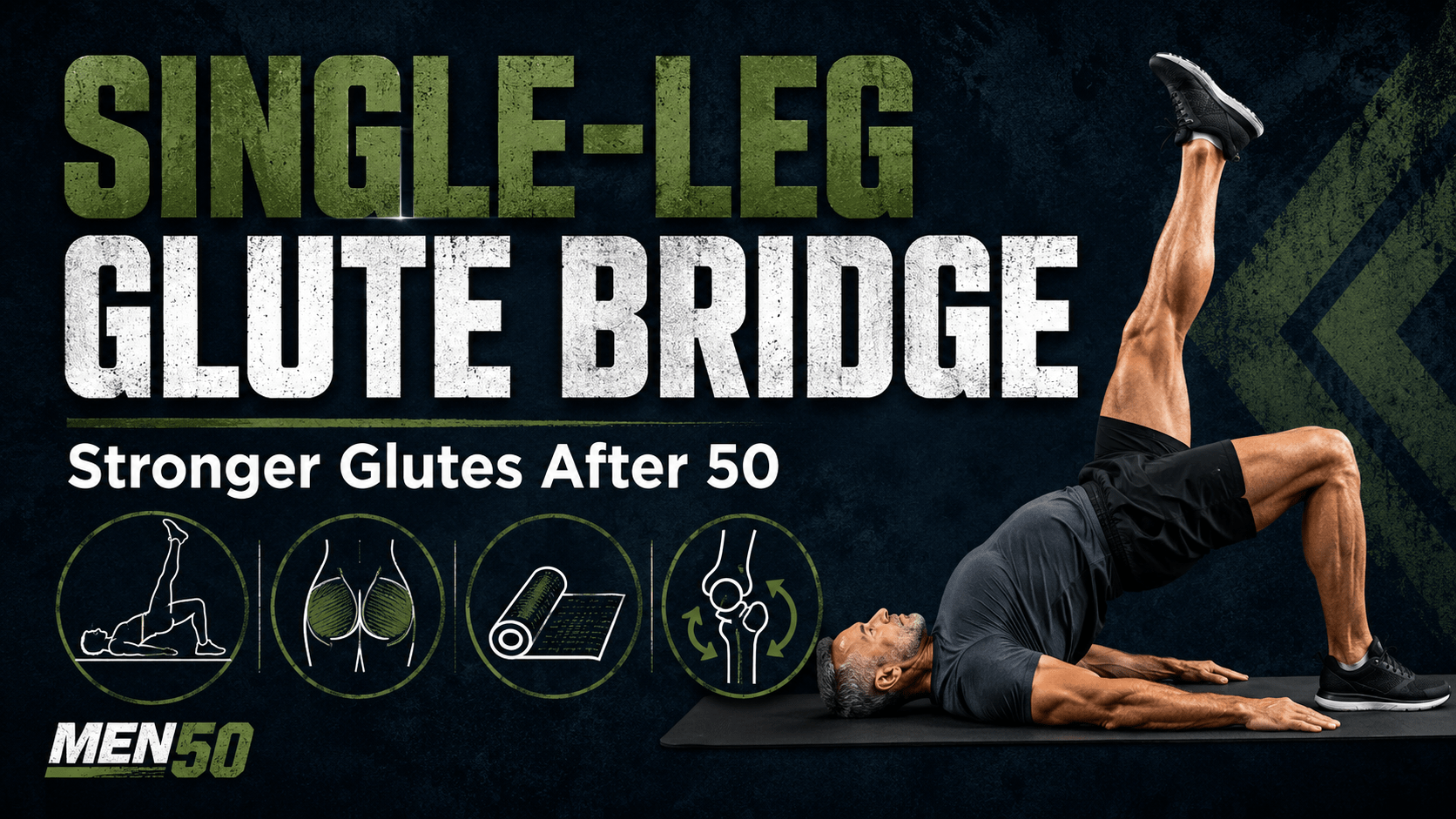
The single-leg glute bridge is the natural progression beyond the standard glute bridge — and it does something the bilateral version can’t. By forcing one leg to handle the entire load on each rep, it exposes the left-right glute asymmetry that bilateral bridging hides. Most men over 50 have meaningful glute strength imbalance (usually because they favour one side for years of daily tasks), and that asymmetry contributes to chronic low back pain, hip discomfort, and uneven walking mechanics. The single-leg version is also genuinely harder — most men can lift far less than half their bilateral weight on one leg, which exposes how much the stronger side has been compensating.
Part of the Build Muscle After 50 pillar — strength training for men over 50.
Key Takeaways
- The single-leg glute bridge trains the same primary muscle as the bilateral version (gluteus maximus) — but on one leg at a time, exposing and correcting left-right asymmetry.
- Most men over 50 can lift significantly less than half of their bilateral bridge load on one leg. That difference is the asymmetry the exercise corrects.
- Programming: 2–4 sets of 8–15 reps per leg, 2–3 times per week. Rest 45–90 seconds between sets.
- Drive through the heel, squeeze the glute hard, and don’t arch the lower back. Stronger glutes improve balance, protect your back and hips, and help you move better every day.
- This is the unilateral version of an established staple — same benefits, single-leg challenge.
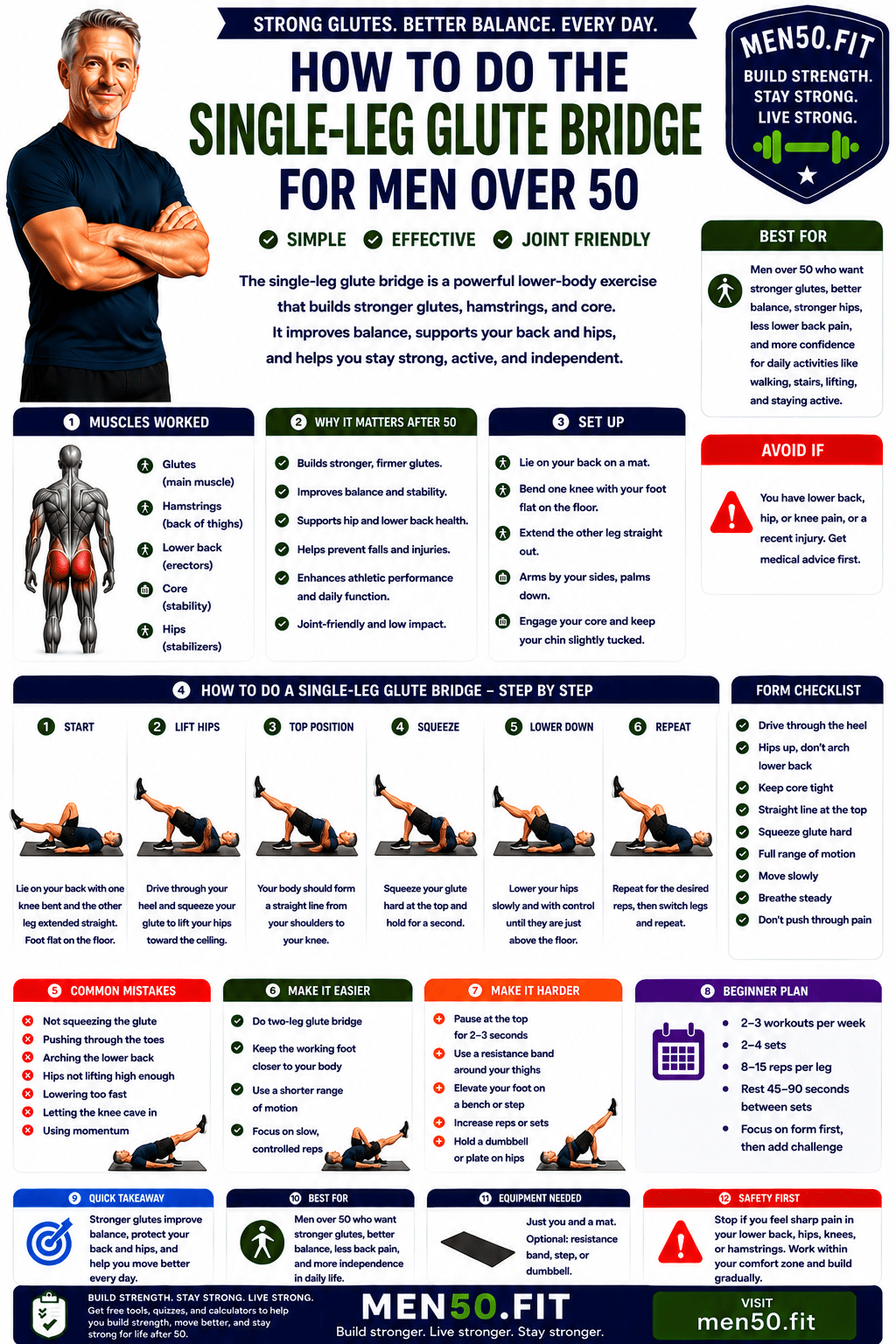
How to Perform the Single-Leg Glute Bridge
Set up first:
- Lie on your back on a mat.
- Bend one knee with that foot flat on the floor about hip-width from your bum.
- Extend the other leg straight out — either parallel to the floor (easier) or pointed at the ceiling (harder).
- Arms by your sides, palms down — this provides stability.
- Engage your core and keep your chin slightly tucked (don’t crane your neck back).
Then the movement:
- Start. Lie on your back with one knee bent (foot flat on the floor) and the other leg extended straight out. Arms at your sides for stability.
- Lift hips. Drive through the heel of your working leg and squeeze your glute to lift your hips toward the ceiling. Take 1–2 seconds to lift.
- Top position. Your body should form a straight line from your shoulders to your knee of the working leg. The non-working leg stays straight. Don’t let the hips tilt — keep them level.
- Squeeze. Squeeze your glute hard at the top and hold for a second. Feel the glute work — not the lower back.
- Lower down. Lower your hips slowly and with control until they are just above the floor. Take 2–3 seconds to lower. Don’t rest at the bottom — touch lightly and lift again.
- Repeat. Complete the reps on one leg, then switch. Maintain clean form on every rep — quality over quantity.
The cue that matters most: drive through the heel of the working leg, not the toes. Pushing through the heel keeps the glute engaged. Pushing through the toes shifts work to the hamstring and calf. Most of the lift should come from the glute on the working side — you should feel the glute work hard, and the hamstring assisting moderately.
Why the Single-Leg Glute Bridge Matters After 50
The gluteus maximus is the largest muscle in the body — and one of the most important for men over 50. The glute does multiple jobs: drives hip extension (walking, climbing stairs, standing up), stabilises the pelvis during single-leg moments (every step you take), and protects the lower back by handling the load that the lumbar spine would otherwise absorb. Weak glutes are associated with:
- Chronic lower back pain (the lower back compensates when glutes don’t fire)
- Hip discomfort and stiffness
- Reduced walking efficiency
- Higher fall risk during single-leg moments
- Knee pain (weak glutes cause knee valgus during squats and stairs)
The standard glute bridge is the foundational exercise for glute strength. The single-leg version adds two specific things the bilateral version can’t:
1. Asymmetry Detection and Correction
This is the main reason the single-leg version matters. Just like single-leg strength asymmetry in the legs and single-arm asymmetry in the upper body, men over 50 typically have glute strength imbalance between left and right sides. The bilateral glute bridge hides this — your stronger side automatically compensates for the weaker side. The single-leg version exposes it immediately: you’ll usually feel which side is weaker by the second set, and you’ll often be able to do significantly more reps on the stronger side.
Most men over 50 can lift less than half their bilateral glute bridge load on one leg — typically 30–40%. That difference reflects how much the stronger side has been compensating during bilateral work. Over weeks of training the single-leg version, the weaker side catches up, and total bilateral strength improves as a result.
2. Core Anti-Rotation Demand
The single-leg position adds something the bilateral version doesn’t: anti-rotation. As the working leg lifts the body, the pelvis wants to rotate or tilt toward the non-working side. The core has to actively resist this rotation throughout every rep. This trains the deep core stabilisers in a functional pattern — similar to the dead bug and bird dog work from Stuart McGill’s spine research. The single-leg glute bridge is essentially a glute exercise that also trains core stability automatically.
How It Fits in the Lower-Body Cluster
The hip-extension cluster is now comprehensive across difficulty levels:
| Exercise | Level | Best For |
|---|---|---|
| Glute Bridge | Beginner | Foundation pattern, bilateral |
| Single-Leg Glute Bridge (this article) | Intermediate | Asymmetry correction, core demand |
| Hip Hinge / Good Morning | Intermediate | Standing hinge pattern, bodyweight |
| Dumbbell Romanian Deadlift | Advanced | Loaded standing hinge |
Together, these four exercises cover the full hip-extension spectrum from “first time training glutes” to “heavy loaded hinge work.” Most men over 50 benefit from doing 2–3 of these per week (typically the glute bridge or single-leg bridge plus one standing variation).
Sets and Reps
Progressive loading is the goal. The single-leg position allows bodyweight to be plenty of resistance for a long time.
| Stage | Variation | Sets × Reps per Leg | Frequency |
|---|---|---|---|
| Beginner | Working foot closer to body, partial range | 2 × 8–10 | 2× per week |
| Novice | Standard position, full range | 2–3 × 8–15 | 2–3× per week |
| Intermediate | Pause at top + slow lowering | 3 × 8–15 | 2–3× per week |
| Advanced | Foot elevated on step + dumbbell on hips | 3–4 × 8–15 | 2–3× per week |
Rest 45–90 seconds between sets. Pick a variation where the last 2–3 reps on the weaker side maintain clean form — hips level, full lift height, controlled tempo.
Always start with your weaker side. This is important. Do the weaker side first, use that rep count as the cap, then match the same number on the stronger side. This naturally trains the asymmetry toward balance over weeks. If you start with the stronger side and do 15 reps, you’ll force the weaker side to attempt 15 reps when it might genuinely only manage 10 with clean form.
Common Mistakes
The seven errors that turn a great glute exercise into a lower back or hamstring strain:
- Not squeezing the glute. The single most important point in this exercise. Going through the motion without consciously contracting the glute wastes the rep — the lower back and hamstrings take over instead. Actively squeeze the glute hard as you lift, and hold the squeeze at the top.
- Pushing through the toes. When you push through the front of the foot, work shifts to the hamstring and calf. Drive through the heel — you should feel the pressure on the heel of the working foot throughout the rep.
- Arching the lower back. As fatigue sets in, the lower back wants to over-arch to lift the hips higher. This shifts the work from glutes to lumbar spine and is the most common cause of back pain in this exercise. Keep the rib cage down and the lower back gently flat against the floor at the start of each rep. The lift should come from glute contraction, not back extension.
- Hips not lifting high enough. Stopping with the body bent at the hips skips the productive range of motion. Lift until your body forms a straight line from your shoulders to your working knee.
- Lowering too fast. Dropping back down quickly skips the eccentric phase. Lower slowly over 2–3 seconds. The slow descent builds strength.
- Letting the knee cave in. When the glute medius is weak, the working knee wants to drift inward toward the midline as you lift. This is knee valgus — the position associated with anterior knee pain. Track the knee in line with the middle toes throughout. If it won’t stay tracking, the glute medius needs work too (side-lying leg raises, standing hip abductions).
- Using momentum. Bouncy, quick reps use elastic recoil. Slow controlled reps build strength. Use 1–2 seconds up, brief pause at the top, 2–3 seconds down.
Make It Easier or Harder
If standard single-leg glute bridges are too challenging:
- Do the two-leg glute bridge for another 2–4 weeks to build the foundation. Most men over 50 should manage 3 sets of 15 clean bilateral reps before attempting single-leg.
- Keep the working foot closer to your body — heel closer to your bum reduces the lever arm and the demand.
- Use a shorter range of motion — lift only 70–80% of the way up while building strength.
- Focus on slow, controlled reps — clean bodyweight reps train the pattern.
To make it harder once form is solid:
- Pause at the top for 2–3 seconds with the glute squeezed hard.
- Use a resistance band around your thighs — adds glute medius demand (resisting the band’s pull toward the midline) on top of the glute maximus work.
- Elevate your foot on a bench or step — increases the range of motion and shifts more load to the working glute.
- Increase reps or sets — extend to 15–20 per leg before adding load.
- Hold a dumbbell or plate on the hips (with one hand if needed for stability) — adds direct load. Most men over 50 start with 10–15 lbs (4.5–7 kg).
For variety, try the single-leg glute bridge with the working leg elevated on a bench (Bulgarian-style glute bridge) once a week — significantly harder because it removes the floor as a stopping point and increases range of motion.
Safety Note
Avoid the single-leg glute bridge if you have lower back, hip, or knee pain, or a recent injury that affects single-leg loading. Get medical advice first.
Lower back pain during this exercise usually means: the lower back is over-arching to compensate for weak glutes, the rib cage is flaring up, or the lift is too high. Keep the rib cage down and lift only as high as you can with the glute doing the work — not the lower back. If pain persists, drop back to the bilateral glute bridge and rebuild from there.
Hamstring cramping is common when first learning this exercise — usually because the hamstring is doing work the glute should be doing. Squeeze the glute consciously; the hamstring’s role is secondary. Cramping usually disappears within 2–3 sessions as glute engagement improves.
Knee pain in the working leg is usually caused by knee valgus (knee caving inward). Track the knee over the middle toes; add glute medius work (side-lying leg raise, standing hip abduction) to your routine.
If you feel sharp pain anywhere, stop. Mild muscular fatigue in the glute is normal; sharp joint pain is not.
Build Your Personal Training Plan
The single-leg glute bridge is one piece of a complete lower-body and core programme. Get a personalised exercise plan based on your current strength, mobility, and any limitations.
Take the Free Fitness Profiler →
FAQs
Single-leg vs two-leg glute bridge — which is better?
Different stages of the same exercise. The two-leg glute bridge is the foundational version — easier, bilateral, and the right starting point for most men over 50. The single-leg version is the progression — harder, exposes asymmetry, adds core demand. Most men over 50 should master the bilateral version first (3 sets of 15 clean reps comfortably), then progress to single-leg. Both belong in a complete programme. Many men over 50 alternate between them — bilateral one workout for total glute volume, single-leg another for asymmetry correction. Neither is “better” — they serve different purposes at different stages.
Why does this feel so much harder than the regular glute bridge?
Two reasons. (1) Single-leg means one leg supports all the bodyweight that two legs shared in the bilateral version — not exactly double the load, but close. (2) The single-leg position adds significant core and balance demand because the body wants to rotate or tilt toward the non-working side, and the core has to actively resist that throughout every rep. Most men over 50 can lift less than half of their bilateral bridge load on one leg — typically 30–40%. That difference reflects both the increased load per leg AND the additional stabilisation work. It’s normal. The exercise is genuinely harder.
How do I keep my hips level?
This is one of the harder technical points. As the working leg lifts, the pelvis wants to rotate (the non-working side tries to lift higher than the working side). To prevent this: (1) Engage the core actively before lifting — brace as if you’re about to be punched in the stomach. (2) Press the non-working leg slightly downward into nothing — this engages the muscles on that side and helps keep the pelvis level. (3) Use a mirror or video to check yourself for the first 2–3 sessions. If hips are visibly uneven at the top, the lift is too high or the core isn’t bracing enough. (4) Place your hand briefly on each hip during a rep to feel whether they’re level — they should be.
Why is my lower back working more than my glutes?
This is the most common issue with this exercise — and it’s a glute activation problem, not a back problem. Solutions (in order):
- Squeeze the glute first, then lift. Most men start the lift by extending the back, with the glute joining later. Reverse the order — contract the glute consciously, then let it lift the hips.
- Keep the rib cage down. When the ribs flare up, the lower back over-arches. Keep ribs gently pulled toward the hips throughout the rep.
- Lift less high. Going too high forces the back to extend beyond what the glutes can produce. Stop at the point where the body forms a straight line from shoulders to knee — no higher.
- Squeeze briefly at the top for 1–2 seconds — gives the glute time to “find” the work.
If the lower back continues to dominate, drop back to bilateral glute bridges and practice glute activation before progressing.
Can I do this every day?
For light bodyweight work, yes — the glutes respond well to frequent practice. Daily mini-doses (1 set of 10–15 per leg every morning) are a sustainable habit that builds glute strength over weeks. For heavier work (with dumbbells or bands), 2–3 times per week is the sweet spot, with 48 hours of recovery between sessions. Many men over 50 benefit from doing bodyweight single-leg bridges most days plus loaded versions 2 days per week.
References
- McGill SM. Low Back Disorders: Evidence-Based Prevention and Rehabilitation. 3rd ed. Champaign, IL: Human Kinetics; 2016.
- American College of Sports Medicine. Resistance Training for Older Adults Position Stand. acsm.org
- Centers for Disease Control and Prevention. STEADI: Stopping Elderly Accidents, Deaths & Injuries. cdc.gov
Disclaimer: This article is for educational purposes only and is not medical advice. Consult a qualified healthcare professional before starting any new exercise programme, especially if you have existing back, hip, or knee conditions.