
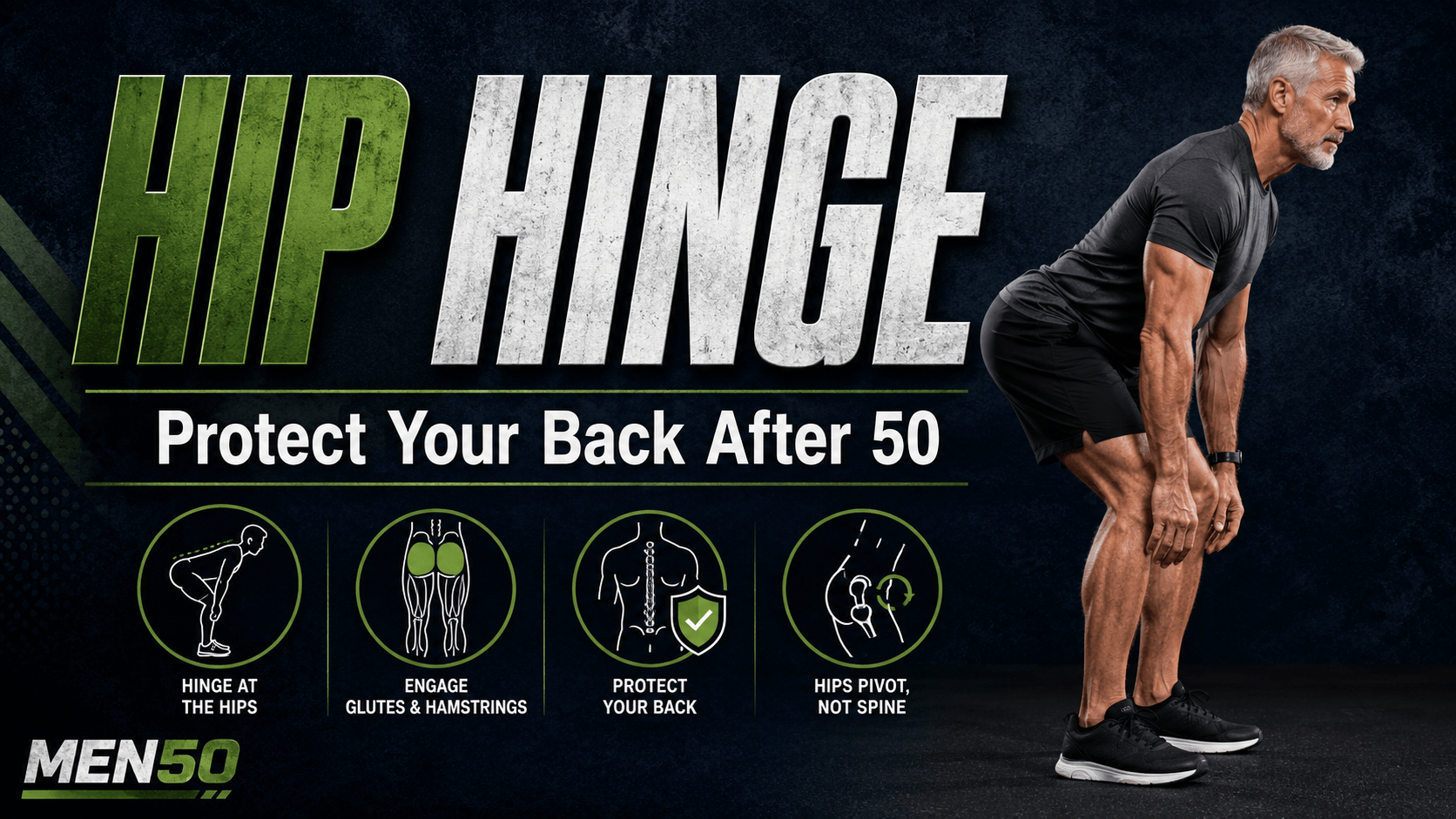
The hip hinge is not optional — it’s the foundational movement pattern that every man over 50 needs to master if he wants to keep lifting things, bending over, and picking things up from the floor for the rest of his life. The vast majority of “I just bent over and my back went” injuries are hip hinge failures: men bending from the spine instead of from the hips. Learn this pattern with bodyweight first, then add a light load with the good morning variation, and you’ve built the foundation that makes Romanian deadlifts, farmer’s carries, and real-world lifting genuinely safe.
Part of the Build Muscle After 50 pillar — strength training for men over 50.
Key Takeaways
- The hip hinge is the foundational movement pattern for everyone bending or lifting — and the single most important pattern to master for back protection after 50.
- The good morning is the lightly loaded version (light dumbbells at chest) — the natural progression once the bodyweight hinge feels solid.
- Programming: 2–3 sets of 8–12 reps, 2–4 times per week. Rest 45–75 seconds between sets.
- Push your hips back, keep your ribs down, and stop before your back rounds. The whole technique in one cue.
- This article is the pattern-learning prerequisite for the Dumbbell Romanian Deadlift. Master this first; the RDL becomes the loaded application of what you’ve learned.
How to Perform the Hip Hinge
Set up first:
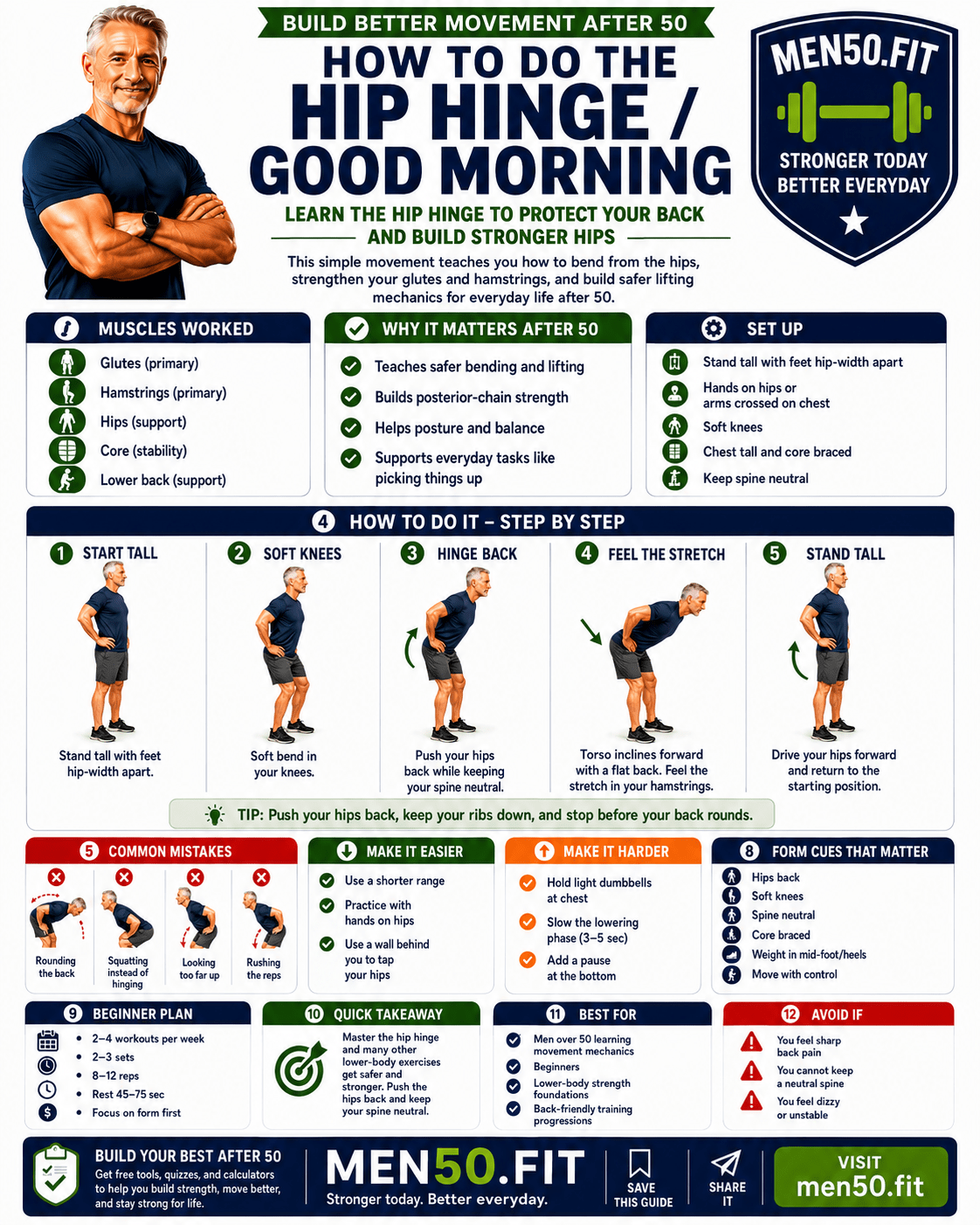
- Stand tall with feet hip-width apart.
- Hands on hips, or arms crossed across the chest (for the bodyweight version).
- Soft knees — slightly bent and they stay slightly bent throughout. They don’t bend more as you hinge.
- Chest tall, core braced, spine neutral.
Then the movement:
- Start tall. Stand upright with feet hip-width apart, hands on hips or arms crossed. Core engaged. Take a moment to set the position before the first rep.
- Soft knees. Bend your knees slightly — about 10–15 degrees. This is the knee position you maintain for the entire rep. The knees do not bend more as you hinge.
- Hinge back. Push your hips straight back like you’re closing a car door with your bum. Your torso angles forward as the hips travel backward. The knees stay in the same slightly-bent position throughout.
- Feel the stretch. Continue the hinge until you feel a comfortable stretch in your hamstrings — typically when your torso is at about 45 degrees from vertical. Stop before the back rounds. Back stays flat throughout.
- Stand tall. Drive your hips forward to return to the starting position. Squeeze your glutes at the top. Don’t lean back or hyperextend.
The cue that matters most: push your hips back, keep your ribs down, and stop before your back rounds. Pushing the hips back is what makes it a hinge — without that, it becomes a squat or a forward fold. Stopping before the back rounds is what makes it safe — past that point, the lumbar spine takes load it shouldn’t.
Why the Hip Hinge Matters After 50
The hip hinge is one of the seven fundamental human movement patterns (alongside squat, push, pull, lunge, twist, and walk). You use it every time you:
- Pick something up from the floor
- Bend over the kitchen sink
- Lift a suitcase from the boot of a car
- Reach into a low cupboard
- Pick up a grandchild
- Move furniture or carry groceries
Men who hinge well — keeping the back flat and letting the hips do the work — rarely hurt their backs during these tasks. Men who don’t hinge — who round their backs to reach the floor — accumulate small spinal injuries over years until something finally breaks. The vast majority of “I just bent over and my back went” incidents in men over 50 are hip hinge failures.
Stuart McGill, one of the world’s leading spine researchers (and a recurring authority across this matrix — his work also underpins the dead bug, bird dog, glute bridge, and Romanian deadlift articles), has spent decades showing that the hip hinge is the most important movement pattern to train for back health. People who can hinge well, with strong hamstrings and glutes doing the work, protect their spines for life. People who can’t, don’t.
Hip Hinge vs Squat — They’re Different Patterns
The single most important technical distinction you’ll learn from this article:
| Pattern | Hips Travel | Knees | Torso |
|---|---|---|---|
| Hip Hinge | Backward | Stay slightly bent | Angles forward, flat back |
| Squat | Downward | Bend significantly | Stays more vertical |
Both involve “bending forward” — but the mechanics are different. The hip hinge is what protects your back during real-world lifting. The squat is what handles loads when you can keep your torso upright. Confusing the two patterns is one of the most common causes of lifting injuries in men over 50.
The Good Morning — The Next Step
Once the bodyweight hip hinge feels solid, the good morning is the natural progression. Hold a pair of light dumbbells against your chest (palms in toward each other, dumbbells held vertically like an X across your chest) and perform the same hinge pattern. The dumbbells add load to the eccentric (downward) phase and increase the demand on the hamstrings, glutes, and core — but only modestly, because the load is held at your chest rather than further from your body.
The good morning is the bridge between the bodyweight hip hinge and the loaded Romanian deadlift. The RDL loads the hip hinge with dumbbells held at your sides — which creates much more lever arm and demands significantly more strength. The good morning, with the load close to your chest, is the in-between step that lets you build hip hinge strength under load before the RDL becomes appropriate.
Most men over 50 should follow this progression:
| Stage | Variation | When to Progress |
|---|---|---|
| Stage 1 | Bodyweight hip hinge | Spend 2–4 weeks here, focus on the pattern |
| Stage 2 | Light good morning (5–10 lb dumbbells at chest) | Once Stage 1 is reliable |
| Stage 3 | Heavier good morning (10–20 lb at chest) | Once Stage 2 feels easy |
| Stage 4 | Romanian deadlift (dumbbells at sides) | The full loaded application |
Each stage builds the foundation for the next.
Sets and Reps
Bodyweight focus initially. Add load only when the pattern is clean.
| Stage | Variation | Sets × Reps | Frequency |
|---|---|---|---|
| Beginner | Bodyweight, shorter range | 2 × 8–10 | 2–3× per week |
| Novice | Bodyweight, full range | 2–3 × 8–12 | 2–4× per week |
| Intermediate | Good morning with 5–10 lb dumbbells at chest | 3 × 8–12 | 2–3× per week |
| Advanced | Good morning with 10–20 lb at chest + slow lowering | 3 × 8–12 | 2–3× per week |
Rest 45–75 seconds between sets. Pick a variation where the last 2–3 reps still maintain a flat back and clean hinge pattern — if your back wants to round on the later reps, the set is over (regardless of how many reps you’d planned).
A practical note on programming: this exercise is a skill as much as a strength builder. Most men over 50 should do hip hinges near-daily as a pattern-grooving habit, similar to how the band pull-apart is treated. Five sets of 5 reps every morning with bodyweight builds the motor pattern faster than the standard 2–3 sessions per week with heavier weight. Loaded good mornings, when added, follow the standard 48-hour recovery rule.
Common Mistakes
The four errors that turn a back-protection exercise into a back-injury risk:
- Rounding the back. The single most dangerous mistake — and the entire pattern this exercise is designed to prevent. The lumbar spine flexing forward under load (even bodyweight load) is the mechanism that causes most lifting-related back injuries. Stop the rep immediately if the back starts to round. Reduce your range until the back stays flat throughout.
- Squatting instead of hinging. Bending the knees significantly as you lower turns the hip hinge into a squat — different exercise, different muscles, different pattern. Keep the knees in the same slightly-bent position throughout. Hips travel back; knees stay still.
- Looking too far up. Some men crane the neck upward during the hinge — usually because they’ve been told to “look forward.” This hyperextends the cervical spine and breaks the neutral spine pattern. Keep your eyes on the floor about 6 feet ahead of you. Neck stays in line with the spine.
- Rushing the reps. Quick, bouncy reps use momentum and don’t teach the pattern. Use 2–3 seconds down, brief pause at the bottom, 1–2 seconds up. The slow tempo is what builds the motor pattern.
Make It Easier or Harder
If standard hip hinges are too challenging:
- Use a shorter range — hinge only to about 30 degrees from vertical while you build hamstring flexibility and pattern confidence.
- Practice with hands on hips — gives you a tactile reference for whether your hips are actually moving backward (the standard cue).
- Use a wall behind you to tap your hips — stand about 6 inches in front of a wall and hinge until your bum lightly touches the wall. This is one of the best teaching cues for the pattern. Most men over 50 figure out the hinge in 5 minutes with this method.
To make it harder once form is solid:
- Hold light dumbbells at chest — the good morning progression. Start with 5 lbs each and build up.
- Slow the lowering phase to 3–5 seconds per rep — significantly more demanding than it sounds.
- Add a pause at the bottom for 1–2 seconds at the deepest part of your range.
- Progress to the Romanian deadlift once your loaded good morning feels solid.
For variety, try the single-leg hip hinge (lift one foot slightly off the ground, hinge on the standing leg). Significantly more demanding because of balance + single-leg loading; useful as a balance challenge once basic hinge form is solid.
Safety Note
Avoid the hip hinge if you have sharp back pain during the movement, cannot keep a neutral spine, or feel dizzy or unstable when bending forward. Get medical advice first if any of these apply.
Stop the rep immediately if the back starts to round. This is the rule that protects you. A few reps with a rounded back, especially with load, is how injuries happen. The moment you feel the lower back start to flex forward, stop and return to standing.
If you have dizziness when bending forward (which may indicate orthostatic hypotension or inner ear issues), stay in a shorter range and stand up slowly between reps. Discuss with a doctor if it persists.
Men with diagnosed disc issues, herniations, or any lower-back condition should get clearance from a physiotherapist or physician before progressing past bodyweight hip hinges. The pattern is generally protective, but acute conditions need professional assessment first.
Build Your Personal Training Plan
The hip hinge is one piece of a complete lower-body and movement-mechanics programme. Get a personalised exercise plan based on your current strength, mobility, and any limitations.
Take the Free Fitness Profiler →
FAQs
Hip hinge vs squat — what’s the difference?
Different movement patterns. The hip hinge is hip-dominant — hips travel backward, knees stay slightly bent, torso angles forward with a flat back. You use this pattern every time you bend over to pick something up or lift from the floor. The squat is knee-dominant — hips travel downward, knees bend significantly, torso stays more vertical. You use this pattern to lower yourself into a chair or pick up something between your feet. Both patterns are essential for lower-body function, but they protect different things: the hinge protects your back when bending; the squat protects your knees when descending. Confusing the two is one of the most common causes of lifting injuries in men over 50.
Hip hinge / good morning vs Romanian deadlift — same exercise?
Closely related but not identical. The bodyweight hip hinge is the pattern-learning exercise. The good morning (light dumbbells at chest) is the lightly loaded version that builds strength in the same pattern. The Romanian deadlift is the heavily loaded application with dumbbells held at your sides — which creates a much longer lever arm and demands significantly more strength. All three train the same hip hinge pattern, just at different load levels. Follow the natural progression: bodyweight first, then good morning, then Romanian deadlift.
How do I know if I’m hinging or squatting?
Three checks. Watch your hips — in a hinge, the hips should travel backward (away from your toes); in a squat, they travel downward. Watch your knees — in a hinge, the knees stay relatively still; in a squat, they bend significantly. Watch your shins — in a hinge, your shins stay vertical (or close to it); in a squat, your shins angle forward as the knees bend. If you can’t tell which one you’re doing, try the wall test: stand about 6 inches in front of a wall and try to tap the wall with your bum without falling backward. The only way to do that is with a hip hinge — and that gives you the feel of the pattern.
Why is this called a “good morning”?
The name comes from the way the movement looks — like bowing to greet someone in the morning. It’s a traditional strength training exercise that’s been around for over a century. The barbell version (barbell across the shoulders) was popular in old-school strength training; the modern variation tends to use dumbbells at the chest because the shoulder loading was hard on the cervical spine. For most men over 50, the chest-loaded version is significantly safer and trains the same muscles.
How do I progress to loaded versions?
Spend at least 2–4 weeks on bodyweight hip hinges before adding any load. The goal is to groove the pattern — push the hips back smoothly, keep the back flat, stop before rounding, stand up smoothly. Once that pattern is reliable: add light dumbbells (5–10 lbs each) at the chest for the good morning variation. Spend another 4–8 weeks here before progressing further. Then move to the Romanian deadlift with dumbbells at your sides. The progression takes 3–6 months done correctly — and the patience pays off because you build a back-protective pattern that lasts decades.
References
- McGill SM. Low Back Disorders: Evidence-Based Prevention and Rehabilitation. 3rd ed. Champaign, IL: Human Kinetics; 2016.
- American College of Sports Medicine. Resistance Training for Older Adults Position Stand. acsm.org
- National Institute on Aging. Exercise & Physical Activity: Your Everyday Guide. nia.nih.gov
Disclaimer: This article is for educational purposes only and is not medical advice. Consult a qualified healthcare professional before starting any new exercise programme, especially if you have existing back, hip, or hamstring conditions.