
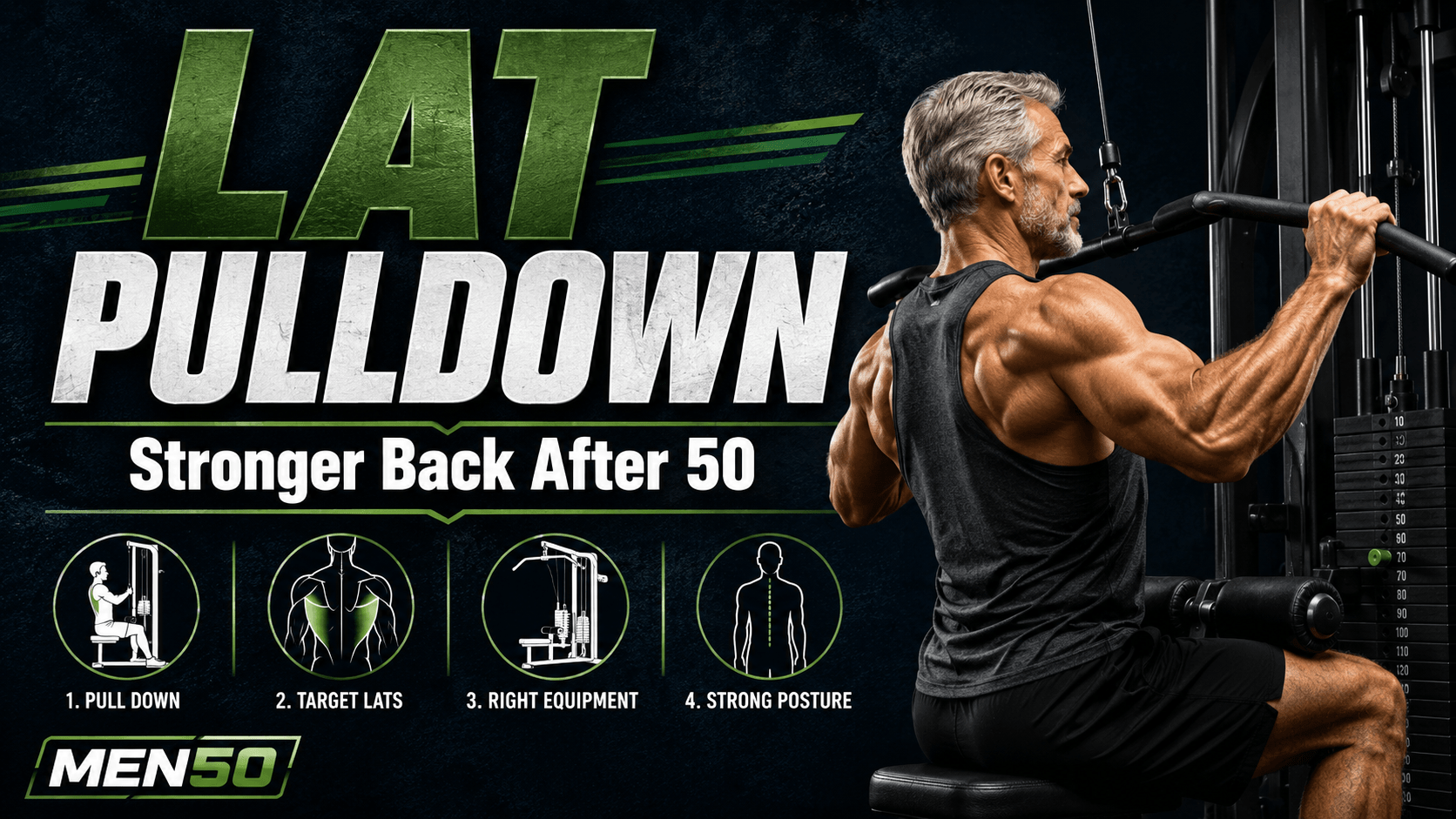
The lat pulldown is the classic gym machine version of vertical pulling — and for most men over 50, it’s the practical alternative to pull-ups. Pull-ups require lifting your entire bodyweight; the lat pulldown lets you start with manageable loads and progress precisely as you get stronger. It’s also the gym counterpart to the band lat pulldown — same fundamental movement, different equipment. For men over 50 with gym access, the lat pulldown is the most reliable way to build the lats and upper back that produce strong-looking posture and meaningful pulling strength.
Part of the Build Muscle After 50 pillar — strength training for men over 50.
Key Takeaways
- The lat pulldown is the vertical pulling exercise — trains the lats, rhomboids, teres major, rear delts, and biceps in a coordinated pattern.
- It’s the gym-machine counterpart to the band lat pulldown and the practical alternative to pull-ups for most men over 50.
- Programming: 2–4 sets of 8–12 reps, 2–3 times per week. Rest 60–90 seconds between sets.
- Pull elbows down and back, squeeze the lats, control the movement. Strong lats mean better posture, strength, and confidence.
- Critical safety point: pull the bar to your upper chest, not behind the neck. Behind-the-neck pulldowns are one of the most shoulder-damaging exercises and should be avoided.
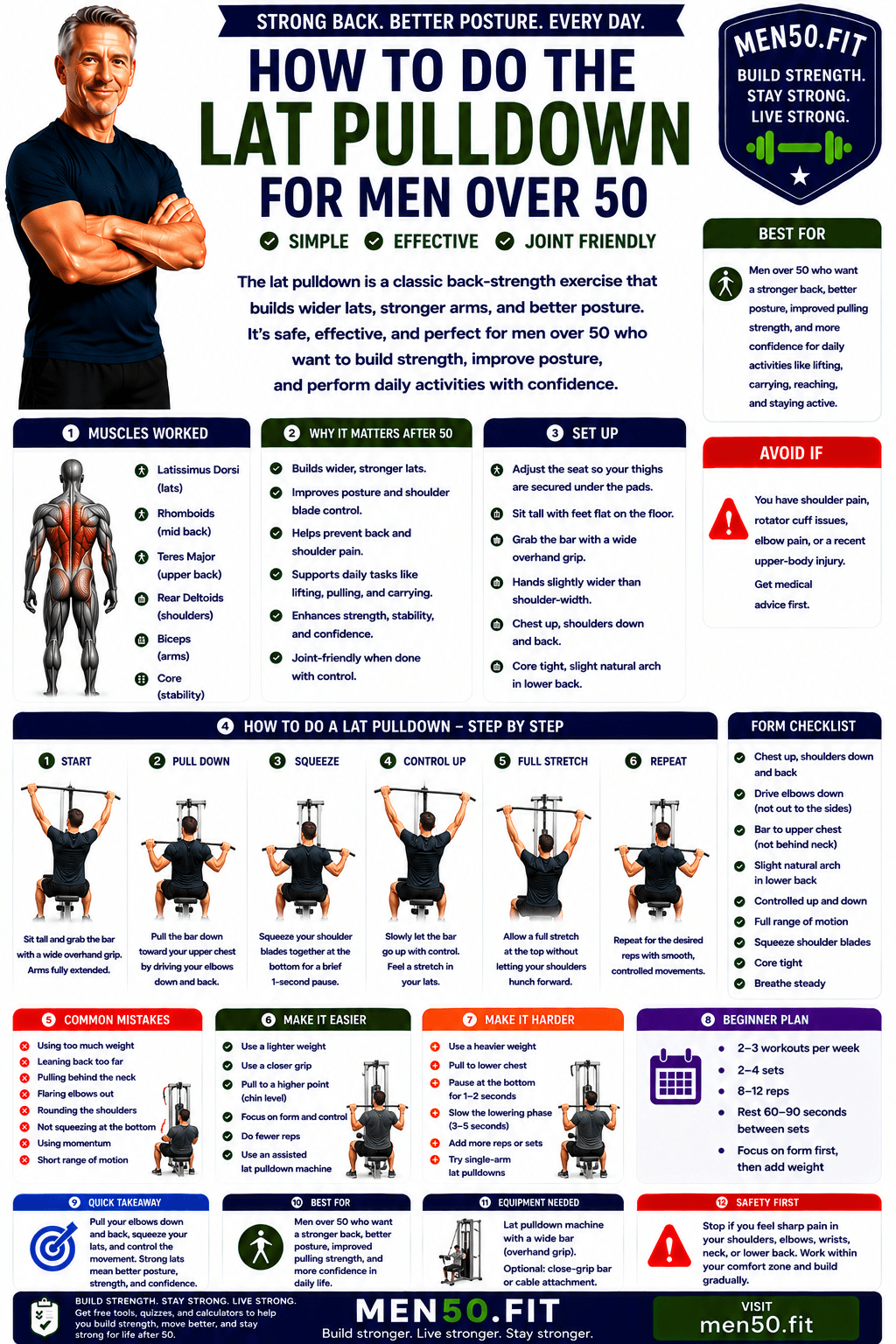
How to Perform the Lat Pulldown
Set up first:
- Adjust the seat so your thighs are secured under the pads — this prevents you from lifting off the seat when pulling.
- Sit tall with feet flat on the floor.
- Grab the bar with a wide overhand grip — hands slightly wider than shoulder-width.
- Chest up, shoulders down and back — pinned in this position before you start the rep.
- Core tight, with a slight natural arch in your lower back.
Then the movement:
- Start. Sit tall and grab the bar with a wide overhand grip. Arms fully extended overhead. Body braced.
- Pull down. Pull the bar down toward your upper chest by driving your elbows down and back. Take 1–2 seconds to pull down. Lead with the elbows, not the hands.
- Squeeze. Squeeze your shoulder blades together at the bottom for a brief 1-second pause. The bar should touch (or nearly touch) your upper chest. Feel the lats actively work.
- Control up. Slowly let the bar go up with control. Take 2–3 seconds on the way up. Don’t let the weight pull your arms straight up violently — control the eccentric on every rep.
- Full stretch. Allow a full stretch at the top without letting your shoulders hunch forward. Feel a stretch in your lats with the bar arms fully extended overhead.
- Repeat. Maintain clean form on every rep. Quality over weight.
The cue that matters most: drive the elbows down and back, not the hands. Most men intuitively focus on lifting the bar down with their hands, which recruits the biceps and shifts work away from the lats. Think “elbows toward your hip pockets” — this brings the lats into the work properly. When the elbows lead, the back does the work. When the hands lead, the biceps takes over.
Why the Lat Pulldown Matters After 50
The back is one of the most under-trained muscle groups in men over 50 — and the lats specifically (latissimus dorsi, the large back muscle running from spine to upper arm) are particularly neglected because vertical pulling rarely happens in daily life. You don’t pull things downward from above your head in normal activities. Without deliberate training, the lats waste away.
Why does this matter? Three specific reasons relevant to men over 50:
1. Upper crossed syndrome correction. Czech physiotherapist Vladimir Janda’s upper crossed syndrome — the rounded-shoulder pattern in men over 50 from decades of desk work — produces tight chest and weak upper back. Back training is the strength-building half of the correction (the doorway chest stretch is the lengthening half). The lat pulldown trains the lats and upper back in the vertical plane, complementing the horizontal pulling work covered by the row variations in the matrix.
2. Pulling capacity for daily life. The lats are involved in many real-world pulling tasks: pulling a heavy bag overhead into a luggage rack, climbing a ladder, opening a heavy garage door, pulling a pet leash, hanging from a bar for safety if falling. Vertical pulling capacity declines significantly after 50 if untrained — and the loss shows up first as these tasks becoming surprisingly hard.
3. Shoulder health and scapular control. The lat pulldown trains scapular depression and downward rotation — the opposite of the shrugged-up shoulder position that defines forward-rounded posture. Research by Kibler and Sciascia (2010, British Journal of Sports Medicine) on scapular dyskinesis identifies this scapular pattern as protective against shoulder impingement and rotator cuff issues. The lat pulldown isn’t just back training — it’s part of shoulder health maintenance.
The Behind-the-Neck Warning
This is non-negotiable: pull the bar to your upper chest, never behind your neck. The behind-the-neck variation — popular in 1970s and 80s bodybuilding — is now well-established as one of the most shoulder-damaging exercises in fitness. The position forces the shoulders into extreme external rotation while loaded, which:
- Places significant stress on the rotator cuff
- Compresses the cervical spine
- Encourages the head to jut forward (the opposite of good posture)
- Is associated with both acute and chronic shoulder injuries
For men over 50, the behind-the-neck variation should never be done. Period. If you learned this variation decades ago, stop. The front-of-chest version trains the lats more effectively AND protects your shoulders.
Lat Pulldown vs Pull-Up
The natural question many men over 50 ask: should I work toward pull-ups instead? Honest answer: most men over 50 should not prioritise pull-ups. Here’s why:
- Pull-ups require lifting your entire bodyweight — for most men over 50, this is well beyond their pulling capacity, especially in the strict (no swinging) form that’s actually safe.
- The lat pulldown produces equivalent muscle development with manageable loads that can be progressed precisely.
- The strength carryover between lat pulldowns and pull-ups is real but limited — pull-ups also require significant grip endurance, hand-shoulder coordination, and core bracing that comes from doing pull-ups specifically.
For most men over 50, the lat pulldown is the better choice for back development — safer, more loadable, more sustainable over years. If you want to achieve pull-ups specifically as a fitness milestone, that’s a worthy goal, but it requires dedicated pull-up-progression training (assisted pull-ups, negative pull-ups, etc.) rather than just doing more lat pulldowns. The two are complementary but not interchangeable.
Position in the Pulling Matrix
The lat pulldown completes the comprehensive pulling matrix for men over 50:
| Direction | Equipment | Exercise |
|---|---|---|
| Vertical (top-down) | Machine | Lat Pulldown (this article) |
| Vertical (top-down) | Band | Band Lat Pulldown |
| Horizontal (front-back) | Dumbbells, standing | Bent-Over Row |
| Horizontal | Dumbbells, single arm | One-Arm Dumbbell Row |
| Horizontal | Dumbbells, supported | Chest-Supported Row |
| Horizontal | Band | Resistance Band Row |
Combined with the postural exercises (band pull-apart, band face pull, reverse fly) and the lengthening work (doorway chest stretch), this is the most comprehensive back and shoulder posture training set in any fitness content for men over 50.
Sets and Reps
Progressive loading is the goal. The lat pulldown tolerates this well because the machine controls the resistance precisely.
| Stage | Sets × Reps | Frequency | Load Guide |
|---|---|---|---|
| Beginner | 2 × 8–10 | 2× per week | Light (40–60 lbs / 18–27 kg) |
| Novice | 2–3 × 8–12 | 2–3× per week | Working (60–90 lbs / 27–41 kg) |
| Intermediate | 3 × 8–12 | 2–3× per week | Moderate (90–130 lbs / 41–59 kg) |
| Advanced | 3–4 × 8–12 | 2–3× per week | Moderate-heavy + pause at bottom + slow lowering |
Rest 60–90 seconds between sets. Pick a weight where the last 2–3 reps feel clearly challenging but you can complete them with: chest up, shoulders down, elbows driving down and back, bar reaching the upper chest, no body lean to generate momentum.
A practical note on load: most men over 50 progress significantly over 6–12 months. A starting load of 60 lbs often becomes 100+ lbs within a year of consistent training. The machine’s precise resistance control makes this kind of progression visible and motivating. Don’t try to match other gym-goers’ weights — pick the load that lets you complete the rep range with clean form and progress from there.
Common Mistakes
The eight errors that turn a great back exercise into a shoulder or back problem:
- Using too much weight. The single most common mistake. Heavy weight forces compensation — leaning back, momentum, half reps, swinging. Drop a size if form breaks down. The lats are large muscles but respond better to controlled loading than ego-loading.
- Leaning back too far. Some lean is natural (5–15 degrees from vertical), but extreme leaning turns the pulldown into a horizontal row. Stay relatively upright — torso at about 80–85 degrees from horizontal throughout.
- Pulling behind the neck. The most dangerous mistake. NEVER pull the bar behind your neck. The position is associated with shoulder impingement, rotator cuff irritation, and cervical spine compression. Bar to the upper chest, always.
- Flaring elbows out. If the elbows drift out to 90 degrees from the body, the work shifts to the rear delts and upper traps — not where you want it for a lat-focused exercise. Keep elbows close to the body, driving down and back.
- Rounding the shoulders. As fatigue sets in, the shoulders want to round forward. Shoulders stay back and down throughout — pinned in position before each rep.
- Not squeezing at the bottom. Rushing through the bottom of the rep skips the most productive moment. Pause briefly at the bottom, squeeze the shoulder blades together.
- Using momentum. Bouncy, body-swinging reps use elastic recoil and torso movement instead of lat strength. Stay still in the torso; only the arms move.
- Short range of motion. Not letting the bar fully extend overhead at the top skips the lat stretch. Not bringing the bar down to the upper chest skips the squeeze. Full range every rep.
Make It Easier or Harder
If standard lat pulldowns are too challenging:
- Use a lighter weight — most men over 50 should start with 40–60 lbs (18–27 kg) and build up.
- Use a closer grip — slightly narrower hand position (closer to shoulder-width than wide) reduces the demand on the shoulders.
- Pull to a higher point (chin level rather than upper chest) — partial range of motion while building strength.
- Focus on form and control — clean reps with lighter weight train the pattern.
- Do fewer reps — start with 2 sets of 6–8 and build up.
- Use an assisted lat pulldown machine — some gyms have machines that subtract bodyweight to make the lift easier.
To make it harder once form is solid:
- Use a heavier weight — but only when the lighter weight feels easy with clean form.
- Pull to the lower chest instead of upper chest — increases range of motion.
- Pause at the bottom for 1–2 seconds with shoulder blades squeezed.
- Slow the lowering phase to 3–5 seconds per rep — significantly more demanding.
- Add more reps or sets — extend to 12–15 reps before adding weight.
- Try single-arm lat pulldowns with a D-handle attachment — exposes left-right asymmetry and trains anti-rotation core.
For variety once form is solid, try the neutral-grip lat pulldown (palms facing each other, V-bar attachment) once a week — slightly more biceps recruitment but more shoulder-friendly for some men. Useful as an alternative on shoulder-sensitive days.
Safety Note
Avoid the lat pulldown if you have shoulder pain, rotator cuff issues, elbow pain, or a recent upper-body injury. Get medical advice first.
Never pull the bar behind the neck. This bears repeating because it’s the most damaging variation of this exercise. The position forces extreme shoulder external rotation under load, which is associated with rotator cuff injuries, shoulder impingement, and cervical spine compression. Bar to upper chest, always. If you’ve been doing behind-the-neck pulldowns for years, switching to front pulldowns will feel different — but it’s the right change.
Shoulder pain during the rep usually means the elbows are flaring out (compromising shoulder position) or the weight is too heavy. Correct elbow path first; drop the weight if pain persists.
Lower back pain during the rep usually means excessive backward lean or insufficient core bracing. Stay relatively upright and brace the core. If pain persists, drop back to the chest-supported row for back work instead.
Wrist pain is common with the wide-grip overhand position. Solutions: slightly narrower grip, neutral-grip attachment (V-bar), or wrist wraps. If pain persists, switch to dumbbell-based pulling work.
Don’t release the bar overhead at the end of a set. Bring the bar back to the rack position (top of the machine, where you started) with control — many gym injuries happen when men release the bar from the bottom position and the cable snaps it upward.
If you feel sharp pain anywhere during the rep, stop. Mild muscular fatigue in the lats is normal; sharp joint pain is not.
Build Your Personal Training Plan
The lat pulldown is one piece of a complete upper body programme. Get a personalised exercise plan based on your current strength, goals, and any limitations.
Take the Free Fitness Profiler →
FAQs
Lat pulldown vs band lat pulldown — which is better?
Different tools for the same job. The lat pulldown machine provides constant cable resistance — heavy loading is possible with precise weight increments. The band lat pulldown provides variable resistance (harder at the bottom, easier at the top) and is portable/home-friendly. For men over 50 with gym access, the machine version is generally the better default because of the precise progressive overload. For men training at home or while travelling, the band version is the practical choice. Many men over 50 use both — gym pulldowns during normal training, band pulldowns when away from home or for variety. Neither is “better” — they serve different equipment situations.
Lat pulldown vs pull-ups — should I aim for pull-ups?
For most men over 50, the lat pulldown is the better choice for back development. Pull-ups require lifting your entire bodyweight, which is well beyond most men’s pulling capacity at this age. The lat pulldown gives you the same fundamental muscle pattern with loads you can actually use, and precise progression you can track. If pull-ups are a specific fitness goal, you’ll need dedicated pull-up progression training (assisted pull-ups, negative pull-ups, band-assisted pull-ups) — the strength carryover from pulldowns alone is limited. For pure back development without the specific milestone goal, lat pulldowns are the more practical and sustainable choice.
Should I pull behind the neck?
No. Never. The behind-the-neck lat pulldown is one of the most shoulder-damaging exercises in fitness — associated with rotator cuff issues, shoulder impingement, and cervical spine compression. It was popular in 1970s and 80s bodybuilding before the orthopaedic research caught up. Modern evidence is clear: pull to the upper chest, never behind the neck. For men over 50 specifically (where rotator cuff capacity has typically declined and shoulder mobility may be limited), the behind-the-neck position can cause acute injury even at moderate loads. If you’ve been doing behind-the-neck pulldowns for years, switching to front pulldowns feels different — but it’s the right change for your shoulders.
How heavy should the weight be?
Heavy enough that the last 2–3 reps feel clearly challenging, but light enough that you can complete the set with: chest up, shoulders down, controlled tempo, no excessive lean, bar reaching the upper chest. For most men over 50 starting out, 40–60 lbs (18–27 kg) is the right range. After 3–6 months of consistent training, many progress to 60–90 lbs (27–41 kg). Advanced lifters often work in the 90–130 lb (41–59 kg) range. Don’t try to match what other gym-goers are using — pick the load that lets you complete the rep range with clean form, and progress from there. The lat pulldown tolerates significant progressive overload over years — most men over 50 progress meaningfully if they’re consistent.
What grip width should I use?
For the standard lat pulldown, slightly wider than shoulder-width is the right starting position. Going extremely wide (way past the shoulders) increases shoulder demand without much added benefit — and can cause shoulder discomfort over time. Going too narrow (closer than shoulder-width) shifts work to the biceps and away from the lats. Slightly wider than shoulders is the sweet spot for most men over 50. Variations to try once form is solid: neutral-grip (V-bar, palms facing each other) for shoulder-friendly variety, close-grip (hands together) for emphasis on the lower lats and biceps. Rotate among these on different sessions for comprehensive development.
References
- Janda V. Muscles, Central Nervous Motor Regulation and Back Problems. In: Korr IM (ed). The Neurobiologic Mechanisms in Manipulative Therapy. Plenum Press; 1978. (Upper Crossed Syndrome framework.)
- Kibler WB, Sciascia A. Current concepts: scapular dyskinesis. British Journal of Sports Medicine. 2010;44(5):300-305.
- American College of Sports Medicine. Resistance Training for Older Adults Position Stand. acsm.org
Disclaimer: This article is for educational purposes only and is not medical advice. Consult a qualified healthcare professional before starting any new exercise programme, especially if you have existing shoulder, neck, or back conditions.