
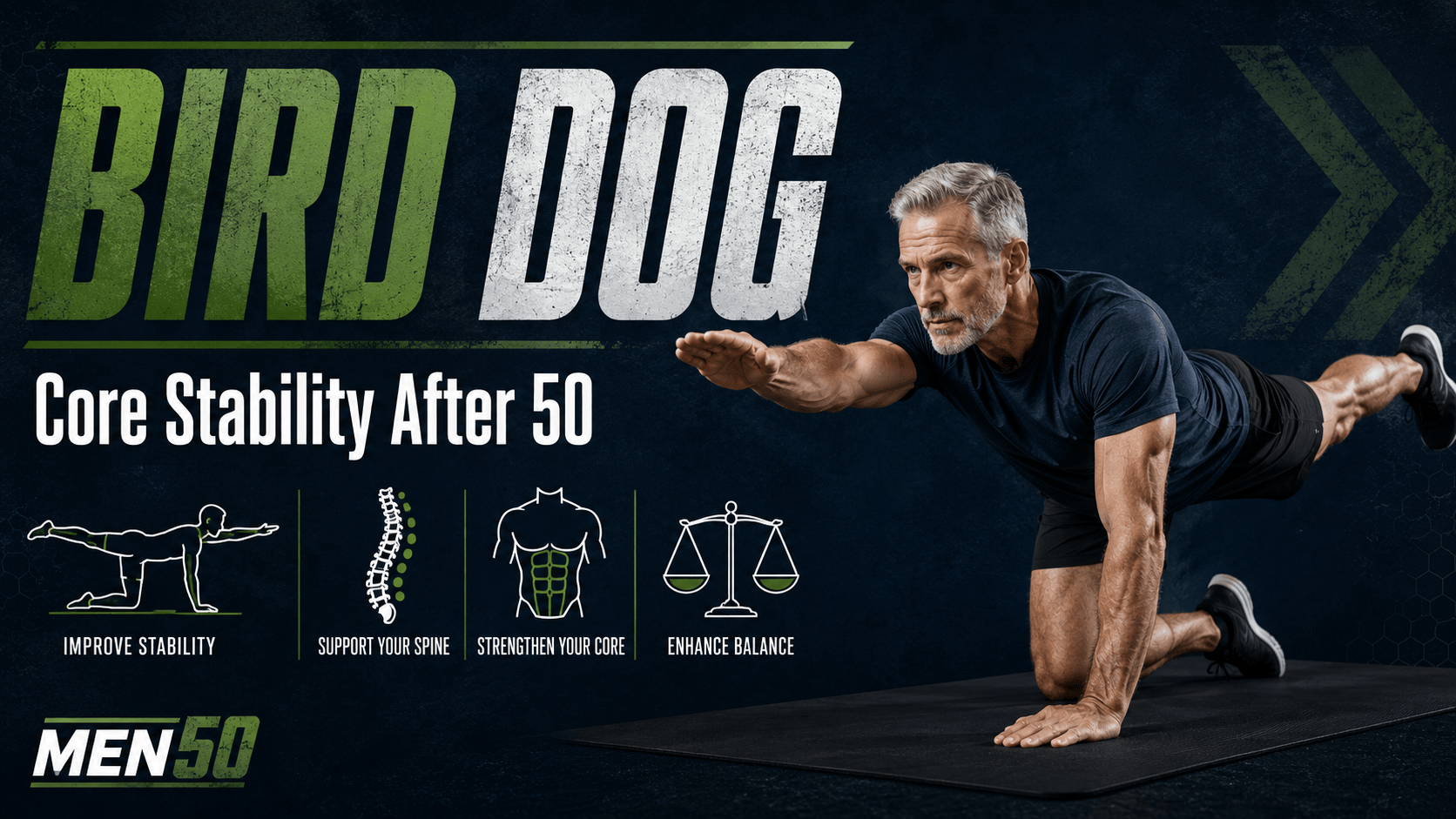
The bird dog is one of the most useful back-safe core exercises a man over 50 can do. It trains the deep spinal stabilisers, glutes, and shoulder muscles in a diagonal pattern that mimics how your body actually moves through walking, lifting, and most daily activities. It’s also one of three foundational exercises that physiotherapists prescribe more than almost any other for protecting and rehabilitating the lower back.
Part of the Build Muscle After 50 pillar — strength training for men over 50.
Key Takeaways
- The bird dog trains anti-rotation core stability — keeping the spine steady while opposite limbs move.
- Programming: 2–3 sets of 6–10 reps per side, 2–4 times per week. Slow tempo beats high reps.
- Stay long and steady, not high and wobbly. Reaching the limbs out parallel to the floor matters more than lifting them higher.
- Together with the dead bug and side plank, the bird dog forms Stuart McGill’s “Big 3” — the foundational set of core exercises for lower back health.
- If you can’t keep your hips level and your back flat through the full version, drop to the regression: one limb at a time.
How to Perform the Bird Dog
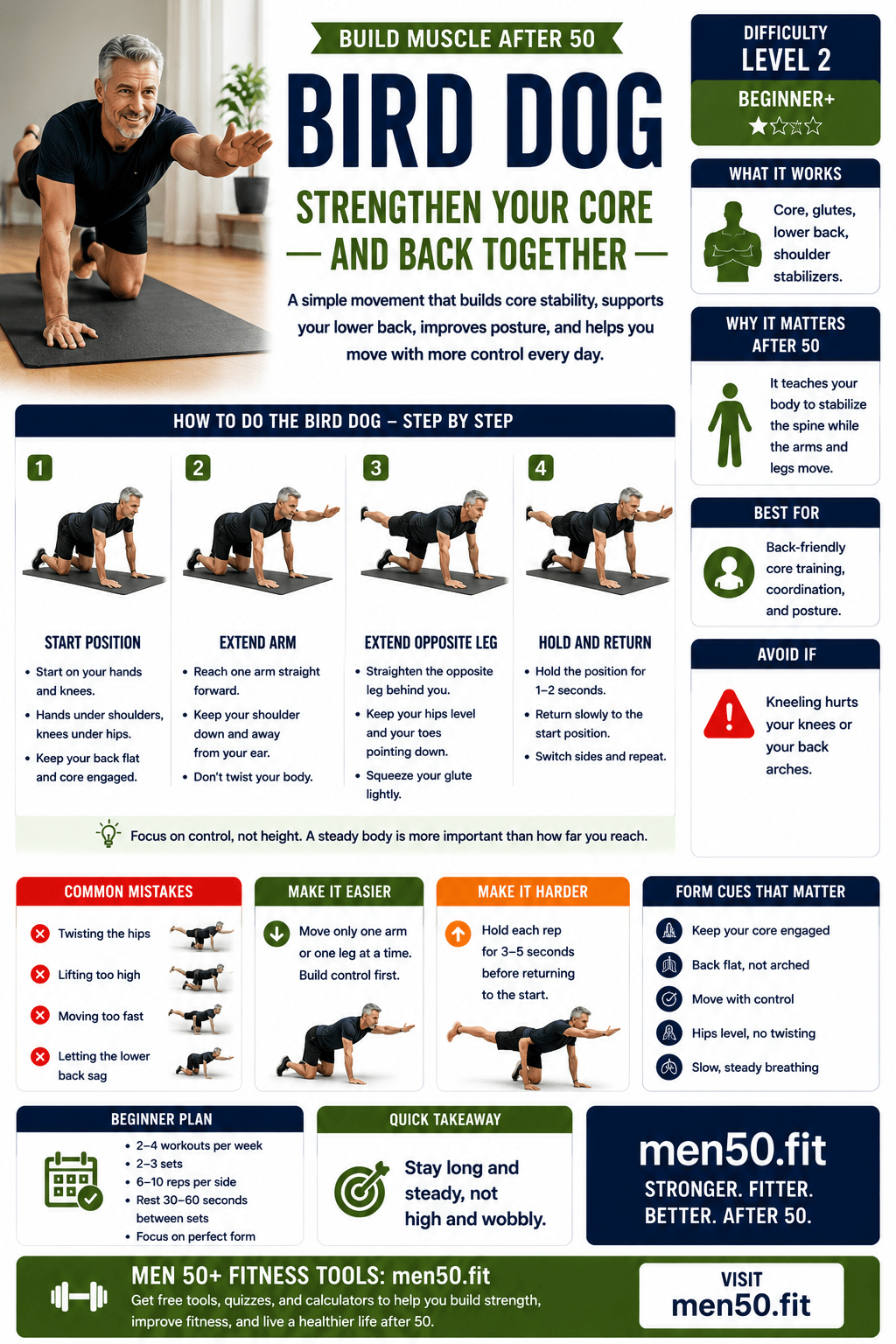
- Start position. Get on your hands and knees with your hands directly below your shoulders and your knees below your hips. Back flat and neutral — neither sagging nor arched. Core gently engaged. Look down at the floor to keep your neck neutral.
- Extend the arm. Reach one arm straight forward at shoulder height, thumb pointing up. Keep your shoulder pulled down away from your ear. Don’t twist your body to do it.
- Extend the opposite leg. Straighten the opposite leg behind you, toes pointing down toward the floor. Hips stay level — don’t let the lifted-leg side rise up. Squeeze the glute of the lifted leg gently.
- Hold and return. Hold the position for 1–2 seconds. Reach long through both extended limbs. Return slowly and with control to the start position. Switch sides and repeat.
The cue that matters most: stay long and steady, not high and wobbly. Reaching out parallel to the floor is the goal — lifting the limbs higher than parallel just turns it into a back-arching exercise, which is the opposite of what you want.
Why the Bird Dog Matters After 50
Lower back pain affects roughly 4 in 5 adults at some point, and the rate climbs after 50. The most common contributing factor is weakness in the deep spinal stabilisers — particularly the multifidus and erector spinae, which run along either side of the spine and act as fine-control muscles holding individual vertebrae in position. When these muscles are weak, larger and shallower muscles take over, the spine moves with less control, and the discs and joints absorb stress they weren’t designed for.
The bird dog targets exactly these stabilisers, and does so in a position where the spine is unloaded — no bodyweight compression through the discs. Better still, it trains them in the diagonal pattern your body actually uses in real life: walking is a series of opposite-limb movements, and the same is true of running, climbing stairs, throwing a ball, or reaching to grab something while stepping forward. The bird dog directly trains the cross-body coordination that supports all of these.
It’s also one of the three exercises recommended by Stuart McGill — the leading spine biomechanist — as the foundation for protecting and rehabilitating the lower back. Together with the dead bug (which trains anti-extension) and the side plank (anti-lateral-flexion), the bird dog (anti-rotation) covers the three planes of motion the spine needs to resist. Research on lower back rehabilitation has consistently shown these movements among the most effective for reducing recurrent back pain.
Sets and Reps
Build slowly. The bird dog is one of those exercises where doing fewer perfect reps beats doing more sloppy ones every single time.
| Stage | Variation | Sets × Reps per Side | Frequency |
|---|---|---|---|
| Beginner | One arm OR one leg at a time | 2 × 6–8 | 2–3× per week |
| Novice | Full bird dog, brief 1-second hold | 2–3 × 6–10 | 2–3× per week |
| Intermediate | Full bird dog, 3–5 second hold | 3 × 8–10 | 2–4× per week |
| Advanced | Add controlled elbow-to-knee tap at midpoint | 3 × 8–10 | 2–4× per week |
Rest 30–60 seconds between sets. The bird dog is mild enough on the body that it can be done most days — many men over 50 do well with a daily 5-minute mini-routine that pairs the bird dog with the dead bug and a glute bridge.
Common Mistakes
The four errors that turn a great exercise into a wasted one:
- Twisting the hips. When the leg lifts, the hip on that side wants to rise up. Keep both hips parallel to the floor as if a glass of water sat on the small of your back. If they twist, you’re not training the anti-rotation pattern the exercise exists for.
- Lifting too high. Trying to lift the arm and leg higher than parallel to the floor arches the lower back and switches off the core. Reach long, don’t reach high. The arm and leg should make one straight line from fingertips to toes.
- Moving too fast. Speed hides poor stability. Slow it down — 2 seconds to extend, 1–2 seconds to hold, 2 seconds to return. If you can’t maintain perfect form at slow tempo, you can’t do it at speed either, you just can’t see the wobble.
- Letting the lower back sag. The starting position should have a flat back, not a sagging belly toward the floor. Gently engage the core before every rep — imagine drawing the navel slightly up toward the spine without holding your breath.
Make It Easier or Harder
If the full bird dog is currently too challenging, drop to the regression: move only one limb at a time. Lift one arm forward, hold, return. Then lift one leg back, hold, return. This cuts the stability demand in half and lets you focus on keeping the spine steady. Spend 2–3 weeks on this version before progressing to the full bird dog.
To make it harder once basic form is solid: increase the hold time to 3–5 seconds per rep, or add a controlled elbow-to-knee tap at the midpoint — bring the extended arm and leg in to meet under the body before extending them back out. This adds a dynamic anti-rotation challenge.
If kneeling is hard on the knees, place a folded towel or thin pillow under them. If wrists are uncomfortable on the floor, try making loose fists rather than flat palms, or use push-up handles.
Safety Note
If you have an acute lower back flare-up, start with a reduced range of motion — only lift the limbs a few centimetres at first — and progress as pain allows. The bird dog is one of the safer exercises for back rehab, but during an acute episode any movement may temporarily aggravate symptoms.
Don’t push through sharp pain. Mild discomfort or stretching sensation in the muscles is normal; sharp or radiating pain in the lower back is a sign to stop and reassess form. If you have a diagnosed condition (disc herniation, stenosis, spondylolisthesis), get clearance from a physiotherapist before starting.
If kneeling hurts your knees or you find your back arches no matter what you try, switch to the dead bug instead — it trains overlapping muscles in a lying-down position that’s easier on both the knees and the lower back.
Build Your Personal Training Plan
The bird dog is one piece of a complete core and back-protection programme. Get a personalised exercise plan based on your current strength, mobility, and any back history.
Take the Free Fitness Profiler →
FAQs
What’s the difference between bird dog and dead bug?
Both are back-safe core exercises and both belong in Stuart McGill’s “Big 3.” The dead bug is performed lying on your back and primarily trains anti-extension — preventing the lower back from arching as the limbs move. The bird dog is performed on hands and knees and trains anti-rotation — preventing the hips from twisting as opposite limbs extend. Most men over 50 benefit from doing both: they target overlapping but distinct stability patterns.
How long should I hold each bird dog rep?
For beginners, 1–2 seconds is plenty — the goal is clean form, not endurance. As you progress, build to 3–5 second holds per rep, which is closer to the McGill protocol. Holding much longer than that doesn’t add benefit and often costs form, since the core fatigues and the back starts to sag.
Is the bird dog safe for lower back pain?
For most non-acute lower back pain, yes — it’s one of the most commonly prescribed exercises by physiotherapists for exactly this purpose. During an acute flare-up, start with reduced range of motion (small limb lifts only) and build gradually. If you have a diagnosed condition like a recent disc herniation, get individual guidance from a physio before starting.
Why am I wobbling so much during bird dog?
Wobbling means your core stabilisers haven’t yet learned the pattern. This is normal — it takes 2–4 weeks of consistent practice for the deep core to coordinate properly. Drop back to the regression (one limb at a time), reduce range of motion if needed, and slow the tempo. Most men see meaningful improvement in stability within a few weeks.
Can I do bird dogs every day?
Yes. The bird dog is low-load and trains stabiliser muscles that are built for frequent, low-intensity work. Many men over 50 do best with a short daily core routine — 3 sets of bird dog plus 3 sets of dead bug plus a glute bridge — which takes about 5 minutes and pays back disproportionately in back health.
References
- McGill SM. Low Back Disorders: Evidence-Based Prevention and Rehabilitation (3rd ed.). Human Kinetics. The “Big 3” core stability exercises framework.
- Centers for Disease Control and Prevention. Chronic Back Pain Prevalence and Trends. cdc.gov
- American College of Sports Medicine. Core Strength and Stability Training Position. acsm.org
Disclaimer: This article is for educational purposes only and is not medical advice. Consult a qualified healthcare professional before starting any new exercise programme, especially if you have existing back, neck, knee, or shoulder conditions.