
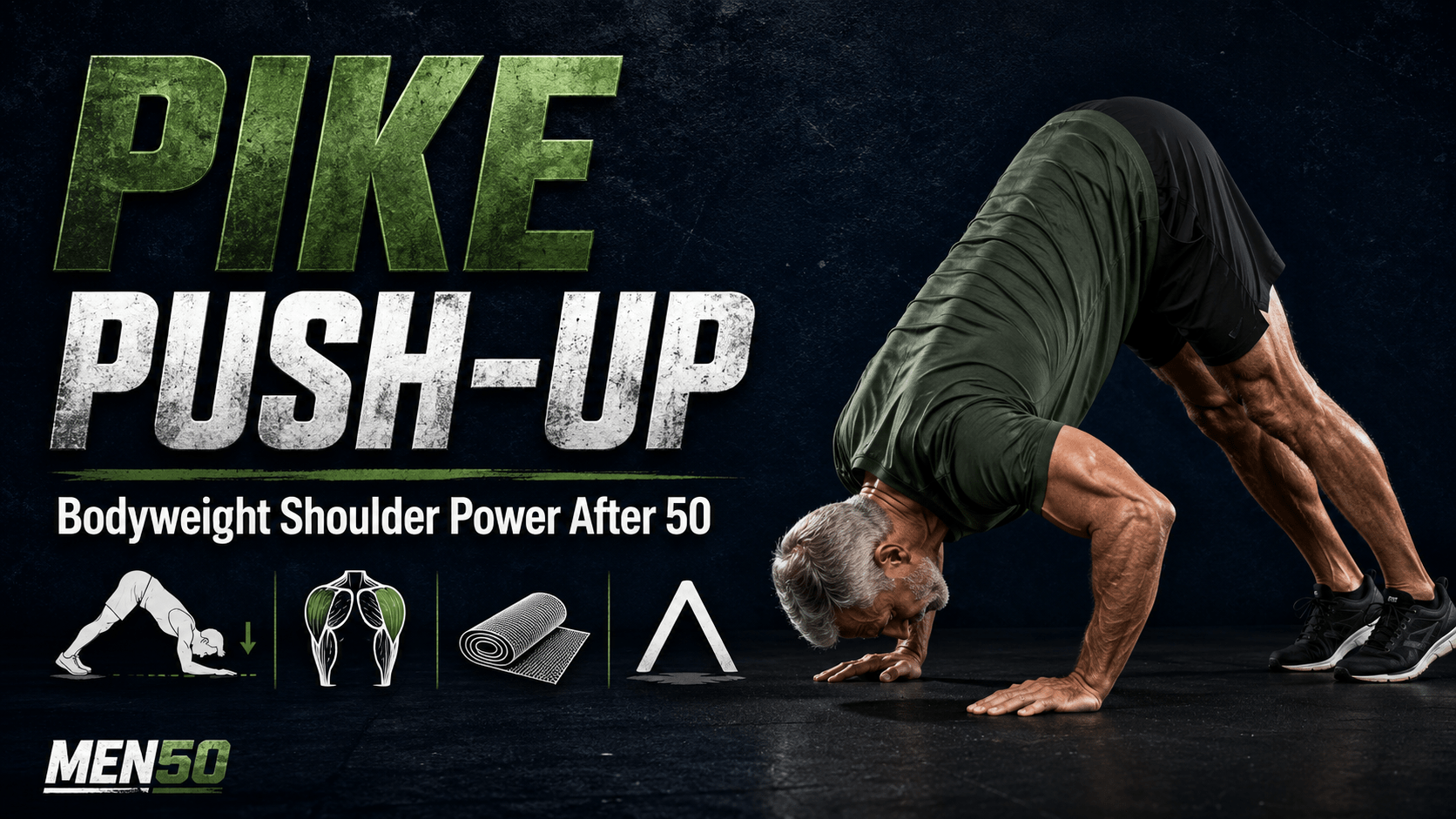
The pike push-up is the only bodyweight overhead pressing exercise in the matrix — and for men over 50 who want shoulder strength without dumbbells, it’s the answer. By tipping the body into an inverted V position (the downward-dog yoga pose), the push-up transforms from a horizontal chest exercise into a vertical shoulder exercise. The shoulders, upper chest, and triceps work the way they would in a standing dumbbell shoulder press — only the weight is your body instead of dumbbells. That said: this is not a beginner exercise. The pike push-up demands shoulder strength, healthy wrists, and clear blood pressure status. Most men over 50 should master other pressing exercises first.
Part of the Build Muscle After 50 pillar — strength training for men over 50.
Key Takeaways
- The pike push-up is a vertical pressing exercise — trains the same pattern as a dumbbell shoulder press but uses bodyweight instead of weights.
- This is the only bodyweight vertical press in the matrix — useful for men over 50 who don’t have dumbbells but want to build overhead strength.
- Programming: 2–4 sets of 6–10 reps, 2–3 times per week. Rest 60–90 seconds between sets.
- This is an advanced exercise. Most men over 50 should be comfortable with floor push-ups (8+ clean reps) and have healthy shoulders/wrists before attempting it.
- Skip this exercise if you have current shoulder pain, wrist issues, or uncontrolled high blood pressure — the inverted position raises blood pressure to the head.
How to Perform the Pike Push-Up
Set up first:
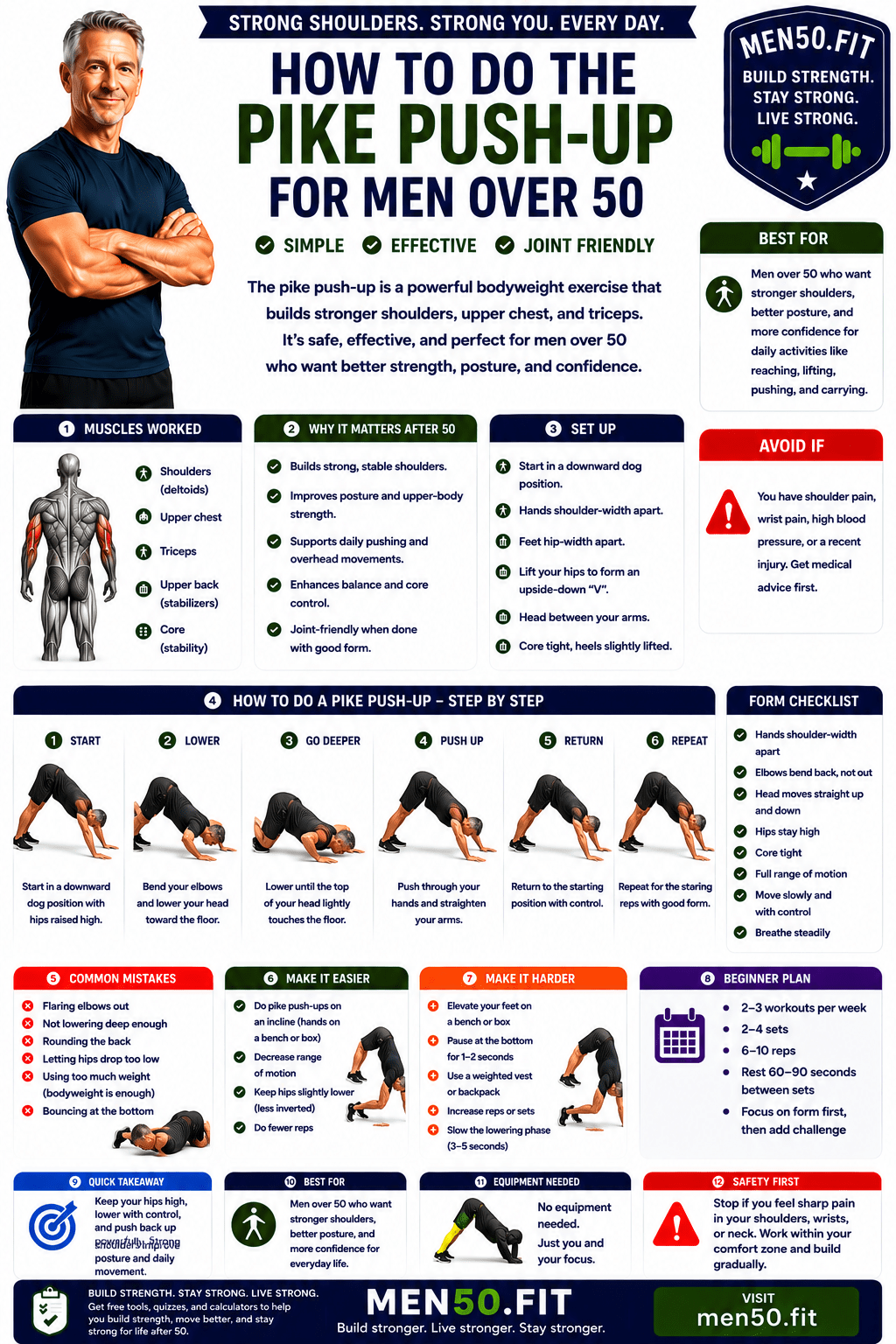
- Start in a downward dog position (the yoga pose) — hands and feet on the floor, hips lifted high to form an upside-down “V” shape.
- Hands shoulder-width apart, fingers spread, palms pressing into the floor.
- Feet hip-width apart, heels slightly lifted off the floor.
- Head between your arms — looking back between your feet, not at the floor.
- Core tight, hips high, weight distributed between hands and feet.
Then the movement:
- Start. Downward dog position with hips raised high. Hands shoulder-width apart, feet hip-width apart. Take a moment to feel the position before the first rep.
- Lower. Bend your elbows and lower your head straight down toward the floor. Take 2–3 seconds to lower. The head moves vertically — straight up and down — not forward or back.
- Go deeper. Lower until the top of your head lightly touches (or nearly touches) the floor between your hands. Don’t smash your head into the floor — touch lightly.
- Push up. Push through your hands and straighten your arms back to the starting position. Take 1–2 seconds to press up. Don’t lock the elbows fully at the top.
- Return. Return to the starting position with control. Maintain the high-hip position throughout — don’t let the hips drop.
- Repeat. Maintain clean form on every rep. Quality over speed — pike push-ups should be slow and controlled, not bouncy.
The cue that matters most: keep your hips high and let the head travel straight up and down. The hips staying high is what makes this a vertical press — the moment the hips drop, the body angles toward horizontal and the chest takes over instead of the shoulders. And the head moving straight up and down (rather than forward toward the hands) is what keeps the elbows pointing in the right direction.
Why the Pike Push-Up Matters After 50
Vertical pressing strength matters in daily life: every overhead reach uses the same muscle pattern as a shoulder press. Lifting a suitcase into an overhead bin, putting boxes on a high shelf, changing a lightbulb, reaching up to a high cupboard — all of these are overhead pressing patterns. Most men over 50 lose this strength gradually because they never train it, and the loss shows up first as tasks becoming surprisingly hard, then later as inability to do them at all.
The matrix already covers vertical pressing with dumbbells — the seated dumbbell shoulder press for beginners and the standing dumbbell shoulder press for progression. The pike push-up adds the bodyweight option to this category. For men over 50 who:
- Don’t have dumbbells but want to build overhead strength
- Travel often and need an equipment-free option
- Want variety in their pressing programme
- Are building bodyweight pressing capacity (think push-up sequences in workouts)
…the pike push-up fills a real gap.
Pressing in the Matrix — Now Complete
This article completes the comprehensive pressing matrix for men over 50:
| Direction | Bodyweight | Dumbbell | Band |
|---|---|---|---|
| Horizontal (chest) | Wall → Incline → Knee → Slow Negative → Floor → Close-Grip | Floor Press | Band Chest Press |
| Vertical (shoulders) | Pike Push-Up | Seated + Standing Shoulder Press | — |
| Isolation (chest) | — | Dumbbell Chest Fly on Floor | — |
Every pressing pattern is now covered with at least one variation per equipment level. The matrix is comprehensive enough that a reader with any setup — bodyweight only, dumbbells only, bands only — has multiple effective options.
Honest Prerequisites
The pike push-up is not the first push-up variation to attempt. It demands:
1. Solid floor push-up strength. If you can’t do at least 8–10 clean floor push-ups, you’re not ready for pike push-ups. The vertical pressing pattern is harder than horizontal pressing because the shoulders have to handle more of the bodyweight load.
2. Healthy shoulders. The pike position concentrates load on the front of the shoulder joint. Men with current rotator cuff issues, impingement, or unresolved shoulder pain should not attempt this exercise. The dumbbell shoulder press variations are gentler shoulder options.
3. Adequate wrist mobility. Holding the pike position requires the wrists to bend backward significantly under load. Men with reduced wrist mobility or wrist arthritis often can’t tolerate this. Push-up handles help.
4. Controlled blood pressure. The inverted position increases blood pressure to the head. For men with uncontrolled hypertension, this exercise is not appropriate. Talk to your doctor first if your blood pressure has been elevated.
Most men over 50 should work through the horizontal pressing progression first (wall push-up → incline → knee → slow negative → floor push-up), build up to comfortable floor push-up reps, and only then consider pike push-ups. The progression takes most men over 50 several months — and that’s appropriate.
The Push-Up Capacity Connection
The recurring Yang et al. 2019 study (JAMA Network Open) on push-up capacity and cardiovascular outcomes applies to pike push-ups too. Adding the pike variation extends bodyweight pressing capacity into vertical territory, contributing to the overall functional pressing strength that the research identifies as a longevity marker.
Sets and Reps
Lower rep counts than horizontal push-ups because the vertical pressing pattern is mechanically harder.
| Stage | Variation | Sets × Reps | Frequency |
|---|---|---|---|
| Beginner | Incline pike (hands on bench/box) | 2 × 6–8 | 2× per week |
| Novice | Floor pike push-up, partial range | 2–3 × 6–10 | 2–3× per week |
| Intermediate | Floor pike push-up, full range | 3 × 6–10 | 2–3× per week |
| Advanced | Feet elevated + slow lowering | 3 × 6–10 | 2× per week |
Rest 60–90 seconds between sets. Pick a variation where the last 1–2 reps still maintain clean form — hips high, elbows bending back (not flaring out), head moving straight up and down.
A practical note: most men over 50 transitioning from floor push-ups to pike push-ups should expect a significant drop in rep count. If you can do 12 floor push-ups, expect to manage 4–6 pike push-ups in your first sessions. That’s normal. The shoulders are smaller than the chest, and they have more bodyweight to support in the pike position.
Common Mistakes
The six errors that turn a great shoulder exercise into a wrist or shoulder problem:
- Flaring elbows out. The single most common mistake. As fatigue sets in, the elbows want to flare out to 90 degrees from the body to recruit more chest. This loads the front of the shoulder joint and is the most common cause of pike push-up shoulder pain. Keep elbows bending back (toward the feet), not out to the sides.
- Not lowering deep enough. Stopping with the head 6 inches above the floor skips the productive range of motion. Lower until the top of your head lightly touches the floor (or nearly does). Full range of motion is part of the exercise.
- Rounding the back. When the core fatigues, the upper back wants to round and the head drops between the arms. This puts the cervical spine in a compromised position. Keep the spine relatively neutral — head between the arms, but not buried below them.
- Letting hips drop too low. When the hips drop, the body angles toward horizontal and the exercise stops being a vertical press — it becomes a regular push-up with bad form. Hips stay high throughout the rep. If you can’t keep them high, the set is over.
- Using too much weight (bodyweight is enough). This isn’t typical — but some men add a weighted vest or backpack while learning the movement. Bodyweight is plenty for most men over 50. The exercise is already demanding without added load.
- Bouncing at the bottom. Smashing the head into the floor and rebounding off uses elastic recoil instead of muscle. Touch lightly or stop just short, then press back up with control. The floor is a reference point, not a rebound surface.
Make It Easier or Harder
If standard pike push-ups are too challenging:
- Do pike push-ups on an incline — hands elevated on a bench, sofa, or sturdy box. The higher the incline, the easier the exercise. This is the right starting point for most men over 50 transitioning from floor push-ups.
- Decrease range of motion — only lower halfway down at first while you build shoulder strength.
- Keep hips slightly lower (less inverted) — body angled at 60–70 degrees rather than fully inverted. Reduces shoulder demand.
- Do fewer reps — start with 2 sets of 4–6 reps and build up.
To make it harder once form is solid:
- Elevate your feet on a bench or box — increases the inversion and shifts more bodyweight to the shoulders. Significantly more demanding.
- Pause at the bottom for 1–2 seconds with the head near the floor.
- Use a weighted vest or backpack — only for advanced lifters who already manage 3 sets of 10 clean pike push-ups.
- Increase reps or sets — extend to 10–12 reps before adding difficulty.
- Slow the lowering phase to 3–5 seconds per rep — significantly more demanding than it sounds.
For variety, try the wall pike push-up (feet on a wall, hands on the floor close to the wall) once a week — even more vertical inversion. This is the bridge between pike push-ups and full handstand push-ups (which are too advanced for most men over 50).
Safety Note
Skip the pike push-up if you have: shoulder pain, wrist pain, uncontrolled high blood pressure, recent injury affecting the upper body, or current shoulder/rotator cuff issues. Get medical advice first.
High blood pressure is a specific concern. The inverted position raises blood pressure to the head. Men with uncontrolled hypertension or those at risk should not do this exercise without medical clearance. If you have diagnosed hypertension that’s well-controlled with medication, this exercise is usually fine but check with your doctor.
Wrist pain is common in any push-up variation, but the pike position concentrates wrist load more than horizontal push-ups. If your wrists hurt:
- Try push-up handles (which keep the wrists neutral)
- Stop and build wrist mobility separately
- Switch to dumbbell pressing (which is wrist-neutral)
Shoulder pain during the descent is usually a sign the elbows are flaring out instead of bending back. Correct the elbow path; if pain persists, drop back to incline pike push-ups or use the dumbbell shoulder press variations instead.
If you feel dizzy or lightheaded in the inverted position, stop. The blood pressure shift from the inversion can affect some men. The dizziness should clear within seconds once you return upright; if it doesn’t, talk to your doctor before continuing.
If you cannot maintain the position (hips dropping, back rounding, head not staying between arms), the exercise is too hard for you right now. Drop back to incline pike push-ups and build up over weeks.
Build Your Personal Training Plan
The pike push-up is one piece of a complete upper body programme. Get a personalised exercise plan based on your current strength, goals, and any limitations.
Take the Free Fitness Profiler →
FAQs
Pike push-up vs dumbbell shoulder press — which is better?
Different tools for the same job. The pike push-up uses bodyweight in an inverted position — no equipment, scales by changing body angle (incline = easier, feet elevated = harder). The dumbbell shoulder press uses progressive load with dumbbells — easier to scale precisely, easier on the wrists, less demanding on shoulder stability. For most men over 50, the dumbbell version is the better default because it’s more controllable and shoulder-friendly. The pike push-up is the bodyweight backup — useful for travel, no-equipment training, or programme variety. If you have both options, prefer the dumbbell version. If you only have bodyweight, the pike push-up is the only direct way to build vertical pressing strength.
Should I do this if I have high blood pressure?
If your blood pressure is uncontrolled or you’ve never been screened, talk to your doctor first. The inverted position increases blood pressure to the head, which can be problematic for men with hypertension. If your blood pressure is well-controlled with medication and your doctor has cleared you for normal exercise, the pike push-up is usually fine — but start with incline variations (less inverted) and progress gradually. If you ever feel dizzy or lightheaded during the exercise, stop. For men with significant hypertension, the dumbbell shoulder press is a much better option — it doesn’t invert the body and produces equivalent training stimulus.
How is this different from a regular push-up?
Body position changes everything. A regular push-up has the body roughly horizontal to the floor — this makes it a chest exercise with the deltoids and triceps assisting. The pike push-up has the body in an inverted V with hips high — this makes it a shoulder exercise with the upper chest and triceps assisting. Same basic mechanics (lower yourself, push back up), but the changed body orientation shifts which muscles do most of the work. Most men over 50 can do significantly more horizontal push-ups than pike push-ups because the chest is stronger than the shoulders.
What if I can’t get into the position?
The downward-dog position requires hamstring flexibility (to keep the legs reasonably straight while the hips are high) and shoulder mobility (to keep the head between the arms). If you can’t achieve a clean pike position, two options: (1) Use the incline pike variation — hands on a bench or box, less demand on hamstring flexibility. (2) Bend the knees in the pike position — knees soft, hips still high. This significantly reduces the hamstring demand while preserving the vertical pressing pattern. As your flexibility improves over weeks, the legs can straighten.
Pike push-up vs handstand push-up — what’s the difference?
Body orientation. The pike push-up has the body in an inverted V at about 45–60 degrees from vertical — feet on the floor, hands on the floor, hips high. The handstand push-up has the body fully vertical — feet against a wall or in free balance, hands on the floor, body upside down. The handstand version is significantly more demanding because the shoulders support nearly all the bodyweight in pure vertical alignment. For most men over 50, the handstand push-up is too advanced — the shoulder demand is severe and the falling risk is real. The pike push-up is the practical ceiling for bodyweight vertical pressing for this demographic.
References
- Yang J, Christophi CA, Farioli A, et al. Association Between Push-up Exercise Capacity and Future Cardiovascular Events Among Active Adult Men. JAMA Network Open. 2019;2(2):e188341.
- American College of Sports Medicine. Resistance Training for Older Adults Position Stand. acsm.org
- American College of Sports Medicine. Exercise and Hypertension Position Stand. acsm.org
Disclaimer: This article is for educational purposes only and is not medical advice. Consult a qualified healthcare professional before starting any new exercise programme, especially if you have existing shoulder, wrist, neck, or blood pressure conditions.