
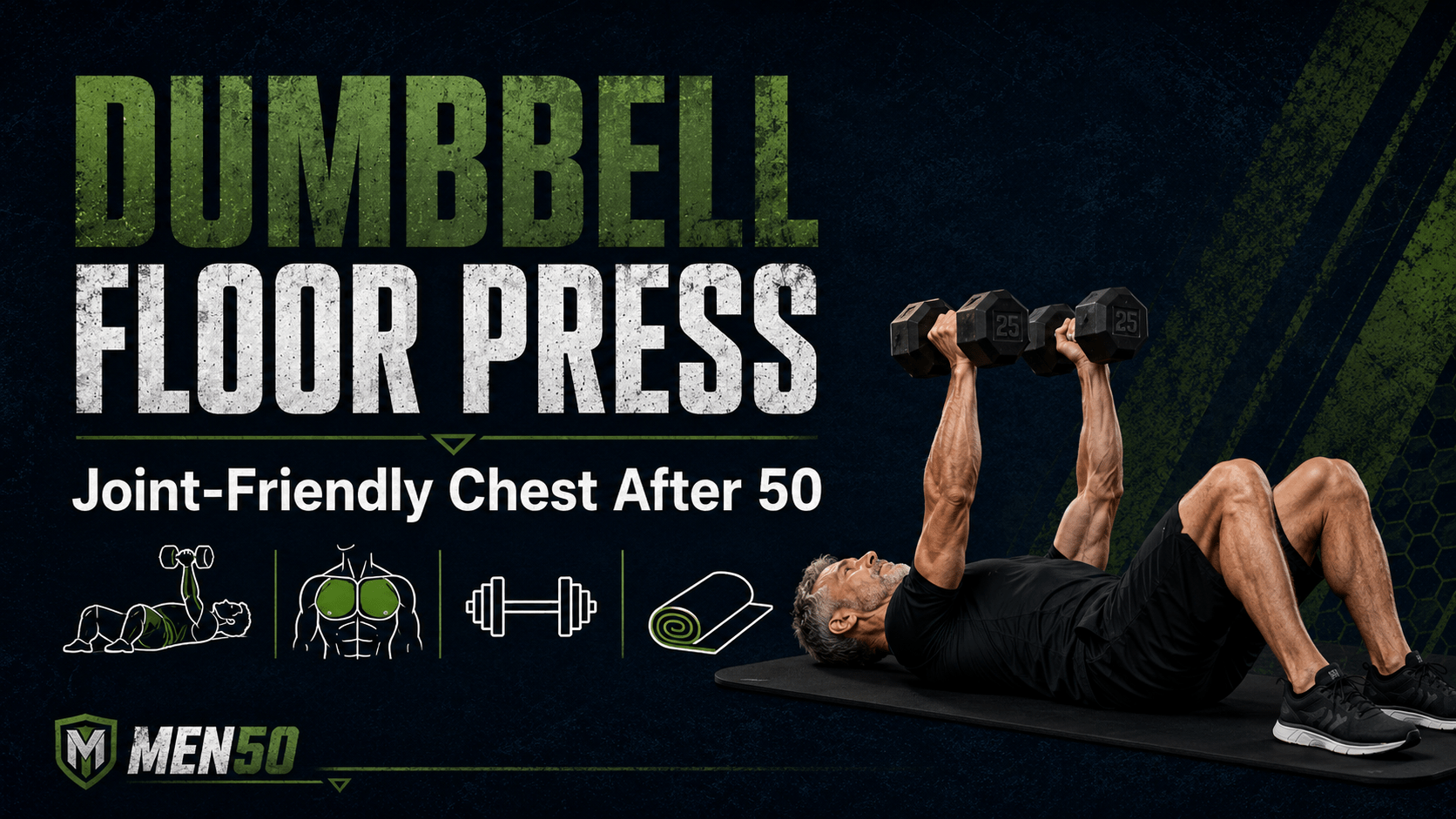
The dumbbell floor press is the smartest loaded pressing exercise most men over 50 don’t know about. It builds chest, triceps, and shoulder strength like a bench press, but with one critical difference: the floor stops the elbows from dropping below the level of the body, which removes the part of the range where shoulder impingement actually happens. For men who want to start adding load to their pressing but have a history of shoulder issues — or want to avoid developing one — this is the right place to start.
Part of the Build Muscle After 50 pillar — strength training for men over 50.
Key Takeaways
- The dumbbell floor press builds chest, triceps, and front shoulder strength with built-in shoulder protection — the floor limits how deep the elbows can drop.
- Programming: 2–4 sets of 8–12 reps, 2–3 times per week. Rest 60–90 seconds between sets.
- Lower with control, touch the floor gently, then press up strong. Bouncing the arms off the floor wastes the eccentric and risks elbow injury.
- This is the bridge between bodyweight push-ups and a full bench press — accessible at home with just a pair of dumbbells.
- For every set of pressing, pair an equal amount of pulling work — dumbbell rows or resistance band rows — to keep the shoulders balanced.
How to Perform the Dumbbell Floor Press
Set up first:
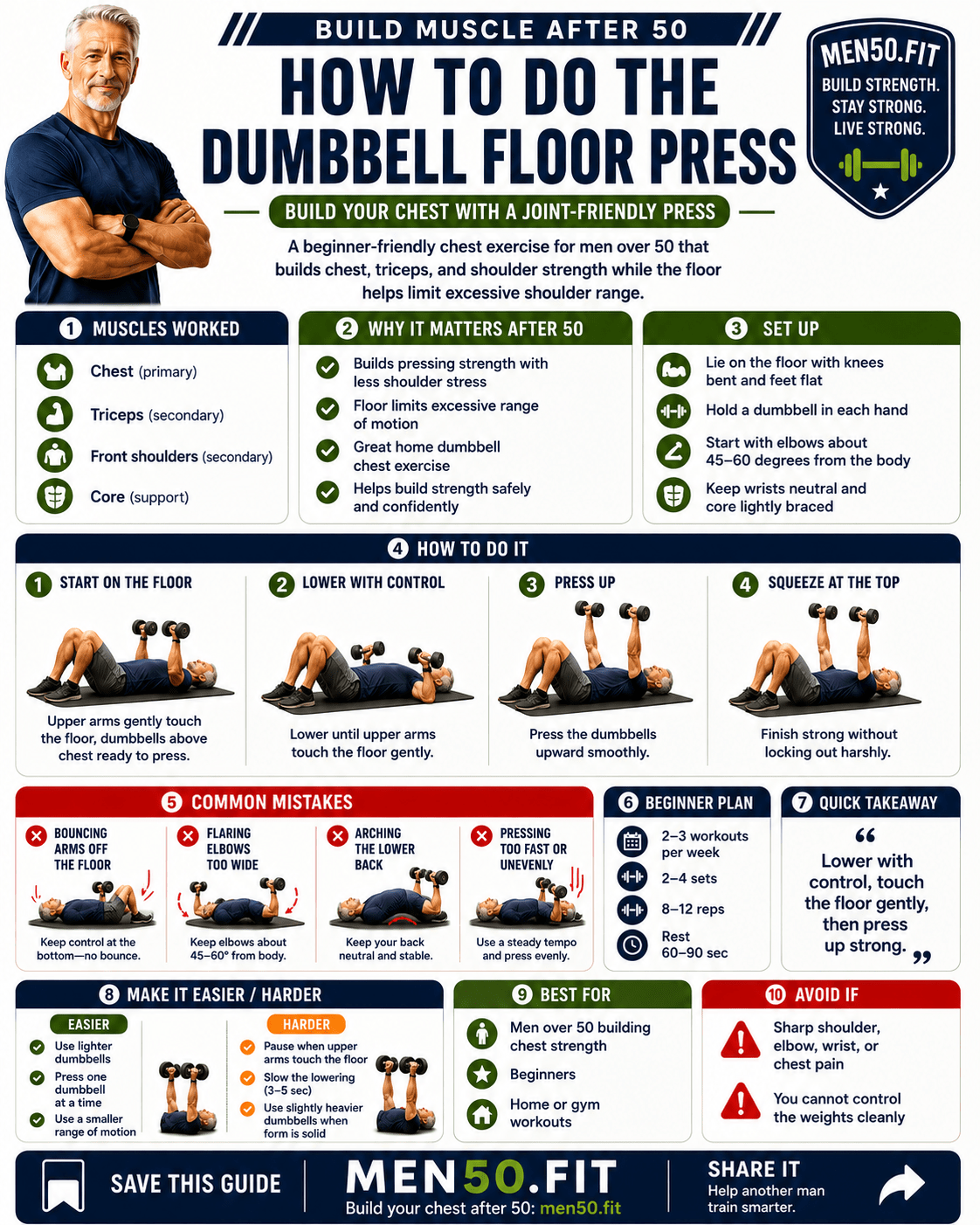
- Lie on the floor with your knees bent and feet flat on the ground.
- Hold a dumbbell in each hand, palms facing forward or slightly toward each other.
- Start with elbows about 45–60 degrees from your body — not flared straight out to the sides.
- Wrists stay neutral (don’t let them bend backward), core lightly braced.
Then the movement:
- Start on the floor. Lying on your back, knees bent, feet flat. Hold the dumbbells above your chest with arms extended, ready to press. Upper arms gently touch the floor in the bottom position with elbows tracking at 45–60 degrees from the torso.
- Lower with control. Bend the elbows and lower the dumbbells toward your chest. Take 2–3 seconds on the way down. Lower until your upper arms touch the floor gently — don’t crash, don’t bounce.
- Press up. Drive the dumbbells upward smoothly. Press evenly with both arms — neither one finishing first or going further than the other. Keep elbows tracking at 45–60 degrees throughout.
- Squeeze at the top. Pause for 1 second at the top with arms extended but not locked harshly. Squeeze the chest muscles. Don’t slam the elbows straight — keep a slight bend.
The cue that matters most: lower with control, touch the floor gently, then press up strong. The eccentric (lowering) phase is where most of the chest strength is built. Treating the floor as a “rest stop” between reps — bouncing off it — skips the most productive part of the rep and risks elbow injury.
Why the Dumbbell Floor Press Matters After 50
The shoulder joint is one of the most common sites of training-related injury in men over 50. The biggest culprit is the bench press done with too much range of motion — letting the elbows drop below the level of the torso pulls the head of the humerus forward in the joint, which is exactly the position where rotator cuff tendons get compressed. Decades of bench pressing through that range, combined with the postural changes that come with sitting all day, is why so many men over 50 develop shoulder impingement when they try to add loaded pressing back to their routine.
The dumbbell floor press solves this problem by design. The floor physically stops your elbows at the level of your body — exactly the point where pressing benefits the chest without compressing the rotator cuff. You get most of the strength benefit of a bench press with significantly less shoulder risk. For men returning to loaded pressing after a long break, men managing existing shoulder issues, or men who want to bench press but are wisely cautious about it after 50, the floor press is the better starting point.
It’s also a useful transition exercise in the pressing progression. The bodyweight chain — wall push-up → incline push-up → floor push-up — builds pressing strength up to bodyweight. The next step is loaded pressing, and the floor press is the safest entry point. Master it for 3–6 months, build the strength to handle the load cleanly, and you’ve earned the option to progress to a dumbbell bench press on an actual bench (with full range of motion) — by then your shoulders will have built the stability to handle the deeper press.
There’s also a practical home-training argument. A pair of dumbbells and a yoga mat is all you need. No bench required. No spotter required. If you drop the weights, they hit the floor before they hit your chest. For home gym set-ups or men who travel, the floor press is one of the most efficient pieces of equipment-to-result ratio you can get.
Sets and Reps
Build moderate load with clean reps. The floor press isn’t where you chase one-rep maxes.
| Stage | Sets × Reps | Frequency | Load Guide |
|---|---|---|---|
| Beginner | 2 × 8–10 | 2× per week | Light dumbbells, focus on form |
| Novice | 2–3 × 8–12 | 2–3× per week | Moderate, last 2 reps challenging |
| Intermediate | 3 × 8–12 | 2–3× per week | Working weight, RPE 7–8 |
| Advanced | 3–4 × 6–10 | 2–3× per week | Heavier, slow lowering, pause at bottom |
Rest 60–90 seconds between sets. Pick a weight where the last 2–3 reps are clearly challenging but you can complete them with clean form — both arms moving evenly, controlled lowering, no swinging or uneven pressing.
A practical starting load: most men over 50 begin with 15–25 lb (7–11 kg) dumbbells per hand. After 3–6 months of consistent training, many men progress to 25–40 lbs (11–18 kg). Don’t rush the load. Cleaner reps with lighter dumbbells build more strength than heavier reps that break form.
Common Mistakes
The four errors that turn a great exercise into a shoulder or elbow problem:
- Bouncing arms off the floor. Using the floor as a springboard to start the next rep skips the hardest, most productive part of the lift. Worse, the impact of the dumbbells through your upper arms can irritate the elbows over time. Lower gently, pause briefly, then press.
- Flaring elbows too wide. Elbows at 90 degrees from the torso loads the front of the shoulder joint — even on the floor. Keep elbows tracking at 45–60 degrees from your body. The arms should make an arrow shape, not a T.
- Arching the lower back. Some men arch aggressively to push the chest up toward the weight. This loads the lumbar spine and shifts the work away from the chest. Keep the lower back neutral and the core lightly braced. Glutes squeezed gently helps anchor the pelvis.
- Pressing too fast or unevenly. Rushed reps mean one arm typically finishes before the other, or you push one dumbbell higher than the other. Both indicate the load is too heavy or your control isn’t yet developed. Slow down. Press both arms evenly. If one side is clearly weaker, do single-arm presses on the weaker side once a week to even it out.
Make It Easier or Harder
If standard floor presses are too challenging:
- Use lighter dumbbells — strength is built from where you are. 10 lbs per hand is fine to start.
- Press one dumbbell at a time — keeping the other on the floor or on your hip lets you focus on form on each side individually.
- Use a smaller range of motion — pause higher up if your shoulders complain at full depth.
To make it harder once form is solid:
- Pause for 1–2 seconds when the upper arms touch the floor before pressing up. This kills any momentum and forces the chest to do all the work.
- Slow the lowering to 3–5 seconds per rep — much harder than it sounds.
- Use slightly heavier dumbbells — once form holds at the lighter weight.
For variety: try the single-arm dumbbell floor press (one dumbbell, opposite hand resting on the floor for stability) — exposes left-right imbalances and adds an anti-rotation core challenge.
The natural next progression after the floor press is the dumbbell bench press on an actual bench, with full range of motion. Move to that once you can complete 3 sets of 10 reps with 30+ lb (14+ kg) dumbbells using clean form on the floor — your shoulders will have built the stability to handle the deeper press.
Safety Note
If you feel sharp pain in the shoulder, elbow, wrist, or chest during the press, stop immediately. Mild muscular fatigue in the chest and triceps is normal; sharp joint pain is not. Adjust elbow position (try 45 degrees instead of 60, or vice versa), reduce the load, or check that you’re not arching the lower back.
If you cannot control the dumbbells cleanly — they sway, one side finishes before the other, or you can’t lower them gently — the weight is too heavy. Drop a size and rebuild.
Make sure your dumbbells are sized appropriately for your strength when starting out, especially if you’re training alone at home. You should always be able to set the weights down to the side at the end of a set without struggling.
Build Your Personal Training Plan
The dumbbell floor press is one piece of a complete upper body programme. Get a personalised exercise plan based on your current strength, goals, and any limitations.
Take the Free Fitness Profiler →
FAQs
Floor press vs bench press — which is better?
For men over 50 starting to add loaded pressing, the floor press is safer and a better starting point. The bench press allows greater range of motion, which is useful for advanced lifters but is also where most shoulder impingement happens. After 3–6 months of consistent floor pressing with clean form, many men progress to a dumbbell bench press on an actual bench. Some men stay on the floor press long-term if they have ongoing shoulder issues — and that’s a perfectly valid choice. Either way, the floor press belongs in the programme.
How heavy should the dumbbells be?
Heavy enough that the last 2–3 reps of each set feel clearly challenging, but light enough that you can complete the set with both arms moving evenly, controlled lowering, and no arching the lower back. For most men over 50 starting out, that’s 15–25 lbs (7–11 kg) per hand. After 3–6 months of training, many men progress to 25–40 lbs (11–18 kg). The right weight is the one your form can handle — not the heaviest you can muscle through.
Why does the floor press hurt less than bench pressing?
The floor stops your elbows at the level of your body, which removes the deep range of motion where shoulder impingement happens. On a bench, the elbows can drop several inches below the torso, which pulls the head of the humerus forward in the joint and compresses the rotator cuff tendons. The floor prevents that. If bench pressing aggravates your shoulders, switching to the floor press usually solves the problem without giving up loaded chest training.
Can I use one heavy dumbbell instead of two?
Two dumbbells is the standard variation and the one you should default to. Single-dumbbell floor presses (using one heavy dumbbell held with both hands) are a useful variation occasionally, but they’re a different exercise — more triceps-dominant, less chest-focused. If equipment is limited and you only have one heavy dumbbell, single-dumbbell presses are fine. If you have two matched dumbbells, use them.
How does the dumbbell floor press fit with push-ups?
They complement each other. Push-ups (wall → incline → floor) are bodyweight pressing that scales easily and develops the pressing pattern under your own weight. The dumbbell floor press adds load beyond bodyweight, which is necessary for continued strength gains once push-ups become easy. Most men over 50 benefit from doing both — 1–2 push-up sessions per week and 1–2 floor press sessions, alternating which one comes first in the week.
References
- American College of Sports Medicine. Resistance Training for Older Adults Position Stand. acsm.org
- National Institute on Aging. Sarcopenia and Muscle Strength in Older Adults. nia.nih.gov
- Centers for Disease Control and Prevention. Physical Activity Guidelines for Americans, 2nd Edition. cdc.gov
Disclaimer: This article is for educational purposes only and is not medical advice. Consult a qualified healthcare professional before starting any new exercise programme, especially if you have existing shoulder, elbow, wrist, or chest conditions.