
The slow negative push-up is the most underrated progression tool in bodyweight training. Most men over 50 who want to do floor push-ups but can’t yet keep doing more and more knee push-ups — and then wonder why they still can’t do a real push-up. The reason: knee push-ups don’t train the exact geometry of the floor push-up. The slow negative does. You start in the full floor push-up position, lower under control over 4–6 seconds, then drop to your knees to push back up. You’re training the precise body position you want to master, but only handling the lowering half of each rep. It’s the smartest bridge between knee push-ups and full floor push-ups.
Part of the Build Muscle After 50 pillar — strength training for men over 50.
Key Takeaways
- The slow negative push-up trains the exact body position of a full floor push-up, but only the lowering (eccentric) phase.
- Eccentric strength is often preserved better than concentric in men over 50 — which means you can usually lower a load before you can push it back up. This exercise exploits that biological reality.
- Programming: 2–4 sets of 3–8 reps, 2–3 times per week. Rest 45–90 seconds between sets.
- Lower slowly, stay tight, and build control. Quality over speed on every rep.
- The complete bodyweight pressing progression now reads: wall push-up → incline push-up → knee push-up → slow negative push-up → floor push-up.
How to Perform the Slow Negative Push-Up
Set up first:
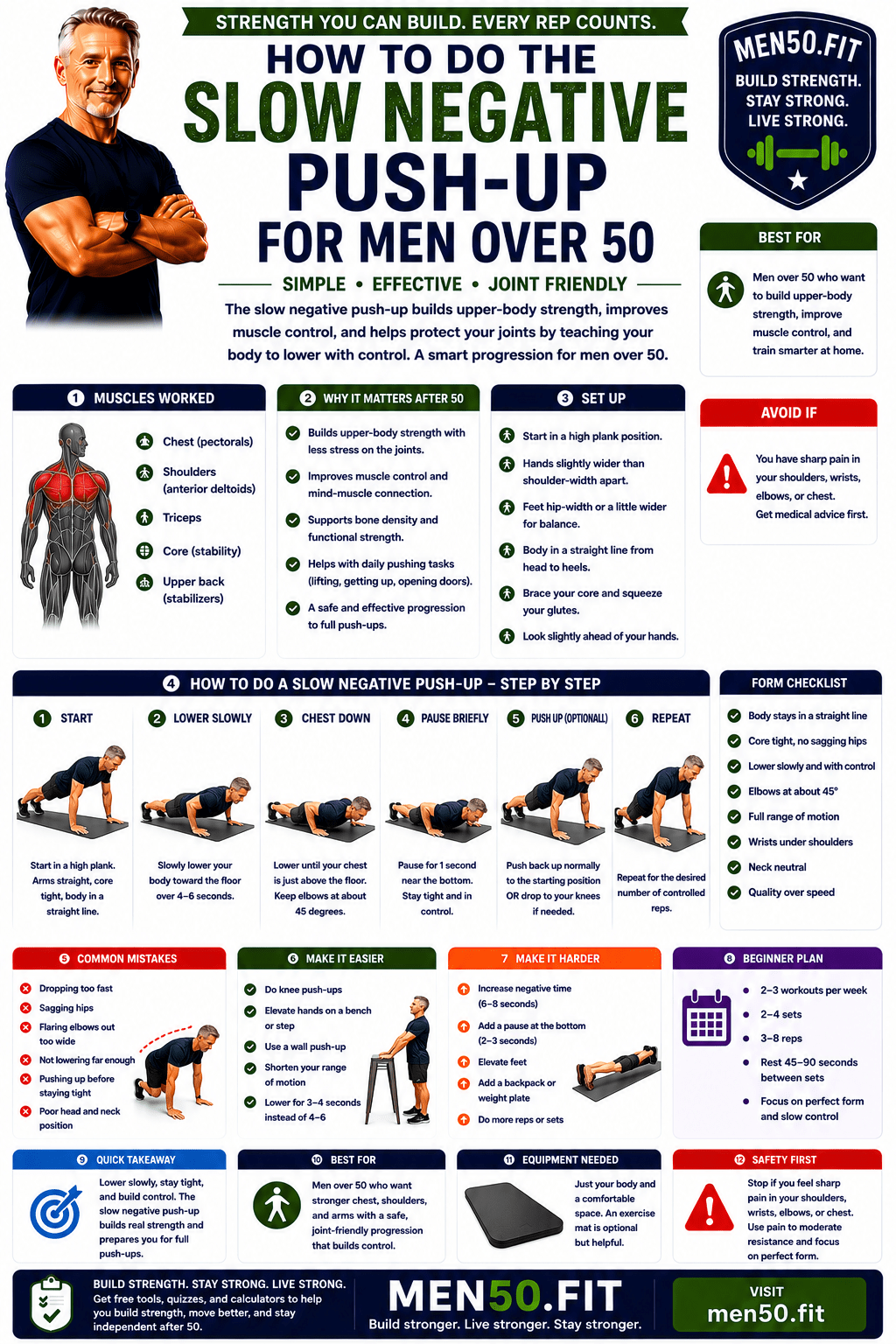
- Start in a high plank position — hands on the floor, arms straight, legs straight, body in a line from head to heels.
- Hands slightly wider than shoulder-width apart, wrists directly under shoulders.
- Feet hip-width apart or a little wider for balance.
- Body in a straight line — no sagging hips, no piked-up hips.
- Brace your core and squeeze your glutes. Look slightly ahead of your hands.
Then the movement:
- Start. Lock into the full plank position. Arms straight, core tight, glutes squeezed, body in a line. Take a moment to feel this position — this is the position you maintain throughout the descent.
- Lower slowly. Bend your elbows and lower your body toward the floor over 4–6 seconds. Resist gravity actively the whole way down. Elbows at about 45 degrees from your body — not flared straight out to the sides.
- Chest down. Continue lowering until your chest is just above the floor. Keep your body in a straight line — don’t let the hips sag or rise.
- Pause briefly. Pause for 1 second near the bottom. Stay tight throughout — no resting on the floor, no losing the plank shape.
- Push up (optional). Push back up to the starting position if you can with clean form. If you can’t push up cleanly, drop your knees to the floor, push back up from the knees, then return your feet to the floor for the next rep.
- Repeat. Maintain clean form on every rep. Quality over speed always.
The cue that matters most: lower slowly, stay tight, and build control. The slow eccentric phase is the entire purpose of the exercise. Rushing the descent — even if you can do a full push-up cleanly afterward — defeats the point.
Why the Slow Negative Push-Up Matters After 50
There’s a genuine biological reason this exercise works so well for men over 50: eccentric strength is typically preserved better than concentric strength as men age. In plain English, you can usually lower a load before you can push it back up. This is one of the few areas where ageing biology actually favours a specific training method. The slow negative push-up exploits this — it lets you train the full floor push-up position even when you can’t yet push yourself back up from the floor.
The mechanism: muscles are stronger during the eccentric (lengthening) phase than during the concentric (shortening) phase. This is true at every age, but the gap is even larger after 50. Multiple studies have shown that older adults can produce significantly more force eccentrically than concentrically. This is why the standard advice “if you can’t do a push-up, do knee push-ups until you can” often doesn’t work — knee push-ups don’t bridge the eccentric strength gap that comes between knee push-ups and floor push-ups.
The slow negative push-up directly trains the geometry of a full floor push-up:
- Same hand position — directly under the shoulders.
- Same body line — straight from head to heels.
- Same elbow angle — 45 degrees from the body.
- Same range of motion — chest near the floor.
What’s different is only that you don’t need to push yourself back up from the floor. You can drop to your knees for the push-up phase, or take a longer rest between negatives if your shoulders need it. The descent does most of the strength-building work, and after 4–8 weeks of consistent practice, most men find they can do the concentric (push-up) phase too — because the strength has accumulated.
There’s also a joint-friendly mechanism worth noting. The biggest cause of shoulder pain in push-ups isn’t usually the position itself — it’s the impact at the bottom when men drop quickly toward the floor and try to bounce out of the deep position. The slow descent eliminates this impact entirely. Your tissues never get loaded faster than your muscles can control. For men with mild shoulder, elbow, or wrist sensitivity, the slow negative is often the only push-up variation they can do without aggravation.
Beyond the physical mechanism, push-ups themselves carry health markers worth taking seriously. A 2019 study published in JAMA Network Open by Yang and colleagues followed over 1,000 men over a 10-year period and found that men who could do 40+ push-ups had a 96% lower risk of cardiovascular events compared with men who could do fewer than 10. Push-up capacity, in other words, isn’t just about chest aesthetics — it tracks something real about cardiovascular health and functional strength. Building push-up capacity matters. The slow negative is one of the most effective tools for getting there.
Sets and Reps
Rep count is lower than other push-up variations because each rep takes 4–6 seconds in the descent alone. Total time under tension is high.
| Stage | Variation | Sets × Reps | Frequency |
|---|---|---|---|
| Beginner | 3-second negative, knees down for push-up | 2 × 3–5 | 2× per week |
| Novice | 4-second negative, knees down for push-up | 2–3 × 4–6 | 2–3× per week |
| Intermediate | 5-second negative, occasional full push-up | 3 × 5–8 | 2–3× per week |
| Advanced | 6-second negative + pause at bottom | 3–4 × 5–8 | 2–3× per week |
Rest 45–90 seconds between sets — longer than for regular push-ups because each rep is more demanding. Pick a number of reps where the last 2–3 reps still maintain controlled descent — if you start dropping faster on the later reps, the set is over.
When you can consistently do 3 sets of 6 reps with a 5-second descent, you’ve earned the floor push-up. Start your sessions with 1–2 sets of attempted full floor push-ups before transitioning to slow negatives.
Common Mistakes
The six errors that turn a smart progression into a wasted exercise:
- Dropping too fast. The single most common mistake. If you collapse toward the floor in 2 seconds instead of 4–6, you’ve turned the exercise back into a regular push-up attempt — and lost the entire benefit. Count “one-thousand-one, one-thousand-two…” in your head to maintain tempo. The slow descent IS the exercise.
- Sagging hips. The body should stay in a straight line from head to heels throughout the descent. Letting the hips drop means the lower back takes load it shouldn’t, and the core is no longer doing its job. Squeeze the glutes; brace the core. If hips sag consistently, do knee push-ups for a few more weeks before progressing.
- Flaring elbows out too wide. Elbows at 90 degrees from the torso load the front of the shoulder joint and are the most common cause of push-up shoulder pain. Keep elbows at about 45 degrees from your body — they should make an arrow shape with your torso, not a T.
- Not lowering far enough. Stopping with the chest 6 inches above the floor skips the deep range where most of the strength gets built. Lower until your chest is just above the floor — about 2–3 inches from contact. The full range of motion is part of the exercise.
- Pushing up before staying tight. Some men reach the bottom, immediately collapse onto the floor, then push back up. Stay tight at the bottom for at least 1 second before initiating the push (or dropping to your knees). The brief pause is when the muscles do additional stabilising work.
- Poor head and neck position. Looking up tilts the neck into hyperextension; looking down at your hands hyperflexes it. Keep the neck neutral — eyes on the floor about 6 inches ahead of your hands.
Make It Easier or Harder
If standard slow negatives are too challenging:
- Do knee push-ups for another 2–4 weeks to build the baseline strength.
- Elevate hands on a bench or step — like an incline push-up but lowered slowly. Same eccentric training at lighter load.
- Use a wall push-up with slow descent — easiest version, still trains the eccentric pattern.
- Shorten your range of motion — lower only halfway down at first while you build strength. Add depth over weeks.
- Lower for 3–4 seconds instead of 4–6 — still slower than regular push-ups, but more manageable.
To make slow negatives harder once form is solid:
- Increase negative time to 6–8 seconds per rep — significantly more demanding than it sounds.
- Add a pause at the bottom for 2–3 seconds with chest just above the floor and body tight.
- Elevate feet on a low step or stair — increases the load on the upper body (similar to a decline push-up).
- Add a backpack or weight plate on your back for added resistance — usually reserved for advanced lifters.
- Do more reps or sets before increasing intensity.
For variety once basic form is solid, try the deficit slow negative (hands elevated on parallel bars or push-up handles, allowing a deeper descent below normal floor level) — adds range of motion and is particularly effective at building deep-range chest strength.
Safety Note
If you feel sharp pain in your shoulders, wrists, elbows, or chest during the descent, stop. Mild muscular fatigue is normal; sharp joint pain is not. Adjust elbow angle (45 degrees, not flared), check that wrists are directly under shoulders, or drop to easier variations.
Wrist pain is common in any floor-based push-up variation for men over 50. If it persists, try push-up handles (which keep the wrists neutral), make a fist and push on the knuckles (with a mat), or switch to incline variations which usually have less wrist load.
If you cannot maintain the plank position with a straight body line throughout the descent, you’re not ready for slow negatives yet. Drop back to knee push-ups and add core work (dead bug, bird dog, glute bridge) for 2–4 weeks before trying again. The plank is the foundation; without it, the slow negative doesn’t work.
Build Your Personal Training Plan
The slow negative push-up is one piece of a complete upper body programme. Get a personalised exercise plan based on your current strength, goals, and any limitations.
Take the Free Fitness Profiler →
FAQs
Why train negatives instead of regular push-ups?
Because negatives let you train the floor push-up position before you can do a full floor push-up. Eccentric (lowering) strength is typically preserved better than concentric (pushing) strength in men over 50, which means you can usually lower a load you can’t push back up. Standard advice — “keep doing knee push-ups until you can do floor push-ups” — often doesn’t work because knee push-ups don’t train the same body position as floor push-ups. Slow negatives bridge that gap by training the exact floor push-up geometry, but only requiring you to handle the descent. After 4–8 weeks, most men find the concentric (push-up) phase has improved as well.
How slow is “slow”?
Aim for 4–6 seconds on the descent for most reps. That’s significantly slower than a regular push-up (which takes about 1–2 seconds to lower) but achievable. Count “one-thousand-one, one-thousand-two, one-thousand-three…” in your head to maintain the pace. If you can do 8-second negatives cleanly, you can probably do regular push-ups — at that point, transition to standard floor push-ups. If you can’t manage 3 seconds without dropping, drop back to easier variations.
Slow negative push-up vs knee push-up — when to use which?
Use knee push-ups when you’re still building baseline pressing strength and can’t yet hold a full plank position with a straight body for 30+ seconds. Use slow negatives when you can hold a plank and you’re ready to bridge to floor push-ups. Many men over 50 use both in the same programme — knee push-ups for higher rep volume (10–15 reps per set), slow negatives for low-rep specific eccentric work (4–6 reps per set). The two complement each other beautifully during the progression to floor push-ups.
Will this really help me do full push-ups?
Yes — and faster than most men expect. Eccentric overload training is one of the most well-established methods for building strength to perform a movement you currently can’t do. Most men over 50 who add 2 weekly sessions of slow negative push-ups (3 sets of 5 with 5-second descents) can do at least 1–3 clean floor push-ups within 4–8 weeks. The transition is usually rapid once the eccentric strength accumulates — many men go from zero floor push-ups to 5+ clean reps in a single session once the strength builds up.
Why are negatives easier than regular reps?
Two reasons. Eccentric strength is greater than concentric strength at every age — muscles can resist a load they can’t actively lift. After 50, the gap is even larger. The slow tempo lets you cheat in small ways — there’s no momentum, no quick bounce out of the bottom, so you can rest briefly between reps and aren’t trying to overcome inertia. Both factors make negatives a more accessible training method than full push-ups for men still building pressing strength.
References
- Yang J, Christophi CA, Farioli A, et al. Association Between Push-up Exercise Capacity and Future Cardiovascular Events Among Active Adult Men. JAMA Network Open. 2019;2(2):e188341.
- American College of Sports Medicine. Resistance Training for Older Adults Position Stand. acsm.org
- National Institute on Aging. Sarcopenia and Muscle Strength in Older Adults. nia.nih.gov
Disclaimer: This article is for educational purposes only and is not medical advice. Consult a qualified healthcare professional before starting any new exercise programme, especially if you have existing shoulder, wrist, elbow, or chest conditions.