
The dumbbell shoulder press is the main overhead pressing exercise for men over 50 — and the natural progression beyond the seated dumbbell shoulder press we covered earlier. Where the seated-with-back-support version teaches the pattern safely with minimal lower-back demand, this broader version of the exercise — done either seated without back support or standing — adds full-body bracing requirements that translate more directly to real-world strength. The standing variation in particular is one of the most functional overhead movements you can do: every overhead reach in daily life is a standing press without dumbbells.
Part of the Build Muscle After 50 pillar — strength training for men over 50.
Key Takeaways
- The dumbbell shoulder press trains the deltoids, triceps, upper chest, upper back, and core in a vertical pressing pattern.
- This article covers the progression from seated-with-support → seated-without-support → standing. The seated version with back support is the entry point; this is what comes next.
- Programming: 2–4 sets of 8–12 reps, 2–3 times per week. Rest 60–90 seconds between sets.
- Press with control, keep your core tight, and protect your joints. Stronger shoulders help you move, lift, and live better after 50.
- This exercise is not for everyone. If you have current shoulder pain, impingement, or rotator cuff issues, skip overhead pressing until cleared by a physiotherapist.
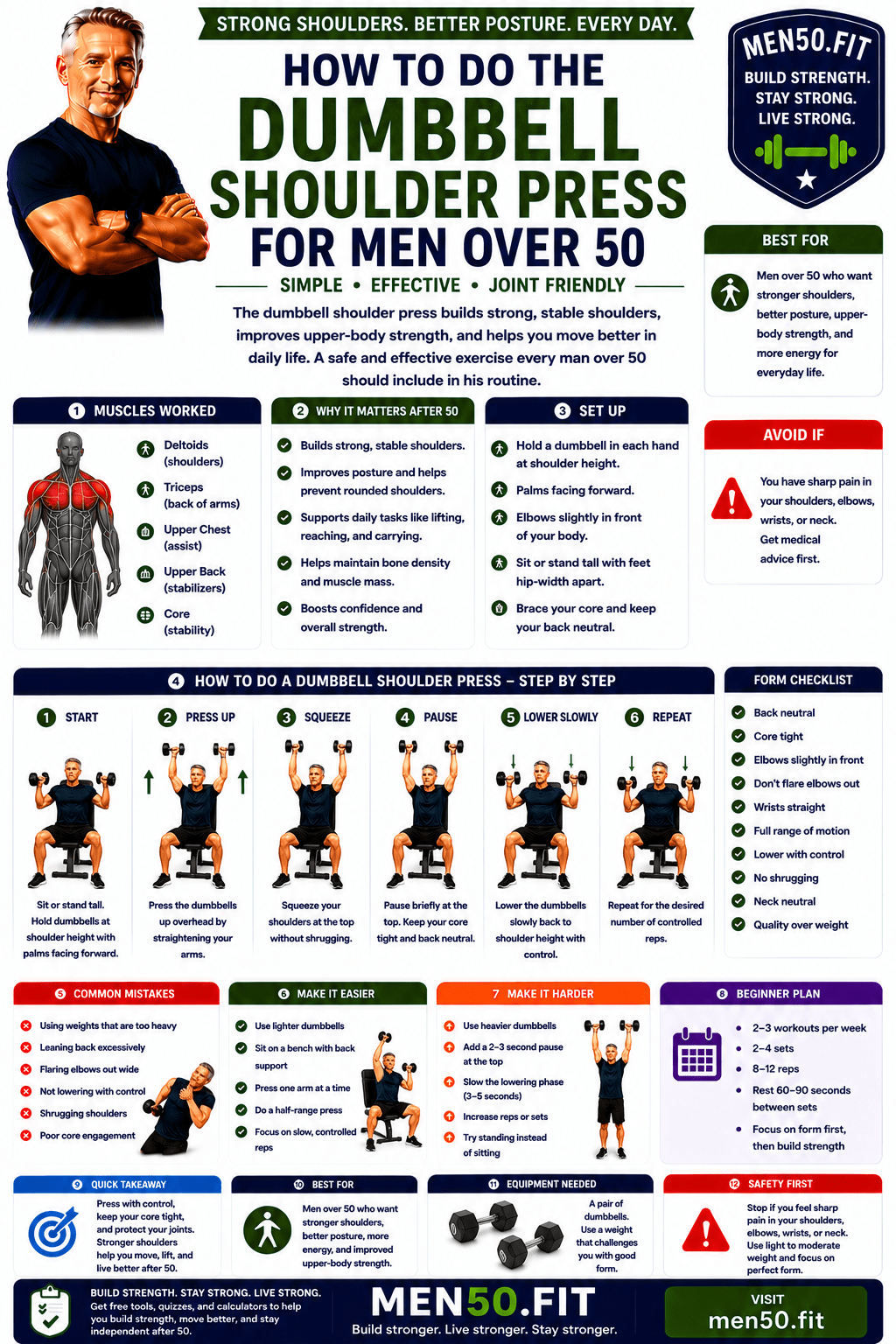
How to Perform the Dumbbell Shoulder Press
Set up first:
- Hold a dumbbell in each hand at shoulder height, palms facing forward (or slightly inward for a more shoulder-friendly grip).
- Sit or stand tall with feet hip-width apart. If seated, use a bench without back support (for the progression beyond the seated-with-back-support version).
- Elbows slightly in front of your body, not flared straight out to the sides.
- Brace your core, keep your back neutral (no arching the lower back), and wrists straight.
Then the movement:
- Start. Dumbbells at shoulder height, palms facing forward, elbows slightly in front of your body. Core engaged, chest up, back neutral.
- Press up. Press the dumbbells straight up overhead by straightening your arms. The dumbbells should travel in a straight line, not arc inward at the top.
- Squeeze. Pause briefly at the top with arms nearly straight. Squeeze your shoulders at the top without shrugging — keep the shoulders down, away from the ears.
- Pause. Hold briefly at the top. Keep your core tight and back neutral throughout.
- Lower slowly. Lower the dumbbells slowly back to shoulder height with control. Take 2–3 seconds on the way down.
- Repeat. Maintain clean form on every rep. Back stays neutral, core stays engaged, dumbbells travel in a straight path overhead.
The cue that matters most: press in a straight path over your head, with elbows slightly in front of your body. Pressing straight up keeps the shoulder joint in its safest position. Letting the elbows flare straight out to the sides is the most common cause of shoulder pain in this exercise — regardless of whether you’re seated or standing.
Why the Dumbbell Shoulder Press Matters After 50
Vertical pressing strength matters more than most men over 50 realise — until they lose it. Every overhead reach you make in daily life uses the same muscles trained by the dumbbell shoulder press: lifting a suitcase into an overhead bin, putting boxes on a high shelf, reaching up to change a lightbulb, hanging clothes in a wardrobe, hoisting yourself out of a swimming pool. Lose this strength gradually after 50 and these tasks become harder than they should be — long before you actively notice them becoming difficult.
The dumbbell shoulder press trains the deltoids (all three sections), triceps, upper chest, upper back stabilisers, and core. It’s one of the most efficient compound exercises for upper-body strength generally — and arguably the most important for maintaining overhead function specifically.
There’s a progression sequence worth understanding clearly:
Stage 1 — Seated with back support (the right starting point). The bench’s vertical back pad takes lower-back compensation out of the equation. Shoulders do the work or they don’t — no cheating.
Stage 2 — Seated without back support. The bench is still there, but you’re sitting tall without leaning against anything. Your core has to brace through every rep to keep the spine neutral. This builds the bracing pattern needed for standing without the additional balance demand.
Stage 3 — Standing. The most demanding version. The entire body — feet, legs, hips, core — has to brace and stabilise while the shoulders press. This is the most functionally transferable version, but also the most demanding.
Each stage adds total-body bracing demand without changing the basic shoulder pattern. Most men over 50 benefit from spending 4–8 weeks at each stage before progressing. Rushing through the progression — going straight from seated-with-support to standing — often produces lower-back compensation or shoulder issues that wouldn’t have happened with a slower progression.
There’s also a bone density angle. Overhead pressing applies mechanical loading to the shoulders, upper arms, and spine in an axial pattern that supports bone health in regions vulnerable to age-related density loss. For men over 50 — and particularly those with family history of osteoporosis — overhead pressing belongs in a complete strength programme.
The honest caveat from the seated version article still applies: not every man over 50 should be doing overhead pressing. Men with current shoulder impingement, rotator cuff injuries, or unresolved shoulder pain often make those conditions worse with overhead work. If your shoulders aren’t healthy enough for pain-free overhead pressing, work on the postural pattern first (wall angels, band pull-aparts, doorway chest stretches) and use the dumbbell floor press for pressing strength.
Sets and Reps
Same fundamental programming as the seated version, but expect to use lighter weight when you transition to standing because the full-body bracing demand increases dramatically.
| Stage | Variation | Sets × Reps | Frequency | Load Guide |
|---|---|---|---|---|
| Stage 1 | Seated with back support | 2–3 × 8–12 | 2× per week | 10–20 lbs (4.5–9 kg) |
| Stage 2 | Seated without back support | 2–3 × 8–12 | 2× per week | 10–25 lbs (4.5–11 kg) |
| Stage 3 | Standing | 3 × 8–12 | 2–3× per week | 10–25 lbs (4.5–11 kg) |
| Advanced | Standing, slow lowering + pause at top | 3–4 × 6–10 | 2–3× per week | 20–35 lbs (9–16 kg) |
Rest 60–90 seconds between sets. Pick a weight where the last 2–3 reps feel clearly challenging but you can complete them with: back neutral (no arching), core tight, elbows slightly in front of body, no leaning, dumbbells pressing in a straight path overhead.
A practical note on load: many men over 50 are surprised to find they can press less weight standing than seated. This is normal — the standing version forces more muscles to stabilise, which reduces how much weight your shoulders can press. Don’t try to match your seated press weight when you progress to standing. Drop the load by 20–30% and rebuild.
Common Mistakes
The six errors that turn a great compound exercise into a shoulder or back problem:
- Using weights that are too heavy. The most common mistake. Heavy dumbbells force compensation — leaning back, arching the lower back, flaring the elbows, jerking the weights up. All of them turn the press into a different exercise. If you can’t press cleanly, drop a size.
- Leaning back excessively. When the shoulders fatigue, the lower back wants to arch dramatically to “help” the press. Even seated without back support, the lower back wants to do this. Keep ribs down, core braced, lower back neutral. If you have to lean significantly, the load is too heavy.
- Flaring elbows out wide. Elbows flared straight out to 90 degrees — the “scarecrow” position — loads the front of the shoulder joint and is the single biggest cause of shoulder pain in this exercise. Keep elbows slightly in front of the body throughout. If you look at yourself in a mirror from the front, your arms should look like a slightly narrowed Y, not a wide W.
- Not lowering with control. Letting the dumbbells drop quickly back to shoulder height skips the eccentric phase, where significant strength gets built. Take 2–3 seconds on the way down on every rep.
- Shrugging shoulders. As you press, the upper traps want to lift the shoulders toward the ears. Keep the shoulders down and back, away from the ears. If you can’t keep them down, the weight is too heavy.
- Poor core engagement. Without active core bracing, the lower back becomes the path of least resistance for the load. Brace the core like you’re about to be punched in the stomach — every single rep.
Make It Easier or Harder
If the standing or seated-without-support shoulder press is too challenging:
- Drop back to the seated with back support variation — strength is built from where you are.
- Use lighter dumbbells — 8–12 lbs (3.5–5.5 kg) is fine for beginners returning to seated-without-support.
- Sit on a bench with back support — full back support takes lower-back compensation out of the equation.
- Press one arm at a time — lets you focus on form one side at a time, exposes left-right imbalances.
- Do a half-range press — only press partway up while you build shoulder mobility and strength.
- Focus on slow, controlled reps — clean tempo with light weight trains the pattern correctly.
To make it harder once form is solid:
- Use heavier dumbbells — but only when the lighter weight feels easy with clean form.
- Add a 2–3 second pause at the top with arms nearly straight.
- Slow the lowering phase to 3–5 seconds per rep.
- Increase reps or sets before increasing load.
- Try standing instead of sitting — the natural progression beyond the seated-without-support version.
For variety, try the neutral grip shoulder press (palms facing each other instead of palms forward) — easier on the shoulder joint for many men. Some men find this version much more comfortable, especially if they have any rotator cuff history.
Safety Note
Overhead pressing has more shoulder injury risk than horizontal pressing. Be honest about whether your shoulders are healthy enough for this exercise.
Skip the shoulder press if you have: current shoulder pain, diagnosed rotator cuff injury, shoulder impingement, frozen shoulder, recent shoulder surgery, or pain that gets worse during the press. If your shoulders aren’t healthy enough for pain-free overhead pressing, don’t push through it — use the dumbbell floor press or band chest press instead.
If you feel sharp pain in the shoulder, neck, elbow, or wrist during the press, stop immediately. Adjust the elbow position (slightly more in front of body), try the neutral grip, or reduce the load.
The standing variation specifically also brings lower-back risk. If you arch significantly to complete reps, the lower back takes load it shouldn’t. Drop the weight, brace the core harder, or go back to the seated version until your bracing pattern is solid.
If you cannot maintain good form — back neutral, core tight, dumbbells pressing in a straight path — the weight is too heavy. Drop a size and rebuild.
Build Your Personal Training Plan
The dumbbell shoulder press is one piece of a complete upper body programme. Get a personalised exercise plan based on your current strength, goals, and any limitations.
Take the Free Fitness Profiler →
FAQs
Standing vs seated dumbbell shoulder press — which is better?
Seated is the right starting point for almost every man over 50. The bench gives you a stable base and (with back support) removes lower-back compensation. Standing is the next progression once your seated press is solid — it adds full-body bracing demand that translates more directly to real-world overhead strength. Most men over 50 benefit from a progression path: seated with back support → seated without back support → standing. Each stage should be solid before progressing. Most men over 50 don’t need to progress past seated — the seated version is genuinely sufficient for the strength goals most men have. Standing is the more advanced option, not necessarily the better one.
How is this different from the seated dumbbell shoulder press article?
The seated dumbbell shoulder press article covers specifically the seated-with-back-support variation — the safest, beginner-friendly version of the exercise. This article covers the progressions beyond it: seated without back support, and standing. Both articles cover the same fundamental movement, but at different stages. If you’re new to overhead pressing, start with the seated version. Move to this version when seated reps feel easy and your form is reliable.
How heavy should the dumbbells be?
Heavy enough that the last 2–3 reps feel clearly challenging, but light enough that you can complete the set with back neutral, ribs down, no leaning, no arched lower back, and a straight pressing path. For most men over 50 starting out, that’s 10–20 lbs (4.5–9 kg) per hand for seated work. Standing usually requires 20–30% less weight than seated for the same rep range because more muscles are working to stabilise. After 3–6 months of training, many men progress to 20–35 lbs (9–16 kg) per hand seated, perhaps 15–25 lbs (7–11 kg) standing.
Should I do this if I have shoulder issues?
Generally, no — at least not until those issues resolve. Overhead pressing places more demand on the rotator cuff and the front of the shoulder joint than horizontal pressing. If you have current shoulder pain, impingement, or a recent rotator cuff issue, work on the postural pattern first (wall angels, band pull-aparts, doorway chest stretches) and use the dumbbell floor press for pressing strength. Once the shoulder is pain-free with full mobility, you can usually return to overhead pressing — but get a physio’s opinion if the issue was significant.
Can I do shoulder presses every day?
Better not to. The shoulder press is a moderate-to-high intensity compound exercise that loads the shoulders significantly — they need 48 hours of recovery between sessions. 2–3 times per week is the sweet spot. If you want to train shoulders more often, pair shoulder press days with lower-intensity work like lateral raises, band pull-aparts, or face pulls on the off days. The shoulders are smaller, more vulnerable joints than the chest or back — they need more recovery, not less.
References
- American College of Sports Medicine. Resistance Training for Older Adults Position Stand. acsm.org
- National Institute on Aging. Sarcopenia and Muscle Strength in Older Adults. nia.nih.gov
- Centers for Disease Control and Prevention. Physical Activity Guidelines for Americans, 2nd Edition. cdc.gov
Disclaimer: This article is for educational purposes only and is not medical advice. Consult a qualified healthcare professional before starting any new exercise programme, especially if you have existing shoulder, neck, or back conditions.