
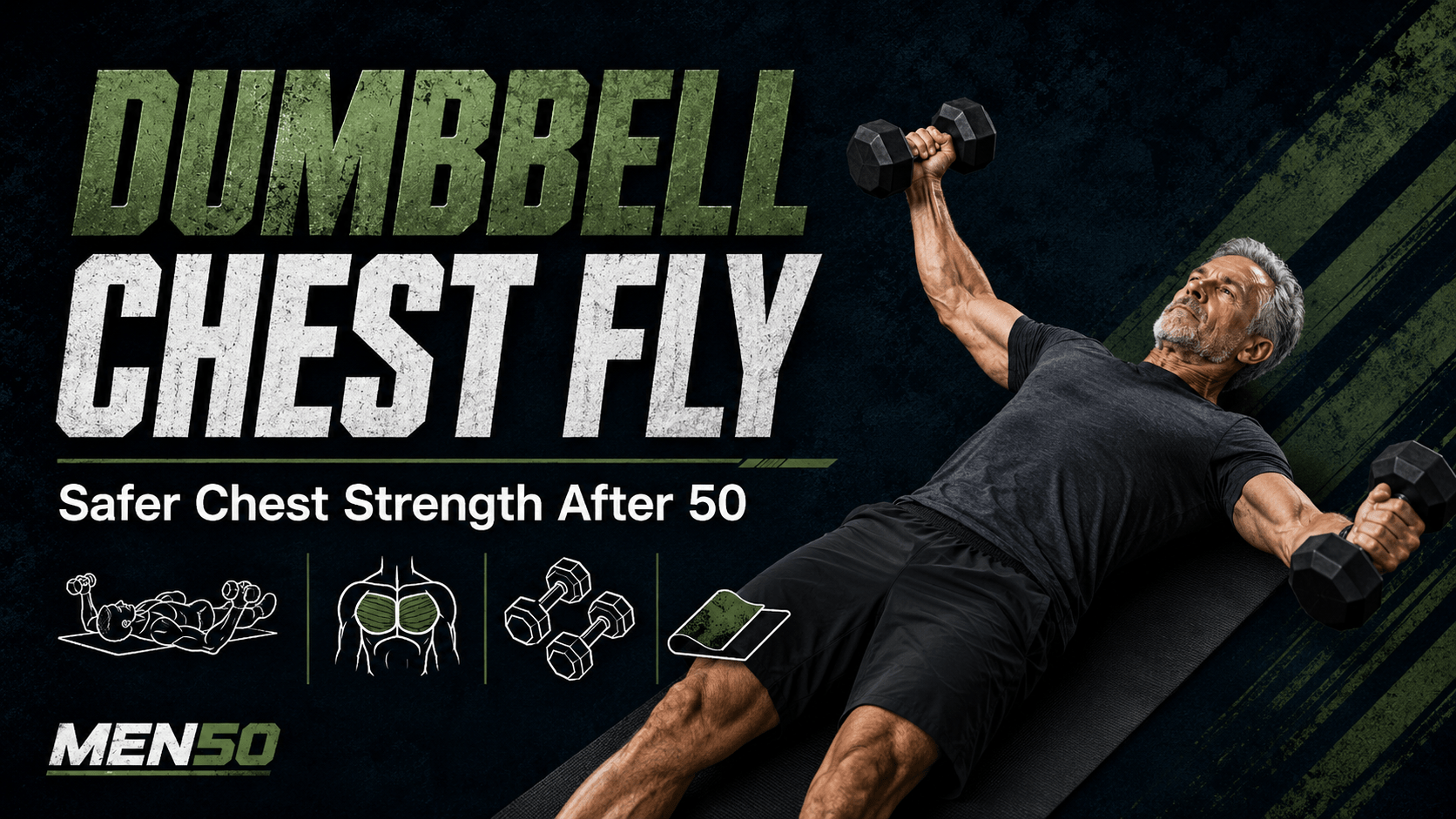
The dumbbell chest fly is the isolation exercise for the chest — the one that trains the pectorals directly without the help of the triceps or front delts that compound presses recruit. But the traditional bench version, where the arms drop below the level of the torso, is one of the most common causes of front-of-shoulder pain in men over 50. The floor variation fixes that problem completely by physically stopping the arms at floor level — exactly where they should stop. You get the chest-isolation benefits without the shoulder-impingement risk. For men over 50, this is the only chest fly variation worth doing.
Part of the Build Muscle After 50 pillar — strength training for men over 50.
Key Takeaways
- The chest fly is the isolation exercise for the pectorals — different pattern from compound pressing exercises like the floor push-up and dumbbell floor press.
- The floor variation physically limits how far the arms can extend, protecting the front of the shoulder from the over-stretch position that causes pain in men over 50.
- Programming: 2–4 sets of 8–15 reps, 2–3 times per week. Rest 45–75 seconds between sets.
- The floor limits how far your arms can go, which protects your shoulders while still building a strong, stable, and well-developed chest. That’s the entire case for this variation.
- Use lighter weights than you press with — typically 50–70% of your floor press weight.
How to Perform the Dumbbell Chest Fly on Floor
Set up first:
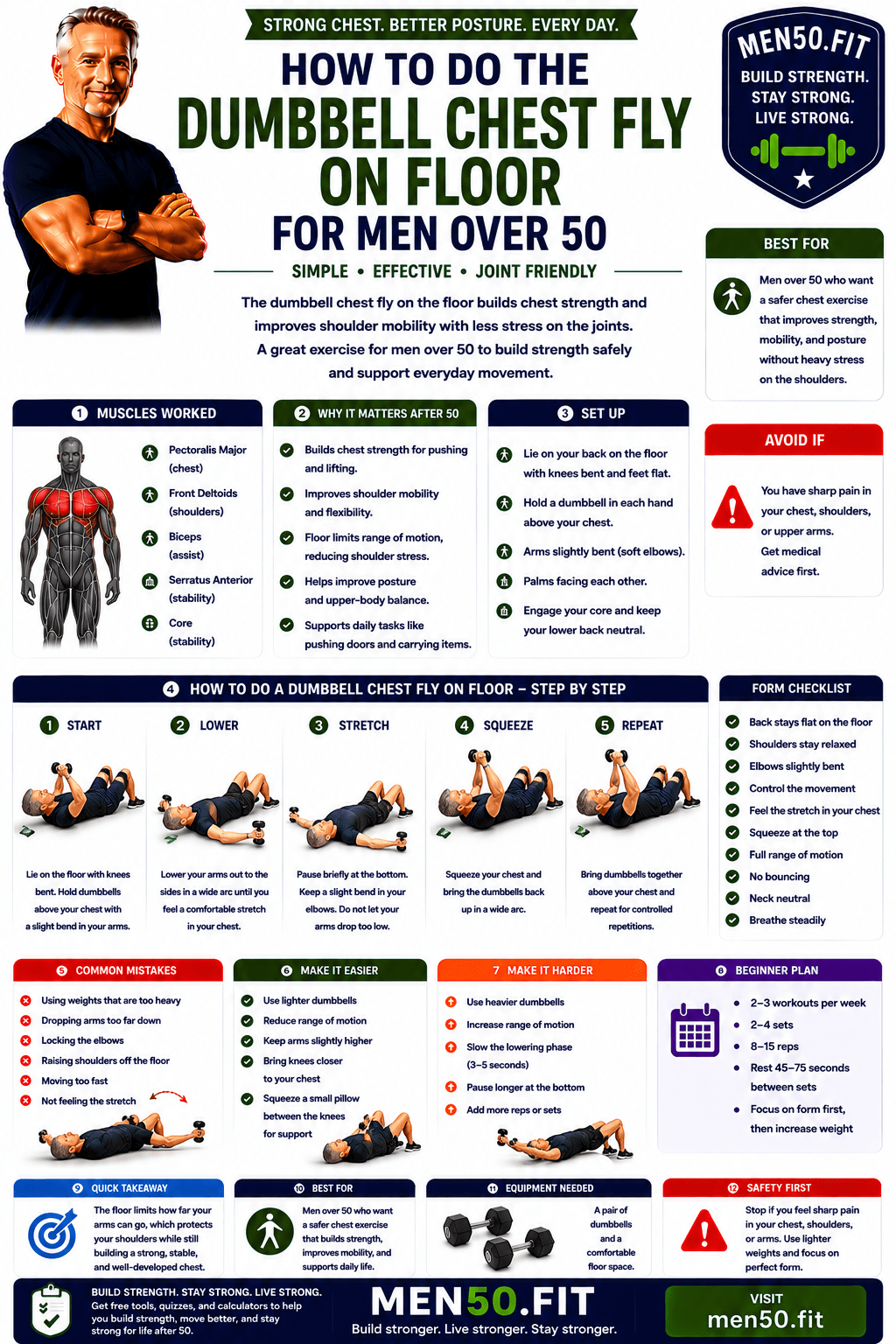
- Lie on your back on the floor with knees bent and feet flat on the floor about hip-width apart.
- Hold a dumbbell in each hand directly above your chest.
- Arms slightly bent — soft elbows, not locked straight. This bend stays constant throughout the rep.
- Palms facing each other (dumbbells held vertically).
- Engage your core, keep your lower back neutral (no excessive arch), keep your shoulders pressed gently into the floor.
Then the movement:
- Start. Lie on the floor with knees bent. Hold dumbbells above your chest with a slight bend in your arms. Palms facing each other.
- Lower. Lower your arms out to the sides in a wide arc — like you’re opening up your chest. Keep the slight elbow bend constant. Take 2–3 seconds to lower.
- Stretch. Pause briefly at the bottom when your elbows lightly touch the floor. Keep the slight bend in the elbows. Feel a comfortable stretch across the chest. Do not let your arms drop too low — the floor is your safety stop.
- Squeeze. Squeeze your chest and bring the dumbbells back up in a wide arc to the starting position above your chest. Take 1–2 seconds to lift. Imagine hugging a tree.
- Repeat. Bring dumbbells together above your chest and repeat for controlled repetitions. Maintain the slight elbow bend throughout every rep.
The cue that matters most: keep the slight bend in your elbows throughout the entire rep — they should look the same at the top as they do at the bottom. Locking out the elbows turns the fly into a press; bending them too much turns it into a different exercise entirely. The arm shape stays constant; only the angle at the shoulder changes.
Why the Dumbbell Chest Fly on Floor Matters After 50
The pectoral muscles (the chest) play several roles men over 50 care about: pushing strength for daily tasks (getting up from the floor, pushing doors), maintaining shoulder health from the front, supporting good posture by balancing the upper-back pull (when the chest is weak, the front of the shoulder collapses), and contributing to upper-body strength generally. The chest fly is the most efficient way to train the pectorals directly — without the assistance of other muscles that compound presses recruit.
But there’s a problem with the traditional bench-based chest fly that matters specifically for men over 50: in the bench version, the arms drop below the level of the torso at the bottom of the rep. That position stretches the front of the shoulder capsule under load — which can be safe for younger men with healthy shoulders, but is one of the most common causes of front-of-shoulder pain in men over 50. The over-stretched position contributes to:
- Anterior shoulder impingement (pinching at the front of the shoulder)
- Long head of biceps tendon irritation
- Pec minor tightness pulling the shoulder forward
- Aggravation of any existing rotator cuff issues
The floor variation solves this by physically limiting how far the arms can go. The floor itself acts as a safety stop — when your elbows touch the floor, that’s the end of the range. You can’t over-stretch even if you try. The result: you get the chest-isolation benefits of a fly without the over-extension that causes shoulder problems.
This makes the floor fly uniquely valuable in the chest silo. The pressing exercises already in the matrix train the chest as part of a compound movement:
| Exercise | Chest Training Pattern |
|---|---|
| Wall Push-Up | Compound, easiest |
| Incline Push-Up | Compound, intermediate |
| Knee Push-Up | Compound, bridge to floor |
| Slow Negative Push-Up | Compound, eccentric focus |
| Floor Push-Up | Compound, full bodyweight |
| Dumbbell Floor Press | Compound, loaded |
| Resistance Band Chest Press | Compound, band-based |
| Dumbbell Chest Fly on Floor | Isolation, direct chest |
The fly fills a unique gap. It’s the first chest isolation exercise in the matrix — and the only one with a true safety-stop built into the movement.
Press vs Fly — They’re Different Patterns
The single most important technical distinction in chest training:
| Pattern | What Happens | Primary Muscles |
|---|---|---|
| Press | Elbows bend and extend | Chest + triceps + front delts |
| Fly | Elbows stay slightly bent throughout; arms open and close in arc | Chest (primarily) |
In a press, the elbows do most of the visible motion — bending at the bottom, straightening at the top. The triceps and front delts assist significantly. In a fly, the elbows stay in the same slightly-bent position from start to finish — only the shoulders move (in adduction and abduction). This means the chest does almost all the work because the triceps and front delts can’t contribute much.
Both patterns belong in a complete chest programme — presses for compound strength, flies for direct chest development. Most men over 50 benefit from doing both, typically presses one workout per week and flies on another.
Sets and Reps
Use lighter weights than you press with. The fly is mechanically less efficient for moving heavy weight because the lever arm is much longer than in a press.
| Stage | Variation | Sets × Reps | Frequency |
|---|---|---|---|
| Beginner | Very light dumbbells, shorter range | 2 × 8–10 | 2× per week |
| Novice | Light dumbbells, full range to floor | 2–3 × 10–12 | 2–3× per week |
| Intermediate | Moderate dumbbells, slow lowering | 3 × 10–15 | 2–3× per week |
| Advanced | Heavier dumbbells, pause at bottom + slow lowering | 3–4 × 10–15 | 2–3× per week |
Rest 45–75 seconds between sets. Pick a weight where the last 2–3 reps feel clearly challenging but you can complete them with: shoulders pressed into the floor, slight elbow bend constant, slow controlled tempo, no bouncing at the bottom.
A practical starting load: most men over 50 should start with 5–10 lb (2–4.5 kg) dumbbells per hand. After 2–3 months of training, many progress to 10–20 lbs (4.5–9 kg). Use significantly lighter weight than your floor press — typically 50–70% of your floor press load. The longer lever arm in a fly means even moderate weights feel much heavier than the same weight in a press.
Common Mistakes
The six errors that turn a great isolation exercise into a shoulder strain:
- Using weights that are too heavy. The single most common mistake — and the one that almost always causes shoulder pain in this exercise. Heavy weights force the elbows to bend more (turning the fly into a press) or the form to break down (shoulders leave the floor, range gets cut short). The fly is an isolation exercise; expect to use significantly less weight than for compound pressing.
- Dropping arms too far down. Even on the floor, some men try to press the arms below floor level (lifting the shoulders to find more range). This defeats the entire purpose of the floor variation. The floor IS your stopping point. Let the elbows lightly touch the floor and lift back up.
- Locking the elbows. Straightening the arms during the rep turns the fly into a different exercise (closer to a press or a pullover). The slight elbow bend stays constant throughout. The same shape from start to finish.
- Raising shoulders off the floor. As fatigue sets in, the shoulders want to lift off the floor to “help” the lift. This puts the chest in a less efficient position and shifts work to the front delts. Press the shoulders gently into the floor throughout every rep.
- Moving too fast. Quick, bouncy reps use elastic recoil and skip the eccentric phase. Slow controlled reps build chest strength. Use 2–3 seconds down, brief pause, 1–2 seconds up.
- Not feeling the stretch. If you don’t feel a comfortable stretch across the chest at the bottom of the rep, you’re either using too narrow an arc or stopping too high. Open the arms wider and let the elbows actually touch the floor.
Make It Easier or Harder
If standard floor flys are too challenging:
- Use lighter dumbbells — 3–5 lb (1.5–2 kg) is fine for beginners. The chest responds to volume more than load.
- Reduce range of motion — don’t go all the way to the floor at first; stop 6 inches above floor level while you build shoulder mobility.
- Keep arms slightly higher — start the rep with arms angled 10–15 degrees outward instead of straight up. Reduces the demand.
- Bring knees closer to your chest — feet on the floor closer to your bum increases lower-back support.
- Squeeze a small pillow between the knees — helps engage the core and pelvic floor for better stability.
To make it harder once form is solid:
- Use heavier dumbbells — but only when the lighter weight feels easy with clean form. Most men over 50 stay in the 10–20 lb (4.5–9 kg) range long-term.
- Increase range of motion — only if you can maintain shoulder contact with the floor and a comfortable stretch (not pain).
- Slow the lowering phase to 3–5 seconds per rep — significantly more demanding than it sounds.
- Pause longer at the bottom for 2–3 seconds with the chest in stretched position.
- Add more reps or sets — extend sets to 15–20 reps before adding weight.
For variety, try the alternating arm floor fly (one arm at a time) once a week — same setup, single arm working while the other holds the dumbbell at the top. Exposes left-right imbalances and adds core demand.
Safety Note
Avoid the chest fly if you have sharp pain in your chest, shoulders, or upper arms, current rotator cuff injury, or shoulder impingement. Get medical advice first.
The chest fly is more shoulder-demanding than the chest press, even in the floor variation. If you have any history of shoulder issues, start with very light dumbbells (5 lbs or less) and shorter range of motion. Build up gradually over months.
If you feel front-of-shoulder pain or pinching during the descent, stop immediately. The most common causes: dumbbells too heavy, range of motion too deep, or arms angled too far behind the head instead of out to the sides. The arms should travel directly outward to the sides — at right angles to your torso — not back behind your head.
Don’t bounce the dumbbells off the floor at the bottom of the rep. The floor is meant as a safety stop, not as a rebound surface. Touching down lightly and lifting back up is the correct technique; slamming the dumbbells into the floor can cause shoulder injury and possibly damage the dumbbells.
Build Your Personal Training Plan
The dumbbell chest fly is one piece of a complete upper body programme. Get a personalised exercise plan based on your current strength, goals, and any limitations.
Take the Free Fitness Profiler →
FAQs
Chest fly vs chest press — which is better?
Different exercises that train the same muscle in different ways. The chest press (floor press or band chest press) is a compound exercise — the elbows bend and extend, and the chest works together with the triceps and front delts. The chest fly is an isolation exercise — the elbows stay in a fixed slight bend, and the chest does almost all the work because the triceps and front delts can’t help. Most men over 50 benefit from doing both: presses for compound strength and overall pressing capability, flies for direct chest development. A simple programme: floor press one workout per week, floor fly on another workout. The two complement each other; neither is “better.”
Floor fly vs bench fly — what’s the difference?
The bench fly (lying on a flat bench) allows the arms to drop below the level of the torso at the bottom of the rep — typically 6–12 inches below shoulder level. This deep range stretches the front of the shoulder under load and is one of the most common causes of front-shoulder pain in men over 50. The floor fly physically limits how far the arms can drop — the floor stops them at torso level. You lose a few inches of range; you gain dramatically better shoulder safety. For men over 50, this trade-off is almost always worth making. Most men get equivalent chest development from the floor version without the shoulder risk.
How is this different from the dumbbell floor press?
Same starting position (lying on the floor with dumbbells), same equipment, completely different muscle pattern. The dumbbell floor press is a press — elbows bend and extend, dumbbells travel up and down. The chest fly is a fly — elbows stay slightly bent throughout, dumbbells travel in a wide arc out to the sides. The press is compound and recruits the triceps and front delts heavily; the fly is isolation and emphasises the chest directly. Both belong in a complete chest programme. Most men over 50 do them on different days because they tax the chest in different patterns.
How heavy should the dumbbells be?
Lighter than you’d press with. For most men over 50 starting out, 5–10 lbs (2–4.5 kg) per hand. After 2–3 months of training, many progress to 10–20 lbs (4.5–9 kg). The right weight lets you complete the rep range with: shoulders pressed into the floor, slight elbow bend constant, controlled tempo, no shoulder pain. Expect to use significantly less weight than your floor press — the longer lever arm in a fly makes the same weight feel much heavier. If you press 25 lb dumbbells, you’ll probably fly with 12–15 lb dumbbells.
Should the arms touch the floor at the bottom?
Yes — the elbows should lightly touch the floor. The floor is your safety stop and the right end-point of the rep range. Touch lightly, then lift back up — don’t slam the dumbbells down and don’t lift the shoulders off the floor to find more range. If your elbows can’t comfortably reach the floor without raising your shoulders or feeling pinching, reduce the range of motion (stop higher up) and build shoulder mobility with doorway chest stretches and wall angels before progressing.
References
- American College of Sports Medicine. Resistance Training for Older Adults Position Stand. acsm.org
- Kibler WB, Sciascia A. Current concepts: scapular dyskinesis. British Journal of Sports Medicine. 2010;44(5):300-305.
- National Institute on Aging. Sarcopenia and Muscle Strength in Older Adults. nia.nih.gov
Disclaimer: This article is for educational purposes only and is not medical advice. Consult a qualified healthcare professional before starting any new exercise programme, especially if you have existing chest, shoulder, or arm conditions.