
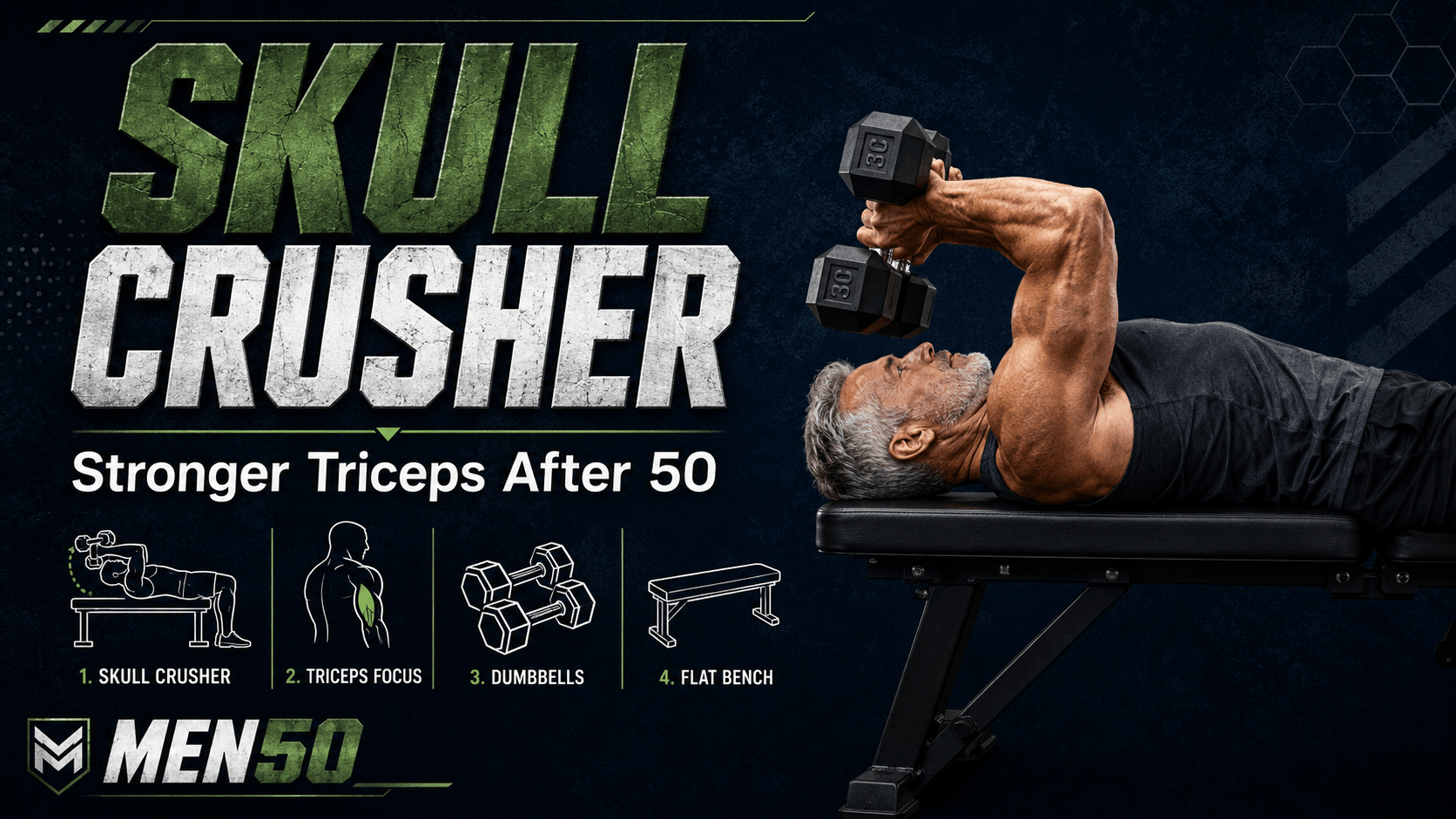
The dumbbell skull crusher has an alarming name and a sensible purpose. It’s a bench-based triceps isolation exercise that lets you load the triceps heavier than any other isolation movement — and trains them in a position that’s surprisingly shoulder-friendly when done with proper form. The “skull crusher” name comes from the obvious risk of lowering the dumbbells too close to your head with weight you can’t control. Used sensibly — light weights, controlled tempo, optionally on the floor for added safety — it’s one of the most efficient direct triceps exercises in existence. For men over 50, it completes the four-piece triceps training system in the matrix.
Part of the Build Muscle After 50 pillar — strength training for men over 50.
Key Takeaways
- The dumbbell skull crusher trains the triceps in isolation — only the elbow joint moves, so the triceps does all the work.
- The lying position is more stable than standing variations, which means heavier loading is possible while form stays clean.
- Programming: 2–4 sets of 8–12 reps, 2–3 times per week. Rest 60–90 seconds between sets.
- Use the floor variation if you don’t have a bench, or if you want extra safety while learning the movement — the floor stops the dumbbells naturally at the right depth.
- This is the fourth piece of the comprehensive triceps training cluster: bodyweight (close-grip push-up), standing dumbbell (overhead extension), band (pressdown), and now bench dumbbell.
How to Perform the Dumbbell Skull Crusher
Set up first:
- Lie on a flat bench (or on the floor — see below).
- Hold a dumbbell in each hand, palms facing each other (neutral grip).
- Extend arms straight up over your chest, with the dumbbells directly above your shoulders.
- Keep a slight bend in your elbows — soft, not locked.
- Keep your core tight, lower back gently pressed to the bench, and feet flat on the floor.
Then the movement:
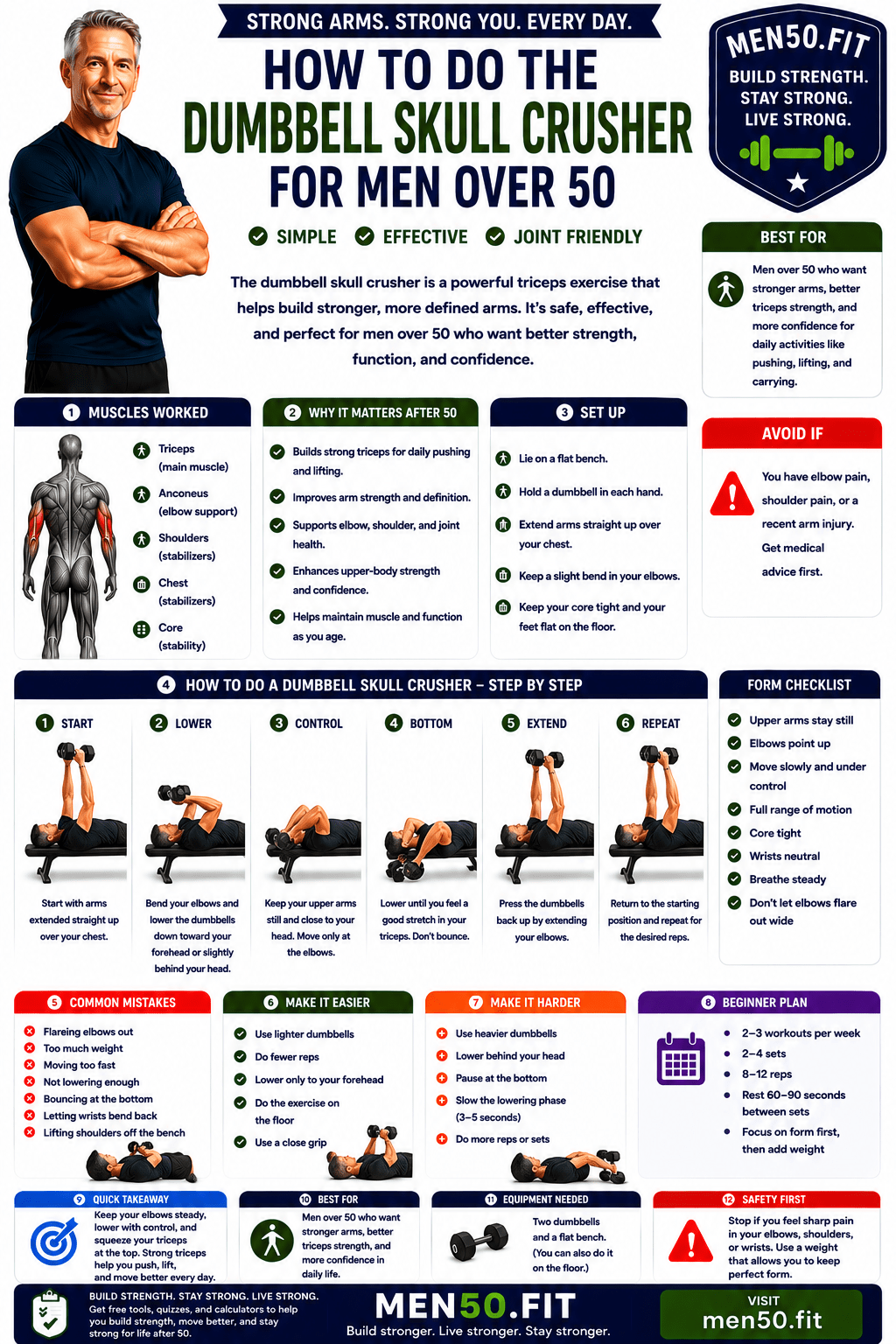
- Start. Arms extended straight up over your chest, slight bend in the elbows, dumbbells directly above your shoulders.
- Lower. Bend your elbows and lower the dumbbells down toward your forehead or slightly behind your head. The upper arms stay vertical — only the forearms move. Take 2–3 seconds to lower.
- Control. Keep your upper arms still and close to your head throughout the descent. Move only at the elbows — the upper arms shouldn’t drift forward or back.
- Bottom. Lower until you feel a good stretch in your triceps. Don’t bounce. Stop with controlled tension, not by hitting the bench or your head.
- Extend. Press the dumbbells back up by extending your elbows. Take 1–2 seconds. Don’t lock the elbows fully at the top — keep the slight bend.
- Repeat. Return to the starting position and repeat for the desired reps. Maintain clean form on every rep.
The cue that matters most: upper arms stay still, elbows point up, and only the forearms move. This single principle is the entire technique. The upper arms remain vertical (or nearly so) throughout the rep. The dumbbells travel down and back up like a hinge. Once the upper arms start drifting (back toward your face or forward over your chest), the triceps stops doing the work and the exercise becomes something else.
Why the Dumbbell Skull Crusher Matters After 50
The triceps is the largest muscle on the back of the upper arm — about two-thirds of total upper arm volume. It’s involved in every pressing motion in daily life: pushing up from a chair, opening a heavy door, pressing items overhead, getting up off the floor, carrying a heavy bag with arms straight. The triceps also loses strength faster than the biceps in men over 50 if not trained directly — most men end up with disproportionately weak triceps relative to their pressing strength.
The skull crusher trains the triceps in an isolated, heavily loadable position that complements the other triceps exercises in the matrix:
| Position | Exercise | Best For |
|---|---|---|
| Plank (bodyweight) | Close-Grip Push-Up | Compound, no equipment |
| Standing (overhead) | Overhead Triceps Extension | Long-head triceps emphasis, light load |
| Standing (downward) | Band Triceps Pressdown | Band training, variable resistance |
| Lying (bench or floor) | Skull Crusher (this article) | Heaviest isolation loading, stable position |
Each position has unique advantages. The skull crusher’s specific value:
1. Stability allows heavier loading. Lying on a bench eliminates the bracing and balance demands of standing positions. The triceps can be loaded more directly. Most men over 50 can use 30–50% more weight per arm in skull crushers than in overhead extensions for the same rep range.
2. Less shoulder demand than overhead variations. The overhead triceps extension requires the shoulders to hold the arms overhead throughout the rep — which can be uncomfortable for men with shoulder issues. The skull crusher keeps the shoulders in a more neutral position with less active demand. For men with shoulder concerns, this is often a more tolerable triceps option.
3. Different fibre emphasis. When the dumbbells are lowered behind the head (rather than to the forehead), the long head of the triceps gets more emphasis because it’s the only head of the triceps that crosses the shoulder joint. Combined with the overhead extension (also long-head dominant), you can hit this part of the triceps from two angles.
The Name Deserves Respect
The “skull crusher” name is not a marketing exaggeration — it reflects a genuine biomechanical reality. With heavy weight and poor form, dumbbells can be dropped on the face. For men over 50 starting this exercise:
- Use light weight for the first 2–3 sessions to learn the movement.
- Consider the floor variation initially — the floor physically stops the dumbbells at a safe depth.
- Never go to failure with heavy weight. The last rep should still be completable with clean form.
- Spotters help when working with heavier loads. Have someone nearby if available.
This is not an exercise to ego-lift. The triceps are smaller muscles than the chest or back; they don’t need heavy loads to develop. Most men over 50 produce excellent triceps growth with 15–25 lb (7–11 kg) dumbbells per hand.
Sets and Reps
The skull crusher tolerates progressive loading well, but rep ranges should stay moderate.
| Stage | Variation | Sets × Reps | Frequency | Load Guide |
|---|---|---|---|---|
| Beginner | Floor variation, light dumbbells | 2 × 8–10 | 2× per week | 5–10 lbs (2–4.5 kg) |
| Novice | Bench variation, lower to forehead | 2–3 × 8–12 | 2–3× per week | 10–20 lbs (4.5–9 kg) |
| Intermediate | Bench, lower behind head | 3 × 8–12 | 2–3× per week | 15–25 lbs (7–11 kg) |
| Advanced | Bench + slow lowering + pause | 3–4 × 8–12 | 2–3× per week | 20–35 lbs (9–16 kg) |
Rest 60–90 seconds between sets. Pick a weight where the last 2–3 reps feel clearly challenging but you can complete them with: upper arms still, elbows pointing up, controlled tempo, full range of motion. Stop 1–2 reps before form breaks down, not at failure.
A practical note: most men over 50 do this exercise lying on a flat bench. If you don’t have a bench, the floor variation works just as well — and it’s actually safer while learning. On the floor, the elbows can only descend to floor level, which physically prevents lowering too far. Many men over 50 prefer the floor version long-term.
Common Mistakes
The seven errors that turn a great triceps exercise into an elbow or face problem:
- Flaring elbows out. When the elbows drift outward instead of pointing up, the work shifts from triceps to shoulders and chest. Keep elbows pointing up at the ceiling throughout the rep — they should be vertical, not splayed sideways.
- Too much weight. The single most common mistake — and the most dangerous in this specific exercise. Heavy weight forces the upper arms to drift backward, the elbows to flare out, and form to break down. Use lighter weight than ego suggests, especially while learning. Better to use 15 lbs with clean form than 25 lbs with a near-drop.
- Moving too fast. Bouncy reps use elastic recoil and don’t train the triceps well. The lowering phase is where most strength gets built. Use 2–3 seconds down, brief pause, 1–2 seconds up.
- Not lowering enough. Stopping with the elbows only partially bent skips the productive range of motion. Lower until you feel a good triceps stretch at the bottom — typically forehead level (for beginners) or slightly behind the head (intermediate+).
- Bouncing at the bottom. Hitting the bench (or your forehead) and rebounding off uses elastic recoil instead of muscle. Touch down lightly or stop just short, then press back up with control.
- Letting wrists bend back. When the weight gets heavy at the bottom of the rep, the wrists want to bend backward (hyperextend) to “help.” This shifts load to the wrist joint and increases drop risk. Keep wrists straight and neutral throughout.
- Lifting shoulders off the bench. As fatigue sets in, the shoulders want to lift off the bench to recruit more muscles. Keep the upper back and shoulders gently pressed into the bench throughout every rep.
Make It Easier or Harder
If standard skull crushers are too challenging:
- Use lighter dumbbells — 5–8 lbs (2–3.5 kg) per hand is fine for beginners.
- Do fewer reps — start with 2 sets of 6–8 and build up.
- Lower only to your forehead rather than behind the head — shorter range, less stretch demand.
- Do the exercise on the floor — the floor stops the dumbbells naturally at a safe depth. The floor variation is the right starting point for many men over 50.
- Use a close grip (palms facing each other, dumbbells together) — feels more controlled for some men than the standard parallel-hands position.
To make it harder once form is solid:
- Use heavier dumbbells — but only when the lighter weight feels easy with clean form. Most men over 50 stay in the 15–25 lb range long-term.
- Lower behind your head instead of to the forehead — increases triceps stretch and long-head emphasis.
- Pause at the bottom for 1–2 seconds with the triceps fully stretched.
- Slow the lowering phase to 3–5 seconds per rep — significantly more demanding than it sounds.
- Do more reps or sets — extend to 12–15 reps before adding weight.
For variety, try the single-arm skull crusher (one dumbbell, non-working hand braces the working elbow) once a week — eliminates left-right imbalance compensation and produces a cleaner triceps stimulus per side.
Safety Note
Avoid the dumbbell skull crusher if you have elbow pain, shoulder pain, or a recent arm injury. Get medical advice first.
The name is a warning. With heavy weight and poor form, dumbbells can be dropped on the face. For men over 50 starting this exercise:
- Start light. Build up over weeks.
- Use the floor variation while learning — the floor stops the dumbbells safely.
- Never train to failure with heavy weight. Stop 1–2 reps before form breaks.
- If you feel uncertain mid-rep, don’t push through — lower the dumbbells safely to your side and rest.
Elbow pain is the most common issue with this exercise. The triceps tendon attaches at the elbow, and skull crushers concentrate load on this tendon. For men with lateral epicondylitis (tennis elbow) or triceps tendinopathy, the standard skull crusher can aggravate the condition. Reduce load significantly, use the floor variation, or switch to the overhead triceps extension or band pressdown — both of which load the elbow differently.
Shoulder pain during the rep can occur if the upper arms drift backward into shoulder extension. Keep the upper arms vertical throughout — if they want to drift back, drop the weight.
Wrist pain can occur from letting the wrists bend backward under load. Keep wrists neutral and grip firm but not crushing.
If you feel sharp pain anywhere during the rep, stop. Mild muscular fatigue in the triceps is normal; sharp joint pain is not.
Build Your Personal Training Plan
The dumbbell skull crusher is one piece of a complete upper body programme. Get a personalised exercise plan based on your current strength, goals, and any limitations.
Take the Free Fitness Profiler →
FAQs
Why is it called “skull crusher”?
The name reflects the obvious mechanical risk: if you lower the dumbbells too far with weight you can’t control, they can drop on your face. The name is a warning, not a marketing exaggeration. Used properly — light weight, controlled tempo, optionally with the floor variation for safety — the exercise is safe and effective. Used badly — heavy weight, ego-lifting, form breakdown — it can genuinely cause injury. Treat the name with respect. Start light, build up over weeks, never train to failure with heavy weight, and consider the floor variation while learning.
Skull crusher vs overhead triceps extension — which is better?
Different exercises that train the same muscle from different angles. The overhead triceps extension is performed standing or seated with the weight overhead — emphasises the long head of the triceps and requires more shoulder stability. The skull crusher is performed lying with the weight going down toward the forehead — more stable, allows heavier loading, less shoulder demand. For most men over 50, doing both gives the most comprehensive triceps development. If you can only pick one, the skull crusher is the better default for direct triceps work because it tolerates heavier loading and isn’t as shoulder-demanding. The overhead extension has its place for variety and additional long-head emphasis.
Floor variation vs bench variation — what’s the difference?
Two specific differences. (1) Range of motion — on the floor, the elbows can only descend to floor level (which physically stops the rep). On a bench, the elbows can drop below the level of the bench, giving a longer stretch. (2) Safety — the floor stops the dumbbells naturally at a safe depth, removing the “skull crusher” risk almost entirely. The bench version is theoretically more effective because of the longer range, but the floor version is significantly safer and produces excellent results for men over 50. Most men starting this exercise should begin with the floor variation for at least 4–8 weeks before progressing to the bench. Some men prefer the floor version long-term.
How heavy should the dumbbells be?
Lighter than ego suggests, especially while learning. For most men over 50 starting out, 10–15 lbs (4.5–7 kg) per hand is the right range. After 3–6 months, many progress to 15–25 lbs (7–11 kg). Some advanced lifters use 25–35 lbs (11–16 kg). The right weight lets you complete the rep range with: upper arms still, elbows pointing up, controlled tempo, full range of motion, and at least 1–2 reps in reserve at the end of each set. Going to absolute failure with heavy dumbbells in this exercise is genuinely dangerous — that’s the entire reason for the name.
Why do my elbows hurt during this exercise?
Two common causes. (1) Triceps tendinopathy — the triceps tendon attaches at the elbow, and skull crushers concentrate load on this tendon. Men over 50 commonly have mild triceps tendinopathy from years of repetitive use; this exercise can aggravate it. Solution: reduce load significantly, use the floor variation, and progress slowly. (2) Upper arms drifting forward or backward — if the upper arms don’t stay vertical, the load goes through the elbow joint at a bad angle, causing joint stress. Solution: focus on keeping upper arms still and vertical throughout. If elbow pain persists despite these corrections, switch to the band triceps pressdown — same muscle, different elbow loading pattern, usually well-tolerated even with mild elbow issues.
References
- American College of Sports Medicine. Resistance Training for Older Adults Position Stand. acsm.org
- National Institute on Aging. Sarcopenia and Muscle Strength in Older Adults. nia.nih.gov
- Centers for Disease Control and Prevention. Physical Activity Guidelines for Americans, 2nd Edition. cdc.gov
Disclaimer: This article is for educational purposes only and is not medical advice. Consult a qualified healthcare professional before starting any new exercise programme, especially if you have existing elbow, shoulder, or wrist conditions.