
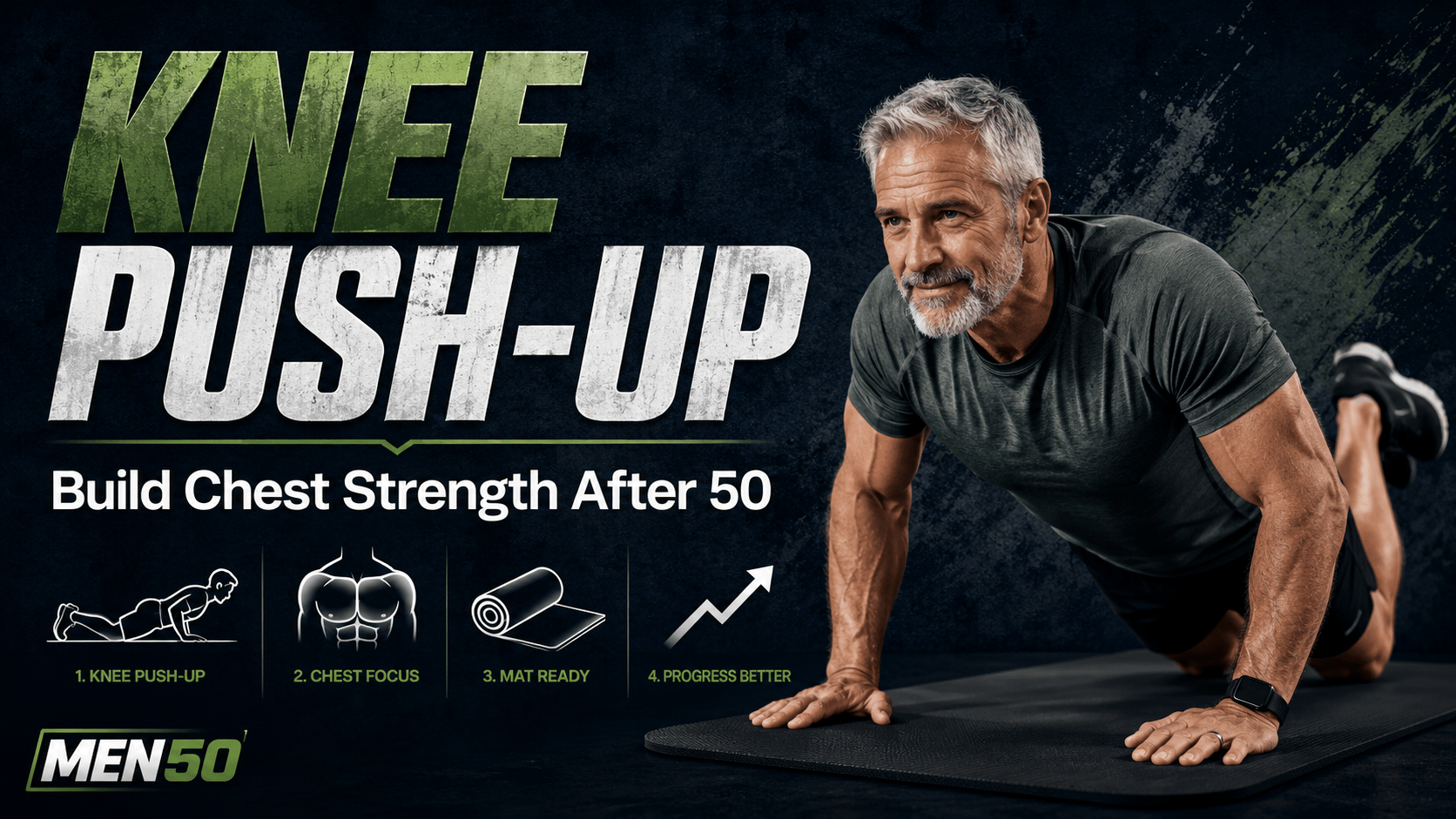
The knee push-up gets dismissed as a “beginner’s exercise” by men who don’t realise how useful it actually is. It’s the only chest-pressing exercise in the matrix that requires literally nothing — no wall, no bench, no equipment. Just a soft surface and your bodyweight. For men over 50 rebuilding pressing strength, training while travelling, or wanting a joint-friendly alternative to floor push-ups, the knee push-up is one of the most accessible pressing options available. It removes about 40% of your bodyweight from the press while keeping the full pressing pattern intact.
Part of the Build Muscle After 50 pillar — strength training for men over 50.
Key Takeaways
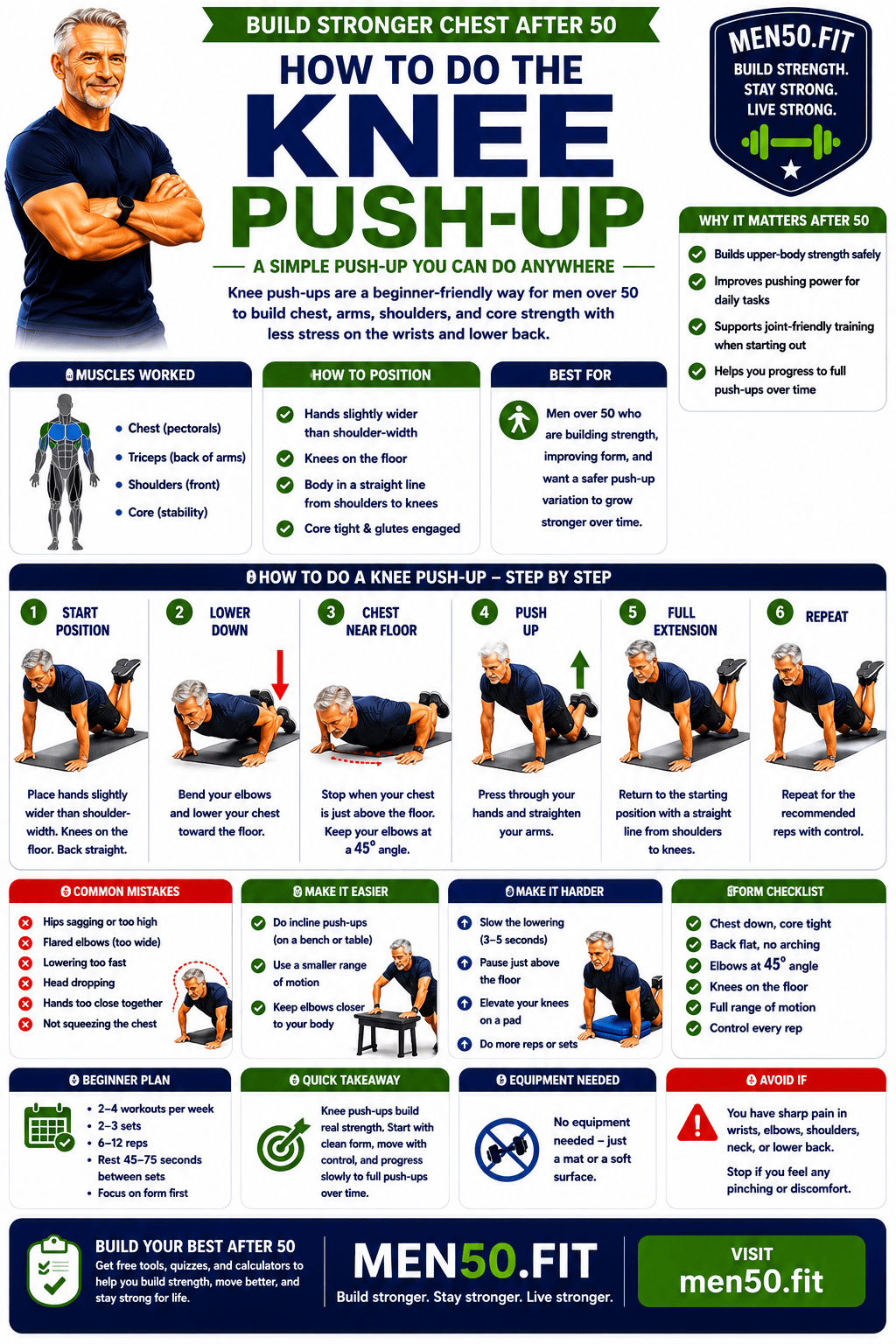
- The knee push-up trains the chest, triceps, front shoulders, and core — the same muscles as a full push-up at roughly 60% of the load.
- Programming: 2–3 sets of 6–12 reps, 2–4 times per week. Rest 45–75 seconds between sets.
- Knee push-ups build real strength. Start with clean form, move with control, and progress slowly to full push-ups over time.
- Bodyweight pressing progression: wall push-up → incline push-up or knee push-up → floor push-up.
- This is the only pressing exercise that genuinely needs no equipment. If you’re in a hotel room, a friend’s spare bedroom, or anywhere without a wall or bench at the right height, knee push-ups work.
How to Perform the Knee Push-Up
Set up first:
- Place a mat or soft surface on the floor for knee comfort.
- Position your hands slightly wider than shoulder-width apart.
- Knees on the floor — about hip-width apart.
- Body in a straight line from shoulders to knees — this is the key. Hips don’t sag down, don’t push up.
- Core tight, glutes engaged, back flat.
Then the movement:
- Start position. Hands slightly wider than shoulder-width, knees on the floor, back straight. Body in a straight line from shoulders to knees. Core engaged.
- Lower down. Bend your elbows and lower your chest toward the floor. Take 2–3 seconds on the way down. Elbows track at about a 45-degree angle from your body — not flared straight out to the sides.
- Chest near floor. Stop when your chest is just above the floor. Keep your elbows at the 45-degree angle, back flat, hips in line with shoulders and knees.
- Push up. Press through your hands and straighten your arms. Drive the floor away from you. Push evenly with both arms.
- Full extension. Return to the starting position with a straight line from shoulders to knees. Don’t slump or arch.
- Repeat. Maintain clean form on every rep. Six clean knee push-ups build more strength than twelve sloppy ones.
The cue that matters most: body in a straight line from shoulders to knees, elbows at 45 degrees. If the hips sag or push up, the exercise stops training the chest and core together as a unit.
Why the Knee Push-Up Matters After 50
Pressing strength matters at every age, but it matters more after 50 because most men experience meaningful upper-body strength decline by then. The chest, triceps, and front shoulders — the muscles that handle every pushing motion in daily life — lose strength steadily without resistance training. Pushing a heavy door, getting up from the floor, lifting groceries onto a shelf, even moving furniture around the house all rely on this strength.
The knee push-up serves three specific purposes in the pressing silo:
It reduces the load to manageable levels. A standard floor push-up requires you to press roughly 100% of your bodyweight minus your feet and lower legs — about 65–75% of total bodyweight. The knee push-up reduces this to roughly 50–60% of bodyweight because the legs from the knees down stay on the floor. For a 180-pound man, that’s the difference between pressing 130 pounds and pressing 100 pounds — a meaningful drop that lets men with limited pressing strength still train the pattern at a useful load.
It teaches the chest-near-floor position. Where the incline push-up brings your hands up to a bench or counter (the chest reaches the bench level), the knee push-up brings your chest to the actual floor. This trains the full range of motion that a floor push-up requires, which is something inclines don’t fully replicate.
It needs no equipment at all. This is the genuine practical case for knee push-ups vs incline push-ups. Wall push-ups need a wall. Incline push-ups need a stable surface at the right height. Floor push-ups need the right pressing strength. Knee push-ups need a soft surface for your knees — that’s it. For travel, hotel rooms, garages, or anywhere without good surfaces, knee push-ups are often the only available bodyweight pressing exercise.
The honest comparison with incline push-ups: many strength coaches prefer incline push-ups as the primary progression bridge because they maintain the full-body plank position that floor push-ups require. Knee push-ups break the plank by resting the lower body on the floor. This is a real consideration if your goal is specifically to progress to floor push-ups. But knee push-ups still build the upper-body pressing strength you need, and they remain useful even for men who include incline push-ups in their routine.
Push-pull balance still applies: for every set of knee push-ups, pair an equivalent set of pulling work — band pull-aparts, resistance band rows, or dumbbell rows — to keep the shoulders balanced and protect against the forward-rounded posture that develops in chest-heavy training.
Sets and Reps
Bodyweight pressing rewards consistency over heavy load. Clean reps with control beat rushed reps every time.
| Stage | Variation | Sets × Reps | Frequency |
|---|---|---|---|
| Beginner | Knee push-up, partial depth | 2 × 6–8 | 2–3× per week |
| Novice | Knee push-up, full depth (chest near floor) | 2–3 × 8–12 | 2–3× per week |
| Intermediate | Knee push-up with 3-second lowering | 3 × 8–12 | 2–4× per week |
| Advanced | Knee push-up with 1-second pause at floor + slow lower | 3 × 8–12 | 2–4× per week |
| Progression | Move to floor push-up | 3 × 5–10 | 2–3× per week |
Rest 45–75 seconds between sets. Stop the set 1–2 reps before form breaks — hips sagging, elbows flaring, or chest not reaching the proper depth all indicate fatigue has caught up with you.
When you can complete 3 sets of 12 knee push-ups with: a controlled 2-second descent, chest reaching the floor, elbows at 45 degrees, back flat throughout, and no form breakdown — you’ve earned the floor push-up. Start by doing your first 1–2 sets as floor push-ups and finishing with knee push-ups, then gradually shift the ratio over weeks.
Common Mistakes
The six errors that turn a great chest exercise into a wasted rep:
- Hips sagging or too high. The most common mistake. Hips drooping toward the floor turns the press into a lower-back exercise; hips hiked up in the air shifts load to the shoulders and reduces chest work. The fix: imagine a straight line from your shoulders to your knees and keep it. Squeeze the glutes and brace the core throughout every rep.
- Flared elbows. Elbows straight out to 90 degrees from the body load the front of the shoulder joint and are the most common cause of push-up shoulder pain. Keep elbows at about 45 degrees from your torso — they should form an arrow shape, not a T.
- Lowering too fast. Dropping toward the floor with speed skips the eccentric (lowering) phase, where most of the strength gets built. Take 2–3 seconds on the way down on every rep.
- Head dropping. Letting the head hang down breaks the neutral spine and adds neck strain. Keep your gaze on the floor about 6 inches ahead of your hands. Neck stays in line with your spine.
- Hands too close together. Narrow hand placement makes the exercise more triceps-dominant and increases wrist and elbow stress. Hands slightly wider than shoulder-width is the standard chest-focused position.
- Not squeezing the chest. Many men “just push” through reps without actively engaging the chest. At the top of each rep, consciously squeeze the chest muscles together. The mind-muscle connection genuinely helps build chest strength.
Make It Easier or Harder
If standard knee push-ups are too challenging:
- Do incline push-ups on a bench, counter, or sturdy chair — usually easier than knee push-ups and teaches the full plank position.
- Use a smaller range of motion — lower only halfway down while you build strength. Add depth over weeks.
- Keep elbows closer to your body — about 30 degrees from your torso, which makes the press slightly more triceps-driven and easier for some men.
- Reduce reps — start with 2 sets of 4–6 reps and build up.
To make knee push-ups harder once form is solid:
- Slow the lowering phase to 3–5 seconds per rep — significantly more demanding.
- Pause just above the floor for 1–2 seconds at the bottom of each rep.
- Elevate your knees on a pad — slightly raises your hips so more weight transfers to the arms, making the press harder.
- Do more reps or sets — extend sets to 12–15 reps before considering a harder variation.
- Progress to floor push-ups — the natural next step when knee push-ups feel easy.
For variety, try the wide-hand knee push-up (hands placed wider than usual) once a week — emphasises the outer chest more than the standard position.
Safety Note
Use a soft surface — a yoga mat, folded towel, or carpeted floor — to protect your knees. The knee position is a key reason men get sore from this exercise unnecessarily.
If you feel sharp pain in your wrists, elbows, shoulders, neck, or lower back during knee push-ups, stop. Adjust your elbow angle (45 degrees from the torso, not flared), check your hand position (slightly wider than shoulder-width), and make sure your body stays in a straight line from shoulders to knees. Pinching or sharp discomfort at any joint is worth checking with a physiotherapist before continuing.
Wrist pain is common in men over 50 doing any floor-based push-up variation. If it persists, try push-up handles (which keep the wrists neutral), make a fist and push up on the knuckles (with a mat for cushioning), or switch to incline push-ups which usually have less wrist load.
Build Your Personal Training Plan
The knee push-up is one piece of a complete upper body programme. Get a personalised exercise plan based on your current strength, goals, and any limitations.
Take the Free Fitness Profiler →
FAQs
Knee push-up vs incline push-up — which is better?
Both work; they have different advantages. Incline push-ups maintain the full plank position (body straight from heels to head), which trains the core and full-body bracing pattern that translates directly to floor push-ups. Knee push-ups train the same chest, shoulder, and triceps muscles but with the knees as a support point — easier on the wrists for some men, and they need no equipment beyond a soft surface. Most strength coaches prefer incline push-ups for the progression-to-floor goal. But knee push-ups remain useful for: travel (no equipment needed), wrist comfort (you can adjust hand position more easily), and as an alternative if no incline surface is available. Many men over 50 benefit from doing both — incline push-ups some sessions, knee push-ups others.
How many knee push-ups should I be able to do?
There’s no fixed target — the right number is the one that lets you keep clean form. For most men over 50, the working range is 6–12 clean reps per set. If you can do 20+ knee push-ups with perfect form, you’re likely ready to start incorporating floor push-ups into your routine. If you can barely do 5, that’s where you start — and with 2–4 weeks of consistent training, most men can double their starting count.
When am I ready to move to floor push-ups?
When you can complete 3 sets of 12 knee push-ups with: a controlled 2-second descent, chest reaching the floor, elbows at 45 degrees, back flat throughout, and no form breakdown on the last reps. Hit that consistently for 2–3 sessions in a row and you’ve earned the floor push-up. Start your sessions with 1–2 sets of floor push-ups (do as many as you can with clean form), then finish with knee push-ups for higher rep volume. Over weeks, the ratio shifts toward more floor push-ups.
Why do my wrists hurt during knee push-ups?
Three common causes. Existing wrist arthritis or tendinopathy — common in men over 50, especially those who type a lot. Wrist angle too extreme — the standard 90-degree bend at the wrist puts pressure on tissues that may not handle it well. Try push-up handles, dumbbell handles, or pushing on your knuckles (with cushion) to keep the wrist more neutral. Hand position — hands too far forward of the shoulders increases wrist load. Position the hands directly under the shoulders. If wrist pain persists, incline push-ups usually have less wrist load because more of your weight is on your feet rather than your hands.
Can I do knee push-ups every day?
For low-intensity, partial-set work, daily is fine — one set of 8–10 with full rest each morning is a sustainable habit. For higher-intensity sessions (multiple sets to near-failure with slow tempo), 48 hours between sessions is the standard recommendation. The chest, shoulders, and triceps need recovery to grow stronger. Most men over 50 do best with 2–3 dedicated push-up sessions per week.
References
- American College of Sports Medicine. Resistance Training for Older Adults Position Stand. acsm.org
- Yang J, Christophi CA, Farioli A, et al. Association Between Push-up Exercise Capacity and Future Cardiovascular Events Among Active Adult Men. JAMA Network Open. 2019;2(2):e188341.
- National Institute on Aging. Sarcopenia and Muscle Strength in Older Adults. nia.nih.gov
Disclaimer: This article is for educational purposes only and is not medical advice. Consult a qualified healthcare professional before starting any new exercise programme, especially if you have existing wrist, shoulder, or back conditions.