
The floor push-up remains the most reliable bodyweight test of upper body strength you can do. It builds the chest, triceps, and front shoulders, trains the core to hold a rigid plank under load, and needs zero equipment. After 50, it’s also one of the cleanest measures of whether your pressing strength is keeping pace with your bodyweight — and a benchmark you can track for years.
Part of the Build Muscle After 50 pillar — strength training for men over 50.
Key Takeaways
- The floor push-up is an intermediate movement. Most men over 50 should earn it by mastering incline push-ups first.
- Hands slightly wider than shoulders, elbows at 45 degrees from the body, body in one straight line from head to heels.
- A landmark study found men who could do 40+ push-ups had a 96% lower risk of cardiovascular events over 10 years compared with those who could do under 10.
- Programming: 3–4 sets of 6–12 clean reps, 2–3 times per week. Quality reps beat junk reps every time.
- Stop a rep or two before form breaks. Sagging hips and flared elbows turn a great exercise into a shoulder problem.
How to Perform the Floor Push-Up
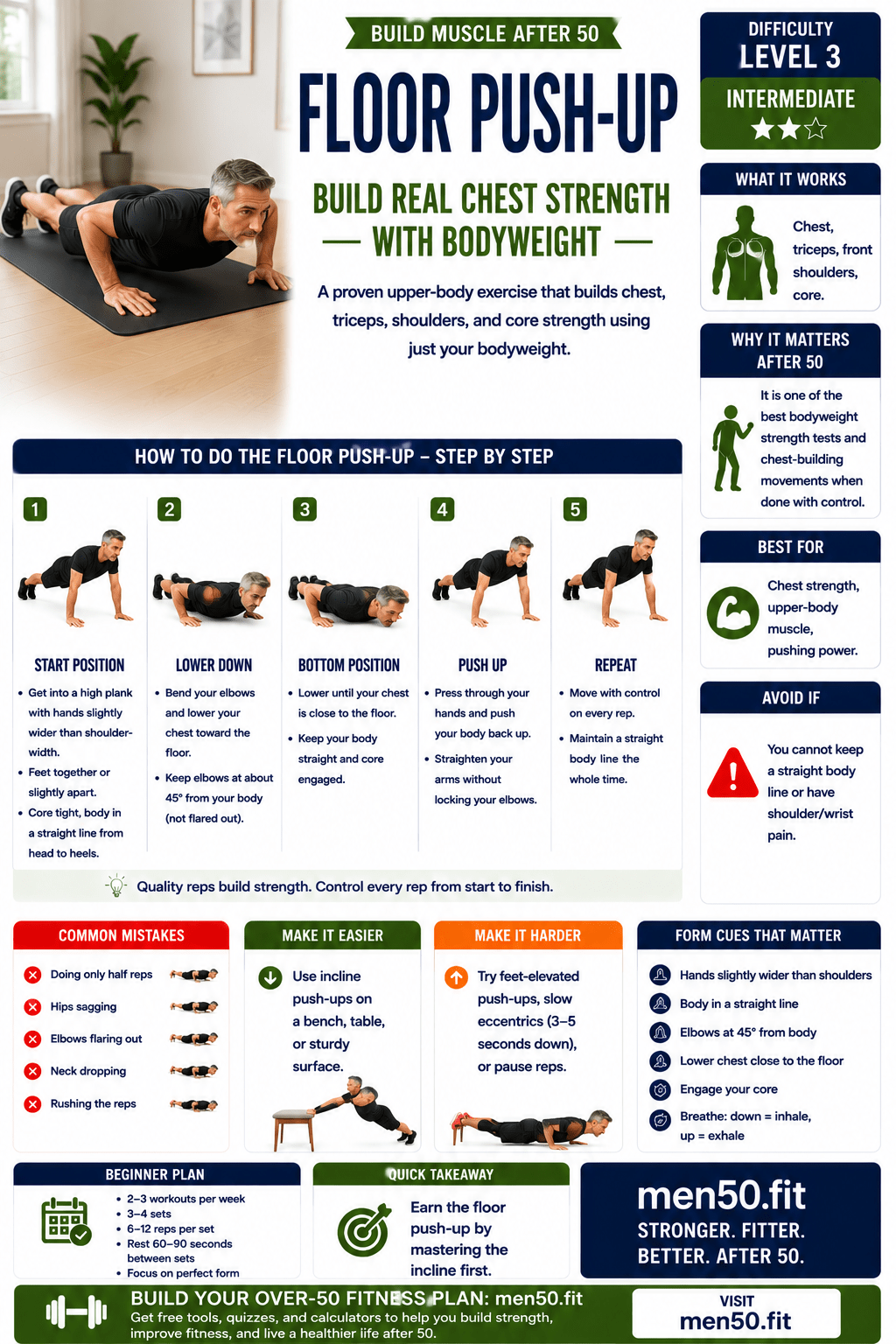
- Get into a high plank with your hands slightly wider than shoulder-width, fingers pointing forward, body forming one straight line from head to heels.
- Brace your core and squeeze your glutes so your hips don’t sag or pike up. This is the position you maintain the entire set.
- Lower your chest toward the floor by bending your elbows. Keep them at roughly 45 degrees from your torso — not flared straight out to the sides.
- Stop when your chest is just above the floor or lightly touches it. Don’t crash down.
- Press firmly back to the start position. Straighten your arms without locking the elbows.
- Breathe in as you lower, out as you push up.
Stop the set when form starts to break — sagging hips, flared elbows, or half-range reps. Five clean push-ups build more strength than fifteen sloppy ones.
Why the Floor Push-Up Matters After 50
A 2019 study published in JAMA Network Open tracked over 1,100 middle-aged men for 10 years and found that those who could complete 40 or more consecutive push-ups had a 96% lower risk of cardiovascular disease events compared with those who could manage fewer than 10. Push-up capacity turned out to be a stronger predictor of cardiovascular health than treadmill-tested aerobic capacity in that sample.
That’s not because push-ups themselves are cardiovascular training — they aren’t, much. It’s that the ability to perform many of them reflects a combination of upper body strength, core stability, bodyweight management, and recovery between reps that tracks closely with overall functional health. Improving your push-up number is one of the cleanest ways to improve all of those at once.
The push-up also trains the serratus anterior, a shoulder stabiliser that sits along the side of the ribcage and is critical for healthy shoulder mechanics. Machine chest presses don’t recruit it the same way — the floor push-up does, because your shoulder blades have to move freely against your ribcage as you press up.
Sets and Reps
Progress through these stages. Don’t skip ahead — every stage you skip becomes a sticking point later.
| Stage | Variation | Sets × Reps | Frequency | Goal |
|---|---|---|---|---|
| Beginner | Wall or high incline (counter height) | 2–3 × 8–12 | 2–3× per week | Build pressing pattern, no shoulder pain |
| Novice | Lower incline (bench or sturdy chair) | 3 × 8–12 | 2–3× per week | Hold a rigid plank through every rep |
| Intermediate | Floor push-up (the goal) | 3–4 × 6–12 | 2–3× per week | Earn your first 10 clean reps, then 20 |
| Advanced | Floor with 3-second lowering, or feet elevated | 3–4 × 6–10 | 2–3× per week | Build toward 40+ reps in a single set |
Rest 60–90 seconds between sets. Track your numbers in a notebook or app — consistent improvement in push-up count is one of the most reliable signals that your upper body training is working.
Common Mistakes
The five errors that turn a good push-up into a shoulder or back problem:
- Doing only half reps. Stopping when your chest is still a foot off the floor doesn’t count. The bottom half of the movement is where the chest and triceps do the most work.
- Hips sagging. Means your core isn’t bracing. The lower back gets the load instead. Squeeze the glutes and brace the abs hard before starting each rep.
- Elbows flaring out to 90 degrees. This is the single biggest cause of shoulder pain in push-ups. Keep elbows tracking at roughly 45 degrees from the torso — the arms form an arrow shape when viewed from above, not a T.
- Neck dropping or head straining forward. Keep the head in line with the spine. Look at the floor about six inches in front of your hands.
- Rushing the reps. Speed hides poor form. Slow down, especially on the lowering phase, and you’ll feel exactly which muscles are working.
Make It Easier or Harder
If the floor push-up is currently out of reach, use an incline push-up with your hands on a sturdy bench, chair, or kitchen counter. The higher the surface, the easier the movement. As you get stronger, lower the surface step by step — counter, then a sturdy table, then a low bench, then the floor.
Once you can do 12–15 clean floor push-ups in a set, progress in this order: slow the lowering phase to 3–5 seconds per rep, add a pause at the bottom for 1–2 seconds, then elevate your feet on a low step or bench to shift more load onto the shoulders and upper chest.
Knee push-ups are also an option, but they teach a slightly different bracing pattern than the full push-up. For most men over 50, the incline progression transfers better to the eventual goal.
Safety Note
If you have wrist discomfort, try push-up handles or making loose fists on the floor — both keep the wrist in a more neutral position than the flat-palm version. If wrist pain persists, drop back to incline push-ups on a bench or counter, where the angle reduces the load on the wrist.
If you have a history of shoulder impingement or rotator cuff issues, check your elbow position first — flared elbows are usually the cause. If pain persists with clean form, stay on incline push-ups until cleared by a physiotherapist.
Avoid the floor push-up entirely if you can’t hold a rigid plank for 20 seconds without sagging. The plank is the foundation — without it, every rep loads your lower back instead of your chest.
Build Your Personal Training Plan
The floor push-up is one piece of a complete upper body programme. Get a personalised exercise plan based on your current strength, goals, and any limitations.
Take the Free Fitness Profiler →
FAQs
How many push-ups should a man over 50 be able to do?
There’s no single right number, but the JAMA Network Open study found significant cardiovascular benefit at 40+ reps. A reasonable progression for most men over 50: get to 10 clean floor push-ups first, then 20, then aim for 30–40 over the following year. If you can do 25+ clean reps in your 50s, you’re in better shape than most men 20 years younger.
What if I can’t do a single floor push-up?
Start with incline push-ups against a wall, kitchen counter, or sturdy table. The steeper the angle, the easier the movement. Work through 3 sets of 10 reps at each height, then lower the surface and repeat. Most men progress from wall push-ups to floor push-ups in 6–12 weeks if they train 2–3 times per week.
Are push-ups bad for shoulders after 50?
Done with flared elbows and sagging hips, yes — they’re one of the most common causes of shoulder pain. Done with elbows at 45 degrees and a rigid plank, they actively strengthen the shoulder stabilisers and rotator cuff support muscles. Form is everything. If you have existing shoulder pain, start with wall or high-incline push-ups and progress slowly.
How often should I do push-ups?
Two or three times per week is enough. The chest and triceps need 48 hours to recover between sessions for men over 50 — more often than that and you’ll lose strength rather than build it. Pair push-up sessions with a pulling exercise like the dumbbell row to keep the shoulders balanced.
Knee push-ups vs incline push-ups — which is better?
Incline push-ups for most men over 50. They train the same plank-and-press pattern you’ll need for the full version, just with less load. Knee push-ups shift the bracing pattern enough that some of the transfer is lost. If knee push-ups are your only option (limited furniture, travel, injury), they still work — they’re just less efficient as a step toward the floor version.
References
- Yang J, Christophi CA, Farioli A, et al. Association Between Push-up Exercise Capacity and Future Cardiovascular Events Among Active Adult Men. JAMA Network Open. 2019;2(2):e188341.
- Centers for Disease Control and Prevention. Physical Activity Guidelines for Americans, 2nd Edition. cdc.gov
- American College of Sports Medicine. Resistance Training for Older Adults Position Stand. acsm.org
Disclaimer: This article is for educational purposes only and is not medical advice. Consult a qualified healthcare professional before starting any new exercise programme, especially if you have existing shoulder, wrist, or back conditions.