
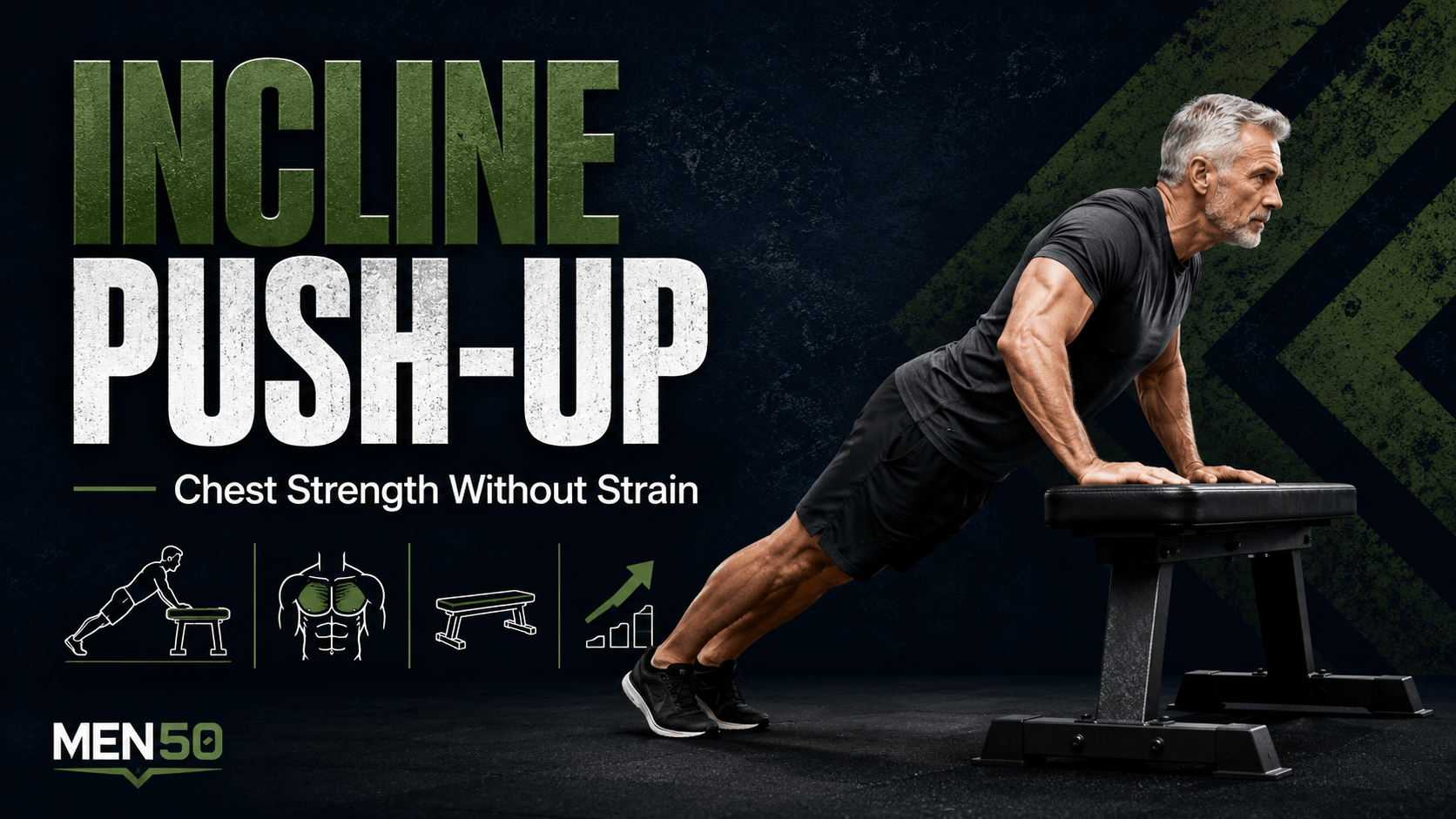
The incline push-up is the workhorse pressing exercise for most men over 50 — and the one most likely to live in your routine for years. It builds chest, shoulder, and triceps strength with significantly less joint stress than a floor push-up, scales to any fitness level just by changing the surface height, and works at home with nothing more than a sturdy bench, table, or countertop. It’s also the crucial middle step in the push-up progression: harder than wall push-ups, easier than floor push-ups, and the one most men should spend the longest time on.
Part of the Build Muscle After 50 pillar — strength training for men over 50.
Key Takeaways
- The incline push-up trains the chest, triceps, and front shoulders at a fraction of the floor push-up’s joint load.
- The lower the surface, the harder the push-up. Progression is built into the exercise — you don’t need new equipment to make it harder.
- Programming: 3 sets of 6–12 reps, 2–3 times per week. Stop 1–2 reps before failure. Quality reps beat junk reps.
- Elbows track at 30–45 degrees from the torso — not flared straight out. Same rule applies at wall, incline, and floor.
- This is the middle of the push-up progression: wall → counter → bench → low bench → floor. Most men should spend 6–12 weeks at each step.
How to Perform the Incline Push-Up
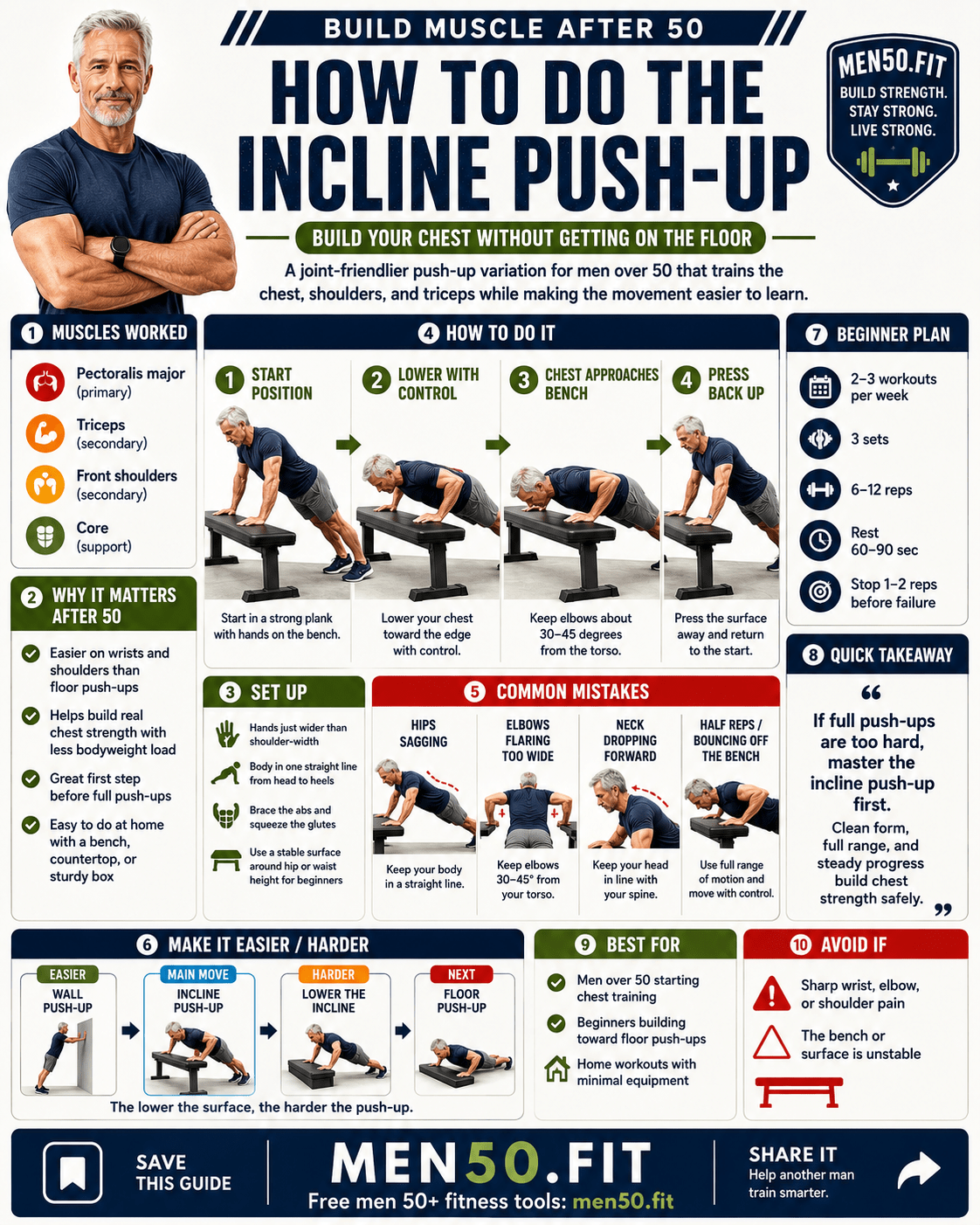
Set up first:
- Choose a sturdy surface around hip or waist height for beginners — a kitchen counter, sturdy table, or bench. Make sure it won’t slide or tip.
- Place your hands just wider than shoulder-width on the surface.
- Step your feet back so your body forms one straight line from head to heels.
- Brace your abs and squeeze your glutes — this is what keeps the hips from sagging or piking.
Then the movement:
- Start position. Strong plank position with hands on the bench, body in a straight line head to heels. Core tight, glutes engaged, neck neutral. Look slightly ahead of your hands, not straight down.
- Lower with control. Bend the elbows and lower your chest toward the edge of the bench. Keep your elbows at roughly 30–45 degrees from your torso — not flared out wide, not pinned to your ribs. Take 2–3 seconds on the way down.
- Chest approaches the bench. Lower until your chest is just above or lightly touches the bench. Don’t crash down. Maintain the rigid plank from head to heels.
- Press back up. Press firmly through your hands to return to the start position. Straighten the arms without locking the elbows. Move smoothly — no bouncing off the bench.
Stop the set 1–2 reps before form starts to break. The last clean rep is more valuable than the first sloppy one.
Why the Incline Push-Up Matters After 50
Pressing strength declines faster than most men expect after 50, particularly in those who stopped formal training in their 40s or never started. The chest, shoulders, and triceps are involved in nearly every daily pushing motion — getting up from the floor, pushing open a heavy door, lifting overhead, pushing a lawnmower or a shopping trolley. Lose this strength quietly over a decade and the consequences show up as slowed daily function long before they show up as a gym performance issue.
The incline push-up trains all three of these muscle groups in their natural movement pattern, with bodyweight as the load, in a position that’s significantly easier on the joints than either the floor push-up or the barbell bench press. The angle of the body — leaning into the bench rather than horizontal to the floor — reduces the percentage of bodyweight loaded through the wrists, elbows, and shoulders. For men with mild shoulder impingement, wrist arthritis, or general joint tenderness, this difference is the difference between training consistently and getting derailed by aches every other week.
The progression principle built into the exercise is also useful. The same movement that’s challenging at counter height becomes manageable in 4–6 weeks. Drop to a lower surface, and it’s challenging again. Drop further still and eventually you’re at the floor. This is one of the cleanest examples of progressive overload available without equipment — and it lets the same exercise stay in your routine for years rather than being something you outgrow.
The 2019 JAMA Network Open study by Yang and colleagues (the one cited extensively in the floor push-up article) found that push-up capacity predicted cardiovascular health better than treadmill aerobic capacity in over 1,100 men. The benchmarks in that study used floor push-ups, but the underlying message — pressing strength tracks closely with cardiovascular and overall health — applies to the broader push-up pattern. Building incline push-up capacity is genuine investment in the markers that matter.
Sets and Reps
Volume first, then load. Build clean reps before lowering the surface.
| Stage | Surface Height | Sets × Reps | Frequency |
|---|---|---|---|
| Beginner | Kitchen counter (waist height) | 2–3 × 6–10 | 2× per week |
| Novice | Counter or high bench | 3 × 8–12 | 2–3× per week |
| Intermediate | Standard bench (knee–hip height) | 3 × 8–12 | 2–3× per week |
| Advanced | Low bench or sturdy step | 3 × 6–10 | 2–3× per week |
| Progression | Floor push-up | See floor push-up article | 2–3× per week |
Rest 60–90 seconds between sets. Stop 1–2 reps before failure — pushing to absolute failure on bodyweight pressing work compromises form and recovery without adding meaningful benefit for men over 50.
When you can do 3 sets of 12 clean reps at a given surface height — full range, controlled tempo, no bouncing, no piking at the hips — you’ve earned the next step down.
Common Mistakes
The four errors that turn a great exercise into a shoulder problem:
- Hips sagging. The most common error. As fatigue sets in, the abs stop bracing and the lower back sags toward the bench. This loads the spine instead of the chest. Squeeze the glutes hard, brace the abs, and stop the set when the body stops moving as one rigid line.
- Elbows flaring too wide. Elbows at 90 degrees from the torso loads the front of the shoulder joint and is the single biggest cause of shoulder pain in any push-up variation. Keep elbows tracking at 30–45 degrees. The arms should make an arrow shape when seen from above, not a T.
- Neck dropping forward. Some men crane the neck down to chase a deeper rep or to peek at their form. Keep the head in line with the spine — look slightly ahead of your hands, not straight down. A long line from skull to heels.
- Half reps or bouncing off the bench. Stopping a foot above the bench skips the bottom of the rep where the chest does its work. Bouncing off the bench uses momentum instead of muscle. Lower with control, briefly touch (or come close), then press back up smoothly.
Make It Easier or Harder
The incline push-up has the cleanest progression path of any exercise in the matrix:
- Easier → Wall push-up. If incline push-ups at your highest available surface are too challenging, step back to the wall variation. Master that first.
- Main move → Incline push-up at counter or bench height.
- Harder → Lower the incline. Counter → high bench → standard bench → low bench → step. Each drop in surface height adds maybe 10–15% of bodyweight to the load.
- Next → Floor push-up. The eventual goal for most men over 50, but only earn it when low-bench reps feel clean and easy.
Other ways to add difficulty without changing surfaces:
- Slow the lowering phase to 3–4 seconds per rep.
- Add a 1–2 second pause at the bottom with chest near the bench.
- Hands closer together (just inside shoulder width) — shifts more load to the triceps.
Pair the incline push-up with the doorway chest stretch to keep the chest mobile, and with horizontal pulling work — band pull-aparts or dumbbell rows — to balance the shoulders. Pushing without pulling is how shoulder problems start.
Safety Note
Make sure your surface is stable. A wobbling table, a chair with wheels, or a bench on a slippery floor is how injuries happen. A solid kitchen counter, a heavy bench secured against a wall, or a sturdy step are all good options.
Avoid locking out the elbows at the top of each rep — keep a slight bend in the arms. Hyperextending the elbows under load is a common source of joint discomfort over time.
If you feel shoulder impingement pain — a sharp pinch at the front of the shoulder during the movement — try widening or narrowing your hand position slightly, or use a higher incline (less load) until the pain resolves. If wrist pain is the issue, push-up handles keep the wrist in a more neutral position and often solve the problem. Sharp pain in any joint that doesn’t resolve with simple adjustments is a sign to see a physiotherapist before continuing.
Build Your Personal Training Plan
The incline push-up is one piece of a complete upper body programme. Get a personalised exercise plan based on your current strength, goals, and any limitations.
Take the Free Fitness Profiler →
FAQs
How do I know when to lower the incline?
When you can complete 3 sets of 12 clean reps at your current surface height — full range of motion, controlled tempo, no bouncing, no piking at the hips. Hit that consistently for 2–3 sessions in a row and you’ve earned the next step down. Don’t rush it. Six months at one incline level is fine if your form is good and you’re still getting stronger. The goal isn’t to reach the floor as quickly as possible; it’s to be able to press your bodyweight cleanly for years.
What’s the right height for the incline surface?
Hip-to-waist height is the standard starting point for most men over 50. A kitchen counter (typically about 36 inches / 90 cm) works well as a beginner-friendly incline. A standard exercise bench (about 18 inches / 45 cm) is a moderate incline. The exact height isn’t critical — what matters is that the surface is stable and the chosen height makes the last 2–3 reps of each set clearly challenging without breaking form.
Can I do incline push-ups every day?
Better to do them 2–3 times per week with proper recovery between sessions. The chest, shoulders, and triceps need roughly 48 hours to recover for men over 50. Daily push-ups will eventually grind the joints down — particularly the wrists and elbows — and reduce rather than improve strength. If you want to train pressing more often, alternate incline push-up days with wall push-up days (lighter load) or with pulling exercises like the dumbbell row.
Are incline push-ups as effective as floor push-ups?
For men whose floor push-ups would have broken form, yes — and arguably more effective, because clean reps at a manageable load build strength faster than messy reps at a load that’s too heavy. For men who can already do clean floor push-ups, incline push-ups are easier and would be less effective for that individual. The right exercise is the hardest version you can do with clean form for the prescribed reps. That’s true at every level.
What should I do if I have shoulder impingement?
Start with a higher incline (counter height or wall push-ups), keep elbows at 30–45 degrees from the torso (never flared wider), and stop immediately if you feel the characteristic sharp pinch at the front of the shoulder. Often a small adjustment in hand position — wider or narrower by an inch or two — eliminates the impingement entirely. If pain persists with all variations, pause pressing work and see a physiotherapist to identify the underlying cause. The doorway chest stretch and wall angels often help impingement by addressing the underlying postural pattern.
References
- Yang J, Christophi CA, Farioli A, et al. Association Between Push-up Exercise Capacity and Future Cardiovascular Events Among Active Adult Men. JAMA Network Open. 2019;2(2):e188341.
- American College of Sports Medicine. Resistance Training for Older Adults Position Stand. acsm.org
- National Institute on Aging. Exercise & Physical Activity: Your Everyday Guide. nia.nih.gov
Disclaimer: This article is for educational purposes only and is not medical advice. Consult a qualified healthcare professional before starting any new exercise programme, especially if you have existing shoulder, wrist, or elbow conditions.