
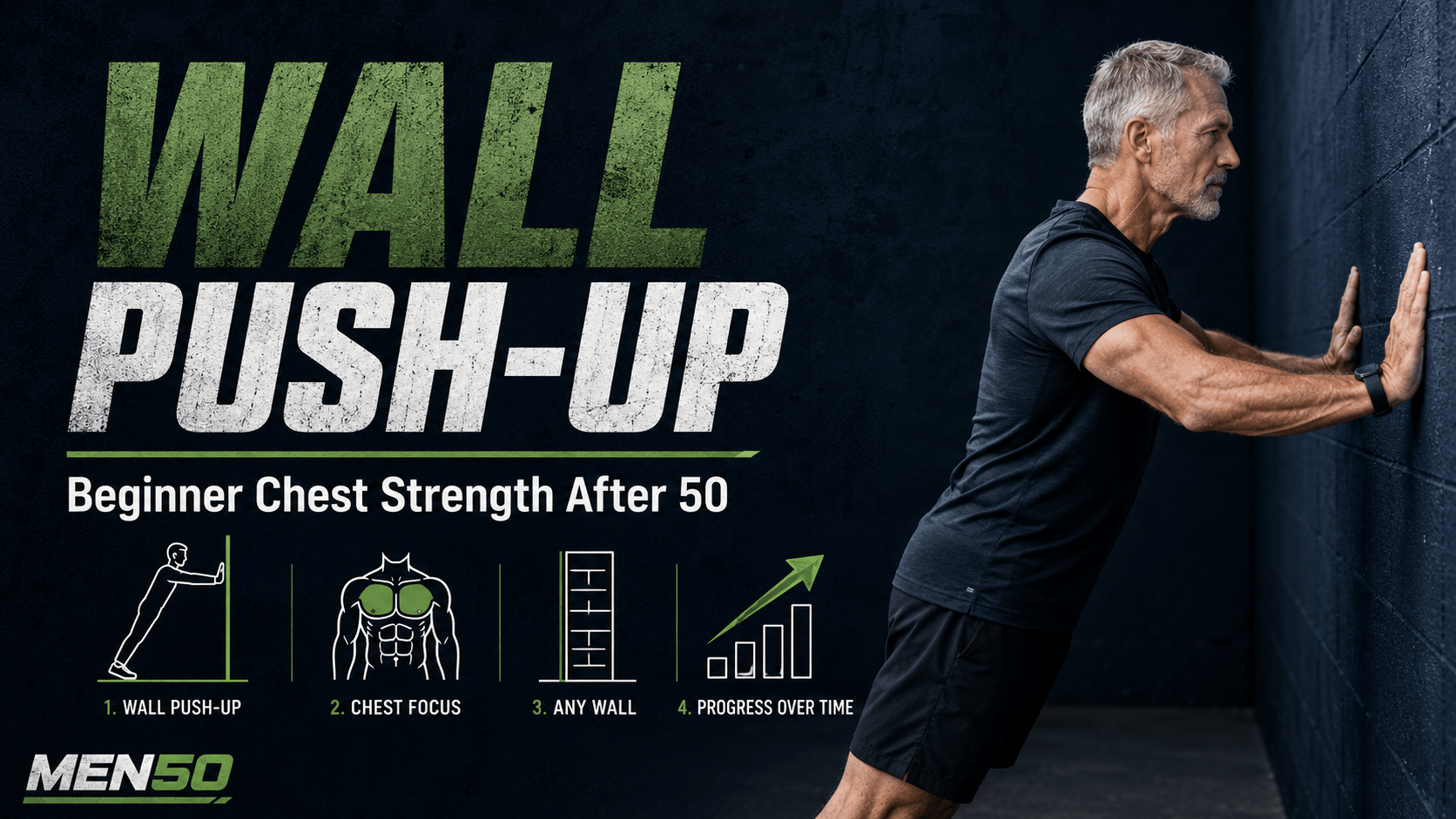
The wall push-up is the most accessible entry point into upper body pressing for men over 50 — and the most underrated. It trains the same pattern as a floor push-up at a fraction of the load, which means you can build pressing strength without aggravating wrists, elbows, or shoulders that aren’t ready for the floor yet. Done consistently, it’s also the cleanest path to the floor push-up: master the wall, earn the incline, then own the floor.
Part of the Build Muscle After 50 pillar — strength training for men over 50.
Key Takeaways
- The wall push-up trains the chest, triceps, shoulders, and core in the same pattern as a floor push-up — with a fraction of the joint load.
- It’s the right starting point for any man over 50 with shoulder pain, wrist discomfort, or who hasn’t trained the upper body for years.
- Programming: 2–4 sets of 8–15 reps, 2–4 workouts per week. Earn the next progression by clean reps, not by counting weeks.
- Master the wall before the floor. The progression chain is wall → counter → bench → floor. Skipping steps is how shoulders get injured.
- Elbows track at roughly 45 degrees from the body — not flared out to the sides. This rule applies at every angle, all the way to the floor.
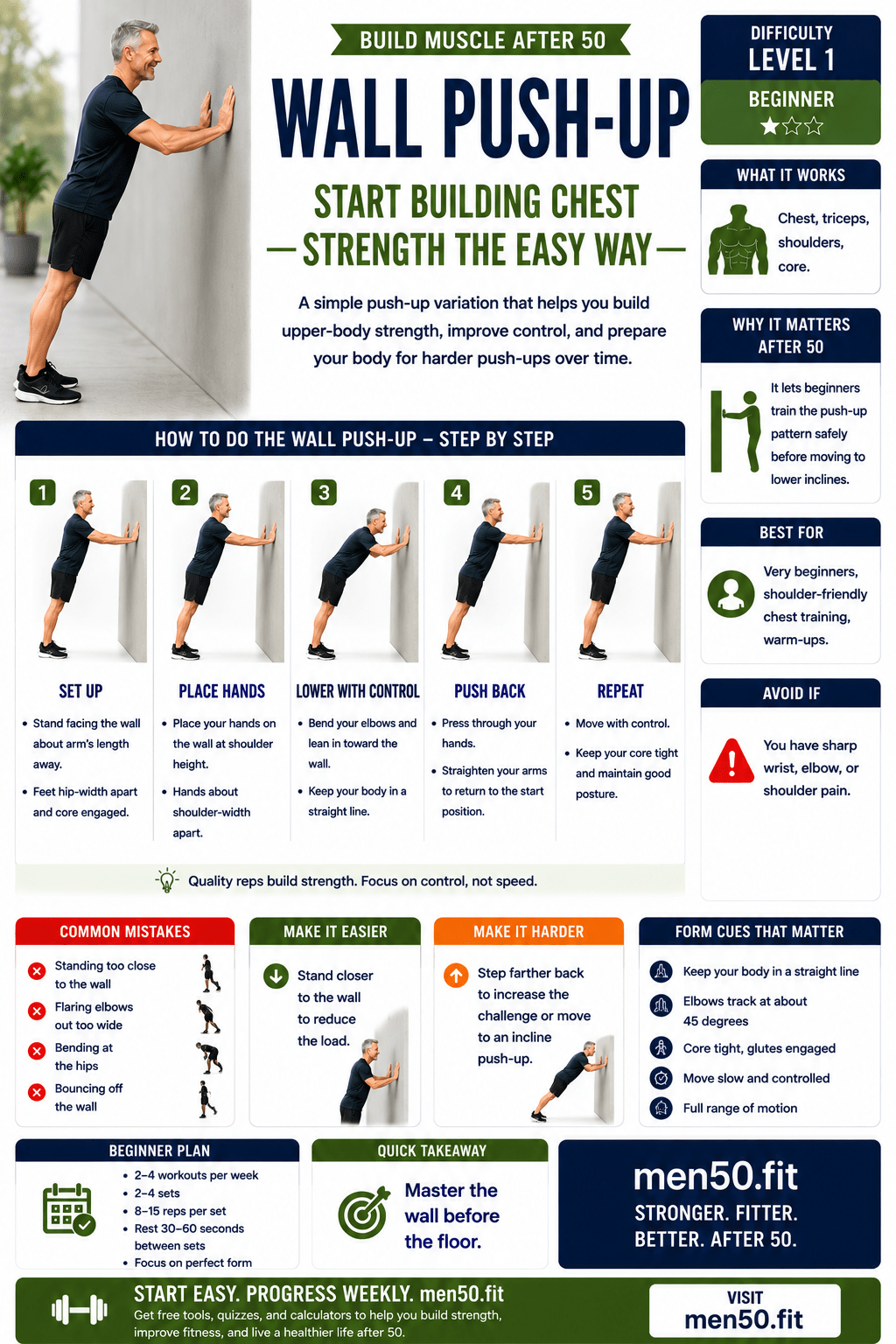
How to Perform the Wall Push-Up
- Set up. Stand facing a wall about arm’s length away. Feet hip-width apart. Core lightly engaged. The further your feet are from the wall, the harder the exercise — start closer if it’s your first session.
- Place hands. Place both palms flat on the wall at shoulder height, hands slightly wider than shoulder-width apart.
- Lower with control. Bend your elbows and lean your chest in toward the wall. Keep your body in one straight line from head to heels — don’t pike at the hips or arch the lower back. Elbows track at about 45 degrees from your torso, not flared out to the sides.
- Push back. Press firmly through your hands to return to the start position. Straighten the arms without locking the elbows.
- Repeat. Move with control. Keep the core tight, glutes engaged, and posture honest the whole way through. No bouncing off the wall.
Quality reps build strength. Five clean wall push-ups will get you to the floor faster than fifteen sloppy ones.
Why the Wall Push-Up Matters After 50
Pressing strength matters more than men over 50 usually realise. It’s what gets you off the floor if you fall, opens heavy doors, pushes a stuck window up, lifts a grandchild overhead. It’s also one of the first things to noticeably decline after 50 if you haven’t been training it — partly because of muscle loss, and partly because most men simply stop pushing things in daily life once desk work takes over.
The push-up is the most efficient bodyweight movement for training that pattern. But for many men over 50, the floor version is currently out of reach — either because the strength isn’t there yet, or because old shoulder, wrist, or elbow issues make full floor loading uncomfortable. That’s where the wall push-up earns its place. It loads the same muscles (chest, triceps, anterior deltoids) and trains the same plank-and-press pattern, at maybe 15–20% of the load. The pattern transfers; the joint stress doesn’t.
There’s also a longevity-of-training argument. Men who jump straight to floor push-ups when their shoulders aren’t ready often pick up a small injury that derails training for weeks or months. Men who progress through wall → incline → floor build the same strength on a slightly longer timeline but without the setbacks — and end up further ahead a year later.
Sets and Reps
Build clean reps before adding difficulty. The wall push-up is the foundation for every harder push-up you’ll ever do.
| Stage | Sets × Reps | Frequency | Distance from Wall |
|---|---|---|---|
| Beginner | 2 × 8–10 | 2–3× per week | Close (arms reach the wall easily) |
| Novice | 3 × 10–15 | 3× per week | Standard (arm’s length) |
| Intermediate | 3–4 × 12–15 | 3–4× per week | Slightly further back (more incline) |
| Progression | 3 × 8–12 | 3× per week | Move to a counter or bench (incline push-up) |
Rest 30–60 seconds between sets. When you can complete 3 sets of 15 clean wall push-ups at standard distance — slow, controlled, full range, no bouncing — you’ve earned the incline push-up using a sturdy kitchen counter or bench.
Common Mistakes
The four errors that turn a great beginner exercise into a wasted one:
- Standing too close to the wall. Makes the exercise too easy and limits the load on the chest. Step back until you feel a real challenge in the last 2–3 reps of each set.
- Flaring elbows out to 90 degrees. This is the single biggest cause of shoulder pain in any push-up variation — wall included. Keep elbows tracking at roughly 45 degrees from the torso. The arms should form an arrow shape, not a T.
- Bending at the hips. Some men pike at the waist so only the upper body leans toward the wall while the hips stay back. The body should move as one straight piece — head, chest, hips, and heels all in line.
- Bouncing off the wall. Using the rebound to start the next rep trains nothing and shortens the range of motion where the chest does its work. Pause briefly at the bottom, then press back with control.
Make It Easier or Harder
If standard distance is too challenging, stand closer to the wall. The closer your feet, the less of your bodyweight is loaded into your hands. There’s no shame in starting six inches from the wall — strength is built from where you are, not where you wish you were.
To make it harder once standard distance feels easy: step further back to increase the incline, slow the lowering phase to 3 seconds per rep, or move to an incline push-up using a sturdy kitchen counter, then a chair or low bench. The progression chain — wall → counter → bench → floor — is the safest path to a full floor push-up.
Pair the wall push-up with the doorway chest stretch to keep the chest mobile, and the band pull-apart to keep the upper back strong. Pushing without pulling is how shoulder problems start.
Safety Note
Keep elbows at roughly 45 degrees from the torso — not flared out to 90 degrees. This single cue prevents most of the shoulder problems that push-up variations cause in men over 50.
If you have a current shoulder, elbow, or wrist injury, stay within a comfortable pain-free range of motion. Don’t push through sharp pain. If standard wrist position causes discomfort, try push-up handles or making loose fists on the wall — both keep the wrist in a more neutral position. If pain persists, see a physiotherapist before continuing.
Build Your Personal Training Plan
The wall push-up is one piece of a complete upper body programme. Get a personalised exercise plan based on your current strength, goals, and any limitations.
Take the Free Fitness Profiler →
FAQs
How do I know I’m ready to progress to incline push-ups?
When you can do 3 sets of 15 clean wall push-ups at standard distance (arm’s length) — full range of motion, controlled tempo, no bouncing, no piking at the hips. If you’re hitting 15 reps but the last few look messy, stay at the wall another week. The point of progression isn’t to move on as fast as possible; it’s to never need to come back.
Can wall push-ups actually build muscle?
Yes — for beginners and for men returning to training after a long break. Any resistance that challenges the muscle through a full range of motion will build it, and wall push-ups are challenging enough for most men over 50 who haven’t been pressing in a while. The strength and size gains plateau once you can do 20+ reps easily, which is your cue to progress to a harder variation. The chest doesn’t know what angle you’re at — it only knows whether the load is challenging.
How many wall push-ups should I be able to do?
3 sets of 15 with clean form at arm’s length distance is a good benchmark. Hit that and you’re ready for incline push-ups. Some men get there in 2–3 weeks; others take 8–12 weeks. Both are fine. The number isn’t a competition — it’s a marker for when to move on.
Are wall push-ups good for shoulder rehab?
For most non-acute shoulder issues, yes — they’re often used in early-stage physio rehab because they load the chest and shoulder muscles at very low intensity. They’re an excellent way to maintain the pressing pattern while a more irritated joint settles down. But if you have a recent acute injury (rotator cuff tear, frozen shoulder, recent surgery), get clearance from your physio before starting — the right starting point depends on the specific condition.
Should I be sore after wall push-ups?
Mild soreness in the chest, fronts of the shoulders, or triceps the day after is normal, especially in the first 2–3 weeks. It usually fades within a couple of sessions as your muscles adapt. If you’re getting sharp pain during the movement, in the wrists, elbows, shoulder joint itself, or lower back — that’s not soreness, that’s a form problem or load problem. Drop closer to the wall and check your elbow angle.
References
- American College of Sports Medicine. Resistance Training for Older Adults Position Stand. acsm.org
- National Institute on Aging. Exercise & Physical Activity: Your Everyday Guide. nia.nih.gov
- Centers for Disease Control and Prevention. Physical Activity Guidelines for Americans, 2nd Edition. cdc.gov
Disclaimer: This article is for educational purposes only and is not medical advice. Consult a qualified healthcare professional before starting any new exercise programme, especially if you have existing shoulder, wrist, or elbow conditions.