
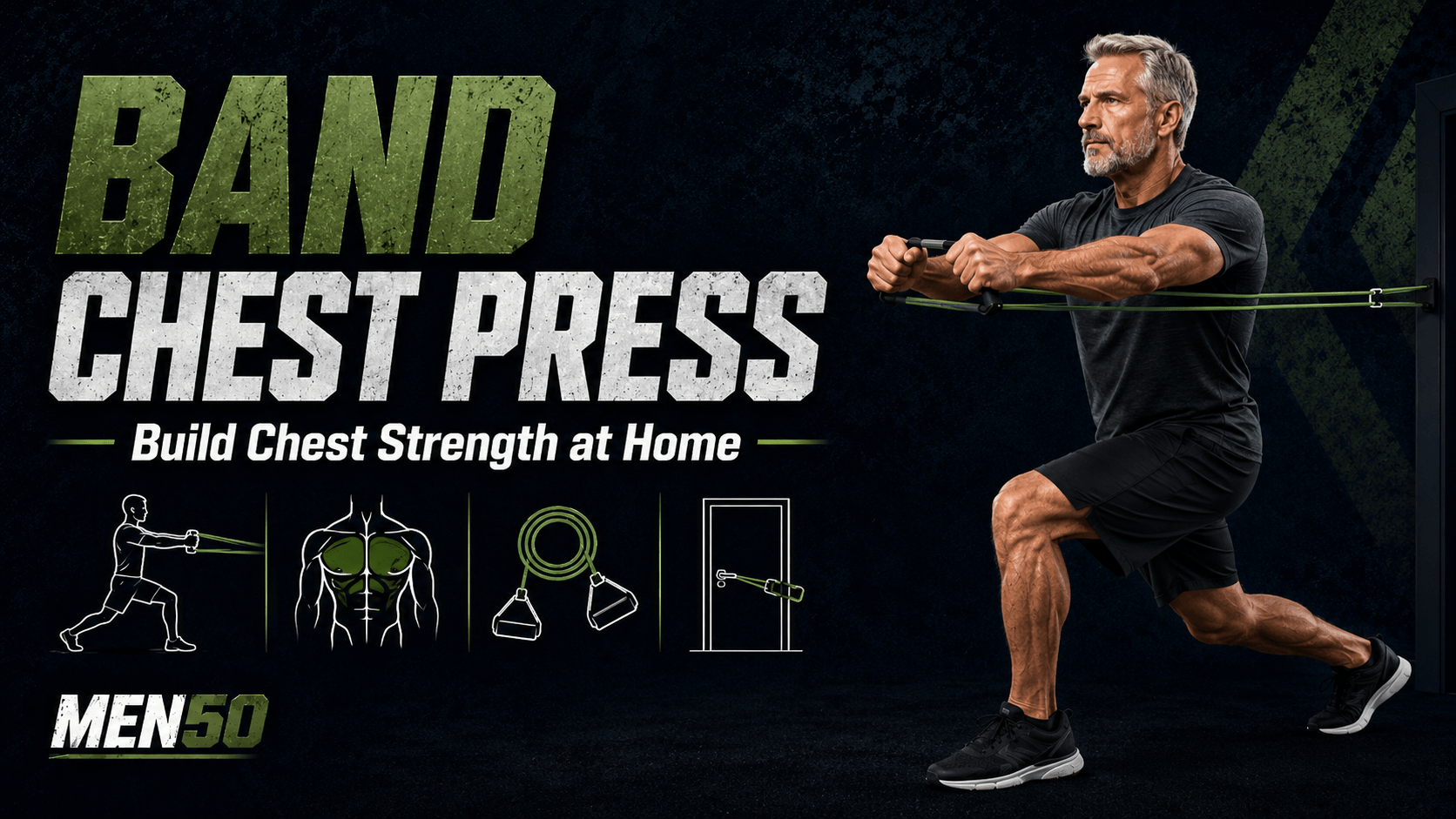
The resistance band chest press is the most portable, scalable, and home-friendly chest exercise in the matrix. The same band kit that works for resistance band rows handles pressing too — anchor it behind you instead of in front, step into a split stance, press forward. No bench, no floor space, no heavy dumbbells. The band scales naturally just by stepping further from the anchor for more tension. For men who train at home, travel often, or want a joint-friendly alternative to weighted pressing, this is genuinely one of the most useful exercises you can learn.
Part of the Build Muscle After 50 pillar — strength training for men over 50.
Key Takeaways
- The resistance band chest press trains the chest, triceps, and front shoulders — the same muscles as a dumbbell floor press, with portable equipment.
- Programming: 2–4 sets of 8–15 reps, 2–3 times per week. Rest 45–75 seconds between sets.
- Press forward with control and keep your ribs down. The ribs-down cue is what stops the lower back from arching to compensate.
- The band’s variable resistance — easier at the start, harder at the end — trains the pressing lockout more than dumbbells do.
- Anchor safety is critical. The band must be on a secure anchor that cannot pull free under tension.

How to Perform the Resistance Band Chest Press
Set up first:
- Anchor the band securely at chest height — a door anchor with the door closed, a sturdy post, or a wall mount designed for resistance training.
- Hold a handle in each hand with palms facing forward (or slightly inward).
- Step forward into a split stance — one foot in front of the other for stability.
- Wrists neutral, core lightly braced, elbows starting at about 45–60° from the body.
Then the movement:
- Anchor and stance. Anchor the band behind you at chest height. Step forward into a stable split stance, far enough away that the band has some tension at the starting position. Feet planted.
- Start. Begin with the handles at chest level, elbows slightly out from the body (not flared straight to the sides), chest tall, shoulders down.
- Press forward. Press the handles straight forward until your arms are almost straight. Don’t lock the elbows hard — keep a slight bend at the end. Press evenly with both arms.
- Squeeze. Pause briefly at the end of the press and squeeze your chest. Don’t over-arch your back. Keep ribs down.
- Return. Bring the handles back slowly and under control to the start position. Take 2–3 seconds on the return. Don’t let the band snap your hands back to the chest.
The cue that matters most: press forward with control and keep your ribs down. The ribs-down cue stops the lower back from arching to “help” the press, which is the most common compensation when the band is too heavy or your core isn’t bracing enough.
Why the Resistance Band Chest Press Matters After 50
The pressing pattern matters at any age, but it matters more after 50 because pressing strength declines faster than men expect. The chest, triceps, and front shoulders handle every push you make in daily life — opening heavy doors, pushing a lawnmower, getting up from the floor. Lose this strength over a decade and the consequences accumulate slowly until everyday tasks suddenly feel harder than they should.
What makes the band chest press particularly useful for men over 50 is variable resistance. With dumbbells, the load is the same throughout the press — gravity doesn’t change. With a band, the resistance starts lighter and gets heavier as the band stretches. This means the lockout (the end of the press, where the arms are most extended) gets the most tension, which is different from how dumbbells work. The chest and triceps both work harder at the end of the rep.
Variable resistance also matters for joint health. The point in any press where the shoulder is most vulnerable is the deep part of the eccentric (lowering), when the elbows drop below the body. The band’s lower tension at this point — combined with not being able to over-stretch backward as easily as a dumbbell can drop — makes the band chest press one of the gentler loaded pressing options for men with shoulder issues.
There’s also the practical accessibility argument. A band kit fits in a drawer, travels in a suitcase, and costs less than a single gym session. The same kit handles dozens of exercises — pressing, rowing, curling, squatting variations. For men who train at home with limited space or travel often for work or grandchildren, a band-based pressing exercise can do most of what dumbbells do without the storage problem.
Compared with the dumbbell floor press, the band version produces less peak load but allows higher rep ranges and works in a standing position. Compared with the floor push-up, the band version lets you train chest pressing without needing to be on the floor. All three have a place; the band version is the most portable and scalable.
Sets and Reps
Band tension is variable by stance distance and band choice — pick what gives you challenging reps with clean form.
| Stage | Variation | Sets × Reps | Frequency |
|---|---|---|---|
| Beginner | Light band, step close to anchor | 2 × 8–10 | 2× per week |
| Novice | Light or medium band, standard stance | 3 × 10–15 | 2–3× per week |
| Intermediate | Medium band, longer stance, slow lowering | 3 × 10–15 | 2–3× per week |
| Advanced | Heavier band, pause at full extension | 3–4 × 8–15 | 2–3× per week |
Rest 45–75 seconds between sets. Stop 1–2 reps before form breaks — pushing through compensation (arched back, flared elbows, jerky return) trains the wrong patterns under load.
The easiest way to fine-tune intensity without changing bands: change your distance from the anchor. Stepping forward 12 inches noticeably increases the tension on every rep. Stepping back reduces it. This makes the band chest press one of the most adjustable pressing exercises available — you can dial intensity rep-to-rep if needed.
Common Mistakes
The five errors that turn a great chest exercise into a back or shoulder problem:
- Using an unsafe anchor. The most dangerous mistake. A band snapping free under tension can cause serious injury. The door must be closed and locked from the opposite side with a proper door anchor. Wall hooks or posts must be rated for resistance training loads. If you can’t anchor safely, don’t do this exercise — switch to push-ups or a dumbbell floor press instead.
- Flaring elbows too wide. Elbows at 90 degrees from the torso load the front of the shoulder joint. Keep elbows at 45–60 degrees from the body — the same rule as every other pressing exercise in the matrix.
- Arching the lower back. When the band is too heavy or the core isn’t bracing, the lower back arches to help “throw” the press. Keep ribs down, core braced, lower back neutral. If you have to arch, drop the band tension or step closer to the anchor.
- Letting the band pull you backward. During the return phase, the band pulls back toward the anchor. If your stance isn’t stable, your whole body sways backward instead of just the arms returning. Plant the front foot firmly; the split stance stops the backward pull.
- Locking the elbows hard at the end. Slamming the elbows straight under band tension is rough on the joints over time. Keep a slight bend in the elbows at full extension. Soft lockout, not hard.
Make It Easier or Harder
If standard band chest presses are too challenging:
- Use a lighter band — most band kits include 3–5 different tensions.
- Step closer to the anchor to reduce the tension at the starting position.
- Press one arm at a time — removes some of the coordination demand and lets you focus on form on each side.
- Use a shorter range of motion at first — press to 70–80% of full extension while you build strength.
To make it harder once standard form is solid:
- Use a stronger band — but only when the lighter band feels easy with clean form.
- Step further forward — adds tension without changing equipment.
- Pause for 1–2 seconds at full extension with arms nearly straight.
- Slow the return phase to 3–5 seconds per rep — significantly harder than it sounds, and where most of the chest strength gets built.
For variety once basic form is solid, try the single-arm band chest press (one hand only, opposite hand on hip) — exposes left-right imbalances and adds core anti-rotation work.
Safety Note
Anchor safety is critical. Bands snapping free under tension can cause real injury — to your eyes, face, or whatever else they hit. Use a proper door anchor with the door fully closed and locked from the opposite side; never anchor to a door that opens toward you. Inspect bands periodically for nicks, cracks, or wear; replace them at the first sign of degradation.
If you feel sharp pain in the shoulder, elbow, wrist, or chest during the press, stop immediately. Adjust elbow position (try 45 degrees instead of 60, or vice versa), step closer to the anchor to reduce tension, or check your core bracing. Persistent sharp pain in a joint is worth checking with a physiotherapist.
If the band cannot be anchored safely in your space, skip this exercise. Don’t improvise with weak anchors. The floor push-up, incline push-up, or dumbbell floor press all train the same muscles without the anchor risk.
Build Your Personal Training Plan
The resistance band chest press is one piece of a complete upper body programme. Get a personalised exercise plan based on your current strength, goals, and any limitations.
Take the Free Fitness Profiler →
FAQs
Resistance band chest press vs dumbbell press — which is better?
Different tools, different uses. The band chest press is more portable, easier to scale, and lets you train chest pressing without floor space or weights. The dumbbell floor press allows heavier peak loads, which is better for pure strength gains. Most men over 50 get the best results doing both — band presses 2 days per week, dumbbell floor presses once or twice per week. If you can only have one piece of home equipment, bands cover more exercises per pound spent.
How do I anchor the band safely?
The safest option is a proper door anchor — a small attachment that loops through the door and locks behind it when the door closes. Use the side of the door that opens away from you so band tension pulls the door more firmly closed, not open. Other options: a sturdy post, a wall-mounted resistance training hook, or the centre support of a heavy piece of furniture (only if it weighs more than the band tension can move). Don’t anchor to anything that might pull free under tension — a chair, a light table, or any flexible structure.
What band tension should I start with?
Most band sets are colour-coded by tension. Start with a light band (often yellow or red) for the first 2–3 weeks while you learn the movement pattern. Once you can complete 3 sets of 15 clean reps with the light band, move to a medium band. Right tension lets you complete the rep range with clean form but feels clearly challenging on the last 2–3 reps. If you can rip through 15 reps without effort, the band is too light. If you can’t hit 8 with clean form, it’s too heavy.
Can this exercise replace push-ups?
Yes, for the men who need a press but can’t do floor push-ups yet — and yes, as an alternative for variety. The band chest press trains the same primary muscles as a push-up (chest, triceps, front shoulders) and is easier on the wrists for men with wrist issues. Push-ups are bodyweight pressing; band presses are scalable resistance pressing. Both train the pressing pattern usefully. Most men over 50 benefit from including both — push-ups one or two sessions per week, band presses another session.
How does the band change the muscle work compared to dumbbells?
Two differences worth knowing. Variable resistance — the band gets harder as it stretches, so the end of the press (lockout) gets the most tension. With dumbbells, the load is constant. This means band presses train the triceps and chest harder at the lockout, while dumbbells train them harder in the deep range (early part of the press). Direction of pull — band tension pulls toward the anchor, which means you’re resisting backward pull rather than gravity pulling down. Both train the chest effectively; they just emphasise slightly different parts of the movement.
References
- American College of Sports Medicine. Resistance Training for Older Adults Position Stand. acsm.org
- National Institute on Aging. Sarcopenia and Muscle Strength in Older Adults. nia.nih.gov
- Centers for Disease Control and Prevention. Physical Activity Guidelines for Americans, 2nd Edition. cdc.gov
Disclaimer: This article is for educational purposes only and is not medical advice. Consult a qualified healthcare professional before starting any new exercise programme, especially if you have existing shoulder, elbow, wrist, or chest conditions.