
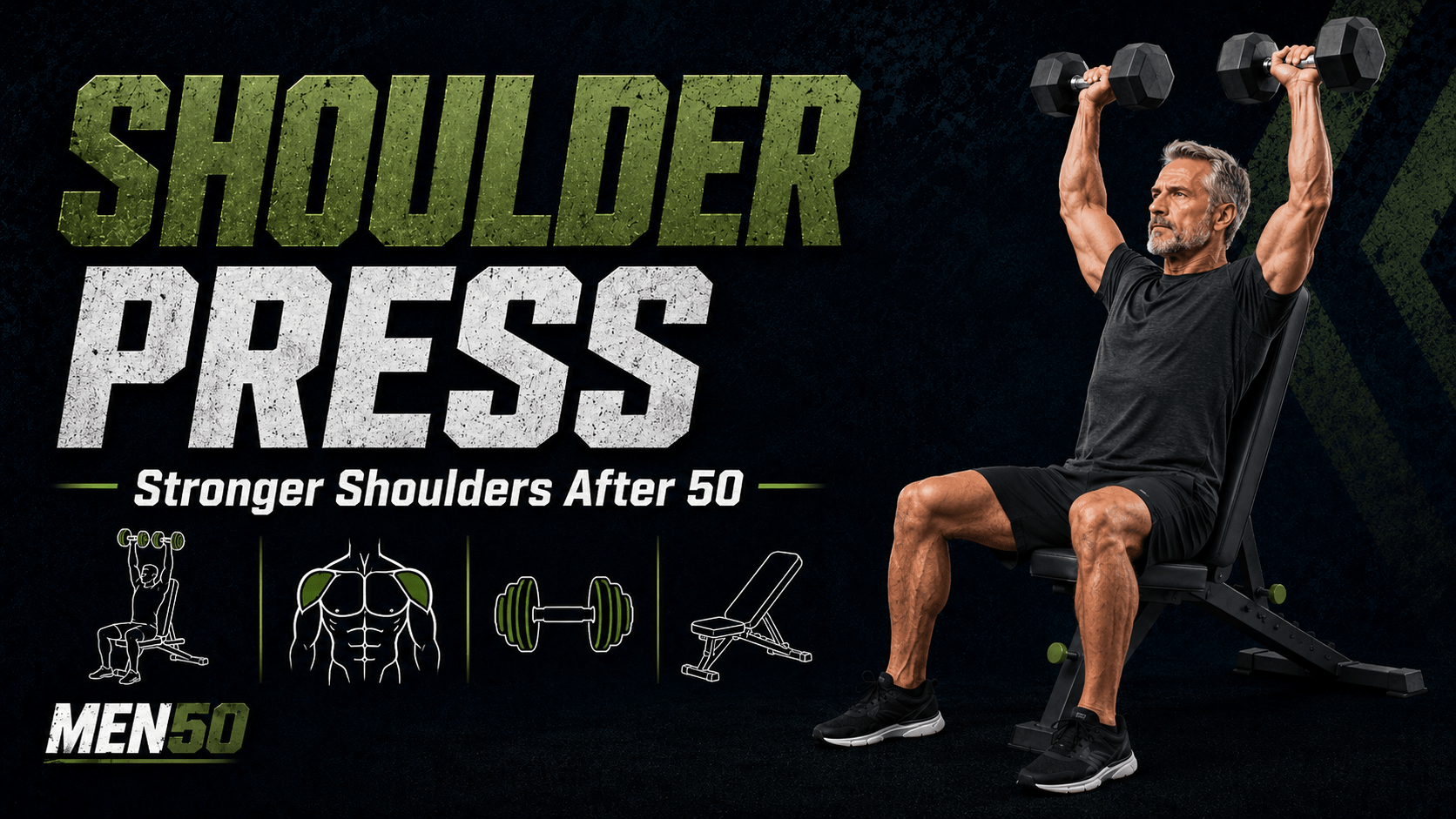
The seated dumbbell shoulder press is the main vertical pressing exercise for men over 50 — and one to take seriously. Done well, it builds shoulder strength that translates directly into lifting overhead, carrying loads above shoulder height, and maintaining the upper-body capacity that quietly fades after 50. Done poorly, or done with the wrong shoulders, it’s also one of the more common ways to develop shoulder pain that lingers. The seated version with back support is the right starting point because the bench takes the lower back out of the equation and forces the shoulders to do the actual work.
Part of the Build Muscle After 50 pillar — strength training for men over 50.
Key Takeaways
- The seated shoulder press trains the deltoids, triceps, and upper chest in a vertical pressing pattern — the main strength pattern for overhead reach.
- Programming: 2–4 sets of 8–12 reps, 2–3 times per week. Rest 45–75 seconds between sets.
- Strong shoulders help you live independently. Press with control, build strength, and stay consistent.
- The seated version with back support is the right starting point. It removes the lower-back compensation that men use to “help” the press.
- This exercise is not for everyone. If you have current shoulder impingement, rotator cuff issues, or shoulder pain, skip overhead pressing until cleared by a physio.
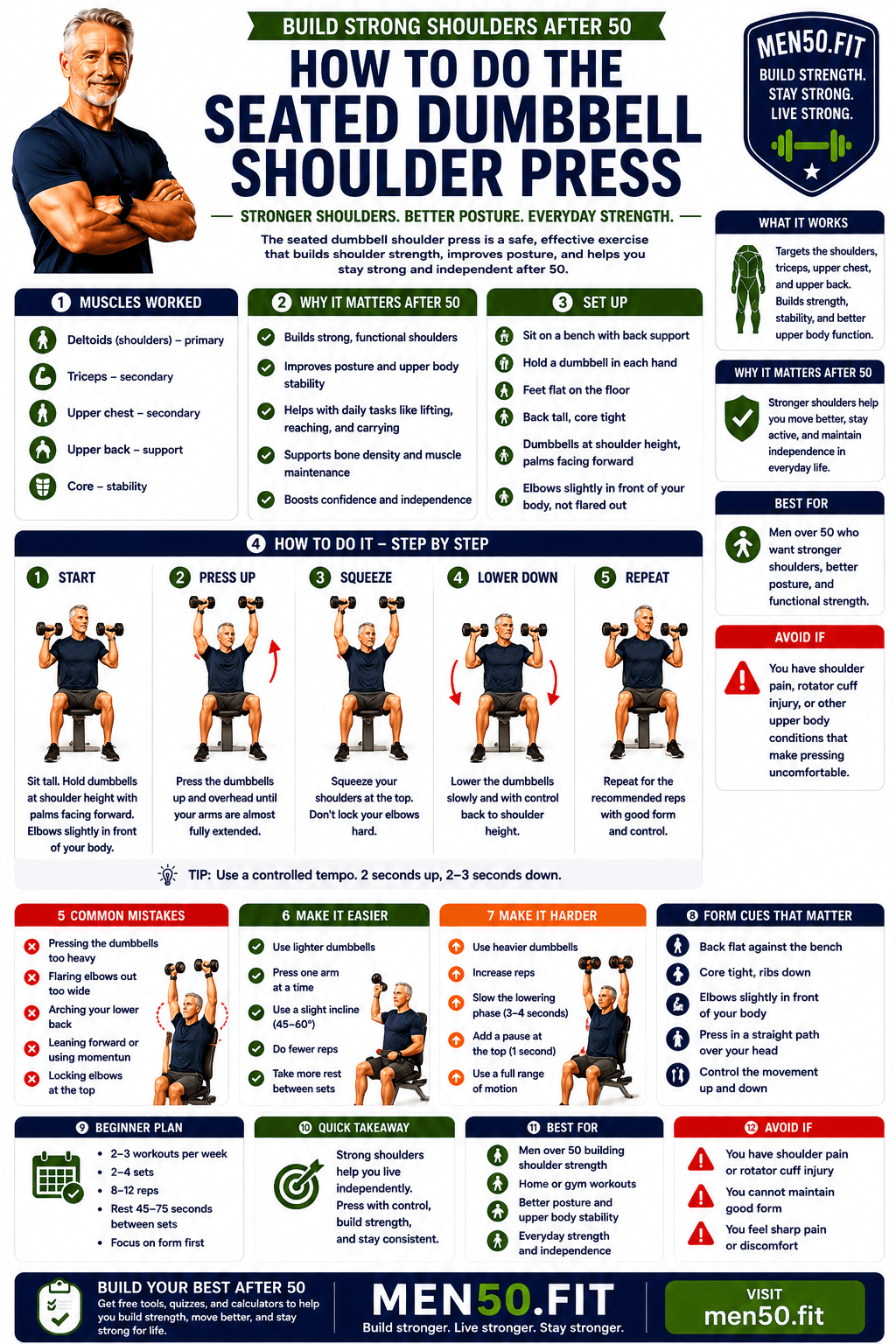
How to Perform the Seated Dumbbell Shoulder Press
Set up first:
- Sit on a bench with proper back support (a vertical or near-vertical back pad).
- Feet flat on the floor for stability.
- Back tall, pressed firmly against the bench. Core tight, ribs down.
- Hold a dumbbell in each hand at shoulder height, palms facing forward.
- Elbows slightly in front of your body, not flared straight out to the sides.
Then the movement:
- Start. Sit tall, dumbbells at shoulder height, palms facing forward, elbows slightly in front of your body. This starting position is the key — if elbows flare to 90 degrees out to the sides, the shoulder joint takes more load than it should.
- Press up. Press the dumbbells straight up and over your head until your arms are almost fully extended. The dumbbells should travel in a straight line, not arc inward at the top.
- Squeeze. Pause briefly at the top with arms nearly straight. Squeeze the shoulders. Don’t lock the elbows hard — keep a slight bend.
- Lower down. Lower the dumbbells slowly and with control back to shoulder height. Take 2–3 seconds on the way down. Don’t drop the weights or let momentum carry them.
- Repeat. Maintain clean form on every rep. Back stays flat against the bench, ribs stay down, dumbbells press in a straight path overhead.
The cue that matters most: press in a straight path over your head, with elbows slightly in front of your body. Pressing straight up keeps the shoulder joint in its safest position. Letting the elbows flare straight out to the sides is the most common cause of shoulder pain in this exercise.
Why the Seated Dumbbell Shoulder Press Matters After 50
Vertical pressing strength matters in ways that are easy to ignore until you lose it. Reaching up to a high cupboard, lifting a suitcase into an overhead bin, putting a box on a shelf, hanging a picture — all rely on the shoulders generating force overhead. Lose this strength gradually after 50 and the consequences accumulate quietly. By 65, men who haven’t trained their shoulders often find that overhead reaching feels harder than it should and that they avoid tasks that require it.
The seated shoulder press trains the deltoids (all three sections — front, side, rear), the triceps, the upper chest, and the upper back stabilisers. Compared with the standing version, the seated press has two specific advantages for men over 50:
The back support removes lower-back compensation. Standing shoulder presses often turn into half-press, half-back-arch because the lower back wants to help when the shoulders fatigue. The bench’s vertical back pad physically prevents this. The shoulders do the work or they don’t — there’s no cheating.
The seated position reduces full-body coordination demand. Standing shoulder pressing requires bracing through the entire kinetic chain — feet, legs, hips, core, all stabilising while the arms press. That’s more total-body work, but it’s also more total-body fatigue. The seated version lets you train the shoulders specifically without the rest of the body limiting how much you can press.
There’s also a bone density angle. Resistance training applies mechanical loading to bones, which stimulates bone maintenance and growth. Overhead pressing specifically loads the shoulders, upper arms, and spine in an axial pattern that supports bone health in regions vulnerable to age-related density loss. For men over 50 — and particularly those with family history of osteoporosis or low bone density on imaging — overhead pressing belongs in a complete strength programme.
The honest caveat: not every man over 50 should be doing overhead pressing. Men with current shoulder impingement, rotator cuff injuries, or unresolved shoulder pain often make those conditions worse with overhead work. If your shoulders aren’t healthy enough for pain-free overhead pressing, work on the postural pattern first (wall angels, band pull-aparts, doorway chest stretches) and use the dumbbell floor press for pressing strength until the overhead position is comfortable again.
Sets and Reps
Moderate load, controlled tempo, clean reps. The shoulder press isn’t where to chase one-rep maxes.
| Stage | Sets × Reps | Frequency | Load Guide |
|---|---|---|---|
| Beginner | 2 × 8–10 | 2× per week | Light dumbbells, focus on form |
| Novice | 2–3 × 8–12 | 2–3× per week | Moderate, last 2 reps challenging |
| Intermediate | 3 × 8–12 | 2–3× per week | Working weight, RPE 7–8 |
| Advanced | 3–4 × 6–10 | 2–3× per week | Heavier, slow lowering, pause at top |
Rest 45–75 seconds between sets. Pick a weight where the last 2–3 reps feel clearly challenging but you can complete them with: back flat against the bench, ribs down, no leaning forward, no arched lower back, and dumbbells pressing in a straight path.
A practical starting load: most men over 50 begin with 10–20 lb (4.5–9 kg) dumbbells. After 3–6 months of training, many men progress to 20–30 lbs (9–14 kg). Don’t rush the load. Cleaner reps with lighter dumbbells build more strength than heavy reps with form breakdown.
Shoulder presses are harder than they look because the shoulders are smaller and weaker than the chest. Working weights for overhead pressing are typically 10–15 lbs lighter per hand than working weights for horizontal pressing like the floor press. Don’t be surprised if you press 30 lb dumbbells on the floor but only 20 lbs overhead — that’s normal.
Common Mistakes
The five errors that turn a great exercise into a shoulder problem:
- Pressing dumbbells that are too heavy. The most common mistake. Heavy dumbbells force compensation — leaning back, arching the lower back, flaring the elbows, jerking the weights up. All of them turn the press into a different exercise that loads the wrong tissues. If you can’t press cleanly, drop a size.
- Flaring elbows out too wide. Elbows flared straight out to 90 degrees from the body — the “scarecrow” position — loads the front of the shoulder joint and is the single biggest cause of shoulder pain in this exercise. Keep elbows slightly in front of the body throughout. If you look at yourself in a mirror from the front, your arms should look like a slightly narrowed Y, not a wide W.
- Arching the lower back. When the shoulders fatigue, the lower back wants to arch to “help” the press. The bench’s back support stops this somewhat, but men still try. Keep ribs down, core braced, lower back firmly against the bench throughout.
- Leaning forward or using momentum. Leaning forward to push the dumbbells back up turns the press into a chest-press-with-bad-form. Stay upright against the bench. If you can’t complete the rep without leaning, drop the load.
- Locking elbows hard at the top. Slamming the elbows straight under load is rough on the joint over time. Stop just short of full extension — a soft lockout. Keep a slight bend in the elbows at the top of every rep.
Make It Easier or Harder
If standard shoulder presses are too challenging:
- Use lighter dumbbells — 8–15 lbs (3.5–7 kg) is fine for beginners. Strength is built from where you are.
- Press one arm at a time — supporting yourself with the free hand on the bench lets you focus on form one side at a time.
- Use a slight incline (45–60°) instead of a fully vertical bench — reduces the demand on the shoulder joint and recruits the upper chest more.
- Do fewer reps — start with 2 sets of 6–8 reps and build from there.
- Take longer rest between sets — up to 2 minutes when you’re learning the pattern.
To make it harder once form is solid:
- Use heavier dumbbells — but only when the lighter weight feels easy with clean form.
- Slow the lowering phase to 3–4 seconds per rep.
- Add a pause at the top for 1–2 seconds with arms nearly straight.
- Use a full range of motion — start the press from below shoulder height and press to nearly straight overhead.
For variety, try the neutral grip shoulder press (palms facing each other) — easier on the shoulder joint than the standard palms-forward grip. Some men find this version much more comfortable, especially if they have any rotator cuff history.
Safety Note
Overhead pressing has more shoulder injury risk than horizontal pressing. Be honest about whether your shoulders are healthy enough for this exercise.
Skip the shoulder press if you have: current shoulder pain, diagnosed rotator cuff injury, shoulder impingement, frozen shoulder, recent shoulder surgery, or pain that gets worse during the press. If your shoulders aren’t healthy enough for pain-free overhead pressing, don’t push through it — use the dumbbell floor press or band chest press instead.
If you feel sharp pain in the shoulder, neck, elbow, or wrist during the press, stop immediately. Adjust the elbow position (slightly more in front of body), try the neutral grip, or reduce the load. Persistent sharp joint pain is worth checking with a physiotherapist before continuing.
If you cannot maintain good form — back flat, ribs down, dumbbells pressing in a straight path — the weight is too heavy. Drop a size and rebuild.
Build Your Personal Training Plan
The seated dumbbell shoulder press is one piece of a complete upper body programme. Get a personalised exercise plan based on your current strength, goals, and any limitations.
Take the Free Fitness Profiler →
FAQs
Should I do shoulder presses if I have shoulder issues?
Generally, no — at least not until those issues resolve. Overhead pressing places more demand on the rotator cuff and the front of the shoulder joint than horizontal pressing. If you have current shoulder pain, impingement, or a recent rotator cuff issue, work on the postural pattern first (wall angels, band pull-aparts, doorway chest stretches) and use the dumbbell floor press for pressing strength. Once the shoulder is pain-free with full mobility, you can usually return to overhead pressing — but get a physio’s opinion if the issue was significant.
Seated vs standing shoulder press — which is better?
For most men over 50, the seated version is better — particularly when learning the pattern or returning to overhead pressing after a break. The bench’s back support stops the lower-back compensation that turns standing presses into half-press, half-back-arch. The standing version requires more total-body coordination and demands a healthy lower back to brace through every rep. Start seated; progress to standing only after 3–6 months of clean seated reps if you want to.
How heavy should the dumbbells be?
Heavy enough that the last 2–3 reps feel clearly challenging, but light enough that you can complete the set with back flat against the bench, ribs down, no leaning, no arched lower back, and a straight pressing path. For most men over 50 starting out, that’s 10–20 lbs (4.5–9 kg) per hand. After 3–6 months of training, many men progress to 20–30 lbs (9–14 kg). Expect to use lighter dumbbells for shoulder presses than for chest presses — the shoulders are smaller and weaker. That’s normal.
Why are my shoulders sore after this exercise?
Mild muscular soreness in the deltoids and triceps the day after is normal — especially in the first 2–3 weeks of training. It usually fades as your muscles adapt. Joint pain (sharp pinching at the front of the shoulder, pain that radiates, pain that worsens over hours) is different — that’s a sign the exercise isn’t right for your current shoulder condition. Stop the exercise, work on postural and mobility prep, and consider seeing a physio before returning.
Can I do lateral raises and shoulder presses in the same session?
Yes, and many programmes pair them. A common structure: shoulder press first (the heavier compound movement), then lateral raises afterward to hit the side deltoid specifically. Press for 3 sets of 8–12 reps, then 2–3 sets of 10–15 lateral raises. Don’t do both on more than 2–3 days per week — the shoulders need recovery time, especially after 50.
References
- American College of Sports Medicine. Resistance Training for Older Adults Position Stand. acsm.org
- National Institute on Aging. Sarcopenia and Muscle Strength in Older Adults. nia.nih.gov
- Centers for Disease Control and Prevention. Physical Activity Guidelines for Americans, 2nd Edition. cdc.gov
Disclaimer: This article is for educational purposes only and is not medical advice. Consult a qualified healthcare professional before starting any new exercise programme, especially if you have existing shoulder, neck, or back conditions.