
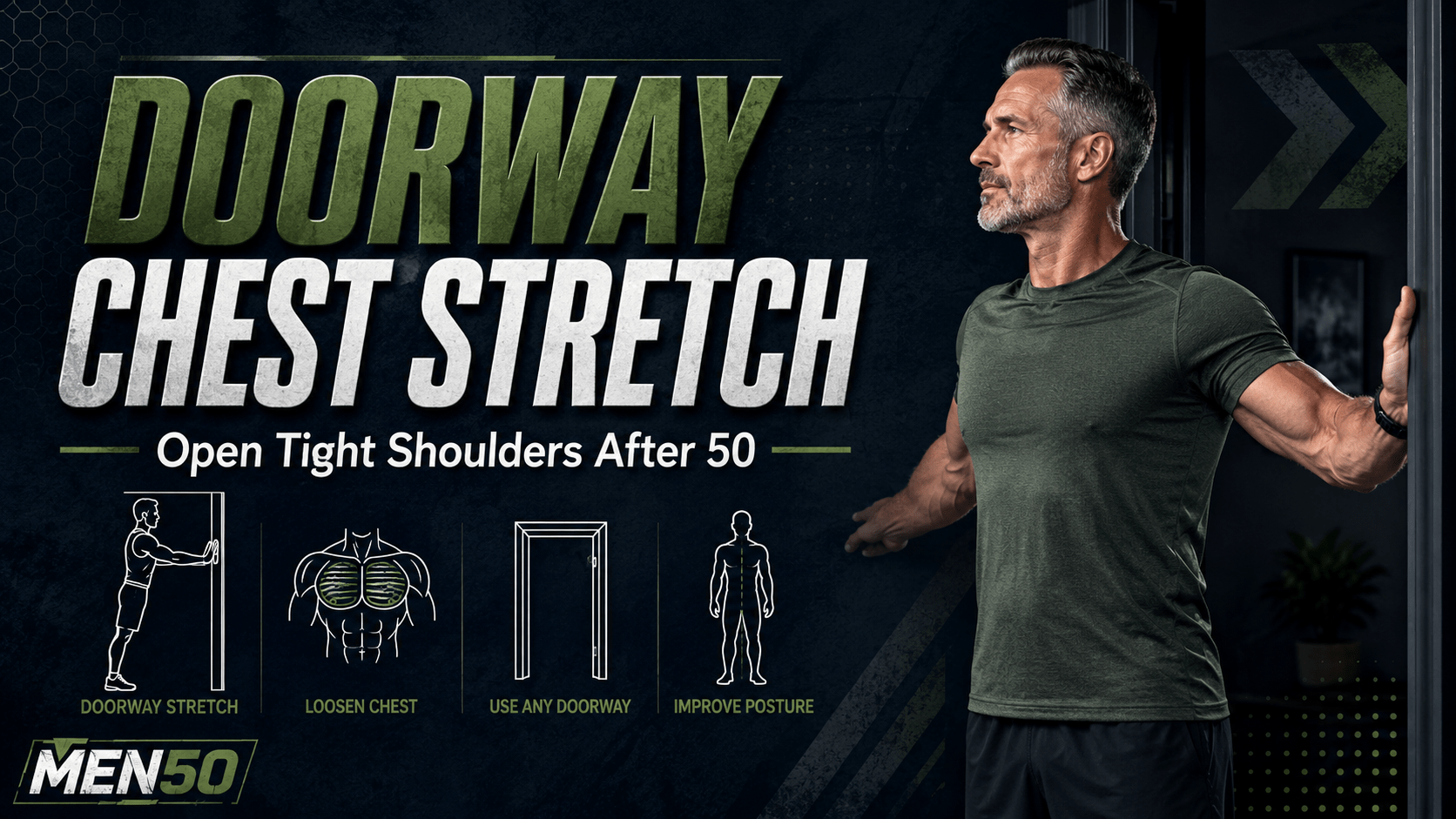
The doorway chest stretch is the simplest postural fix in the matrix. Sixty seconds, no equipment, every house has the gear required. It reverses the chest and shoulder tightness that builds up over decades of sitting at desks, driving cars, and looking at phones — the same pattern that pulls your shoulders forward and adds 10 years to your apparent posture. Do it daily and you’ll stand taller and move more freely. Pair it with the band pull-apart and you’re solving both halves of the rounded-shoulder problem in under five minutes a day.
Part of the Build Muscle After 50 pillar — strength training for men over 50.
Key Takeaways
- The doorway chest stretch lengthens the pectoralis major and minor — the muscles that pull shoulders forward when chronically shortened.
- Programming: 2 holds per side, 20–30 seconds each, daily. Two minutes total.
- Stretch gently — you should feel opening, not pain. A sharp or pinching sensation in the front of the shoulder means the position is wrong.
- This stretch is the lengthening half of the “fix rounded shoulders” pair. The band pull-apart is the strengthening half. You need both.
- Sharp pain or tingling down the arm is a sign to stop. That’s a nerve compression signal, not a stretch sensation.

How to Perform the Doorway Chest Stretch
- Start position. Stand in a doorway. Place both forearms flat against the door frame, elbows at roughly shoulder height. One foot slightly in front of the other for stability.
- Lean forward. Step the front foot forward slightly so your body moves through the doorway. Slowly lean your chest forward. Keep your core lightly engaged.
- Feel the stretch. You should feel a gentle, broad stretch across the chest and the front of the shoulders. Breathe normally. The stretch sensation should be in the muscles — not in the shoulder joint itself.
- Hold and release. Hold for 20–30 seconds. Step back and relax. Switch sides if working one arm at a time, or repeat the bilateral version for a second hold.
The most important cue: stretch gently — you should feel opening, not pain. A broad stretch across the chest is what you’re after. Sharp pinching at the front of the shoulder means you’ve gone too aggressive, gone too high with the arms, or have an underlying shoulder issue worth checking out before continuing.
Why the Doorway Chest Stretch Matters After 50
The pectoralis major (the big chest muscle) and pectoralis minor (a smaller muscle running underneath it from the front of the shoulder to the ribs) shorten predictably with the modern lifestyle. Decades of typing, driving, scrolling phones, and forward-reaching activities keep these muscles in a chronically shortened position. The body adapts — the resting length of the tissue decreases. Stand up, and the now-shorter pecs pull your shoulders forward, creating the rounded-shoulder, forward-head posture pattern that physiotherapist Vladimir Janda named upper crossed syndrome.
The visible effect is the stooped posture commonly associated with ageing. The mechanical effect is more serious. When the shoulders sit forward in the joint, the head of the humerus drifts forward and rotates inward, which reduces the space available for the rotator cuff tendons to move freely. That’s the mechanical setup for shoulder impingement — the most common cause of shoulder pain in men over 50 who haven’t trained for it. The pectoralis minor in particular runs over the brachial plexus (the nerve bundle that supplies the arm), and severe tightness can contribute to thoracic outlet symptoms — numbness, tingling, or weakness running down the arm.
Stretching the chest pulls the shoulders back to where they belong, restores the space in the shoulder joint, and over weeks of consistent practice changes the resting tissue length so the corrections start sticking even when you’re not stretching. But stretching alone solves only half the problem. The other half — strengthening the upper back muscles that pull the shoulders back — has to happen at the same time. The combination of doorway chest stretches plus band pull-aparts is one of the highest-return postural interventions available to men over 50.
Sets and Reps
Daily, not occasional. Tight pecs reset within hours of sitting, so consistent short doses beat occasional long sessions.
| When to Do It | Holds per Side | Duration | Frequency |
|---|---|---|---|
| Morning routine | 2 | 20–30 seconds | Daily |
| After long sitting / desk session | 1–2 | 30 seconds | As needed |
| Before upper body training | 2 | 20 seconds | Every upper-body session |
| Evening / before bed | 2 | 30 seconds | 3–5× per week |
You don’t need to do all of these every day. Two minutes daily — two 30-second holds — is the minimum effective dose. Most men over 50 with sedentary work get better results doing this stretch in 2–3 short doses throughout the day rather than one longer session.
For a complete posture routine, layer the doorway chest stretch with:
- Hip flexor stretch — the lower body equivalent (same upper crossed pattern carries into the hips).
- Band pull-apart — strengthens the muscles being released here.
That’s 5–7 minutes total and addresses the most common postural pattern in men over 50.
Common Mistakes
The three errors that turn a great stretch into a shoulder problem:
- Leaning too aggressively. Forcing the stretch by pushing your chest hard through the doorway turns a muscle stretch into joint stress. The stretch should feel like a broad opening across the chest, not a sharp pull at the front of the shoulder. Step back slightly if it pinches.
- Shrugging the shoulders. As you lean forward, the shoulders want to creep up toward your ears, especially with arms at shoulder height. Pin the shoulders down and back before leaning forward, and keep them there throughout the hold.
- Arching the lower back. Some men compensate for limited shoulder mobility by hyperextending the lumbar spine — sticking the ribs out forward. The ribcage should stay down and the core lightly engaged. If you have to arch to get the stretch, your arms are too high or you’re leaning too far.
Make It Easier or Harder
If standard arm position is uncomfortable or the stretch is too intense, use a lower arm position — elbows at shoulder height or even slightly below. Or take a smaller step forward to reduce the lean depth. There’s no benefit to forcing a deeper stretch — gentler and more consistent beats aggressive and infrequent every time.
To deepen the stretch once basic form is solid: adjust the arms slightly higher (elbows above shoulder height stretches the lower fibres of the pecs differently), or hold each rep longer — 45 seconds to 1 minute. You can also work one side at a time: place one forearm on the door frame and rotate your body away from that side, which creates a stronger single-side stretch.
For a small variation that hits the pectoralis minor specifically (the muscle most associated with rounded shoulders and thoracic outlet symptoms), position the arm with the elbow at roughly chin level and rotate the torso away. This is sometimes called the “high-low” doorway stretch.
Safety Note
Never force the stretch. If you feel a sharp or pinching sensation in the front of the shoulder rather than a broad opening across the chest, lower your arms slightly and reduce how far you lean forward. Pain in the joint is different from stretch sensation in the muscle.
If you feel tingling, numbness, or weakness down the arm, stop immediately. This can indicate compression of the brachial plexus and isn’t a problem you stretch through — it’s a sign to back off the position and, if symptoms persist, see a physiotherapist.
Men with a history of shoulder dislocation, recent rotator cuff surgery, frozen shoulder, or significant shoulder impingement should get clearance from a physiotherapist before performing this stretch. The stretch is generally protective for shoulders, but the wrong position can worsen specific conditions.
Build Your Personal Training Plan
The doorway chest stretch is one piece of a complete mobility and posture programme. Get a personalised plan based on your current posture, mobility, and any limitations.
Take the Free Fitness Profiler →
FAQs
How often should I do this stretch?
Daily is the sweet spot. The pecs tighten back up within hours of sitting, so a single weekly session doesn’t change the resting tissue length much. Two minutes of daily stretching — split into two 30-second holds — is more effective than 15 minutes once a week. Many men get better results doing one set of stretches in the morning and another after work.
Why do I feel the stretch in different places at different arm heights?
Because the pectoralis major has three sections (upper, middle, lower) and each one is stretched best at a different arm angle. Elbows below shoulder height stretches the upper chest fibres; elbows at shoulder height hits the main middle fibres; elbows above shoulder height stretches the lower fibres. A complete routine cycles through all three over the week rather than always using the same height.
Can this stretch fix forward head posture?
It’s part of the fix. Forward head posture is usually a downstream effect of rounded shoulders — the head shifts forward to balance over the rib cage when the shoulders drift forward. The doorway chest stretch helps by pulling the shoulders back, which lets the head settle into a more neutral position. Pair it with the band pull-apart for the strengthening side and you’ve addressed the full pattern. Visible postural change usually takes 6–12 weeks of consistent daily work.
Is the doorway chest stretch safe for shoulder impingement?
For most non-acute impingement, yes — it’s frequently recommended by physiotherapists because tight pecs are a major contributor to the impingement pattern. Start with a low arm position (elbows below shoulder height), shallow lean depth, and short holds. If pain decreases over 2–3 weeks of daily stretching, continue and progress slowly. If pain increases or doesn’t improve, see a physio before continuing.
Should I stretch before or after workouts?
Both work, for different reasons. Before upper body training, a 20-second hold per side helps the shoulders move through full range without strain — a useful warm-up. After workouts or long sitting bouts, longer 30-second holds restore resting tissue length and reduce post-session tightness. Don’t do very long static stretches (60+ seconds) immediately before heavy pressing work, as they can briefly reduce strength output.
References
- Janda V. Muscles, Central Nervous Motor Regulation and Back Problems. In: Korr IM (ed). The Neurobiologic Mechanisms in Manipulative Therapy. Plenum Press; 1978. (Upper Crossed Syndrome framework.)
- American College of Sports Medicine. Flexibility and Stretching Position Stand. acsm.org
- National Institute on Aging. Exercise & Physical Activity: Your Everyday Guide. nia.nih.gov
Disclaimer: This article is for educational purposes only and is not medical advice. Consult a qualified healthcare professional before starting any new stretching or exercise programme, especially if you have existing shoulder, neck, or arm conditions.