
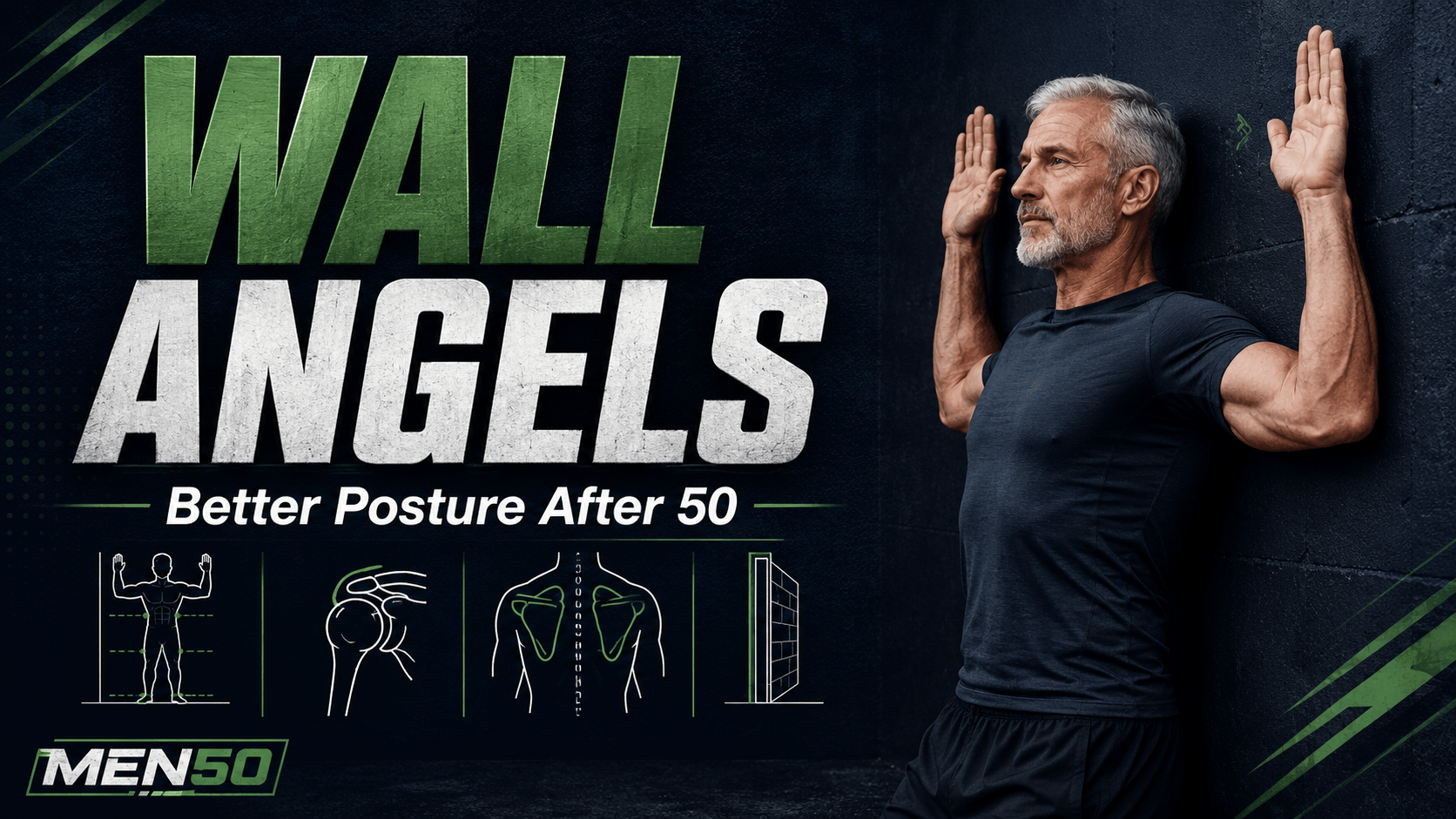
Wall angels are the integrative postural exercise — the move that combines mobility, strength, and motor control into one continuous pattern. While the doorway chest stretch lengthens what’s tight and the band pull-apart strengthens what’s weak, wall angels teach the shoulder blades how to actually move correctly through their full range. For men over 50, this is the missing piece — most postural problems aren’t about strength or flexibility alone, they’re about a brain that has forgotten how to coordinate the shoulder blades. Wall angels retrain that coordination. Two minutes a day, no equipment, just a wall.
Part of the Build Muscle After 50 pillar — strength training for men over 50.
Key Takeaways
- Wall angels train scapular control — teaching the shoulder blades how to glide correctly during overhead movement.
- They expose your current shoulder mobility honestly. If your wrists won’t touch the wall, your shoulders have a problem you need to know about.
- Programming: 2 sets of 8–12 slow reps, 3–5 days per week. Each rep takes 6–8 seconds total.
- Move slowly and keep the ribs down. Most men compensate for limited shoulder mobility by arching the lower back. The wall position prevents that — if you do it honestly.
- This is one of three articles that together fix the rounded-shoulder posture pattern. Pair with the doorway chest stretch and band pull-apart for a complete fix.
How to Perform Wall Angels
Set up first:
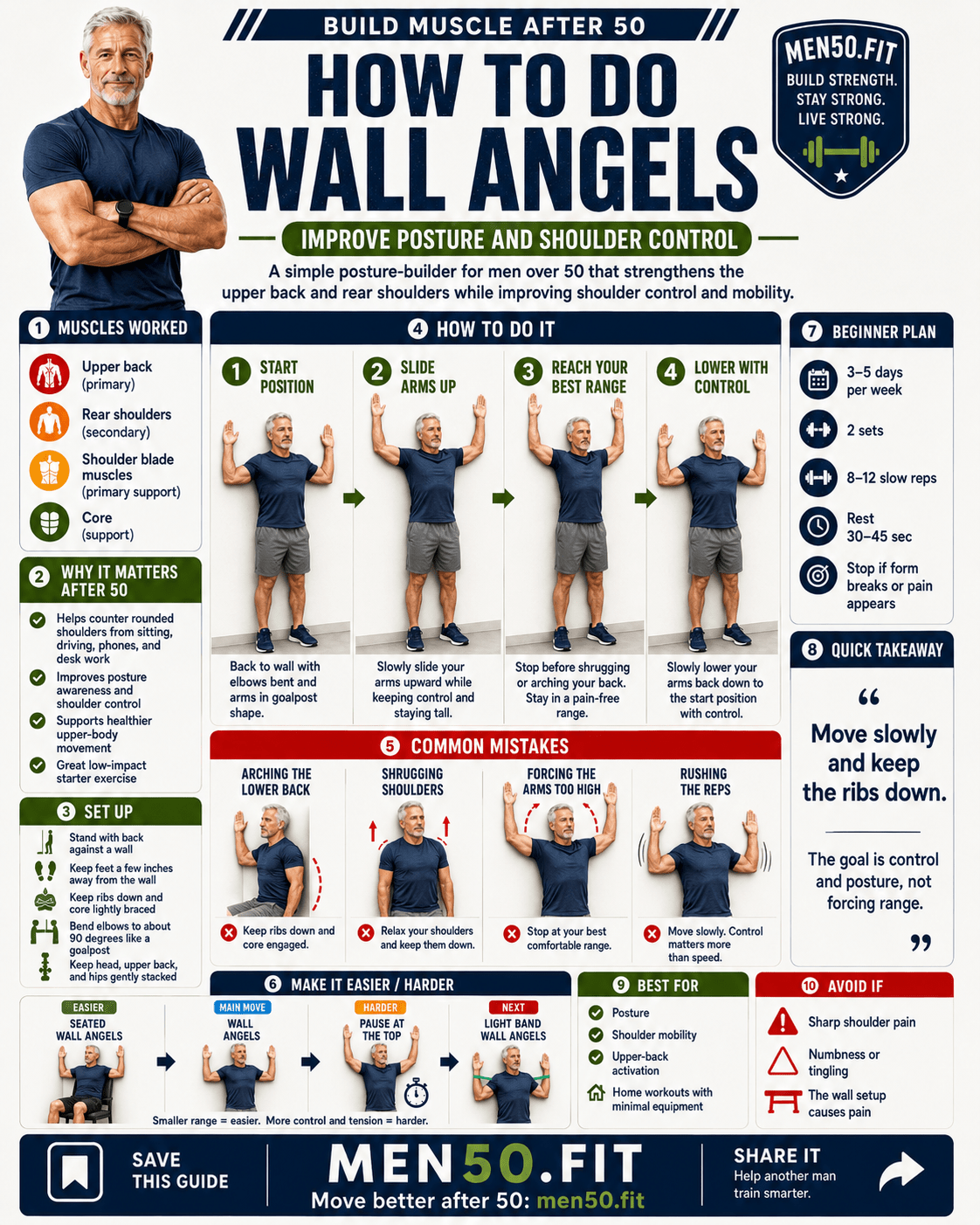
- Stand with your back against a wall.
- Keep your feet a few inches away from the wall — this lets you press the lower back flat without strain.
- Keep your ribs down and your core lightly braced.
- Bend your elbows to about 90 degrees in a “goalpost” position — upper arms parallel to the floor, forearms vertical, backs of the hands touching the wall if possible.
- Head, upper back, and hips should all be gently stacked against the wall.
Then the movement:
- Start position. Back to wall with elbows bent in the goalpost position. Hands and forearms touching the wall if your mobility allows. If they don’t reach, that’s fine — keep them as close as you can while maintaining the rest of the setup.
- Slide arms up. Slowly slide both arms upward along the wall, straightening them as they rise. Keep the elbows and wrists in contact with the wall as much as you can without arching your lower back away from the wall.
- Reach your best range. Go as high as you can without compromising form. Stop before the shoulders shrug toward the ears, the elbows lose contact, or the lower back arches off the wall. Better to reach 80% of full range with clean form than to chase the last 20% with compensation.
- Lower with control. Slowly slide the arms back down to the start position, taking 3–4 seconds. Keep contact with the wall the entire way. This is where most of the motor control is built.
The cue that matters most: move slowly and keep the ribs down. The wall position itself reveals every compensation pattern your body normally uses to hide limited shoulder mobility. Honest reps with limited range are far more valuable than full range achieved through cheating.
Why Wall Angels Matter After 50
The standard problem in men over 50 is well-documented: rounded shoulders, forward head posture, and thoracic kyphosis (the forward rounding of the upper spine) all accelerate after 50, particularly in men with desk jobs or driving-heavy lifestyles. Janda named this pattern upper crossed syndrome — tight chest and front shoulders, weak upper back and rear shoulders.
But there’s a third element that gets less attention: scapular dyskinesis — abnormal movement of the shoulder blades during arm movement. Even men whose chest stretches well and whose upper back is strong sometimes still have shoulder problems because the shoulder blades themselves don’t glide correctly when the arms move overhead. The serratus anterior (along the side of the ribcage) doesn’t fire at the right time, the lower trapezius doesn’t engage, the upper traps over-recruit. The net result: the shoulder blade tilts and protracts when it should rotate and depress, the rotator cuff loses mechanical advantage, and the stage is set for impingement.
Wall angels train exactly this coordination. The wall forces honest scapular motion — you can’t cheat by shifting your bodyweight forward or by shrugging because the wall constrains you. The slow tempo gives the nervous system time to learn the correct firing sequence. Over weeks of consistent practice, the scapular control rewires itself, and the same overhead reaching that used to feel restricted starts to feel free.
The exercise also functions as a diagnostic. If your wrists won’t touch the wall in the start position, or you can’t slide your arms up without losing contact, that’s useful information. It tells you which part of the pattern needs work — the chest stretch if the wrists won’t reach back, the upper back if you can’t maintain contact during the slide, the deep core if the lower back keeps arching. Wall angels are a postural test as much as a postural exercise.
Sets and Reps
Quality over volume — every rep. Wall angels are not a numbers game.
| Stage | Variation | Sets × Reps | Frequency | Tempo |
|---|---|---|---|---|
| Beginner (cannot keep contact) | Seated wall angels (chair against wall) | 2 × 8 | 3–4× per week | Slow, partial range |
| Novice | Standing wall angels, partial range | 2 × 8–10 | 3–5× per week | 3 seconds up, 3 seconds down |
| Intermediate | Standing, full range you can maintain | 2 × 10–12 | 3–5× per week | 3–4 seconds each direction |
| Advanced | Pause at the top for 2–3 seconds | 2–3 × 8–10 | 3–5× per week | Slow with hold |
| Progression | Light resistance band wall angels | 2 × 8–10 | 3× per week | Slow with band tension |
Rest 30–45 seconds between sets. The whole routine takes 2–4 minutes — easy to slot in as a warm-up before any upper body session, or as a standalone postural reset during a desk break.
Common Mistakes
The four errors that turn a great exercise into a worthless one:
- Arching the lower back. The most common cheat. As soon as the arms start to slide up, the body wants to arch the lower back to give the impression of greater overhead range. Keep ribs down and core engaged — the lower back should stay against the wall throughout. If the lower back lifts, you’ve gone too high.
- Shrugging the shoulders. As the arms rise, the upper traps want to shrug the shoulders toward the ears. This is exactly the opposite of what you want. Pin the shoulders down and back before each rep and keep them there. If you feel the work in your neck the next day, you shrugged.
- Forcing the arms too high. Chasing full range with limited mobility forces all the compensations — arched back, shrugged shoulders, elbows away from the wall. Stop at the highest point you can reach with clean form. Range improves over weeks; ego doesn’t help it.
- Rushing the reps. Speed lets you cheat without noticing. Slow tempo — 3–4 seconds up, 3–4 seconds down — exposes every compensation in real time. If you can do them fast and feel nothing, you’re not doing them right.
Make It Easier or Harder
If you can’t maintain the standing wall angel position (lower back keeps arching, or arms won’t reach the wall at all), use seated wall angels. Sit in a sturdy chair with your back against a wall, knees bent at 90 degrees, feet flat on the floor. This removes some of the load on the core and lower back, letting you focus entirely on the scapular and shoulder pattern. Spend 2–3 weeks on seated wall angels before progressing to standing if needed.
To make wall angels harder once standard form is solid:
- Pause at the top for 2–3 seconds with arms reached high — significantly increases the difficulty for the lower traps and serratus anterior.
- Light resistance band wall angels — hold a light resistance band between the hands as you perform the movement. The band creates an outward pulling demand that activates the rear deltoids and rotator cuff throughout the rep.
- Slow eccentric only — slide the arms up quickly, then take 5–6 seconds to lower them. Builds end-range scapular control.
The progression order from the infographic is: Seated → Standing → Standing with pause → Standing with band. Master each stage before progressing.
Safety Note
If you feel sharp shoulder pain, numbness, or tingling during the movement, stop immediately. These are not normal stretching or training sensations and may indicate impingement, nerve compression, or rotator cuff irritation. Talk to a physiotherapist before continuing.
If the wall setup itself causes pain (back, neck, hips), try the seated version or check that you’re keeping your feet a few inches off the wall to allow the lower back to flatten naturally. Standing too close to the wall forces the lower back to arch, which causes problems for most men over 50.
Men with diagnosed shoulder conditions (frozen shoulder, recent surgery, significant impingement, labral tears) should get clearance from a physiotherapist before adding wall angels — the exercise is generally protective, but the right starting variation depends on the specific condition.
Build Your Personal Training Plan
Wall angels are one piece of a complete posture and shoulder programme. Get a personalised plan based on your current posture, mobility, and any limitations.
Take the Free Fitness Profiler →
FAQs
Why can’t I keep my wrists on the wall?
This is the most common starting position for men over 50, and it tells you that your shoulder external rotation and pec mobility are both limited. It’s not a failure — it’s a baseline. Do the exercise with your hands as close to the wall as you can manage without arching the lower back or shrugging. Within 2–4 weeks of consistent practice (paired with the doorway chest stretch), most men can get noticeably closer to wall contact.
How long until I see results?
Two timelines. Mobility improvement is usually noticeable within 2–3 weeks of daily practice — you’ll get closer to wall contact and reach higher with the arms. Visible postural change takes longer — typically 6–12 weeks for a noticeably less rounded resting posture, and it requires pairing wall angels with strengthening (band pull-apart, dumbbell row) and stretching (doorway chest stretch). Wall angels alone won’t fix posture; wall angels as part of a 3–4 exercise routine will.
Wall angels vs band pull-apart — which should I do?
Both, but for different purposes. The band pull-apart is a high-frequency, low-load strengthening exercise — daily, 2–3 sets, builds upper back endurance over months. Wall angels are a motor control and mobility exercise — 3–5 times per week, slower tempo, teaches the shoulder blades how to move correctly. They complement each other. If forced to pick one, band pull-aparts are easier to fit into daily life; wall angels are more comprehensive but require a clear wall.
Are wall angels safe for shoulder impingement?
For most non-acute impingement, yes — they’re frequently used in physiotherapy rehab for exactly this reason. The wall position teaches the shoulder blade to retract and depress, which creates more space for the rotator cuff tendons to move through. Start with seated wall angels and a smaller range of motion if standing causes any sharp pain. Acute or severe impingement should be cleared by a physio first.
Can I do wall angels every day?
Yes — the movement is low-load and the postural muscles benefit from daily practice. Many men over 50 do best with 2 minutes of wall angels in the morning and 2 minutes in the evening, especially during periods of heavy desk work. There’s no recovery cost the way there is with heavier strength work.
References
- Janda V. Muscles, Central Nervous Motor Regulation and Back Problems. In: Korr IM (ed). The Neurobiologic Mechanisms in Manipulative Therapy. Plenum Press; 1978. (Upper Crossed Syndrome framework.)
- Kibler WB, Sciascia A. Current concepts: scapular dyskinesis. British Journal of Sports Medicine. 2010;44(5):300-305.
- American College of Sports Medicine. Flexibility and Stretching Position Stand. acsm.org
Disclaimer: This article is for educational purposes only and is not medical advice. Consult a qualified healthcare professional before starting any new exercise programme, especially if you have existing shoulder, neck, or upper back conditions.