
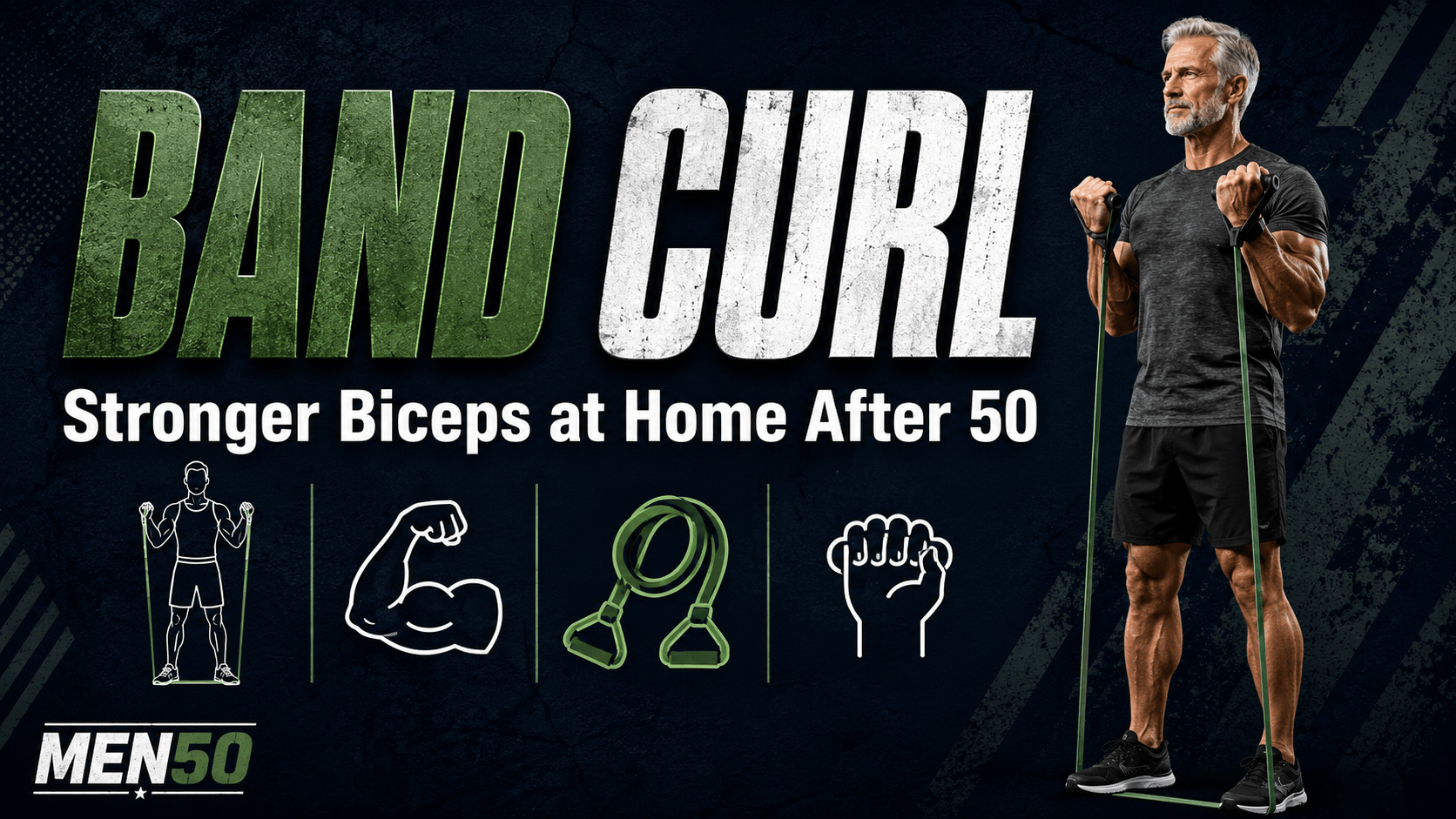
The resistance band curl is the band-based companion to the dumbbell biceps curl — and for many men over 50, it’s actually the better choice. Bands deliver smooth, variable resistance that’s gentler on the elbow and wrist tendons than dumbbells. They’re cheap, portable, and scale by simply changing your foot position on the band. And they complete the seven-piece band-based home training system that now covers comprehensive upper-body work with one kit that fits in a drawer.
Part of the Build Muscle After 50 pillar — strength training for men over 50.
Key Takeaways
- The resistance band curl trains the same primary muscle as the dumbbell biceps curl — the biceps — with band-specific advantages: smoother resistance, joint-friendlier, portable.
- Programming: 2–4 sets of 8–15 reps, 2–3 times per week. Rest 45–75 seconds between sets.
- Keep your elbows close and control the band both up and down. Clean reps build stronger arms after 50.
- This exercise completes the seven-piece band-based home training system — pair with band pull-apart, resistance band row, band lat pulldown, band face pull, band chest press, and band triceps pressdown for comprehensive upper-body coverage with one band kit.
- The biceps is one of the muscles that loses strength fastest after 50 if not trained directly. Ten minutes of curls per week delivers high returns.
How to Perform the Resistance Band Curl
Set up first:
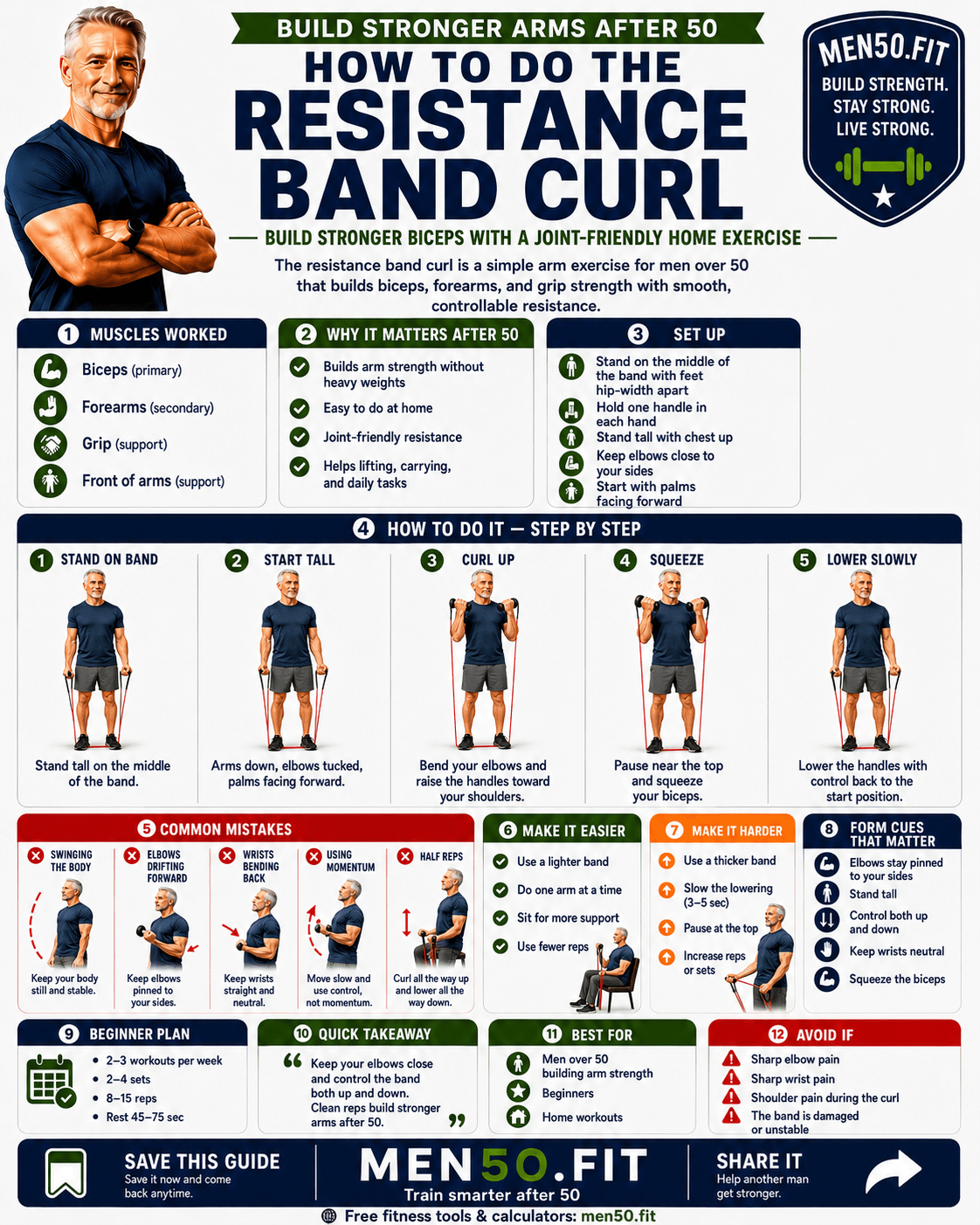
- Stand on the middle of the band with feet hip-width apart. The band creates a U-shape under your feet with the handles in your hands.
- Hold one handle in each hand, palms facing forward (supinated grip).
- Stand tall with chest up, shoulders down, core lightly braced.
- Keep elbows close to your sides — pinned, not flared.
Then the movement:
- Stand on band. Stand tall on the middle of the band with feet hip-width apart. The band should have light tension with your arms hanging straight down.
- Start tall. Arms down at your sides, elbows tucked close to your body, palms facing forward. Posture upright, shoulders back.
- Curl up. Bend your elbows and raise the handles up toward your shoulders. Keep the elbows pinned to your sides — they should not drift forward as you curl. Take 1–2 seconds to curl up.
- Squeeze. Pause near the top with the handles near your shoulders and squeeze your biceps actively. Palms still face up; wrists stay straight (don’t bend backward).
- Lower slowly. Lower the handles back to the start position with control. Take 2–3 seconds on the way down. Don’t let the band snap your arms back down — control the descent on every rep.
The cue that matters most: keep your elbows close and control the band both up and down. Once the elbows drift forward, the front shoulders take over and the biceps stops doing the work. And without controlled lowering, you skip the most productive part of the rep.
Why the Resistance Band Curl Matters After 50
The biceps gets dismissed as “vanity training” more often than any other muscle. That dismissal is wrong for men over 50. The biceps is involved in every lifting and carrying motion you make in daily life — picking up shopping bags, lifting a suitcase, holding a toolbox, hoisting a grandchild. It’s also one of the muscles that loses strength fastest after 50 if not trained directly. Ten minutes per week of curls delivers high functional return.
The resistance band curl has three specific advantages over the dumbbell version for men over 50:
1. Variable resistance. With dumbbells, the load is constant throughout the rep — gravity doesn’t change. With a band, the resistance starts lighter and gets heavier as the band stretches. This means the peak of the curl (where the biceps are fully contracted) gets the most tension. The biceps work harder at the top of every rep — exactly the position where dumbbells produce less tension because gravity is working perpendicular to the lever arm.
2. Joint-friendliness. Bands deliver a smoother resistance curve than dumbbells. There’s no jerky transition at the bottom of the rep (where dumbbells can feel like dead weight) or at the top (where dumbbells become almost weightless). For men with elbow or wrist tendinopathy — common in men over 50 — this smoother loading is often genuinely easier on the joints. Many men who can’t tolerate dumbbell curls because of elbow pain do fine with band curls.
3. Portability and scalability. A resistance band fits in a drawer or a carry-on bag. The same single band handles dozens of exercises. Tension scales by adjusting foot position (wider stance = more tension; narrower stance = less). This makes the band curl an excellent travel exercise and the right choice for home-only training without dumbbell sets.
There’s also the grip strength angle we’ve covered across the matrix. The 2015 PURE study by Leong and colleagues (The Lancet) followed 140,000 adults across 17 countries and found that grip strength was a stronger predictor of all-cause mortality and cardiovascular events than systolic blood pressure. Band curls train grip strength under sustained moderate load — the kind of grip work that contributes to the longevity-relevant capacity also targeted by the farmer’s carry and the dumbbell biceps curl.
This article also completes a major silo milestone — the seven-piece band-based home training system now covers comprehensive upper-body work:
| Band Exercise | Trains |
|---|---|
| Band Pull-Apart | Postural upper back (light, daily) |
| Resistance Band Row | Horizontal pulling (mid-back) |
| Band Lat Pulldown | Vertical pulling (lats) |
| Band Face Pull | Rear delts + rotator cuff + scapular control |
| Resistance Band Chest Press | Horizontal pressing |
| Band Triceps Pressdown | Direct arm work (triceps) |
| Resistance Band Curl | Direct arm work (biceps) |
A complete upper-body programme. One band kit (£20–25), one anchor for some exercises, comprehensive coverage. For men who travel often, train at home, or just don’t want a wall of dumbbells, this is the entire upper body covered.
Sets and Reps
Higher rep ranges than dumbbell-based curls because the band’s variable resistance favours moderate-load, higher-rep training.
| Stage | Variation | Sets × Reps | Frequency |
|---|---|---|---|
| Beginner | Light band, both arms together | 2 × 8–10 | 2× per week |
| Novice | Light or medium band, standard stance | 2–3 × 10–15 | 2–3× per week |
| Intermediate | Medium band, slow lowering | 3 × 10–15 | 2–3× per week |
| Advanced | Heavier band, pause at top + slow lowering | 3–4 × 10–15 | 2–3× per week |
Rest 45–75 seconds between sets. Pick a tension where the last 2–3 reps feel clearly challenging but you can complete them with: elbows pinned, no swinging, controlled lowering, wrists neutral.
A practical note on band tension: most band sets are colour-coded. Start with a light band (often yellow or red) for the first 2–3 weeks while you learn the movement pattern. Once you can do 3 sets of 15 clean reps with the light band, move to a medium band. The right tension lets you complete the rep range with clean form but feels clearly challenging on the last 2–3 reps.
The intensity-by-stance trick: like all band exercises, you can fine-tune intensity by adjusting your foot position. A wider stance shortens the band at rest and increases tension throughout the rep. A narrower stance reduces tension. This means a single light band can produce different intensities just by adjusting where you stand — useful for progression without buying more bands.
Common Mistakes
The five errors that turn a great arm exercise into a wasted one:
- Swinging the body. Rocking forward and back to use momentum to lift the handles turns the curl into a swing. The biceps barely fire; the lower back takes load. Keep your body still and stable. If you can’t lift the band cleanly, drop to a lighter band.
- Elbows drifting forward. As fatigue sets in, the elbows want to drift forward in front of the body to make the lift easier. This recruits the front shoulders and reduces biceps work. Keep elbows pinned to your sides throughout every rep — they shouldn’t move forward, backward, or out.
- Wrists bending back. When the band tension gets heavy at the top of the rep, the wrists want to bend backward (hyperextend) to “help” the lift. This shifts load to the wrist joint. Keep wrists straight and neutral — in line with the forearm, top to bottom.
- Using momentum. Bouncy, quick reps use elastic recoil and body sway. Slow controlled reps build strength. Move slowly and use control — 1–2 seconds up, brief pause, 2–3 seconds down.
- Half reps. Curling only halfway up — or stopping short of full extension at the bottom — skips part of the working range. Curl all the way up and lower all the way down. Full range of motion.
Make It Easier or Harder
If standard band curls are too challenging:
- Use a lighter band — most band sets include several tensions.
- Do one arm at a time — single-arm curls let you focus on form one side at a time and reduce total demand per rep.
- Sit for more support — sit on a sturdy chair while standing on the band with one foot. Removes lower-body fatigue from the equation.
- Use fewer reps — start with 2 sets of 6–8 and build up.
To make band curls harder once form is solid:
- Use a thicker band — but only when the lighter band feels easy with clean form. Most men over 50 stay in the light-to-medium band range and continue making progress through other variables.
- Use a wider stance — increases band tension without changing bands.
- Slow the lowering phase to 3–5 seconds per rep — significantly more demanding than it sounds.
- Pause at the top for 1–2 seconds with biceps fully squeezed.
- Increase reps or sets — extend sets to 15–20 reps before adding tension.
For variety, try the single-arm band hammer curl (palms facing each other) once a week — same setup, neutral grip, hits the brachialis more than the biceps. A useful variation that mirrors the dumbbell hammer curl but with band resistance.
Safety Note
If you feel sharp pain in your elbow, wrist, or shoulder during the curl, stop. Mild muscular fatigue in the biceps is normal; sharp joint pain is not.
Bands themselves can fail. Inspect your band regularly for nicks, cracks, fraying, or wear at high-tension points (especially where it loops around your feet). Replace bands at the first sign of degradation. A band snapping under tension can recoil and cause injury.
Men with lateral epicondylitis (tennis elbow) or medial epicondylitis (golfer’s elbow) often tolerate band curls better than dumbbell curls because the smoother resistance curve is gentler on irritated tendons. Start with very light tension and high reps if you’re working with existing tendinopathy. If pain persists, see a physiotherapist before continuing.
Make sure your feet are firmly planted on the band. A foot slipping off mid-rep means the band suddenly snaps upward — startling and potentially injurious.
Build Your Personal Training Plan
The resistance band curl is one piece of a complete upper body programme. Get a personalised exercise plan based on your current strength, goals, and any limitations.
Take the Free Fitness Profiler →
FAQs
Resistance band curl vs dumbbell biceps curl — which is better?
Different tools, different uses. The band curl has three advantages: variable resistance (harder at the top of the rep), joint-friendliness (smoother loading), and portability. The dumbbell biceps curl has the advantage of being easier to load with specific weights — you know exactly what you’re lifting. For most men over 50, the band version is the better default choice because it’s gentler on elbow tendons (which are commonly irritated) and the variable resistance hits the biceps harder in their strongest position. Many men over 50 do both — band curls 2 days per week, dumbbell curls once a week — and get the best of both training stimuli.
What band tension should I start with?
Start with a light band (often yellow or red in most colour-coded kits) for the first 2–3 weeks while you learn the movement pattern. Once you can complete 3 sets of 15 clean reps with the light band, move to a medium band. Right tension lets you complete the rep range with clean form but feels clearly challenging on the last 2–3 reps. If you can rip through 15 reps without effort, the band is too light. If you can’t hit 8 with clean form, it’s too heavy. Most men over 50 stay in the light-to-medium range long-term and continue making progress through tempo variations, stance changes, and rep increases.
Why does the band feel different from dumbbells?
Two specific differences. Variable resistance — the band gets harder as it stretches, so the peak of the curl (where biceps are fully contracted) gets the most tension. With dumbbells, the resistance is highest at the middle of the rep (where the forearm is horizontal) because gravity has the most leverage there. Smoother resistance curve — bands don’t have a “dead spot” at the top of the rep where dumbbells feel weightless. Both feel different from the standard dumbbell curl, but both train the biceps effectively.
Can I do band curls every day?
For light-band, low-intensity work, yes — the muscles involved respond well to frequent practice. For heavier band tension at the prescribed 10–15 rep range, 2–3 times per week is the sweet spot, with 48 hours between sessions for recovery. Daily light curls are particularly useful for men working through elbow tendinopathy — light loading with high frequency promotes healing better than infrequent heavy loading.
Should I stand on the band or anchor it?
For most curl variations, standing on the band is simpler and more practical. The band loops under your feet, the handles come up to your hands, and you adjust intensity by foot stance. Anchoring (using a door anchor or post) is more useful for certain variations like the rope-style cable curl, but for the standard biceps curl, standing on the band works perfectly. Make sure both feet are firmly planted — a slipping foot causes the band to snap upward unexpectedly.
References
- Leong DP, Teo KK, Rangarajan S, et al. Prognostic value of grip strength: findings from the Prospective Urban Rural Epidemiology (PURE) study. The Lancet. 2015;386(9990):266-273.
- American College of Sports Medicine. Resistance Training for Older Adults Position Stand. acsm.org
- National Institute on Aging. Sarcopenia and Muscle Strength in Older Adults. nia.nih.gov
Disclaimer: This article is for educational purposes only and is not medical advice. Consult a qualified healthcare professional before starting any new exercise programme, especially if you have existing elbow, wrist, or shoulder conditions.