
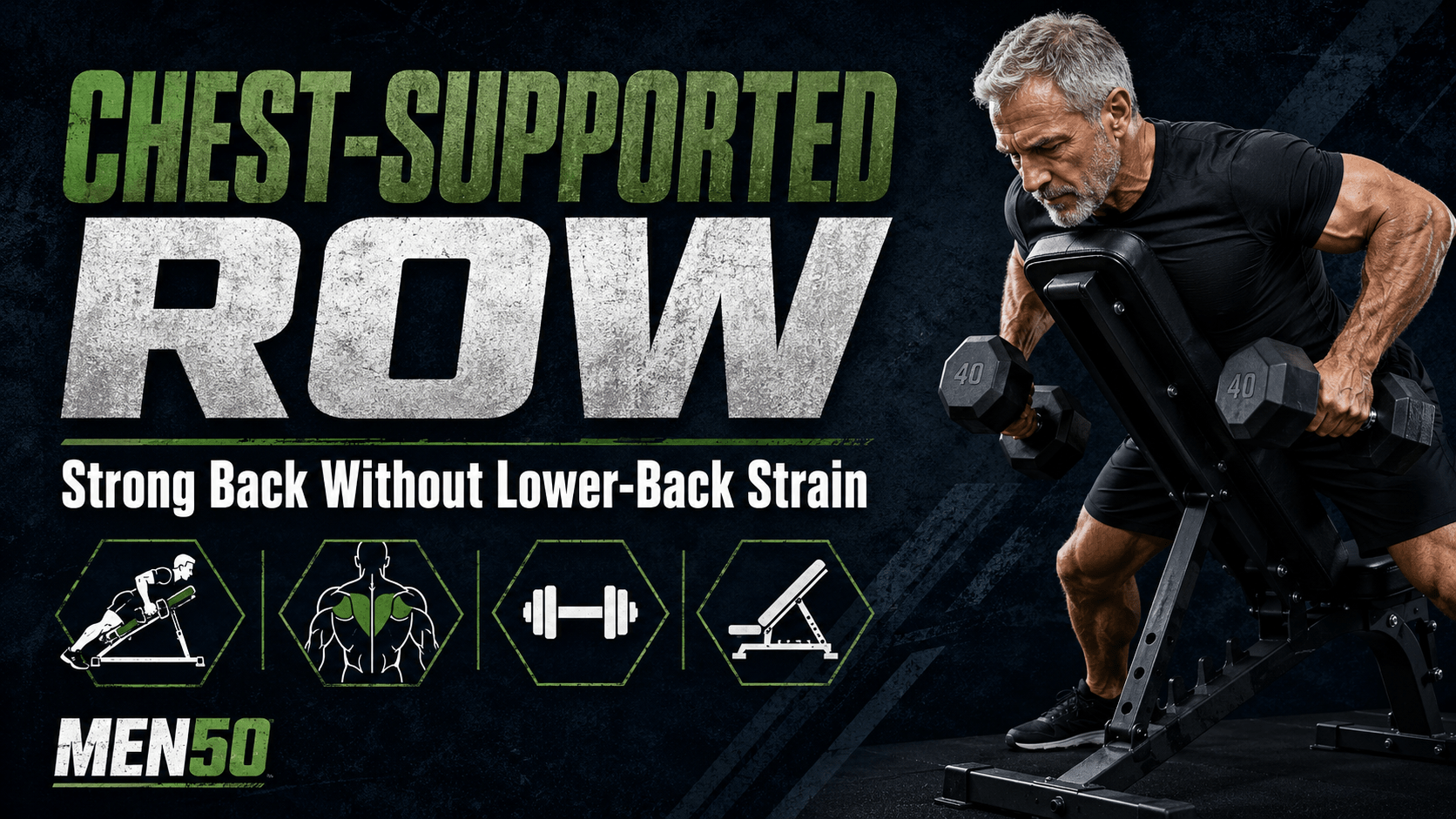
The chest-supported dumbbell row is the smartest heavy-pulling exercise for men over 50 with even mild lower-back concerns. The incline bench takes your lower back completely out of the equation — no bracing through every rep, no isometric hold during the bent-over position, no compensation pattern when the back fatigues before the upper back does. The bench supports your torso so the muscles that actually need to work — lats, upper back, rear shoulders, biceps — can do their job without interference. If you’ve ever tried standard dumbbell rows and felt the lower back limit you before the upper back was finished, this is the variation that fixes it.
Part of the Build Muscle After 50 pillar — strength training for men over 50.
Key Takeaways
- The chest-supported dumbbell row trains the lats, upper back, rear shoulders, biceps, and traps — same muscles as a standard row, with zero lower-back demand.
- Programming: 2–4 sets of 8–12 reps, 2–3 times per week. Rest 60–90 seconds between sets.
- Let the bench support your body so your back muscles can do the work. The whole point of this variation in one sentence.
- This is the heavy-pulling option for men with lower-back issues, lower-back fatigue, or anyone who wants to isolate the upper back without the kinetic chain limiting them.
- Pulling exercises form a four-step progression: band pull-apart → resistance band row → dumbbell row → chest-supported row. Most men over 50 benefit from rotating between several.
How to Perform the Chest-Supported Dumbbell Row
Set up first:
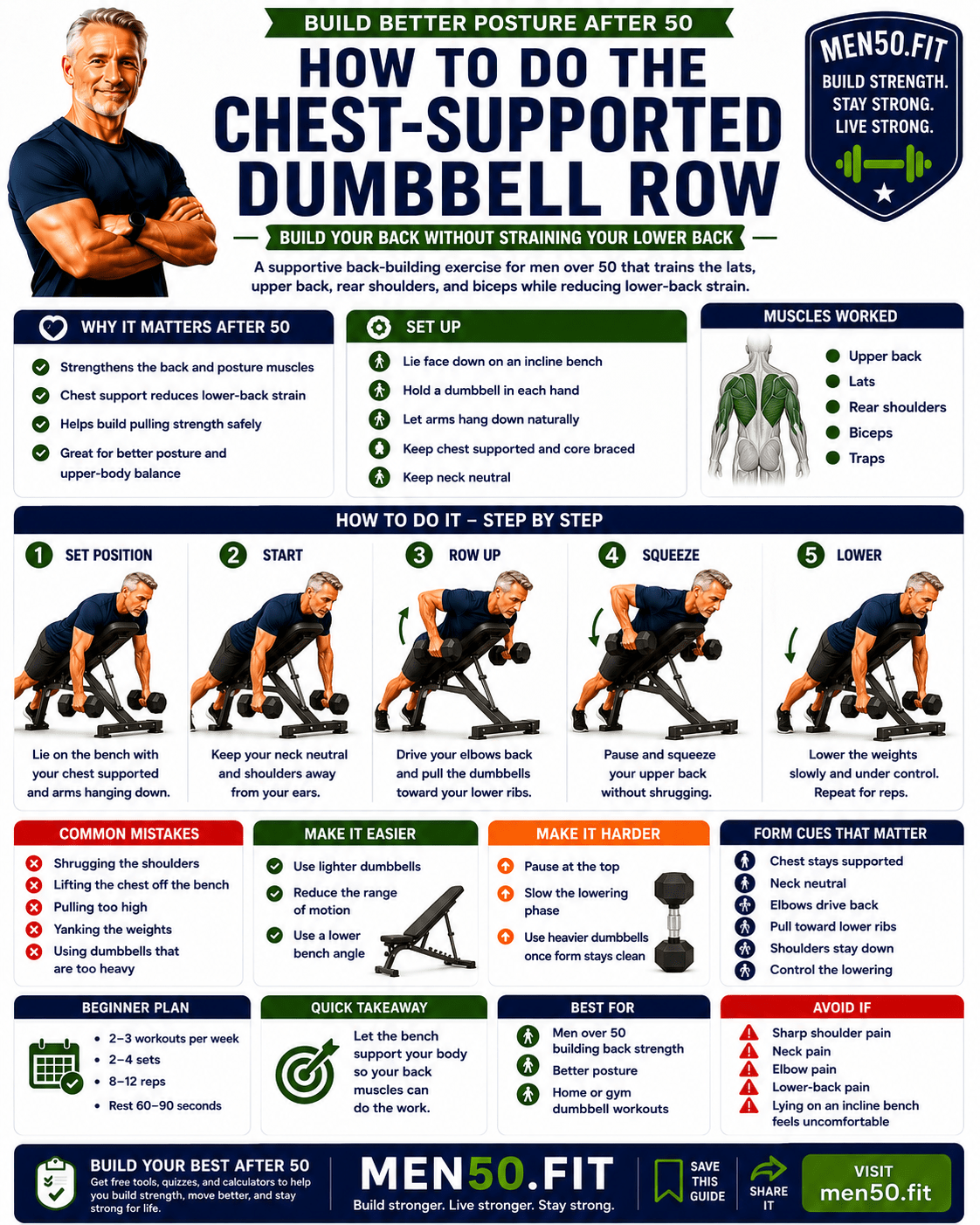
- Set an adjustable incline bench to about 30–45 degrees.
- Lie face down on the bench with your chest pressed firmly against the pad.
- Feet planted on the floor (or on the foot rest if the bench has one).
- Hold a dumbbell in each hand with arms hanging straight down toward the floor.
- Keep your neck neutral — eyes looking down at the floor, not up.
Then the movement:
- Set position. Lie face down on the incline bench with chest supported and arms hanging down naturally. Feet stable. Core lightly braced — even though the bench supports you, the core staying engaged keeps the spine stable.
- Start. Keep your neck neutral and shoulders down, away from your ears. Take a moment to feel the chest pressed firmly against the pad. Grip the dumbbells firmly.
- Row up. Drive your elbows back and pull the dumbbells toward your lower ribs (not toward your armpits). Lead with the elbows, not the hands. Shoulders stay down — don’t shrug.
- Squeeze. Pause at the top with the dumbbells at your lower ribs. Squeeze your shoulder blades together. Don’t shrug the shoulders toward the ears.
- Lower. Slowly extend your arms back to the start under control. Take 2–3 seconds on the way down. Don’t let the weights drop — control the lowering on every rep.
The cue that matters most: let the bench support your body so your back muscles can do the work. The whole purpose of the chest support is to remove the postural demand and let the rowing muscles work at their full capacity.
Why the Chest-Supported Dumbbell Row Matters After 50
The single biggest limit on most heavy rowing exercises is the lower back fatiguing before the upper back does. The standard bent-over dumbbell row puts you in a static bent-over position — the lower back, hamstrings, and glutes all work isometrically just to hold the torso parallel to the floor while the upper back does the actual rowing. After 50, this static holding capacity often runs out before the rowing capacity does. The result: you stop the set because your lower back is tight, not because your upper back is tired.
The chest-supported row solves this by removing the postural demand entirely. The bench holds your torso in position. Your lower back, hamstrings, and glutes don’t have to brace. The only muscles working are the ones doing the actual rowing — lats, upper back, rear shoulders, biceps, traps. For men over 50 with lower-back issues, this is often the only way to get genuinely heavy pulling work without aggravating the lumbar spine.
There’s also the isolation benefit. Even men with healthy lower backs find that chest-supported rows let them feel the upper back working more clearly — because nothing else is competing for fatigue. This makes the exercise particularly useful when the goal is direct upper-back development rather than total-body strength.
The exercise targets the same postural pattern we’ve been training throughout the matrix — Vladimir Janda’s upper crossed syndrome, where the chest and front shoulders tighten while the upper back lengthens and weakens. The chest-supported row hits this pattern hard. Pair it with doorway chest stretches, band pull-aparts, and wall angels for a complete postural reset over 6–12 weeks.
Push-pull balance remains the recurring principle: for every set of pressing (floor press, push-ups, shoulder press), include an equivalent amount of pulling. The chest-supported row is one of the most efficient pulling tools because it isolates the working muscles and lets them be trained heavily without compromise.
Sets and Reps
Heavier than standard dumbbell rows for many men because the lower back is no longer the bottleneck.
| Stage | Variation | Sets × Reps | Frequency | Load Guide |
|---|---|---|---|---|
| Beginner | Lower bench angle (45°), moderate weight | 2 × 8–10 | 2× per week | 15–25 lbs (7–11 kg) |
| Novice | Standard angle (30–40°), working weight | 2–3 × 8–12 | 2–3× per week | 20–35 lbs (9–16 kg) |
| Intermediate | Standard angle, slow lowering | 3 × 8–12 | 2–3× per week | 25–40 lbs (11–18 kg) |
| Advanced | Pause at top + slow lowering | 3–4 × 8–12 | 2–3× per week | 35–55 lbs (16–25 kg) |
Rest 60–90 seconds between sets. Pick a weight where the last 2–3 reps feel clearly challenging but you can complete them with: chest pressed to bench, neck neutral, shoulders down (not shrugged), elbows leading the pull, and controlled lowering on every rep.
A practical note on load: most men over 50 can use 5–10 lbs heavier dumbbells for chest-supported rows than for standard bent-over dumbbell rows, because the lower back is no longer the limiting factor. If you’ve been stuck at the same dumbbell row weight for months and the lower back is the issue, the chest-supported version often unlocks the next progression.
Common Mistakes
The five errors that turn a great upper-back exercise into a trap-and-neck exercise:
- Shrugging the shoulders. The single most common mistake in any rowing exercise. As you pull, the upper traps want to lift the shoulders toward the ears. This loads the wrong muscles and produces neck soreness the next day. Pin the shoulders down before starting each rep and consciously keep them there throughout.
- Lifting the chest off the bench. Some men arch the upper back off the pad to “help” pull the weight higher. This defeats the entire purpose of the chest-supported variation. Chest stays pressed firmly against the pad on every rep, top to bottom.
- Pulling too high. Rowing the dumbbells toward the armpits or chest instead of toward the lower ribs recruits the upper traps and front shoulders more than the upper back. Pull toward the lower ribs — that’s the path that lights up the lats and mid-back.
- Yanking the weights. Quick, jerky reps use momentum to lift the dumbbells. The back muscles barely fire; the joints take the impact. Use a 1–2 second pull, 1-second pause, 2–3 second lower. The slow tempo is the exercise.
- Using dumbbells that are too heavy. If you can’t pull cleanly without arching off the bench, shrugging, or jerking, the load is too heavy. Drop down and rebuild with proper form. Heavier won’t fix bad form; it will reinforce it.
Make It Easier or Harder
If standard chest-supported rows are too challenging:
- Use lighter dumbbells — strength is built from where you are. 10–15 lbs is fine for beginners.
- Reduce the range of motion — pull to about 70–80% of full range while you build strength. Build the full range over weeks.
- Use a lower bench angle — a 45–60° angle reduces the pulling demand and is generally more comfortable for beginners.
- Reduce reps — start with 2 sets of 6–8 reps and build from there.
To make it harder once form is solid:
- Pause at the top for 1–2 seconds with the dumbbells at your lower ribs and shoulder blades squeezed.
- Slow the lowering phase to 3–5 seconds per rep — significantly more challenging than it sounds.
- Use heavier dumbbells — once form stays clean at the lighter weight.
- Use a steeper bench angle (closer to 25–30°) — increases the range of motion and the demand on the upper back.
For variety, try the single-arm chest-supported row (one arm at a time, opposite hand resting on the bench) — exposes left-right imbalances and adds a small anti-rotation core challenge.
Safety Note
Avoid the chest-supported dumbbell row if you have sharp shoulder pain, neck pain, elbow pain, or lower-back pain — even though this variation reduces lower-back demand, severe back issues can still be aggravated by lying face down on a bench.
If lying on an incline bench feels uncomfortable for the chest, sternum, or ribs (some men with chest sensitivity or rib injuries find this position painful), the standard dumbbell row or resistance band row are reasonable alternatives.
Make sure the bench is properly adjusted and stable before starting. The face-down position means dropping dumbbells unexpectedly is harder to recover from than in a seated position — use a weight you’re confident you can control.
Build Your Personal Training Plan
The chest-supported dumbbell row is one piece of a complete upper body programme. Get a personalised exercise plan based on your current strength, goals, and any limitations.
Take the Free Fitness Profiler →
FAQs
Chest-supported row vs standard bent-over dumbbell row — which is better?
Different exercises with different purposes. The standard dumbbell row trains the upper back and the postural musculature that holds you in the bent-over position — a more total-body movement. The chest-supported row isolates the upper back by removing the postural demand. For men over 50 with lower-back issues, lower-back fatigue, or anyone wanting to feel the upper back work cleanly, the chest-supported version is better. For men with healthy backs who want total-body strength, the standard row has its advantages. Many programmes use both — chest-supported one workout per week, standard another.
What bench angle should I use?
For most men over 50, 30–45 degrees is the right starting range. A steeper angle (25–30°) puts you closer to parallel to the floor — more like a standard bent-over row but supported. A shallower angle (45–60°) is more upright and easier on the chest and ribs. Start at about 40 degrees and adjust based on what feels right for your body. Some men find their preferred angle changes over time as their flexibility and strength improve.
How heavy should the dumbbells be?
Heavy enough that the last 2–3 reps feel clearly challenging, but light enough that you can complete the set with clean form — chest pressed to the bench, shoulders down, elbows leading. For most men over 50 starting out, that’s 15–25 lbs (7–11 kg) per hand. After 3–6 months of training, many men progress to 25–40 lbs (11–18 kg). Most men can use 5–10 lbs heavier for chest-supported rows than for standard bent-over dumbbell rows because the lower back is no longer the limiting factor.
Why is my upper back fatiguing before my arms?
That’s exactly what should happen — and is one of the strongest signs the exercise is working. In a properly executed row, the back muscles (lats, rhomboids, mid-traps, rear deltoids) should be the limiting factor, not the biceps. If your biceps fatigue first, you may be pulling with the arms instead of leading with the elbows — focus on the cue “drive your elbows back” rather than “pull the dumbbells up.” If your upper back gets the work it should, you’re doing the exercise right.
Can this exercise replace standard dumbbell rows?
For many men over 50, yes — particularly those with lower-back issues. The chest-supported row trains the same primary muscles (lats, upper back, rear shoulders, biceps) without the lower-back demand of the bent-over position. But the standard dumbbell row trains the postural-bracing pattern that’s also useful. If you have to pick one, the chest-supported row is the safer and more isolation-focused choice. If you can do both, alternate them across the week — the variety is a benefit, not a problem.
References
- Janda V. Muscles, Central Nervous Motor Regulation and Back Problems. In: Korr IM (ed). The Neurobiologic Mechanisms in Manipulative Therapy. Plenum Press; 1978. (Upper Crossed Syndrome framework.)
- American College of Sports Medicine. Resistance Training for Older Adults Position Stand. acsm.org
- National Institute on Aging. Sarcopenia and Muscle Strength in Older Adults. nia.nih.gov
Disclaimer: This article is for educational purposes only and is not medical advice. Consult a qualified healthcare professional before starting any new exercise programme, especially if you have existing back, shoulder, neck, or elbow conditions.