
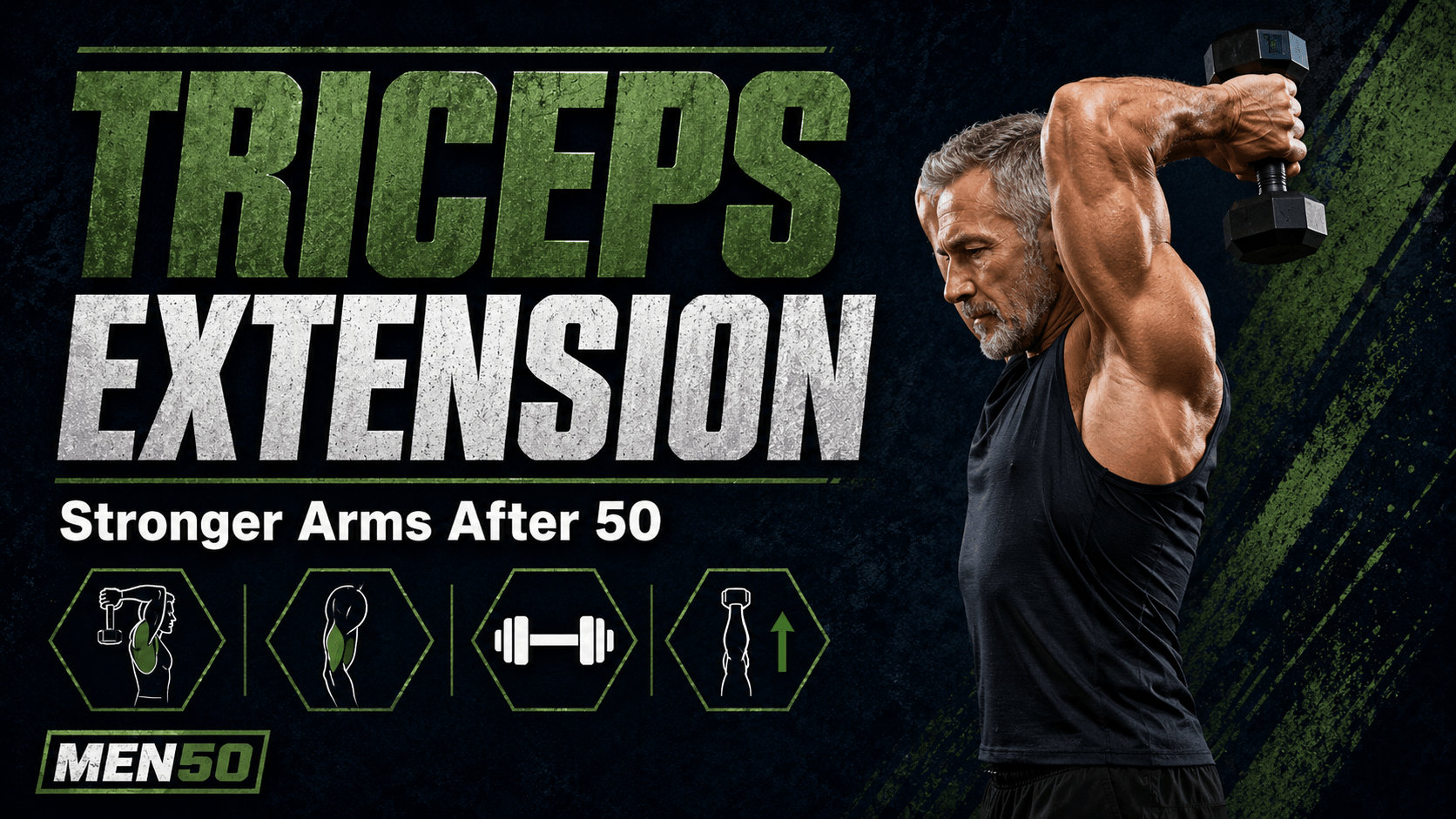
The overhead triceps extension is the most direct way to train the back of your arms. And here’s a fact most men over 50 don’t know: the triceps actually makes up about two-thirds of the upper arm, which means if your arms feel small or weak, the issue is more likely the triceps than the biceps. The triceps also drives every pushing motion — push-ups, presses, lifting things overhead — so triceps weakness often shows up as pressing weakness long before men realise the arm-strength gap is what’s holding them back. This exercise fixes it.
Part of the Build Muscle After 50 pillar — strength training for men over 50.
Key Takeaways
- The overhead triceps extension is direct triceps work — the most efficient way to train the back of the arms.
- The triceps makes up about two-thirds of upper arm mass. It’s larger than the biceps. Direct triceps work matters more than most men think.
- Programming: 2–3 sets of 8–12 reps, 2–3 times per week. Rest 45–75 seconds between sets.
- Keep your elbows close to your ears and your core tight. The whole technique in two cues.
- Triceps weakness commonly limits pressing performance more than chest or shoulder weakness does. Direct triceps work makes your push-ups, floor press, and shoulder press stronger.
How to Perform the Overhead Triceps Extension
Set up first:
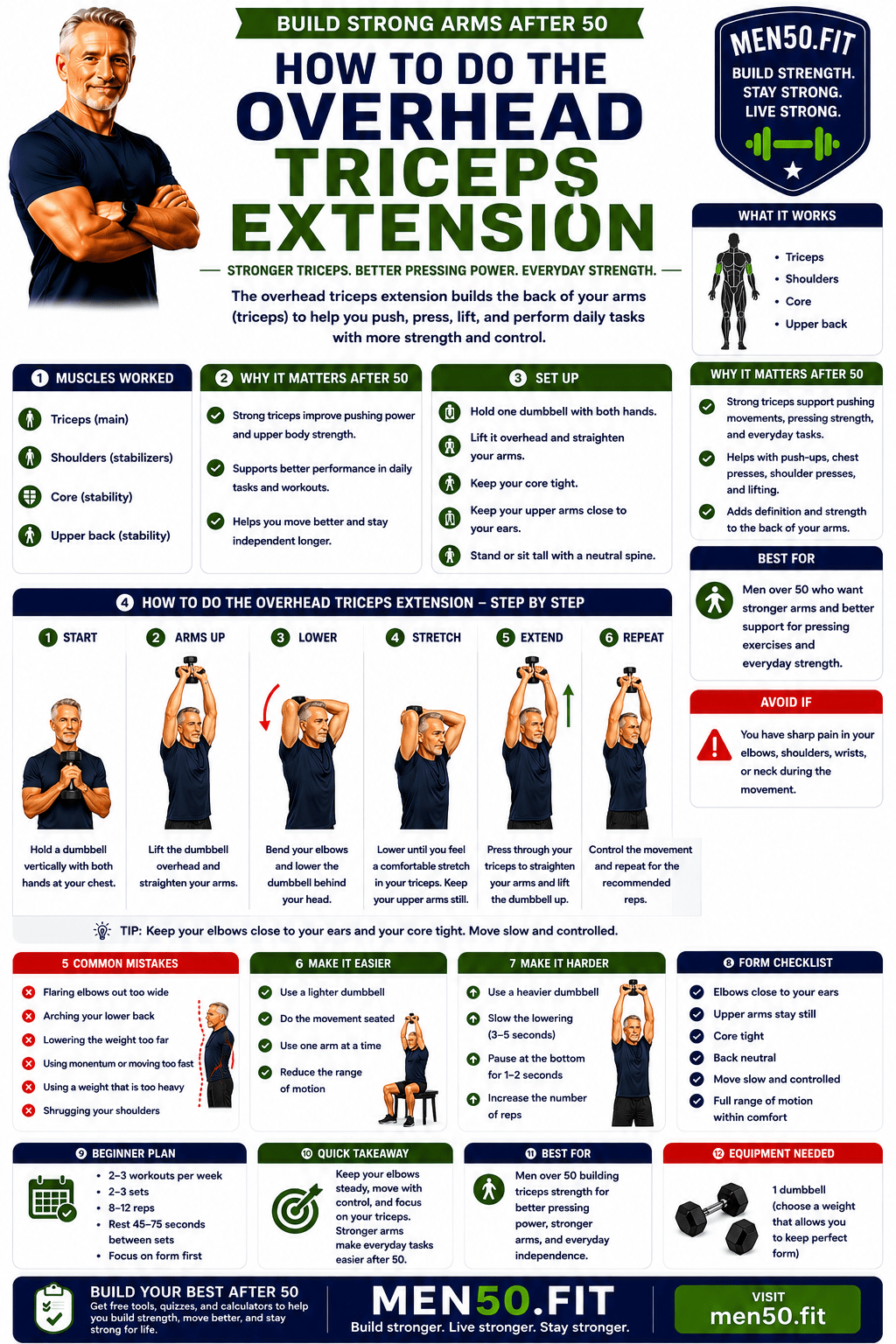
- Hold a single dumbbell vertically with both hands cupping the upper end.
- Stand or sit tall with a neutral spine, core tight, chest up.
- Lift the dumbbell overhead and straighten your arms.
- Keep your upper arms close to your ears throughout — they shouldn’t move during the rep.
Then the movement:
- Start. Hold a dumbbell vertically with both hands at your chest, palms cupping the upper end (like cradling the dumbbell). Core engaged.
- Arms up. Lift the dumbbell overhead by straightening your arms above your head. Upper arms close to your ears, elbows pointing forward (not flared out to the sides).
- Lower. Bend your elbows and lower the dumbbell behind your head, controlled. Take 2–3 seconds. The upper arms stay still — only the forearms move.
- Stretch. Lower until you feel a comfortable stretch in your triceps (about when the dumbbell is at the base of your neck or just below). Keep upper arms still — don’t let them flare out.
- Extend. Press through your triceps to straighten your arms and lift the dumbbell back up overhead. Squeeze the triceps at the top.
- Repeat. Maintain clean form on every rep. Six clean reps build more strength than ten with form breakdown.
The cue that matters most: keep your elbows close to your ears and your upper arms still. The only thing that moves is the forearm — bending and straightening at the elbow. If your upper arms flare out or move forward, the exercise stops training the triceps properly.
Why the Overhead Triceps Extension Matters After 50
The triceps is the largest muscle on your upper arm — it makes up roughly two-thirds of the upper arm’s mass. Most men focus on biceps because that’s what flexes when you “make a muscle” in a mirror, but the triceps is what actually drives your pressing strength and gives your arms substantial size and shape. After 50, the triceps is one of the muscles that loses strength quickly without direct training, partly because most everyday activities don’t load it heavily.
The triceps has three heads: the long head (which runs from the shoulder blade down to the elbow), the lateral head, and the medial head. The overhead position specifically targets the long head — the largest of the three — because stretching the arm overhead pre-stretches the long head before each rep. Other triceps exercises (like rope pushdowns or bench dips) train the lateral and medial heads more. For complete triceps development, the overhead extension is one of the most efficient single exercises.
There’s a less obvious benefit that matters more for men over 50: the triceps is often what limits pressing performance. When a push-up, floor press, or shoulder press stalls at the lockout — the end of the press, where the arms straighten — the limit is usually triceps strength rather than chest or shoulder strength. Direct triceps work specifically addresses this lockout weakness. Most men over 50 who add overhead triceps extensions to their routine see their pressing numbers increase within 4–6 weeks, even without changing their pressing exercises.
The honest case for direct triceps work, similar to the case for biceps work in men over 50: the muscles are useful, they’re declining faster than men realise, and 10 minutes per week of direct training delivers high returns. The “isolation exercises are vanity” argument applies more to advanced bodybuilders who already have plenty of arm strength — for men over 50 rebuilding capacity, it’s functional work.
Sets and Reps
Moderate load, controlled tempo, clean reps. The triceps responds well to steady volume — not heavy maxes.
| Stage | Sets × Reps | Frequency | Load Guide |
|---|---|---|---|
| Beginner | 2 × 8–10 | 2× per week | Light dumbbell, focus on form |
| Novice | 2–3 × 8–12 | 2–3× per week | Moderate, last 2 reps challenging |
| Intermediate | 3 × 8–12 | 2–3× per week | Working weight, RPE 7–8 |
| Advanced | 3 × 6–12 | 2–3× per week | Heavier, slow lowering, pause at bottom |
Rest 45–75 seconds between sets. Pick a weight where the last 2–3 reps feel clearly challenging but you can complete them without flaring the elbows, arching the back, or letting the upper arms move.
A practical starting load: most men over 50 begin with 10–20 lb (4.5–9 kg) dumbbells. After 3–6 months, many men progress to 20–30 lbs (9–14 kg). The overhead position is harder to control than other triceps exercises, so don’t expect to use heavy dumbbells here even when your other lifts progress. Clean reps at moderate load is the right standard.
Common Mistakes
The six errors that turn a great triceps exercise into a shoulder or back problem:
- Flaring elbows out too wide. The biggest mistake. When the elbows drift out to the sides, the exercise stops being a triceps extension and becomes a shoulder/triceps hybrid that loads the shoulder joint awkwardly. Keep elbows close to your ears throughout — they shouldn’t drift outward.
- Arching your lower back. Some men extend the lumbar spine to “help” lift the weight, especially as fatigue sets in. The result: shoulders end up in a worse overhead position and the lower back takes load it doesn’t need. Stay tall, brace the core, ribs down, lower back neutral.
- Lowering the weight too far. Going too deep behind the head — past a comfortable stretch — can aggravate the shoulder joint and pull the upper arms out of position. Stop when you feel a comfortable triceps stretch, not when the dumbbell crashes into your back.
- Using momentum or moving too fast. Quick, jerky reps use shoulder swing instead of triceps strength. Use a 2-second lift, brief pause, 2–3-second lower. The slow tempo is the exercise.
- Using a weight that is too heavy. The overhead position is awkward by nature. Heavier weights force compensation — flared elbows, arched back, body swing. Drop a size and use control.
- Shrugging your shoulders. Some men lift the shoulders toward the ears as the arms straighten, recruiting the upper traps. Keep the shoulders down and back, away from the ears. If you can’t keep them down, the weight is too heavy.
Make It Easier or Harder
If standard overhead triceps extensions are too challenging:
- Use a lighter dumbbell — 5–10 lbs (2–4.5 kg) is fine to start. The overhead position is awkward enough on its own without heavy load.
- Do the movement seated — on a chair with proper back support. Removes balance demand and helps prevent lower-back arching.
- Use one arm at a time — single-arm overhead triceps extensions let you focus on form one side at a time, and your free hand can support the working elbow if needed.
- Reduce the range of motion — only lower the dumbbell partway behind the head while you build strength and shoulder mobility.
To make it harder once form is solid:
- Use a heavier dumbbell — but only when the lighter weight feels easy with clean form.
- Slow the lowering phase to 3–5 seconds per rep — significantly more demanding.
- Pause at the bottom for 1–2 seconds with the dumbbell stretched behind the head (controlled, not crashing).
- Increase the number of reps — extend sets to 12–15 reps with the same weight before adding load.
For variety once basic form is solid, try the single-arm overhead triceps extension (one dumbbell, one hand) — exposes left-right imbalances and adds a small core anti-tilt challenge.
Safety Note
The overhead position is more demanding on the shoulder than other triceps exercises. If you have shoulder impingement, rotator cuff issues, or limited overhead mobility, the overhead triceps extension may aggravate things. Try the seated version with light weight first; if pain persists, switch to a different triceps exercise (kickbacks or close-grip push-ups) until shoulder mobility improves.
If you feel sharp pain in the elbow, shoulder, wrist, or neck during the movement, stop immediately. Adjust the dumbbell hold, check that your elbows aren’t flaring, or reduce the range of motion. Persistent sharp joint pain — particularly at the elbow tendon insertion — is worth checking with a physiotherapist; triceps work can flare existing elbow tendinopathy.
Make sure you have clear space behind your head. The dumbbell lowers behind the head, and bumping into a wall, a low ceiling, or another piece of equipment can disrupt the rep and cause loss of control.
Build Your Personal Training Plan
The overhead triceps extension is one piece of a complete upper body programme. Get a personalised exercise plan based on your current strength, goals, and any limitations.
Take the Free Fitness Profiler →
FAQs
Why train triceps separately when push-ups already work them?
Pushing exercises train the triceps as a secondary muscle — meaning they’re involved, but the chest and shoulders do most of the work. The triceps gets fatigued, but rarely as fully as it would with direct work. Direct triceps work fills the gap that compound pressing misses. It also lets you train the triceps without re-fatiguing the chest and shoulders, which is useful if pressing is already your training priority. Most men over 50 benefit from 1–2 sets per week of direct triceps work alongside their pressing routine — that’s enough.
Overhead triceps extension vs other triceps exercises — which is best?
The overhead extension specifically trains the long head of the triceps — the largest of the three heads — because the overhead position pre-stretches it. Other triceps exercises (rope pushdowns, bench dips, close-grip push-ups, triceps kickbacks) train the lateral and medial heads more. For most men over 50, the overhead extension is the most efficient single exercise for triceps development. If you can do only one, this is it. If you have shoulder issues that make overhead work uncomfortable, triceps kickbacks or close-grip push-ups are the next best options.
How heavy should the dumbbell be?
Heavy enough that the last 2–3 reps feel clearly challenging, but light enough that you can complete the set with elbows close to your ears, upper arms still, and no lower-back arching. For most men over 50 starting out, that’s 10–20 lbs (4.5–9 kg). After 3–6 months of training, many men progress to 20–30 lbs (9–14 kg). The overhead position is awkward enough that even strong men use lighter dumbbells for this exercise than for other triceps work — that’s expected.
Why does my shoulder hurt during this exercise?
Two common causes. Limited shoulder mobility — if you can’t get your arms fully overhead with neutral form (elbows close to ears, no lower-back arching), the overhead position is grinding against your shoulder limits. Work on shoulder mobility with wall angels and doorway chest stretches for 2–3 weeks before trying again. Existing shoulder impingement or rotator cuff irritation — overhead work flares these conditions. If you have a diagnosed shoulder issue, skip overhead triceps work entirely and use seated or kneeling variations instead.
Can I do triceps and biceps work in the same session?
Yes, and it’s the standard way to train them. A typical structure: biceps curls or hammer curls followed by overhead triceps extensions — 2–3 sets of each. Total time: 10–15 minutes. Don’t do extensive direct arm work more than 2–3 times per week — the small arm muscles need recovery between sessions. Many men over 50 add 10 minutes of direct arm work to their existing pressing or pulling sessions and get good results.
References
- American College of Sports Medicine. Resistance Training for Older Adults Position Stand. acsm.org
- National Institute on Aging. Sarcopenia and Muscle Strength in Older Adults. nia.nih.gov
- Centers for Disease Control and Prevention. Physical Activity Guidelines for Americans, 2nd Edition. cdc.gov
Disclaimer: This article is for educational purposes only and is not medical advice. Consult a qualified healthcare professional before starting any new exercise programme, especially if you have existing shoulder, elbow, or wrist conditions.