
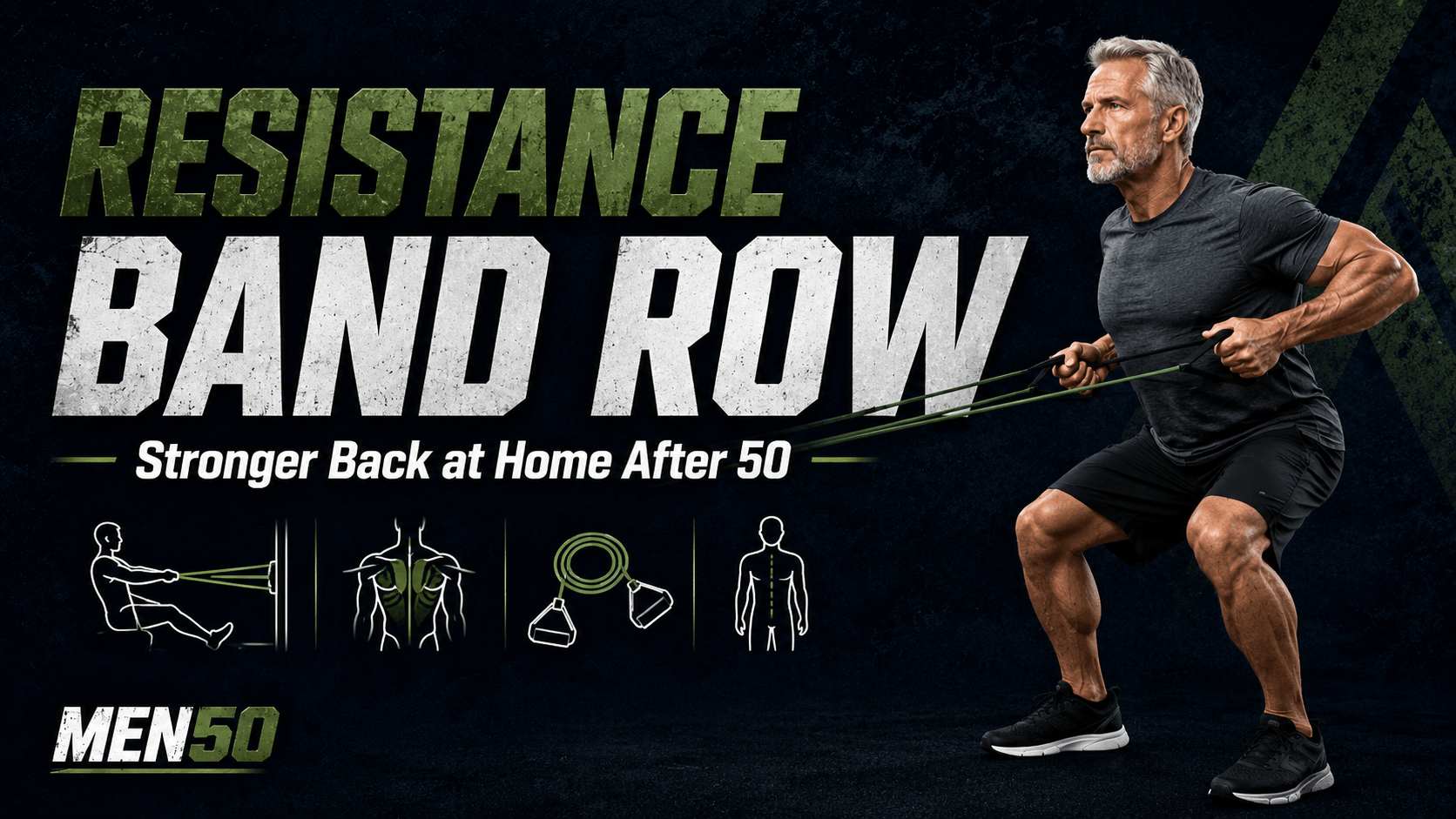
The resistance band row is the most accessible pulling exercise for men over 50. It builds the same upper back, lat, and rear shoulder strength as a dumbbell row, but with cheap, portable equipment that costs under £20 and stores in a drawer. The band scales naturally — sit closer to the anchor for less tension, further for more — which means the same one or two bands carry you through months of progressive overload. For men who train at home, travel often, or just don’t want dumbbells lying around, this is the workhorse back exercise.
Part of the Build Muscle After 50 pillar — strength training for men over 50.
Key Takeaways
- The resistance band row trains the upper back, lats, rear shoulders, biceps, and the shoulder blade muscles that hold posture in place.
- For every pushing exercise you do (push-ups, bench press), pair an equivalent amount of pulling work. The band row is the easiest way to do it at home.
- Programming: 2–4 sets of 10–15 reps, 2–3 times per week. Rest 45–75 seconds between sets.
- Pull your elbows back, not your hands. The single most important cue. If you’re rowing with your arms instead of your back, you’ll feel the work in your biceps the next day, not the back.
- Three band-based pulling exercises form a complete back-strength routine: band pull-apart (daily, light), this row (2–3× per week, moderate), and the dumbbell row (heavier load when you have access).
How to Perform the Resistance Band Row
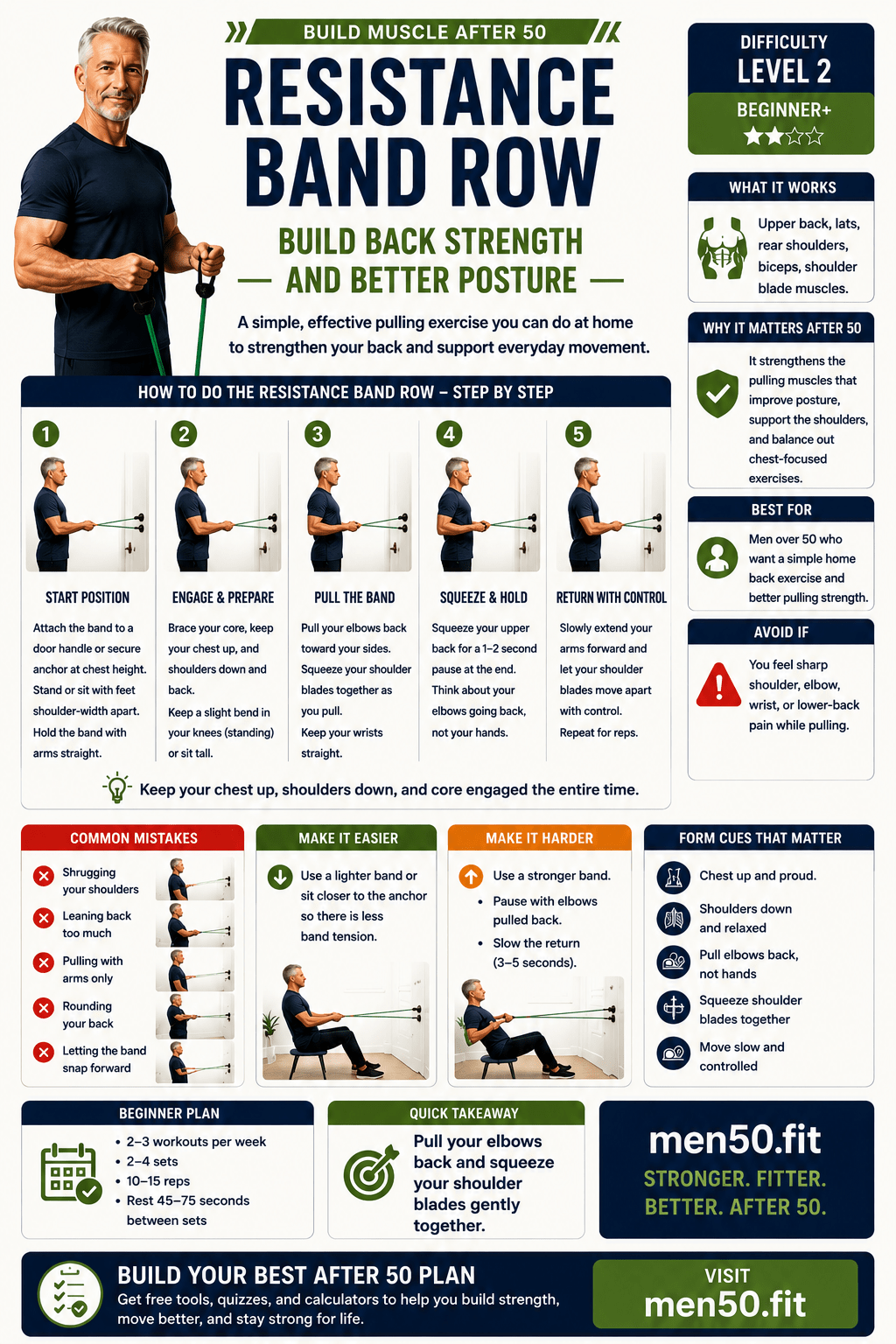
- Start position. Attach the band to a door handle, a secure anchor, or a sturdy post at roughly chest height. Stand or sit with feet shoulder-width apart. Hold the band handles (or grip the band itself) with arms straight out in front of you. Keep a slight bend in the knees if standing, or sit tall if seated.
- Engage and prepare. Brace your core. Chest up. Shoulders down and back — not shrugged toward the ears. Keep your wrists straight and a slight bend in your elbows. This is your bracing position; you maintain it through every rep.
- Pull the band. Pull your elbows back toward your sides, leading with the elbows — not the hands. Imagine your elbows are putting something in your back pockets. Squeeze your shoulder blades together as you pull.
- Squeeze and hold. Pause for 1–2 seconds at the end of the pull, with elbows close to your sides and shoulder blades fully engaged. Think about your elbows going back, not your hands coming closer. Don’t let the shoulders shrug up at the top.
- Return with control. Slowly extend your arms forward and let the shoulder blades move apart with control. Take 2–3 seconds on the return. Don’t let the band snap your arms forward.
The cue that matters most: pull your elbows back and squeeze your shoulder blades gently together. If you focus on this rather than on moving the hands, the right muscles do the work.
Why the Resistance Band Row Matters After 50
Most men over 50 are heavily push-dominant in both daily life and training. Reaching forward at a desk, gripping a steering wheel, holding a phone, pushing through doors — these patterns load the front of the body for hours every day. Pushing exercises (push-ups, bench press) follow the same forward pattern. Without an equal amount of pulling work, the chest and front shoulders tighten while the upper back lengthens and weakens. That’s the Czech physiotherapist Vladimir Janda’s upper crossed syndrome — and it’s the most common postural pattern in men over 50.
The fix is straightforward: for every set of pushing you do, do at least one set of pulling. The band row makes that easy. It targets the rhomboids (between the shoulder blades), lats (the broad back muscles), rear deltoids (back of the shoulders), and mid-traps — the same muscles that hold the shoulders in healthy posture and protect against shoulder impingement.
The other reason this exercise belongs in every home-training routine is the practical reality of resistance bands. Bands give variable resistance — they’re easier at the start of the pull and harder at the end, which matches how the back muscles actually generate force. They also let you adjust intensity instantly without changing weights: step closer to the anchor for less tension, step back for more. A single light band and a single medium band cover most men over 50 for 6–12 months of progressive training. The whole kit fits in a drawer, costs less than a single gym session, and travels easily.
Compared with the dumbbell row, the band row produces less peak load but allows higher rep ranges and is easier on the lower back (no bent-over position required). Both have their place. The band row works at lower load and higher rep; the dumbbell row at higher load and lower rep. Many men get the best results doing both — band rows 2 days per week, dumbbell rows 1–2 days per week.
Sets and Reps
The band row tolerates higher rep ranges than weighted rows because the resistance builds through the rep rather than staying constant.
| Stage | Variation | Sets × Reps | Frequency |
|---|---|---|---|
| Beginner | Light band, seated for stability | 2 × 10–12 | 2× per week |
| Novice | Light or medium band, standing | 3 × 10–15 | 2–3× per week |
| Intermediate | Medium band, slow lowering | 3 × 12–15 | 2–3× per week |
| Advanced | Heavier band, 1–2 second pause at peak contraction | 3–4 × 10–15 | 2–3× per week |
Rest 45–75 seconds between sets. Pick a tension where the last 2–3 reps are clearly challenging but you can complete them without shrugging, leaning back, or losing form. If form breaks before you hit the rep target, reduce the tension (lighter band, or stand closer to the anchor).
A simple way to add or reduce intensity without changing bands: change your distance from the anchor. Stepping back 12 inches noticeably increases the tension on every rep. Stepping forward reduces it. This is the band row’s biggest practical advantage — fine-grained adjustment without buying more equipment.
Common Mistakes
The five errors that turn a great back exercise into a neck or arm exercise:
- Shrugging your shoulders. As you pull, the upper traps want to lift the shoulders toward the ears. This loads the wrong muscles and is the most common reason men feel band rows in their neck the next day. Pin the shoulders down and back before starting each rep and keep them there throughout.
- Leaning back too much. Some men compensate for tension that’s too heavy by leaning their whole torso back to “help” the pull. The torso should stay roughly upright — a 5–10 degree forward lean at the start is fine, but the whole-body sway means the band is too heavy.
- Pulling with arms only. The biggest distinction between a row and a bicep curl. Lead with the elbows, not the hands. If you feel the work in the front of your upper arms instead of in your back, you’re curling, not rowing. Squeeze the shoulder blades together as the elbows pull back.
- Rounding the back. The lower back should stay flat throughout — neither rounded forward nor arched aggressively. Core engaged, chest up, ribs down. If you feel strain in the lower back rather than work in the upper back, drop the band tension and recheck your posture.
- Letting the band snap forward. Releasing the tension at the end of each rep skips the lowering phase, where strength is genuinely built. Take 2–3 seconds on the return. The band wants to snap back fast — your job is to slow it down.
Make It Easier or Harder
If standard band rows feel too challenging:
- Use a lighter band — most band sets include 3–5 different tensions specifically for this kind of progression.
- Sit closer to the anchor point to reduce the stretched-band tension.
- Sit instead of stand — removes balance demands and lets you focus on the upper back work.
- Reduce reps — start with 2 sets of 8 reps and build from there.
To make band rows harder once form is solid:
- Use a stronger band — the obvious progression, but easy to overshoot. Add tension only when the lighter band feels easy.
- Stand further from the anchor — adds tension without changing equipment.
- Pause for 1–2 seconds at the peak contraction with elbows pulled back.
- Slow the return phase to 3–5 seconds per rep — significantly more challenging than it sounds.
For variety: try the single-arm band row (one hand only, the other on a hip or chair for stability) — exposes left-right strength imbalances and forces the core to resist rotation. Useful once basic two-arm form is solid.
Safety Note
Make sure the band’s anchor point is secure. Door anchors should be properly seated with the door closed and locked from the same side. A band snapping free under tension can cause real injury — to your eyes, face, or whatever it hits on the way back. Inspect bands periodically for nicks, cracks, or wear; replace them at the first sign of degradation.
If you feel sharp pain in the shoulder, elbow, wrist, or lower back while pulling, stop immediately. Adjust band tension, hand position, or posture — usually one of these resolves the issue. Persistent sharp pain in the joint (as opposed to muscle fatigue in the back) is worth checking with a physiotherapist.
Men with diagnosed shoulder, elbow, or back conditions should start with a very light band and seated variations, and consult a physio if symptoms appear.
Build Your Personal Training Plan
The resistance band row is one piece of a complete upper body programme. Get a personalised exercise plan based on your current strength, goals, and any limitations.
Take the Free Fitness Profiler →
FAQs
What band tension should I start with?
Most band sets are colour-coded by tension. Start with a light band (often yellow or red) for the first 2–3 weeks while you learn the movement pattern. Once you can do 3 sets of 15 clean reps with the light band, move up to a medium band (often green or blue). Tension that’s “right” lets you complete the rep range with clean form but feels clearly challenging on the last 2–3 reps. If you can rip through 15 reps without effort, the band is too light.
Resistance band row vs dumbbell row — which is better?
Both belong in a complete programme; they serve different purposes. The band row is easier to adjust, easier on the lower back, more accessible (cheap, portable), and tolerates higher rep ranges. The dumbbell row allows heavier peak loads, which is better for pure strength gains, but requires the bent-over position and heavier equipment. Many men over 50 get the best results doing both — band rows 2 days per week, dumbbell rows once or twice per week. If you can only have one piece of home equipment, bands cover more ground per pound spent.
Where should I anchor the band?
The most common anchor is a closed door with a door anchor (a small attachment that loops through the door and locks behind it when the door closes). Anchor at chest height for a standard row. Other options: a sturdy post, a railing, the leg of a heavy piece of furniture, or a purpose-made wall mount. Don’t anchor to anything that might pull free under tension — the band snapping back is genuinely dangerous.
Can I do band rows every day?
For light-band, low-intensity work, yes — the muscles involved respond well to frequent practice. For heavier band tension at the prescribed 10–15 rep range, 2–3 times per week is the sweet spot, with 48 hours between sessions for recovery. If you want to train the upper back more often, pair this exercise with the band pull-apart — which is light enough to do daily.
Are resistance bands really effective for strength training?
Yes — and the evidence has accumulated over the last 15 years. Multiple studies on older adults have found resistance band training produces comparable strength gains to weight training, particularly in the moderate-load, higher-rep range that’s most appropriate for men over 50. Bands won’t replace heavy barbells for advanced lifters, but for the goals most men over 50 actually have — postural strength, functional capacity, muscle preservation — bands are genuinely sufficient.
References
- Janda V. Muscles, Central Nervous Motor Regulation and Back Problems. In: Korr IM (ed). The Neurobiologic Mechanisms in Manipulative Therapy. Plenum Press; 1978. (Upper Crossed Syndrome framework.)
- American College of Sports Medicine. Resistance Training for Older Adults Position Stand. acsm.org
- National Institute on Aging. Exercise & Physical Activity: Your Everyday Guide. nia.nih.gov
Disclaimer: This article is for educational purposes only and is not medical advice. Consult a qualified healthcare professional before starting any new exercise programme, especially if you have existing back, shoulder, or elbow conditions.