
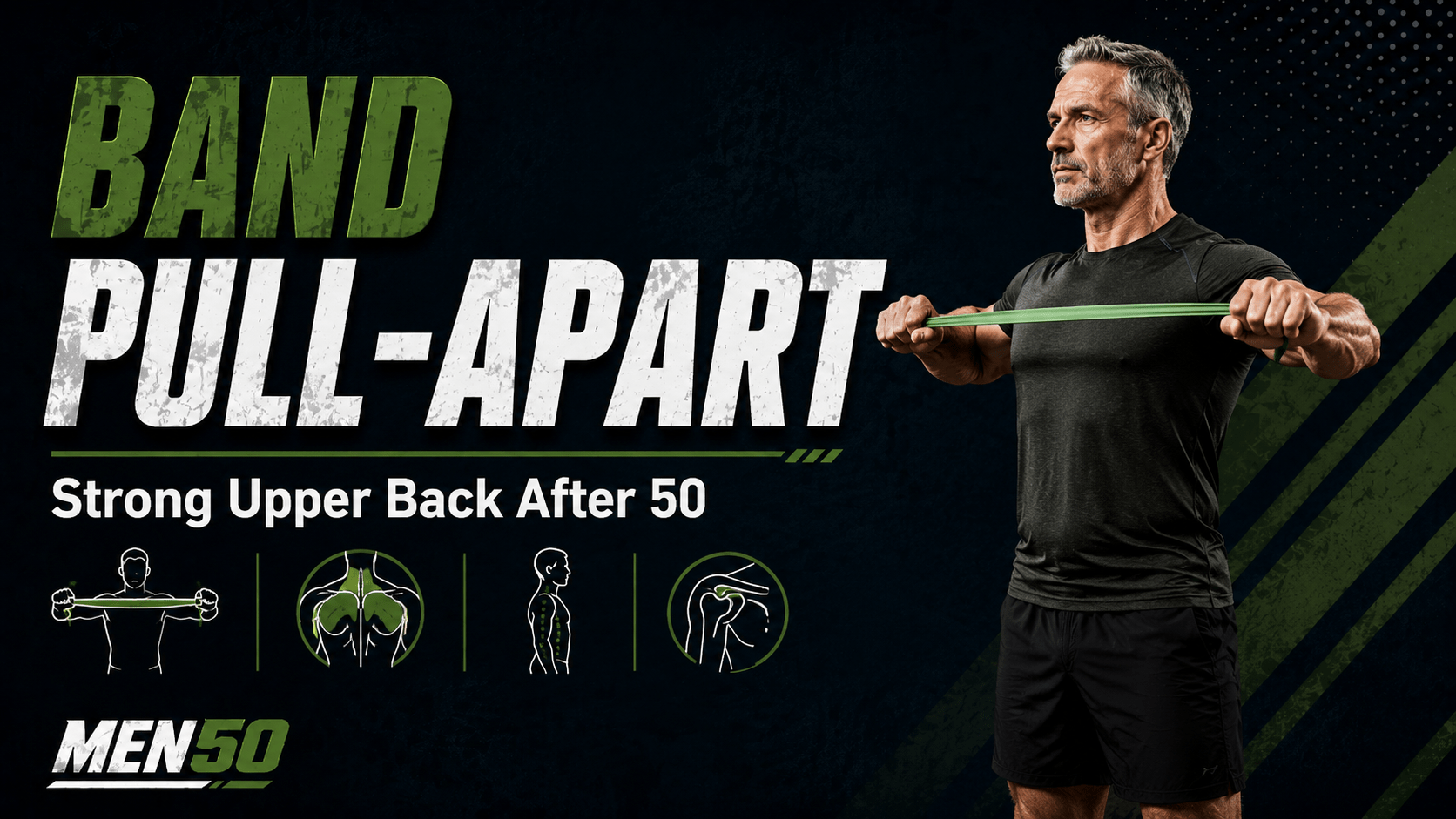
The band pull-apart is one of the most useful exercises a man over 50 can do, and it costs less than ten quid in equipment. It directly trains the rear deltoids, rhomboids, and mid-traps — the muscles that pull the shoulder blades back into a healthy position and keep your shoulders from rounding forward. Do it consistently and you’ll stand taller, feel less neck tension, and protect your shoulder joints from the wear-and-tear of decades of forward-facing activity.
Part of the Build Muscle After 50 pillar — strength training for men over 50.
Key Takeaways
- The band pull-apart trains the rear deltoids, rhomboids, and mid-traps — the postural muscles that get progressively weaker after 50.
- Rounded shoulders are part of “upper crossed syndrome”: tight chest and front shoulders, weak upper back. The band pull-apart fixes the weak side.
- Programming: 2–3 sets of 10–15 reps, 3–4 days per week. The exercise is low-load enough to do daily if you want to.
- Pull apart with the upper back, not the neck. The single most important cue. If your traps are doing the work, you’re cheating.
- A light band is better than a heavy one. Posture work is about quality and frequency, not load.
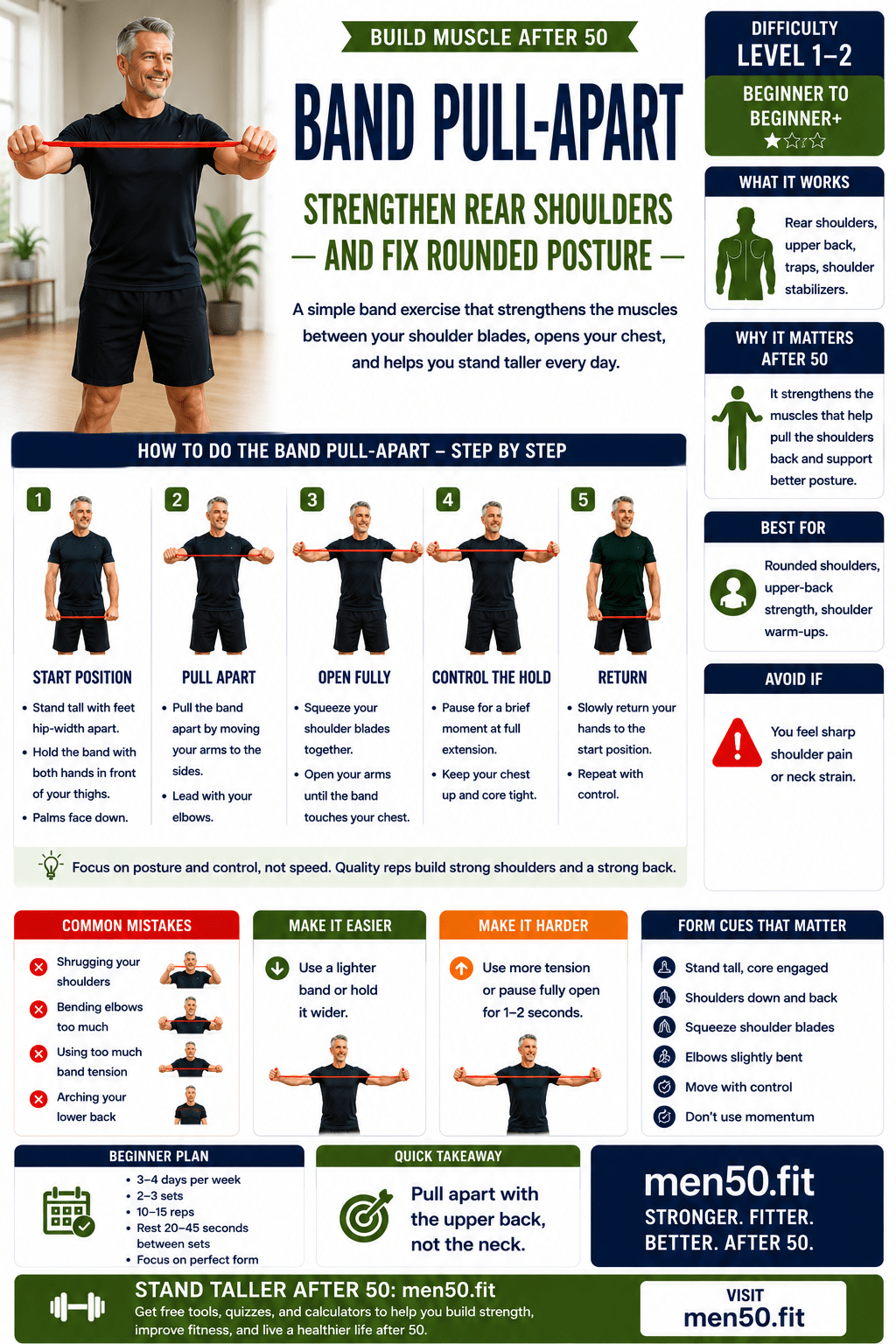
How to Perform the Band Pull-Apart
- Start position. Stand tall with feet hip-width apart. Hold a resistance band with both hands in front of you at roughly chest height, arms straight, hands slightly wider than shoulder-width. Palms face down.
- Pull apart. Move both hands outward and back, leading with your elbows. Keep a slight bend in the elbows — not locked, not bent. The movement comes from the upper back, not the arms.
- Open fully. Continue pulling until the band touches your chest and your arms are stretched wide. Squeeze your shoulder blades together.
- Control the hold. Pause for a brief moment at full extension. Chest up, core tight, shoulders down — not shrugged toward your ears.
- Return. Slowly bring your hands back to the start position. Don’t let the band snap back — control the return as much as the pull.
Breathe out as you pull apart, breathe in as you return. Pull apart with the upper back, not the neck — this is the most important cue in the entire exercise.
Why the Band Pull-Apart Matters After 50
Decades of typing, driving, looking at phones, and reaching forward create a predictable postural pattern that the Czech physiotherapist Vladimir Janda named upper crossed syndrome. The chest and front of the shoulders get tight and short; the upper back and rear shoulders get weak and long. The result is rounded shoulders, forward head posture, and chronic neck and upper back tension — the kind of stiffness that doesn’t go away with a massage because the cause is muscular imbalance, not muscle knots.
The band pull-apart fixes the weak half of that pattern. By training the rhomboids, mid-traps, and rear deltoids, it pulls the shoulder blades back where they belong and over time changes your resting posture. Pair it with the hip flexor stretch and doorway chest stretch and you’re addressing the full pattern — short tissues lengthened, weak tissues strengthened.
There’s also a shoulder-health angle. When the shoulders round forward, the head of the humerus drifts forward in the joint, which reduces the space available for the rotator cuff tendons. That’s the mechanical setup for impingement — the most common cause of shoulder pain in men over 50 who aren’t doing dedicated postural work. Pulling the shoulder blades back creates more room for those tendons to move freely. It’s preventive work that pays dividends every time you reach overhead.
Sets and Reps
This is one of the few exercises where frequency matters more than load. Light, often, and clean.
| Goal | Sets × Reps | Band Tension | Frequency |
|---|---|---|---|
| Posture maintenance | 2 × 10–15 | Light | 3–4 days per week |
| Active posture correction | 3 × 10–15 | Light | Daily |
| Micro-dose (anywhere, anytime) | 1 × 15–20 | Light | Multiple times per day |
| Strength progression | 3 × 8–12 | Medium | 3 days per week |
Rest 20–45 seconds between sets. Many men over 50 get better results doing 2–3 sets spread through the day — one set with morning coffee, one before lunch, one in the evening — than doing all three back-to-back. The band lives on the back of a chair where you’ll see it.
Common Mistakes
The four errors that turn a great postural exercise into a neck problem:
- Shrugging your shoulders. If you feel the work in your upper traps and the sides of your neck, you’re shrugging. Pin your shoulders down away from your ears before each rep and keep them there.
- Bending the elbows too much. Some men curl the arms in toward the chest instead of pulling apart. Keep the elbows in a slight, fixed bend the whole rep. Hands move out, elbows don’t change angle much.
- Using too much band tension. Heavier isn’t better here. A band that’s too stiff forces you to shrug and use momentum, which trains the wrong muscles. Drop one band size if your form is suffering.
- Arching the lower back. Some men compensate by extending the lower back to get the band to touch their chest. Brace the core and keep the ribs down. If you can’t complete the rep without arching, the band is too heavy.
Make It Easier or Harder
If a standard band feels too tense, use a lighter band or hold the band wider (further apart in your starting grip) — both reduce the resistance. There’s no shame in starting with the lightest band you can find. Posture work is about consistency, not heroic effort.
To progress: use more tension (next band up), or pause for 1–2 seconds at full extension with the band pressed against your chest. Both are better progressions than going to a much heavier band — keeping the band light and adding pauses or reps keeps form clean.
For variety once basic form is solid, try the overhead band pull-apart (start with the band held overhead, pull apart and down behind the head) once per week. This trains a slightly different shoulder pattern. Skip it if you have any shoulder impingement issues.
Safety Note
Avoid shrugging the shoulders upward during the pull — the movement should be driven entirely by squeezing the shoulder blades together. If you feel pinching or sharp pain in the shoulder joint, reduce the band tension immediately and focus on controlling a smaller range of motion.
If you have a diagnosed shoulder condition (impingement, rotator cuff tear, frozen shoulder), check with your physiotherapist before adding band pull-aparts to your routine. The exercise is generally protective for shoulders, but individual cases vary.
Build Your Personal Training Plan
The band pull-apart is one piece of a complete posture and upper-body programme. Get a personalised plan based on your current strength, posture, and any limitations.
Take the Free Fitness Profiler →
FAQs
How tight should the band be?
Light enough that you can complete 15 clean reps without shrugging, arching your back, or losing form on the return. Most men over 50 do best starting with the lightest band they can find — usually labelled “light” or “extra light” by manufacturers. If you can rip through 20 reps without feeling the upper back working, the band is too light. If you can’t get to 10 reps with clean form, it’s too heavy.
Can band pull-aparts help fix forward head posture?
Indirectly, yes. Forward head posture is usually a downstream effect of rounded shoulders — the head shifts forward to balance over the rib cage. Strengthening the upper back pulls the shoulders back, which lets the head settle into a more neutral position over the spine. Pair band pull-aparts with chin tuck exercises for a more complete correction. Visible change in resting posture usually takes 6–12 weeks of consistent work.
How often should I do band pull-aparts?
3–4 days per week minimum. Daily is fine because the load is low and the muscles recover quickly. Many men get better results doing one set at a time, several times through the day, than doing three sets in one session. Keep a band where you’ll see it — back of a chair, near the kettle, beside your desk.
What if I don’t have a resistance band?
A long-sleeve shirt or a towel works in a pinch — it won’t provide resistance through the full pull, but the movement pattern still trains the upper back at low load. The proper fix is to buy a set of light resistance bands — they cost under £15 and last for years. Look for “loop bands” or “therapy bands” rather than the heavy door-anchor band systems.
Can I do band pull-aparts every day?
Yes — this is one of the few strength exercises that genuinely benefits from daily practice. The load is low, the muscles involved are postural muscles (built for sustained low-grade work), and the goal is repetition and motor pattern, not muscle growth. Treat it like brushing your teeth: small daily dose, big long-term return.
References
- Janda V. Muscles, Central Nervous Motor Regulation and Back Problems. In: Korr IM (ed). The Neurobiologic Mechanisms in Manipulative Therapy. Plenum Press; 1978. (Upper Crossed Syndrome framework.)
- National Institute on Aging. Exercise & Physical Activity: Your Everyday Guide. nia.nih.gov
- American College of Sports Medicine. Resistance Training for Older Adults Position Stand. acsm.org
Disclaimer: This article is for educational purposes only and is not medical advice. Consult a qualified healthcare professional before starting any new exercise programme, especially if you have existing shoulder, neck, or upper back conditions.