
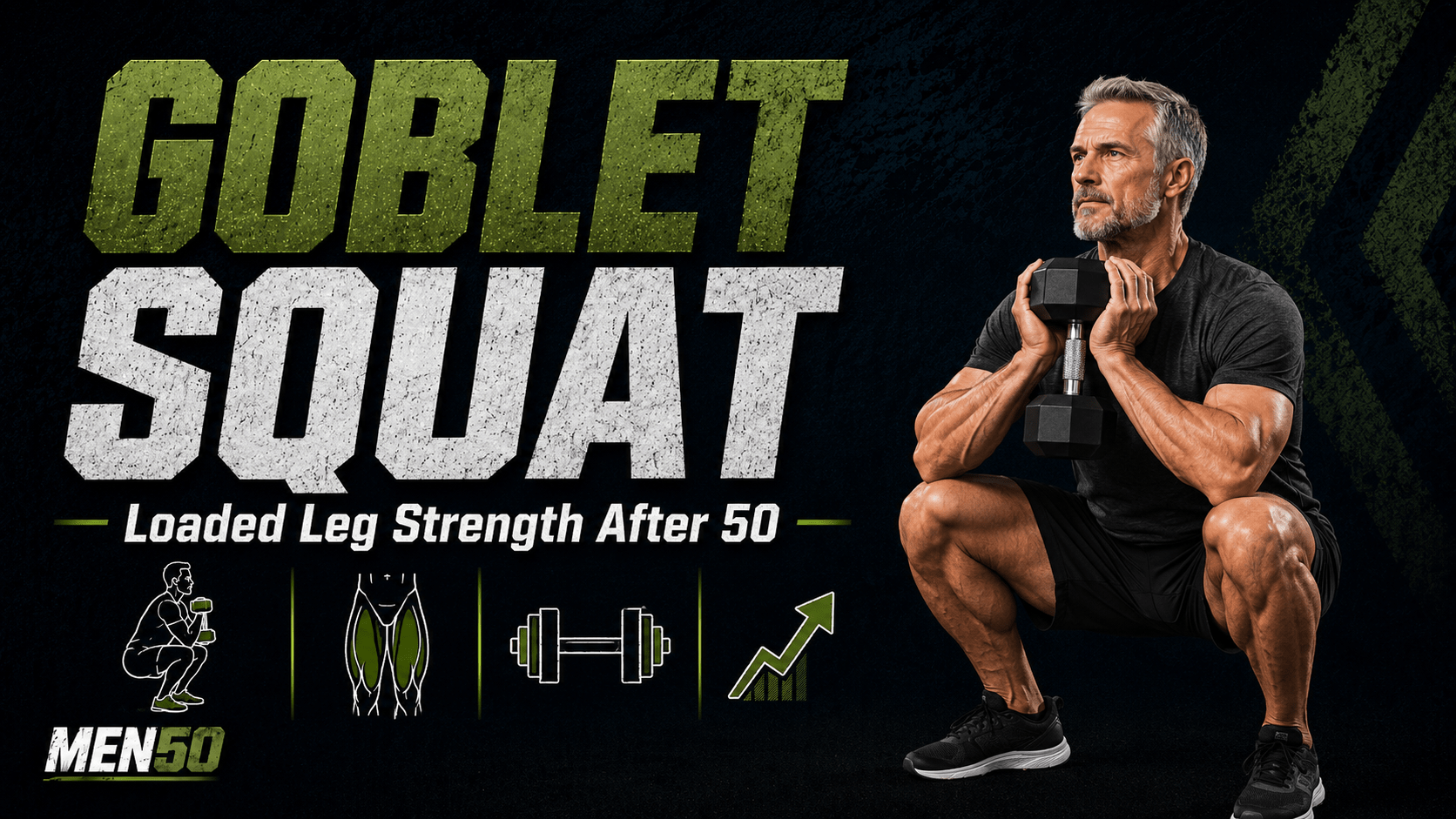
The goblet squat is the smartest first loaded squat any man over 50 can learn. Holding a single dumbbell at chest height creates a counterbalance that naturally keeps your torso upright, lets you squat deeper with less lower-back stress, and self-limits how much weight you can use to whatever you can hold cleanly at your chest. Coach Dan John, who popularised the exercise as a coaching tool, calls it the best teacher for the squat pattern — and he’s right. Most men over 50 will progress from the bodyweight squat to the goblet squat and stay there for years. It’s that good of an exercise.
Part of the Build Muscle After 50 pillar — strength training for men over 50.
Key Takeaways
- The goblet squat is the natural next step after the bodyweight squat — it adds load without requiring a barbell or rack.
- The front-loaded position (dumbbell at chest) keeps the torso upright and reduces lower-back stress compared with back squats.
- Programming: 2–4 sets of 6–10 reps, 2–3 times per week. Rest 60–90 seconds between sets.
- Hold the weight close, keep your chest tall, and squat with control. The quick takeaway covers the whole technique.
- A single dumbbell is enough for years of progress. Most men over 50 can use one well-chosen dumbbell as their main leg-strength tool for 1–2 years before needing anything heavier.
How to Perform the Goblet Squat
Set up first:
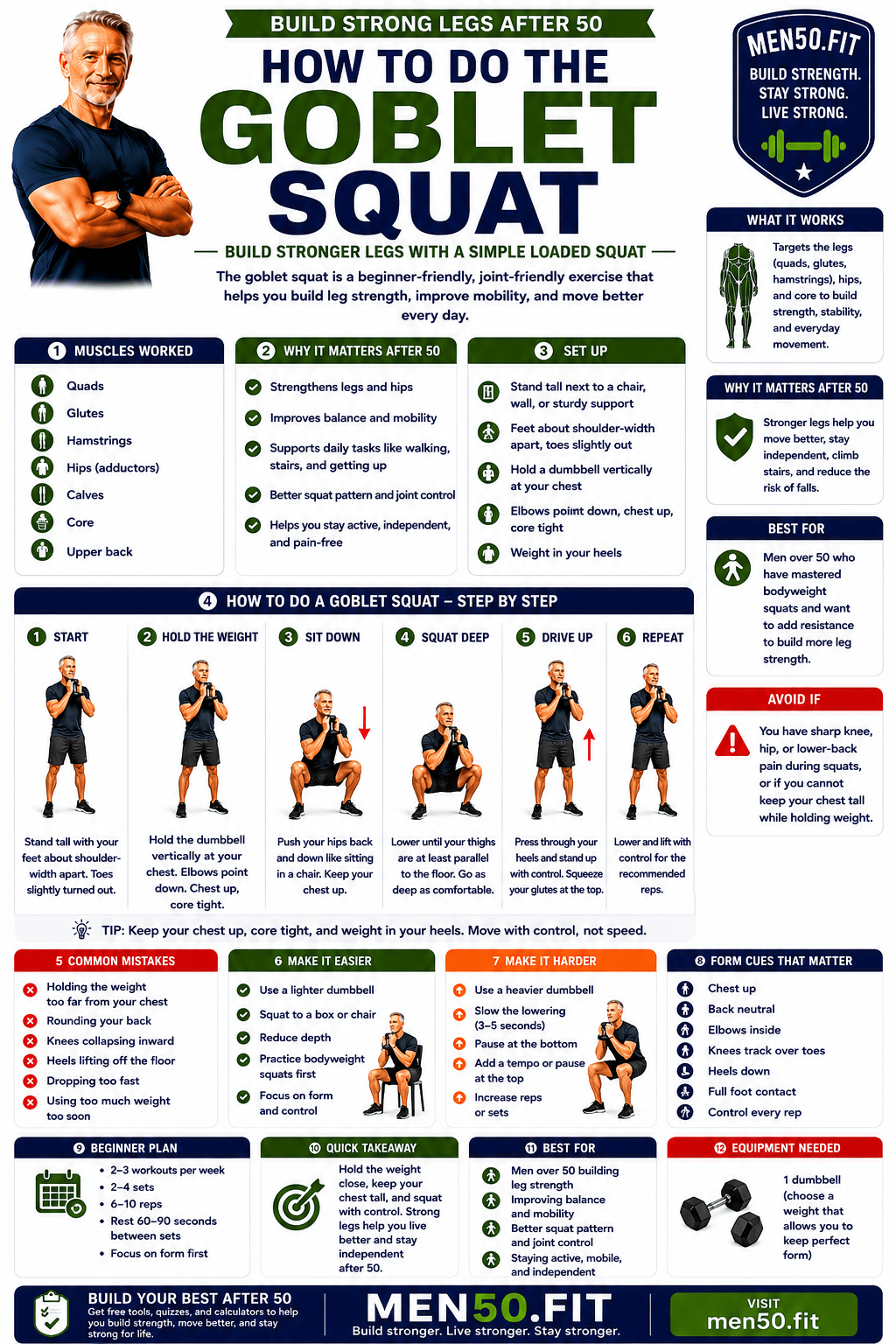
- Stand tall, feet about shoulder-width apart, toes slightly turned out (about 10–15 degrees).
- Hold a dumbbell vertically at your chest — grip one end of the dumbbell with both hands cupped underneath, like holding a goblet (hence the name).
- Elbows point down toward the floor, chest up, core lightly braced.
- Weight distributed through mid-foot and heels — not the balls of the feet.
Then the movement:
- Start. Stand tall with feet shoulder-width apart, dumbbell held vertically at chest height with both hands cupping the end. Elbows pointing straight down.
- Hold the weight. Keep the dumbbell pressed close to your chest throughout the rep. Elbows stay tight to your body, chest stays up, core tight.
- Sit down. Push your hips back like sitting in a chair, then bend your knees. Take 2–3 seconds on the way down. Chest stays up; the dumbbell helps counterbalance the squat.
- Squat deep. Lower until your thighs are at least parallel to the floor — or as deep as you can manage with clean form, heels planted, chest up. The goblet position usually lets men squat deeper than they can with bodyweight alone because of the counterbalance.
- Drive up. Press through your heels and stand up smoothly. Squeeze your glutes at the top. Don’t rush — controlled reps build more strength.
- Repeat. Maintain clean form every rep. Six clean goblet squats build more leg strength than ten with poor form.
The cue that matters most: hold the weight close, keep your chest tall, and squat with control. The dumbbell stays at your chest throughout — drifting forward or letting the elbows flare out causes the whole pattern to break down.
Why the Goblet Squat Matters After 50
The goblet squat fixes most of the common squat problems men over 50 have, by design. Here’s why it works so well:
Front-loading keeps the torso upright. When you hold a weight at your chest, your bodyweight has to shift backward to counterbalance the load. This forces your torso to stay vertical and your weight to settle into your heels — exactly the squat mechanics you want. The result: less leaning forward (which is the most common bodyweight squat error), less lower-back strain, and more work for the quads and glutes.
The elbows-inside-knees position teaches better depth. As you lower into the squat, your elbows naturally end up between your knees. This subtle cue keeps the knees tracking outward over the toes (preventing the knee-cave that’s common in men with weak glutes) and prevents the back from rounding because you can’t physically dump the torso forward when the elbows are pressing into the inner knees.
Self-limiting load is a safety feature. You can only goblet-squat what you can hold at your chest. This naturally prevents ego-driven over-loading. A 50-year-old who can deadlift 200 lbs probably can’t goblet-squat much more than 50 lbs because holding a heavier dumbbell at the chest becomes the limiting factor. That ceiling is a feature, not a bug — it prevents the kind of overloaded back squats that have ended many men’s training careers in their 50s and 60s.
Functional carryover. The front-loaded squat pattern mirrors how you actually lift things in real life — carrying a heavy box, picking up a small grandchild, lifting a bag of mulch. You’re not walking around with a barbell on your back; you’re carrying things in front of you. Training that pattern under load translates directly.
For sarcopenia (age-related muscle loss), the goblet squat is also one of the most efficient compound exercises in the matrix. It trains the quads, glutes, hamstrings, hip adductors, calves, core, and upper back all in one movement. Lower body strength declines at 1–2% per year after 50 without resistance training — the goblet squat directly reverses this in the muscle groups most responsible for daily function.
The natural progression chain in the matrix: sit-to-stand → chair squat → bodyweight squat → goblet squat → barbell variations (optional, only if you genuinely want them).
Sets and Reps
Lower rep range than bodyweight squat because of added load. Quality reps with clean form, not heavy maxes.
| Stage | Variation | Sets × Reps | Frequency | Load Guide |
|---|---|---|---|---|
| Beginner | Light dumbbell, partial depth if needed | 2 × 6–8 | 2× per week | 15–25 lbs (7–11 kg) |
| Novice | Working weight, parallel depth | 2–3 × 8–10 | 2× per week | 20–35 lbs (9–16 kg) |
| Intermediate | Slow 3-second lowering | 3 × 8–10 | 2–3× per week | 25–40 lbs (11–18 kg) |
| Advanced | 1–2 second pause at the bottom | 3 × 6–10 | 2–3× per week | 35–50 lbs (16–23 kg) |
Rest 60–90 seconds between sets. Pick a weight where the last 2–3 reps are clearly challenging but you can complete them with: chest up, back neutral, knees tracking over toes, heels planted, and the dumbbell stays close to your chest throughout.
A practical starting load: most men over 50 begin with 15–25 lb (7–11 kg) dumbbells. Some progress to 30–45 lbs (14–20 kg) over 6–12 months. There’s no rush — clean reps at a manageable weight build strength better than heavy reps with form breakdown. Many men over 50 use a 35–40 lb dumbbell as their primary leg-strength tool for years and continue to make progress through tempo variations, pauses, and rep range changes.
Common Mistakes
The six errors that turn a great exercise into a back or knee problem:
- Holding the weight too far from your chest. When the dumbbell drifts away from the body, it pulls the upper body forward and turns the squat into a back-loaded movement (without the back-loading benefits). Keep the dumbbell pressed against your chest throughout every rep.
- Rounding your back. The lower back curling forward at the bottom — usually from limited hip mobility, weak core, or going too deep too soon. Squat only to the depth where your back stays flat. Mobility improves over weeks of practice.
- Knees collapsing inward. Common when glutes are weak. As you stand up, drive your knees outward to track over your second and third toes. The goblet position itself helps prevent this because the elbows press the knees out at the bottom — use that cue.
- Heels lifting off the floor. Means ankle mobility is limiting your depth, or weight is shifting forward onto the toes. Push weight back into your heels. If heels still lift at depth, reduce squat depth.
- Dropping too fast. Speed lets you cheat with momentum and skip the eccentric work. Take 2–3 seconds on the way down on every rep — that’s where most of the strength gets built.
- Using too much weight too soon. The most common single-exercise mistake. Heavier dumbbells force compensation and break form. Lighter weight with clean reps progresses you faster than heavier weight with form breakdown.
Make It Easier or Harder
If standard goblet squats are too challenging:
- Use a lighter dumbbell — 10–15 lbs (4.5–7 kg) is fine to start. Strength is built from where you are.
- Squat to a box or chair — gives you a depth target and a safety net, similar to the chair squat progression. Tap the surface lightly, don’t sit.
- Reduce depth — partial-range goblet squats are useful work while you build hip and ankle mobility.
- Practice bodyweight squats first — if your bodyweight squat form isn’t clean, adding load won’t fix it. Go back a step.
- Focus on form and control — slow, deliberate reps with light weight beat rushed reps with heavier load every time.
To make it harder once form is solid:
- Use a heavier dumbbell — but only when the lighter weight feels easy with clean form.
- Slow the lowering phase to 3–5 seconds per rep.
- Pause at the bottom for 1–2 seconds.
- Add a tempo or pause at the top for additional time under tension.
- Increase reps or sets before increasing weight — many men over 50 progress better through higher volume with moderate load than through chasing heavier weights.
For variety, try the 2-second pause goblet squat (pause at the bottom of every rep) once a week — significantly more demanding than standard goblet squats and excellent for building strength out of the deep position.
Safety Note
Avoid the goblet squat if you have sharp knee, hip, or lower-back pain during squats, or if you cannot keep your chest tall while holding weight. These are signs the squat pattern isn’t ready for loaded work yet — go back to the bodyweight squat or chair squat and rebuild before adding load.
Don’t grind through depth your mobility doesn’t allow. Squat only as deep as your back stays flat and your heels stay planted. Forcing more depth with load is how lower backs get injured.
Make sure the floor is non-slip and you have clear space around you. If you do need to bail out of a rep, set the dumbbell down between your feet — don’t try to “save” a rep with bad form.
Build Your Personal Training Plan
The goblet squat is one piece of a complete lower-body programme. Get a personalised exercise plan based on your current strength, mobility, and any limitations.
Take the Free Fitness Profiler →
FAQs
How heavy should the dumbbell be?
For most men over 50 starting goblet squats, 15–25 lbs (7–11 kg) is the right range. The right weight lets you complete 6–10 reps with clean form — chest up, heels down, back neutral, dumbbell close to chest. After 3–6 months of consistent training, many men progress to 30–45 lbs (14–20 kg). The self-limiting nature of the goblet position means most men won’t ever use much more than 50 lbs — and that’s fine. Strength gains come from tempo variations, pause reps, and volume increases as much as from heavier weights.
Goblet squat vs barbell back squat — which is better?
For most men over 50, the goblet squat — and many will never need to progress beyond it. The barbell back squat allows heavier loads and is the standard powerlifting movement, but it requires a squat rack, a barbell, more spinal loading, and more mobility than many men over 50 have. The goblet squat trains the same primary muscles, has built-in safety (you can drop the dumbbell), and is genuinely sufficient for the strength goals most men over 50 have. Use a goblet squat for 1–2 years, then decide whether you need a barbell — most men don’t.
Why does the goblet squat improve squat depth?
The counterweight effect. Holding a dumbbell at your chest shifts your centre of gravity forward, which forces your bodyweight to shift backward to balance. The result: your torso stays upright and your weight settles into your heels — both of which let you squat deeper without leaning forward or losing balance. Most men over 50 who couldn’t reach parallel with a bodyweight squat can reach parallel (or deeper) with a goblet squat in their first session.
How deep should I go?
Aim for thighs at least parallel to the floor — that’s the standard target. Many men can go deeper with goblet squats than with bodyweight, thanks to the counterbalance. But your maximum depth is determined by where your form breaks: heels lifting, lower back rounding, or knees collapsing inward. If those happen at half depth, half depth is your current limit. Don’t grind through compensations; the depth will improve over weeks of consistent practice.
Can I do goblet squats every day?
Better not to. Goblet squats are a moderate-intensity compound exercise that loads the legs significantly — they need 48 hours of recovery between sessions. 2–3 times per week is the sweet spot for most men over 50. If you want to train legs more often, alternate goblet squat days with lower-intensity work like sit-to-stands, glute bridges, or calf raises on the off days.
References
- American College of Sports Medicine. Resistance Training for Older Adults Position Stand. acsm.org
- National Institute on Aging. Sarcopenia and Muscle Strength in Older Adults. nia.nih.gov
- Centers for Disease Control and Prevention. Physical Activity Guidelines for Americans, 2nd Edition. cdc.gov
Disclaimer: This article is for educational purposes only and is not medical advice. Consult a qualified healthcare professional before starting any new exercise programme, especially if you have existing knee, hip, or back conditions.