
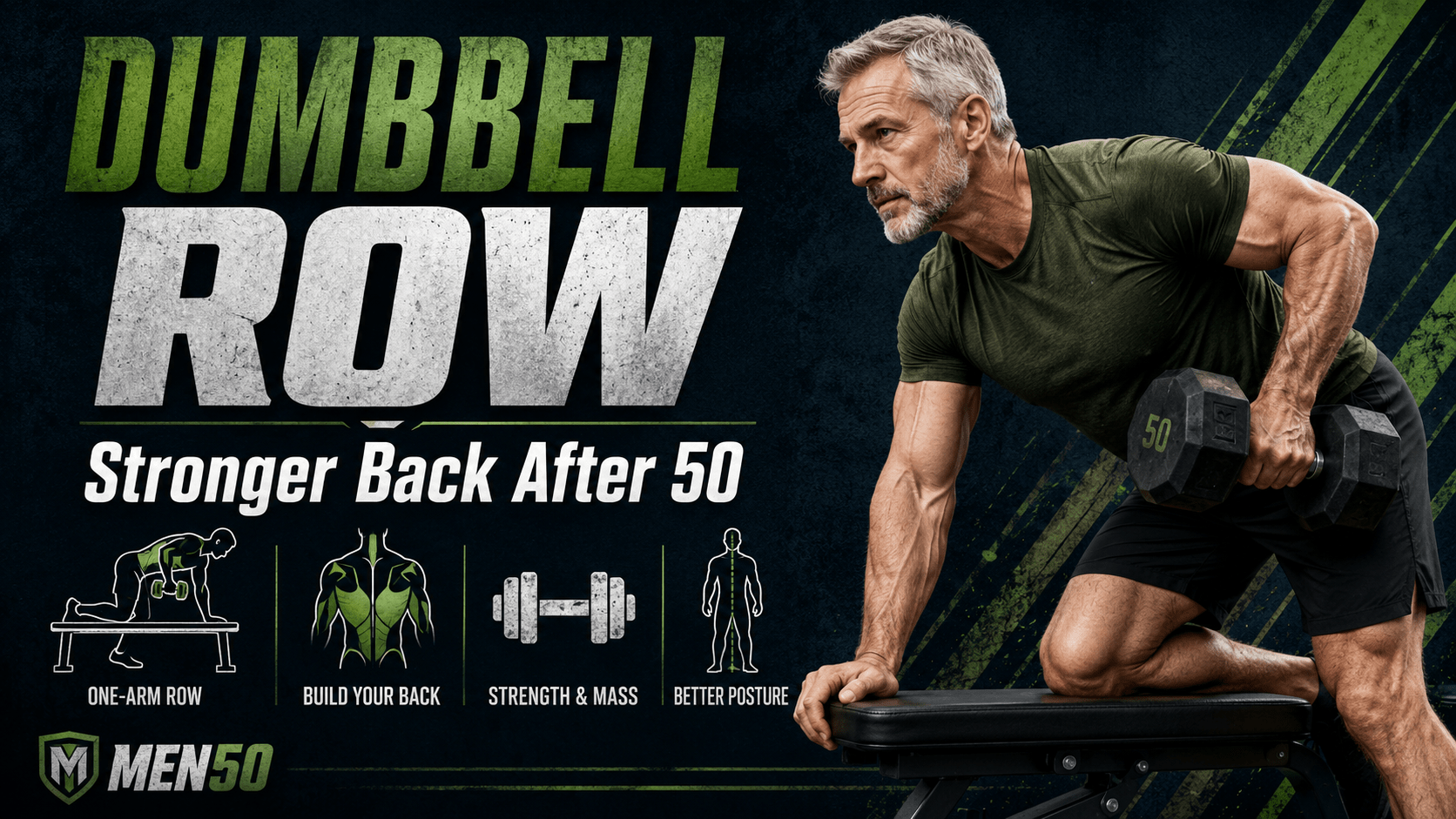
The dumbbell row is the most important pulling exercise most men over 50 are missing from their routines. It builds upper back thickness, strengthens the muscles that pull the shoulders back into healthy alignment, and balances out the pressing work (push-ups, bench presses) that men tend to over-prioritise. If you do any pushing exercise at all, you need a pulling exercise to match it — and the dumbbell row is the simplest, most scalable option for home or gym.
Part of the Build Muscle After 50 pillar — strength training for men over 50.
Key Takeaways
- The dumbbell row trains the upper back, lats, rear shoulders, and biceps — the muscles that pull the shoulders back into healthy posture.
- For every pushing exercise (push-ups, bench press), pair an equivalent volume of pulling work (rows). Most men over 50 are heavily push-dominant, which is why shoulders go bad.
- Programming: 3 sets of 8–12 reps per arm, 2–3 times per week. Rest 45–60 seconds between sets.
- Pull the elbow back, not the shoulder up. The single most important cue. Shrugging the shoulder turns a great back exercise into a trap-and-neck exercise.
- Single-arm dumbbell rows let one side rest while the other works — easier on the lower back than barbell rows, and easier to scale at home.
How to Perform the Dumbbell Row
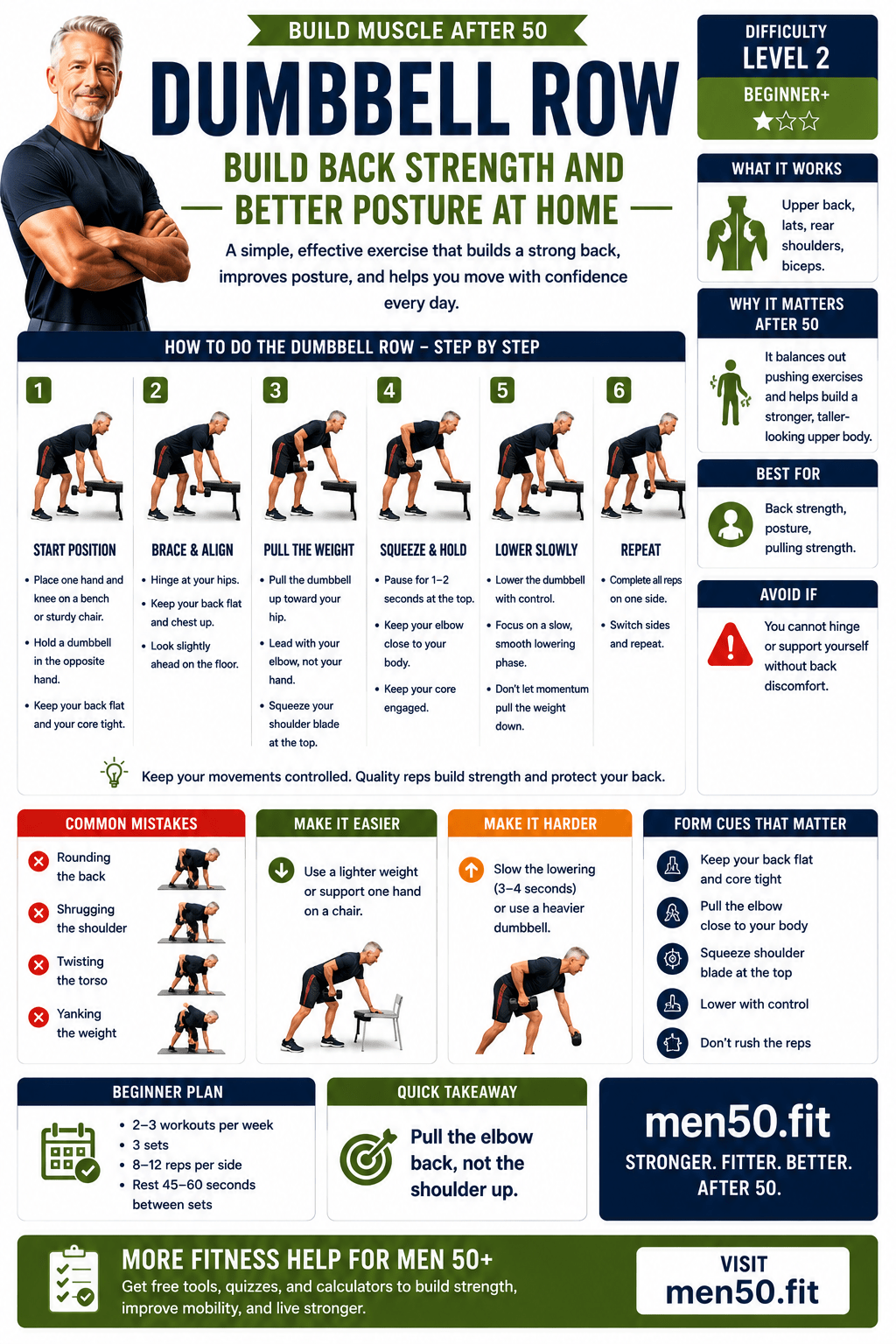
- Start position. Place one hand and the same-side knee on a flat bench or sturdy chair for support. Hold a dumbbell in the opposite hand with the arm hanging straight down. Keep your back flat — not rounded, not arched — and your core tight.
- Brace and align. Hinge at your hips so your torso is roughly parallel to the floor. Look slightly ahead on the floor (not straight down) to keep the neck neutral. Chest up.
- Pull the weight. Pull the dumbbell up toward your hip, leading with your elbow — not your hand. Keep the elbow close to your body, tracking back rather than out to the side. Imagine putting the dumbbell in your back pocket.
- Squeeze and hold. Pause for 1–2 seconds at the top with the dumbbell close to your hip. Squeeze the shoulder blade in toward your spine. Keep the elbow tight to your body. Core engaged the whole time.
- Lower slowly. Lower the dumbbell back to the start under control — 2–3 seconds on the way down. Don’t let momentum yank the weight back to the start. The lowering phase is where strength is built.
- Repeat. Complete all reps on one side, then switch arms. Don’t let form decay on the final reps — stop the set when form breaks, even if you haven’t hit your rep target.
The cue that matters most: pull the elbow back, not the shoulder up. If you feel the work in your upper traps and the side of your neck, you’re shrugging instead of rowing. Pin the shoulder down and back before each rep.
Why the Dumbbell Row Matters After 50
Modern life is push-dominant. Reaching forward at a desk, gripping a steering wheel, holding a phone, pushing through doors — all the patterns the body uses every day load the front of the body more than the back. Over decades, the chest and front shoulders shorten and tighten while the upper back lengthens and weakens. That’s the pattern Czech physiotherapist Vladimir Janda named upper crossed syndrome, and it’s the single most common postural pattern in men over 50.
The dumbbell row is the most direct fix for the strength half of that imbalance. It targets the rhomboids (between the shoulder blades), the lats (the broad back muscles), the rear deltoids (back of the shoulders), and the mid-traps (middle of the upper back). These are the same muscles that hold the shoulders back in healthy alignment — and the muscles that the band pull-apart trains at lighter load for higher frequency. The two exercises complement each other: band pull-aparts maintain the pattern daily, dumbbell rows build the strength to hold it for hours.
There’s also a push-pull balance argument that matters more after 50 than it did at 30. The shoulder joint is held together largely by the rotator cuff and the muscles around the scapula. When pressing strength outpaces pulling strength — which happens by default in most men’s training — the humerus drifts forward in the joint, the rotator cuff loses mechanical advantage, and the stage is set for impingement and tendon problems. A simple rule that prevents most age-related shoulder issues: for every set of pushing you do, do at least one set of pulling.
Finally, the dumbbell row builds grip strength. As covered in the farmer’s carry article, grip strength is one of the strongest predictors of healthspan in men over 50 — the PURE study found grip strength predicted all-cause mortality more strongly than systolic blood pressure. Every set of dumbbell rows trains grip under heavier load than band work, contributing meaningfully to the same longevity-relevant capacity.
Sets and Reps
The dumbbell row tolerates moderate load and is well-suited to standard hypertrophy-rep ranges.
| Stage | Sets × Reps per Arm | Frequency | Load Guide |
|---|---|---|---|
| Beginner | 2 × 8–10 | 2× per week | Light weight, focus on form |
| Novice | 3 × 8–10 | 2–3× per week | Moderate weight, last 2 reps challenging |
| Intermediate | 3 × 8–12 | 2–3× per week | Working weight, RPE 7–8 |
| Advanced | 3–4 × 6–10 | 2–3× per week | Heavier weight, slow lowering |
Rest 45–60 seconds between sets. Pick a weight where the last 2–3 reps are clearly challenging but you don’t need to twist your torso to complete them. If you’re using ego weights and yanking the dumbbell up, drop one size and do clean reps.
A standard load benchmark: most men over 50 starting out work with 15–25 lb (7–11 kg) dumbbells. Some men progress to 35–50 lbs (16–23 kg) over 6–12 months. Don’t chase numbers — chase clean reps.
Common Mistakes
The four errors that turn a great back exercise into a back problem:
- Rounding the back. The most dangerous error. The lower back should be flat, not curled. If you can’t maintain a flat back through the set, the weight is too heavy or your hip hinge is wrong. Reset the position and drop the load.
- Shrugging the shoulder. Pulling the shoulder up toward the ear loads the upper traps instead of the upper back. Before each rep, pin the working shoulder down and back. If you feel the work in the side of your neck the next day, you shrugged through the whole set.
- Twisting the torso. Rotating the body to “help” the dumbbell up means the weight is too heavy. The torso should stay still — only the arm moves. Drop the load until you can keep the torso level.
- Yanking the weight. Using momentum to swing the dumbbell up turns the row into a swing and removes the work from the back muscles. Lift smoothly, lower slowly. Quality reps over heavy reps every time.
Make It Easier or Harder
If standard dumbbell rows are too challenging, use a lighter weight or support one hand on a chair in front of you to take pressure off the lower back. You can also row with both feet on the floor (no bench), bent over from a hip hinge, holding a sturdy table or counter with the free hand. This is a more accessible setup at home and equally effective.
To make rows harder once standard form is solid:
- Slow the lowering phase to 3–4 seconds per rep — increases time under tension without adding load.
- Add a 2-second pause at the top with the dumbbell at your hip — challenges the upper back endurance.
- Use a heavier dumbbell, but only once form holds at the lighter weight.
- Progress eventually to the bent-over barbell row (more load) or the chest-supported row (removes lower back demand entirely).
Pair dumbbell rows with the floor push-up or wall push-up in alternating sets — match push and pull volume for shoulder health.
Safety Note
Keep the lower back flat throughout — neither rounded nor arched. If you feel strain in your lower back rather than your upper back, reduce the weight, recheck your hip hinge, and consider supporting more of your bodyweight with the supporting hand and knee.
Men with current lower back injuries should avoid the bent-over version — use a chest-supported row with an inclined bench instead, which removes lumbar spine loading. Men with shoulder injuries should start with very light weights, focus on form, and consult a physiotherapist if pain persists in the joint (as opposed to muscular fatigue in the back).
Avoid the dumbbell row if you cannot hinge at the hip and support yourself in the bent-over position without lower back discomfort — that’s a mobility or strength deficit worth addressing with simpler movements before progressing here.
Build Your Personal Training Plan
The dumbbell row is one piece of a complete upper body programme. Get a personalised exercise plan based on your current strength, goals, and any limitations.
Take the Free Fitness Profiler →
FAQs
How heavy should the dumbbell be?
Heavy enough that the last 2–3 reps of each set feel clearly challenging, but light enough that you can complete the set with a flat back and no torso twisting. For most men over 50 starting out, that’s 15–25 lbs (7–11 kg) per dumbbell. After 3–6 months of consistent training, many men progress to 30–40 lbs (14–18 kg). The “right weight” is the one your form can handle for the prescribed reps — not what you can lift once with poor form.
What’s the difference between a dumbbell row and a barbell row?
The dumbbell row works one side at a time, which lets the other side rest, removes left-right strength imbalances over time, and keeps the lower back demand lower. The barbell row uses heavier loads bilaterally and creates more lower back loading — better for advanced lifters with good hip hinge mechanics, harder on the back for beginners or men with back issues. Most men over 50 are well-served by sticking with the dumbbell version.
Should I do dumbbell rows on a bench or without one?
Both work. The bench-supported version (one hand and knee on a bench) is steadier and easier on the lower back, which makes it the default recommendation. The bent-over version without a bench requires more lower back endurance and is harder to scale up safely, but works fine at home with a chair or table for support. Use whichever you have access to and can do with clean form.
Can dumbbell rows help with lower back pain?
For non-acute lower back pain, yes — building upper back strength and improving posture reduces the chronic load on the lumbar spine. The supported dumbbell row in particular keeps lumbar demand low while still building the back muscles that protect the spine. But during an acute flare-up, skip rows entirely and stick to back-friendly movements like the dead bug and bird dog until the back settles.
How do I know if I’m “pulling with my back” vs “pulling with my arm”?
The cue that distinguishes them: lead with the elbow, not the hand. If you focus on pulling the elbow up and back behind you, the back muscles fire first and the arm follows. If you focus on pulling the dumbbell up (or worse, pulling with the bicep curl pattern), the arm takes over and the back goes along for the ride. Try squeezing the shoulder blade at the top of each rep — if you feel the squeeze in the upper back, the pattern is correct. If you only feel the arm working, slow down and reset.
References
- Janda V. Muscles, Central Nervous Motor Regulation and Back Problems. In: Korr IM (ed). The Neurobiologic Mechanisms in Manipulative Therapy. Plenum Press; 1978. (Upper Crossed Syndrome framework.)
- Leong DP, Teo KK, Rangarajan S, et al. Prognostic value of grip strength: findings from the Prospective Urban Rural Epidemiology (PURE) study. The Lancet. 2015;386(9990):266-273.
- American College of Sports Medicine. Resistance Training for Older Adults Position Stand. acsm.org
Disclaimer: This article is for educational purposes only and is not medical advice. Consult a qualified healthcare professional before starting any new exercise programme, especially if you have existing back, shoulder, or elbow conditions.