
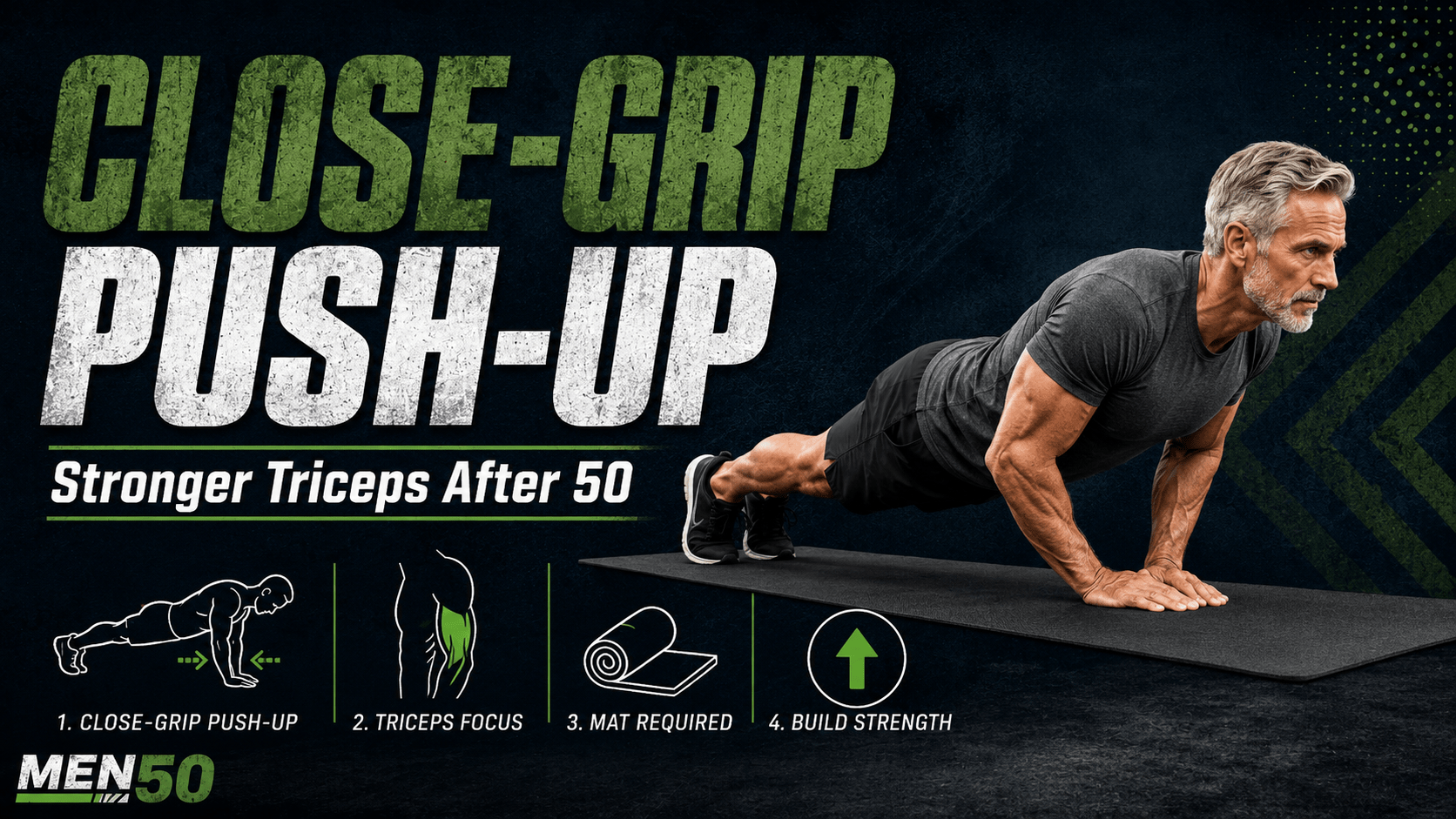
The close-grip push-up is the triceps-focused progression beyond the standard floor push-up — and it’s the only bodyweight exercise in the matrix that emphasises the triceps directly. Where the standard push-up trains chest and triceps together with chest doing most of the work, the close-grip version shifts the emphasis dramatically toward the triceps by changing two things: the hands are placed under the shoulders (narrower) and the elbows tuck close to the ribs instead of flaring out at 45 degrees. The result is a harder push-up that builds triceps strength without dumbbells, bands, or any equipment at all.
Part of the Build Muscle After 50 pillar — strength training for men over 50.
Key Takeaways
- The close-grip push-up trains the triceps as the primary muscle, with the chest and front shoulders assisting.
- It’s the natural progression beyond the floor push-up and a harder bodyweight challenge — most men over 50 can do fewer close-grip reps than standard push-ups.
- Programming: 2–4 sets of 5–10 reps, 2–3 times per week. Rest 60–90 seconds between sets.
- Keep your body tight, elbows close, and lower with control. Clean reps build stronger triceps and chest after 50.
- Completes the triceps training trilogy alongside the overhead triceps extension (dumbbell) and band triceps pressdown (band).
How to Perform the Close-Grip Push-Up
Set up first:
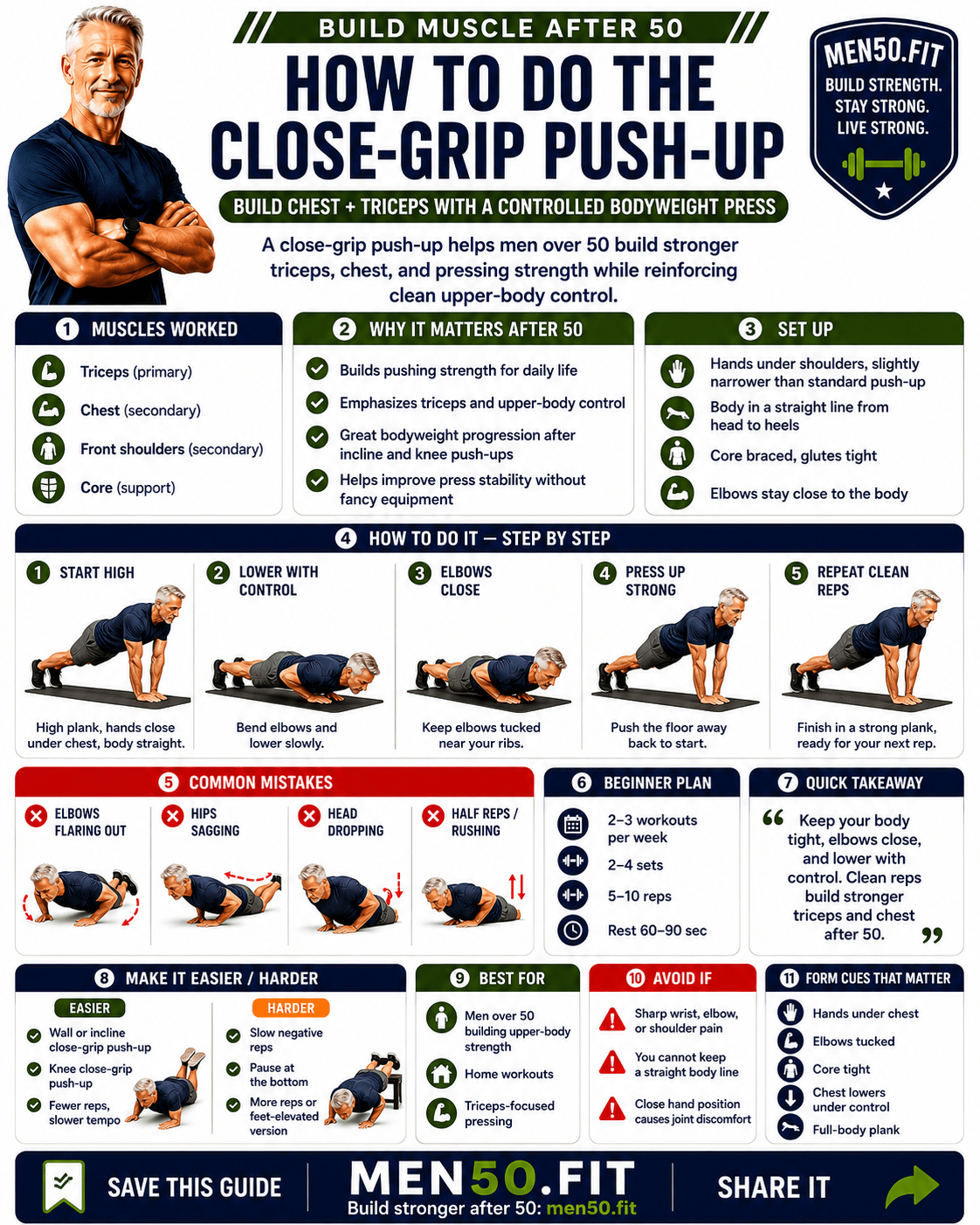
- Get into a high plank position on the floor.
- Hands under your shoulders — slightly narrower than a standard push-up. Some men place their hands close enough that the thumbs and index fingers form a diamond shape (the “diamond push-up”). Most men over 50 should not go that narrow at first — hands directly under the shoulders is the right starting position.
- Body in a straight line from head to heels.
- Core braced, glutes tight.
- Elbows stay close to the body — they should tuck along your ribs as you lower, not flare out at 45 degrees.
Then the movement:
- Start high. High plank position. Hands close under your chest. Body straight from head to heels. Core engaged, glutes squeezed.
- Lower with control. Bend your elbows and lower slowly. Take 2–3 seconds on the way down. The chest should travel toward the hands.
- Elbows close. Keep elbows tucked near your ribs throughout the descent. This is the technical key to the exercise — if the elbows flare out, you’re doing a standard push-up, not a close-grip push-up.
- Press up strong. Push the floor away to return to the starting position. Take 1–2 seconds to press up. Keep elbows close to the body throughout the press as well.
- Repeat clean reps. Finish in a strong plank position, ready for your next rep. Maintain clean form throughout — quality over speed.
The cue that matters most: elbows tuck close to your ribs throughout the rep, never flaring out. This single cue is the entire difference between a standard push-up (chest-focused, elbows at 45°) and a close-grip push-up (triceps-focused, elbows close). Get this right and the triceps do their job; let the elbows drift wide and you’ve turned the exercise back into a regular push-up with bad hand placement.
Why the Close-Grip Push-Up Matters After 50
The triceps are the larger muscle on the back of your upper arm — about two-thirds of the total upper arm volume. They’re involved in every pressing motion in daily life: pushing yourself up from a chair, pressing yourself out of bed, pushing doors open, lifting items overhead, pushing a shopping cart. The triceps also lose strength faster than the biceps after 50 if not trained directly. The result for many men over 50 is disproportionately weak triceps relative to body size — which contributes to weak pressing, soft-looking upper arms, and reduced functional capacity.
The close-grip push-up trains the triceps in a unique way: under full bodyweight load, with no equipment, using a compound multi-joint pattern. Most triceps exercises are isolation movements — the overhead extension and band pressdown target the triceps alone. The close-grip push-up uses the triceps in their natural function as part of a coordinated pressing pattern, just like real-world tasks.
Position in the Pressing Progression
The close-grip push-up sits at the harder end of the bodyweight pressing progression — beyond the standard floor push-up because the triceps have to do more of the work:
| Stage | Exercise | Primary Demand |
|---|---|---|
| 1 | Wall Push-Up | Easiest |
| 2 | Incline Push-Up | Intermediate |
| 3 | Knee Push-Up | Bridge to floor |
| 4 | Slow Negative Push-Up | Eccentric focus |
| 5 | Floor Push-Up | Full bodyweight, chest focus |
| 6 | Close-Grip Push-Up | Full bodyweight, triceps focus |
Most men over 50 should not attempt close-grip push-ups until they can do at least 8–10 clean floor push-ups. The close-grip variation demands genuine pressing strength because the triceps — which are the smaller muscle in the pressing pattern — are doing more of the work.
The Triceps Training Trilogy
This exercise also completes the triceps training trilogy in the matrix. Now men with any equipment setup have a direct triceps option:
| Equipment | Exercise | Pattern |
|---|---|---|
| None (bodyweight) | Close-Grip Push-Up (this article) | Compound |
| Dumbbells | Overhead Triceps Extension | Isolation |
| Band | Band Triceps Pressdown | Isolation |
Combined with the floor push-up (chest-focused compound), dumbbell floor press, and resistance band chest press, this gives comprehensive pressing coverage with explicit triceps emphasis at every equipment level.
The Push-Up Capacity Connection
The recurring research thread from Yang and colleagues (2019, JAMA Network Open) — that push-up capacity tracks cardiovascular health in men — applies to close-grip push-ups too. Building bodyweight pressing capacity is one of the most evidence-supported physical markers of overall fitness in adult men. Adding the close-grip variation extends that capacity into harder territory.
Sets and Reps
Lower rep counts than standard push-ups because the triceps tire faster than the chest. Expect 50–70% of your standard push-up rep count when you transition.
| Stage | Variation | Sets × Reps | Frequency |
|---|---|---|---|
| Beginner | Knee close-grip push-up | 2 × 5–8 | 2× per week |
| Novice | Floor close-grip push-up | 2–3 × 5–10 | 2–3× per week |
| Intermediate | Floor close-grip + slow lowering | 3 × 5–10 | 2–3× per week |
| Advanced | Feet elevated + pause at bottom | 3–4 × 6–10 | 2–3× per week |
Rest 60–90 seconds between sets — longer than standard push-ups because each rep is more triceps-demanding. Pick a number of reps where the last 1–2 reps still maintain clean form — elbows close, body straight, controlled tempo.
A practical note: most men over 50 transitioning from floor push-ups to close-grip should drop their rep count by 30–50% for the first 2–3 weeks. If you can do 12 standard push-ups, expect to manage 6–8 close-grip push-ups in your first sessions. That’s normal — the triceps need to build up to handle the increased load.
Common Mistakes
The four errors that turn a great triceps exercise back into a regular push-up:
- Elbows flaring out. The single most common mistake — and the one that defeats the entire purpose of the exercise. As fatigue sets in, the elbows want to flare out to 45° to recruit the chest and make the lift easier. Keep elbows tucked along the ribs throughout every rep. If you can’t keep them close, drop to a knee close-grip push-up or rest.
- Hips sagging. When the triceps fatigue, the body wants to break the plank to find easier mechanical positions. The lower back sags, the hips drop, and the lumbar spine takes load it shouldn’t. Squeeze the glutes and brace the core throughout every rep. If the plank can’t be maintained, the set is over.
- Head dropping. Looking down at your hands hyperflexes the neck. Looking up hyperextends it. Keep the neck neutral — eyes on the floor about 6 inches ahead of your hands. The neck should stay in line with the spine.
- Half reps or rushing. Cutting the range short — not lowering all the way down or not pressing back to full extension — skips part of the working range. Rushing the tempo uses momentum instead of muscle. Use full range of motion, 2–3 seconds down, brief pause, 1–2 seconds up.
Make It Easier or Harder
If standard close-grip push-ups are too challenging:
- Wall or incline close-grip push-up — same hand position, elbows tucked, but at an angle that reduces bodyweight load. Start with hands on a sturdy table or counter.
- Knee close-grip push-up — same exercise from your knees instead of full plank. Significantly less bodyweight load while still training the triceps pattern.
- Fewer reps with slower tempo — start with 2 sets of 3–5 clean reps and build up.
To make it harder once form is solid:
- Slow negative reps — take 5–6 seconds on the way down, then drop to your knees to push back up if needed.
- Pause at the bottom for 1–2 seconds with the chest near your hands and elbows tucked.
- More reps or sets — increase volume before increasing difficulty further.
- Feet-elevated version — feet on a low step or stair, hands close together. Significantly more triceps load.
For variety once basic form is solid, try the diamond push-up (thumbs and index fingers touching to form a diamond under the chest) — even narrower hand position, even more triceps work, but more wrist-demanding. Most men over 50 should master the close-grip first before progressing to the diamond, and only if the wrists tolerate the narrow position.
Safety Note
Avoid the close-grip push-up if you have sharp wrist, elbow, or shoulder pain, or cannot keep a straight body line throughout the rep. Get medical advice first.
Wrist pain is common in any narrow-grip push-up variation — the close-grip position increases the load on the wrist joint. If your wrists hurt:
- Try push-up handles (which keep the wrists neutral)
- Make a fist and push on the knuckles (with a mat or thick towel for padding)
- Switch to an incline or knee variation to reduce load
- Take a break and build wrist mobility before returning
If you feel sharp elbow pain (especially at the inside of the elbow, where the triceps attaches), back off. The close-grip position concentrates load on the triceps tendon — for men with current or recent triceps tendinopathy, this can aggravate the condition. Start with knee close-grip variations and progress slowly.
For men with shoulder issues, the close-grip position is generally more shoulder-friendly than the standard push-up (because the elbows stay closer to the body). But if you have current rotator cuff issues, get clearance from a physiotherapist first.
If you cannot maintain a straight body line — back sagging, hips dropping, head dropping — the close-grip push-up is too hard right now. Drop to knee variations or stay with the floor push-up until pressing strength catches up.
Build Your Personal Training Plan
The close-grip push-up is one piece of a complete upper body programme. Get a personalised exercise plan based on your current strength, goals, and any limitations.
Take the Free Fitness Profiler →
FAQs
Close-grip push-up vs standard push-up — what’s the difference?
Two technical changes: hand position and elbow position. The standard floor push-up uses hands wider than the shoulders with elbows flaring out at about 45 degrees. The close-grip push-up uses hands under the shoulders (or even closer) with elbows tucked along the ribs. These changes shift the primary work from the chest (in the standard version) to the triceps (in the close-grip version). Both are valuable. Most men over 50 benefit from doing both — standard push-ups for chest development, close-grip push-ups for triceps strength. The close-grip version is generally harder because the triceps are smaller than the chest, so expect 50–70% of your standard push-up rep count.
Close-grip push-up vs overhead triceps extension — which is better?
Different exercises that train the same muscle differently. The close-grip push-up is a compound, bodyweight, multi-joint exercise — the triceps work as part of a pressing pattern alongside the chest and shoulders. The overhead triceps extension is an isolation, dumbbell, single-joint exercise — only the elbow joint moves, and the triceps does all the work. Both have value. For men with no equipment, the close-grip push-up is the right choice. For men with dumbbells, doing both gives the most comprehensive triceps development. The bodyweight version is more functional; the isolation version provides more direct triceps stimulus.
How close should my hands be?
For most men over 50 starting close-grip push-ups, hands directly under the shoulders is the right starting position — slightly narrower than a standard push-up but not extreme. Going narrower (like the diamond push-up, where thumbs and index fingers touch) significantly increases wrist demand and is much harder. Master the under-shoulders version first, then experiment with narrower positions if your wrists tolerate it well. There’s no benefit to forcing a narrow hand position if it causes wrist pain.
Why does this hurt my wrists?
Because narrow-grip push-ups concentrate more load on the wrist joint than wider variations. This is a common issue, especially for men over 50 with reduced wrist mobility. Solutions (in order of preference):
- Use push-up handles (also called push-up bars) — they keep the wrists neutral and eliminate the bent-back position.
- Make a fist and push on the knuckles — with a thick towel or mat for padding. This bypasses the wrist bending entirely.
- Switch to incline or knee close-grip push-ups — reduces total load on the wrists.
- Build wrist mobility separately before trying again — gentle wrist circles, stretches, and light wrist push-ups against a wall.
If wrist pain persists despite all these adjustments, the close-grip push-up may not be right for you. Use the overhead triceps extension or band triceps pressdown for triceps work instead.
How is this different from a regular push-up?
Same basic movement (lower yourself toward the floor, push back up) but two technical changes shift the emphasis: (1) Hands are closer together (under shoulders instead of wider), and (2) Elbows stay close to the ribs instead of flaring out at 45 degrees. These changes recruit the triceps significantly more and the chest significantly less. Same upper-body pattern, different muscle emphasis. Most men over 50 can do significantly fewer close-grip push-ups than regular push-ups because the triceps are the smaller muscle in the pattern.
References
- Yang J, Christophi CA, Farioli A, et al. Association Between Push-up Exercise Capacity and Future Cardiovascular Events Among Active Adult Men. JAMA Network Open. 2019;2(2):e188341.
- American College of Sports Medicine. Resistance Training for Older Adults Position Stand. acsm.org
- National Institute on Aging. Sarcopenia and Muscle Strength in Older Adults. nia.nih.gov
Disclaimer: This article is for educational purposes only and is not medical advice. Consult a qualified healthcare professional before starting any new exercise programme, especially if you have existing wrist, elbow, or shoulder conditions.