
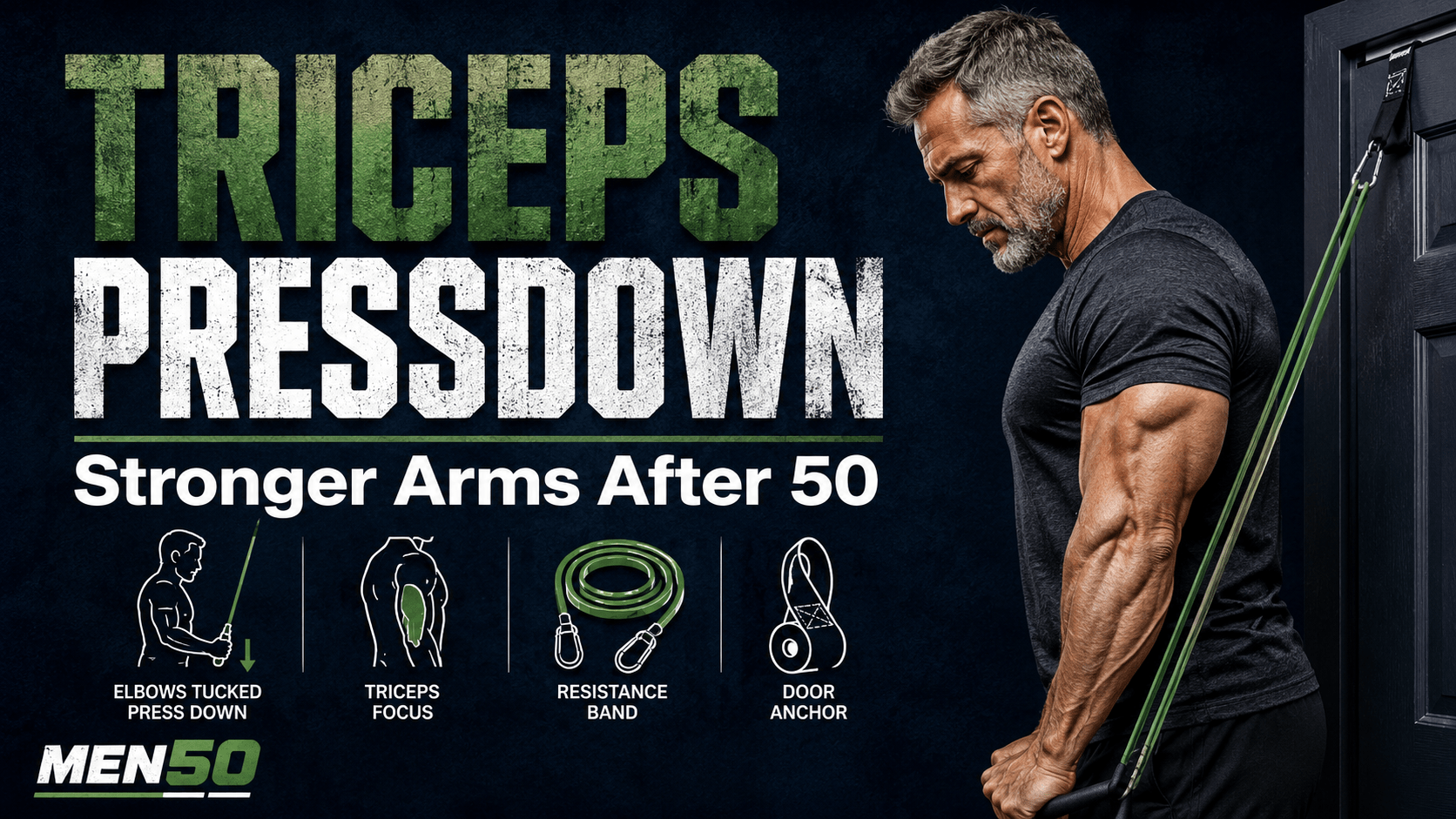
The band triceps pressdown is the joint-friendly cousin of the overhead triceps extension. With the upper arms held at your sides (rather than overhead), the shoulder joint stays in a comfortable, neutral position throughout the entire exercise. For men over 50 with any shoulder history — impingement, rotator cuff irritation, frozen shoulder — this is often the only triceps exercise that doesn’t aggravate things. It’s also portable, scalable, and uses the same resistance band kit that handles rows, presses, and pull-aparts. One band system, four exercises, complete upper-body coverage.
Part of the Build Muscle After 50 pillar — strength training for men over 50.
Key Takeaways
- The band triceps pressdown trains the triceps with the upper arms at your sides — much easier on the shoulder than overhead triceps extensions.
- Programming: 2–4 sets of 10–15 reps, 2–3 times per week. Rest 45–75 seconds between sets.
- Keep your elbows in, press down with control, and squeeze your triceps at the bottom. Small muscles need smart training and consistency.
- This exercise emphasises the lateral and medial heads of the triceps — the overhead extension emphasises the long head. Both belong in a complete arm programme.
- A resistance band with handles + a secure anchor = a complete portable arm-training tool. Pair with band pull-aparts, band rows, and band chest presses for a full upper-body home system.
How to Perform the Band Triceps Pressdown
Set up first:
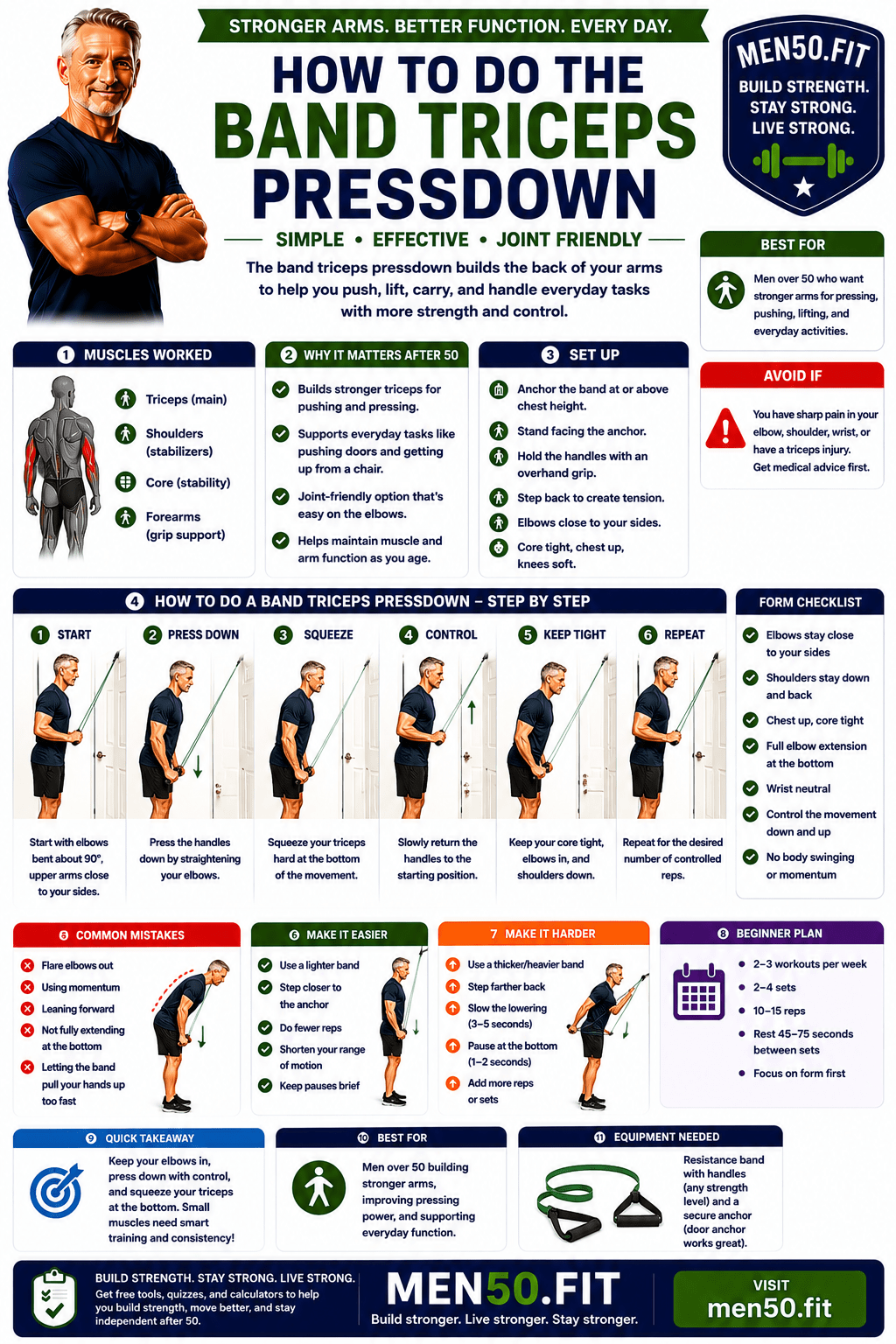
- Anchor the band securely at or above chest height — a door anchor with the door closed, a sturdy post, or a wall-mounted hook designed for resistance training.
- Stand facing the anchor.
- Hold the handles with an overhand grip (palms facing the floor at the start).
- Step back to create tension in the band.
- Elbows close to your sides, core tight, chest up, knees soft.
Then the movement:
- Start. Elbows bent about 90 degrees with upper arms pinned to your sides. Handles at chest height. Wrists neutral, shoulders down.
- Press down. Press the handles straight down by straightening your elbows. Upper arms stay glued to your sides — only the forearms move. Take 1–2 seconds to press down.
- Squeeze. Squeeze your triceps hard at the bottom of the movement with arms fully extended. Pause briefly.
- Control. Slowly return the handles to the starting position. Take 2–3 seconds on the way up — the band wants to snap your hands up, so resist it actively.
- Keep tight. Throughout the rep, keep your core tight, elbows pinned to your sides, and shoulders down. Don’t let the band pull your shoulders forward or your elbows up.
- Repeat. Maintain clean form on every rep. Smooth, controlled, with the upper arms motionless.
The cue that matters most: keep your elbows pinned to your sides — the only thing that moves is your forearm. If the upper arms drift away from your body during the rep, the exercise stops training the triceps properly.
Why the Band Triceps Pressdown Matters After 50
The triceps makes up about two-thirds of the upper arm — larger than the biceps, and arguably more important for functional strength. It drives every pushing motion: push-ups, floor presses, shoulder presses, getting up from the floor, pushing through a heavy door, lifting things overhead. Triceps weakness commonly limits pressing performance more than chest or shoulder weakness does — most men over 50 who plateau on push-ups or floor press are actually triceps-limited, not chest-limited.
The triceps has three heads: the long head (which runs from the shoulder blade down to the elbow), the lateral head, and the medial head. The position of your arms during the exercise determines which heads work hardest:
- Overhead position (like the overhead triceps extension) — emphasises the long head.
- Arms at sides (like this pressdown) — emphasises the lateral and medial heads.
For complete triceps development, both positions belong in a programme. Many men over 50 do one of each per week — overhead extensions one workout, band pressdowns another.
The joint-friendliness is the standout practical benefit of this exercise. The overhead triceps extension puts your shoulders in a fully overhead position, which can aggravate impingement, rotator cuff issues, or limited overhead mobility. The pressdown keeps the upper arms at your sides — a much more comfortable position for almost any shoulder. Men who have had to stop overhead triceps work because of shoulder issues can usually do pressdowns without trouble.
There’s also the practical home-training case. A resistance band with handles costs under £25, lasts for years, and fits in a drawer. The same band kit handles four core upper-body exercises:
| Band Exercise | Purpose |
|---|---|
| Band Pull-Apart | Light, daily upper-back work |
| Resistance Band Row | Pulling strength |
| Resistance Band Chest Press | Pressing strength |
| Band Triceps Pressdown | Direct arm work |
That’s a complete portable upper-body programme for the cost of a single gym session — and it travels in carry-on luggage.
Sets and Reps
Higher rep range than dumbbell-based triceps work because the band’s variable resistance favours moderate-load, higher-rep training.
| Stage | Variation | Sets × Reps | Frequency |
|---|---|---|---|
| Beginner | Light band, step close to anchor | 2 × 10–12 | 2× per week |
| Novice | Light or medium band, standard distance | 3 × 12–15 | 2–3× per week |
| Intermediate | Medium band, slow return | 3 × 12–15 | 2–3× per week |
| Advanced | Heavier band, pause at the bottom | 3–4 × 10–15 | 2–3× per week |
Rest 45–75 seconds between sets. Pick a band tension where the last 2–3 reps feel clearly challenging but you can complete them with: elbows pinned to your sides, no body swinging, full extension at the bottom, controlled return.
The same intensity-dial trick that applies to all band exercises applies here: change your distance from the anchor. Step back 6–12 inches to add tension, step forward to reduce it. This makes the band pressdown one of the easiest exercises to fine-tune without buying more bands.
Common Mistakes
The five errors that turn a great triceps exercise into a shoulder or back exercise:
- Flaring elbows out. When the elbows drift outward from the body, the exercise stops being a triceps pressdown and becomes a shoulder/triceps hybrid that loads the front of the shoulder. Pin the elbows to your sides and keep them there throughout — they’re locked in position; only the forearms move.
- Using momentum. Body swinging — leaning forward, then rocking back — to help press the handles down means the muscles don’t do the work. The band springs back up, you swing again, repeat. Nothing useful gets trained. Stand still; only the arms move.
- Leaning forward. Tilting the torso forward to put more bodyweight on the band turns the exercise into a half-pressdown, half-bodyweight squat hybrid. Stay upright, knees soft, core engaged. If you have to lean to complete the rep, the band is too heavy or you’re too far from the anchor.
- Not fully extending at the bottom. Stopping the press short — without straightening the arms — skips the most productive part of the rep. The triceps works hardest at full extension. Press the handles all the way down until the arms are fully straight, then squeeze.
- Letting the band pull your hands up too fast. The band wants to snap your hands back to the start. Resisting that snap — taking 2–3 seconds on the return phase — is where most of the strength gets built. Don’t let the band do the work for you.
Make It Easier or Harder
If standard pressdowns are too challenging:
- Use a lighter band — most band sets include 3–5 colour-coded tension options.
- Step closer to the anchor to reduce the band tension at the starting position.
- Do fewer reps — start with 2 sets of 8–10 and build from there.
- Shorten your range of motion — press down only to about 80% of full extension while you build strength.
- Keep pauses brief — don’t add intensity yet, just get the pattern right.
To make pressdowns harder once form is solid:
- Use a thicker/heavier band — but only when the lighter band feels easy with clean form.
- Step farther back — adds tension without changing equipment.
- Slow the lowering (return) phase to 3–5 seconds per rep. The band naturally wants to snap your hands up; resisting it slowly is significantly harder than the press itself.
- Pause at the bottom for 1–2 seconds with arms fully extended and triceps squeezed.
- Add more reps or sets — extend sets to 15–20 reps before adding band tension.
For variety, try the single-arm band pressdown (one handle, one hand at a time) — exposes left-right imbalances and reduces the tendency to swing or use the body for momentum.
Safety Note
Anchor safety is critical. Bands snapping free under tension can cause real injury — particularly to the face and eyes. Use a proper door anchor with the door fully closed and locked from the opposite side. Inspect bands periodically for nicks, cracks, or wear; replace them at the first sign of degradation. If you can’t anchor safely, switch to overhead triceps extensions with a dumbbell instead.
If you feel sharp pain in your elbow, shoulder, wrist, or have a current triceps injury, stop. Adjust elbow position (more firmly pinned to your sides), reduce band tension, or take a few weeks off direct triceps work and let the tissue settle.
Men with lateral epicondylitis (tennis elbow) or medial epicondylitis (golfer’s elbow) should start with very light band tension. Direct triceps loading can flare existing elbow tendinopathy. Light tension and high reps usually work; heavy band tension usually doesn’t.
Build Your Personal Training Plan
The band triceps pressdown is one piece of a complete upper body programme. Get a personalised exercise plan based on your current strength, goals, and any limitations.
Take the Free Fitness Profiler →
FAQs
Band triceps pressdown vs overhead triceps extension — which is better?
Different exercises with different emphases. The band pressdown keeps the upper arms at your sides, emphasising the lateral and medial heads of the triceps — and is much easier on the shoulder joint. The overhead triceps extension emphasises the long head of the triceps because the overhead position pre-stretches it. For complete triceps development, both belong in a programme. For men with shoulder issues, the pressdown is often the only triceps exercise they can do comfortably — and it’s genuinely sufficient for the strength goals most men over 50 have.
What band tension should I start with?
Start with a light band (often yellow or red in most colour-coded kits) for the first 2–3 weeks while you learn the movement pattern. Once you can complete 3 sets of 15 clean reps with the light band, move up to a medium band. The right tension lets you complete the rep range with clean form but feels clearly challenging on the last 2–3 reps. If you can rip through 15 reps without effort, the band is too light. If you can’t hit 10 with clean form, it’s too heavy. Most men over 50 stay in the light-to-medium range long-term.
Why do my elbows hurt during this exercise?
Three common causes. Band tension too high — the elbow joint takes excessive load when the muscles can’t manage it cleanly. Drop to a lighter band. Wrists not neutral — bending the wrists backward as you press down transfers load up through the forearm to the elbow. Keep the wrists straight throughout. Existing tennis or golfer’s elbow — direct triceps loading can flare these conditions. Drop to very light band tension, slow the tempo, and consider 2–3 weeks of grip and forearm work (band pull-aparts, light farmer’s carries) before adding more triceps work. If pain persists, see a physiotherapist.
Can this exercise replace overhead triceps extensions?
For most men over 50, yes — particularly those with shoulder issues or limited overhead mobility. The pressdown trains the triceps directly with much less shoulder demand, and is genuinely sufficient for the strength goals most men over 50 have. If your shoulders are healthy and you want comprehensive triceps development (all three heads), do both — pressdowns one workout, overhead extensions another. If you can only do one, the pressdown is the safer choice.
How do I anchor the band safely?
The safest option is a proper door anchor — a small attachment that loops through the door and locks behind it when the door closes. Use the side of the door that opens away from you so band tension pulls the door more firmly closed. Other options: a sturdy post, a wall-mounted resistance training hook, or any structure rated for the tension you’re using. Don’t anchor to anything that might pull free — a chair, a light table, or any flexible structure. If your space doesn’t allow safe anchoring, the overhead triceps extension with a dumbbell is the right alternative.
References
- American College of Sports Medicine. Resistance Training for Older Adults Position Stand. acsm.org
- National Institute on Aging. Sarcopenia and Muscle Strength in Older Adults. nia.nih.gov
- Centers for Disease Control and Prevention. Physical Activity Guidelines for Americans, 2nd Edition. cdc.gov
Disclaimer: This article is for educational purposes only and is not medical advice. Consult a qualified healthcare professional before starting any new exercise programme, especially if you have existing elbow, shoulder, wrist, or arm conditions.