
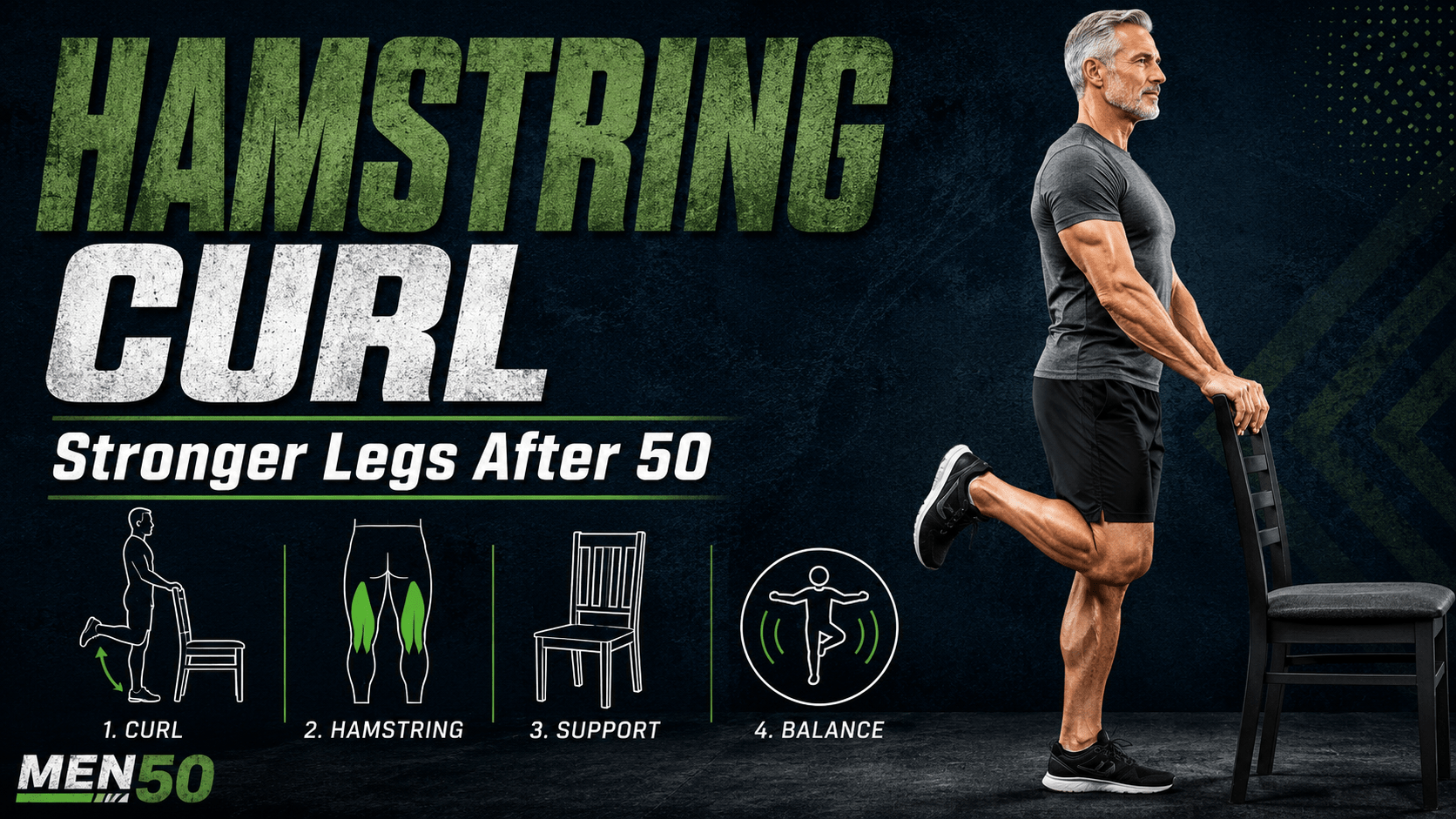
The standing hamstring curl is the most overlooked hamstring exercise in fitness — and one of the most useful for men over 50. Most hamstring training focuses on hip-extension exercises like the Romanian deadlift, hip hinge, and glute bridge. Those are essential — but they only train half of what the hamstrings do. The other half is knee flexion (bending the knee), and the standing hamstring curl is the simplest, equipment-free exercise that trains it. For men over 50, this missing piece contributes to knee health, balance, and protection against the hamstring/quadriceps imbalance that’s behind a lot of knee pain.
Part of the Build Muscle After 50 pillar — strength training for men over 50.
Key Takeaways
- The hamstrings have two functions: hip extension (trained by deadlifts/hinges) and knee flexion (trained by curls). Most men over 50 only train the first.
- This exercise is bodyweight only — no equipment needed, can be done anywhere, ideal for travel or home.
- Programming: 2–3 sets of 10–15 reps per leg, 2–3 times per week. Rest 30–60 seconds between sets.
- A small move that makes a big difference. Stronger hamstrings support your knees, balance, and everyday movement.
- This is also a balance exercise — standing on one leg while curling the other adds a balance component to every rep.
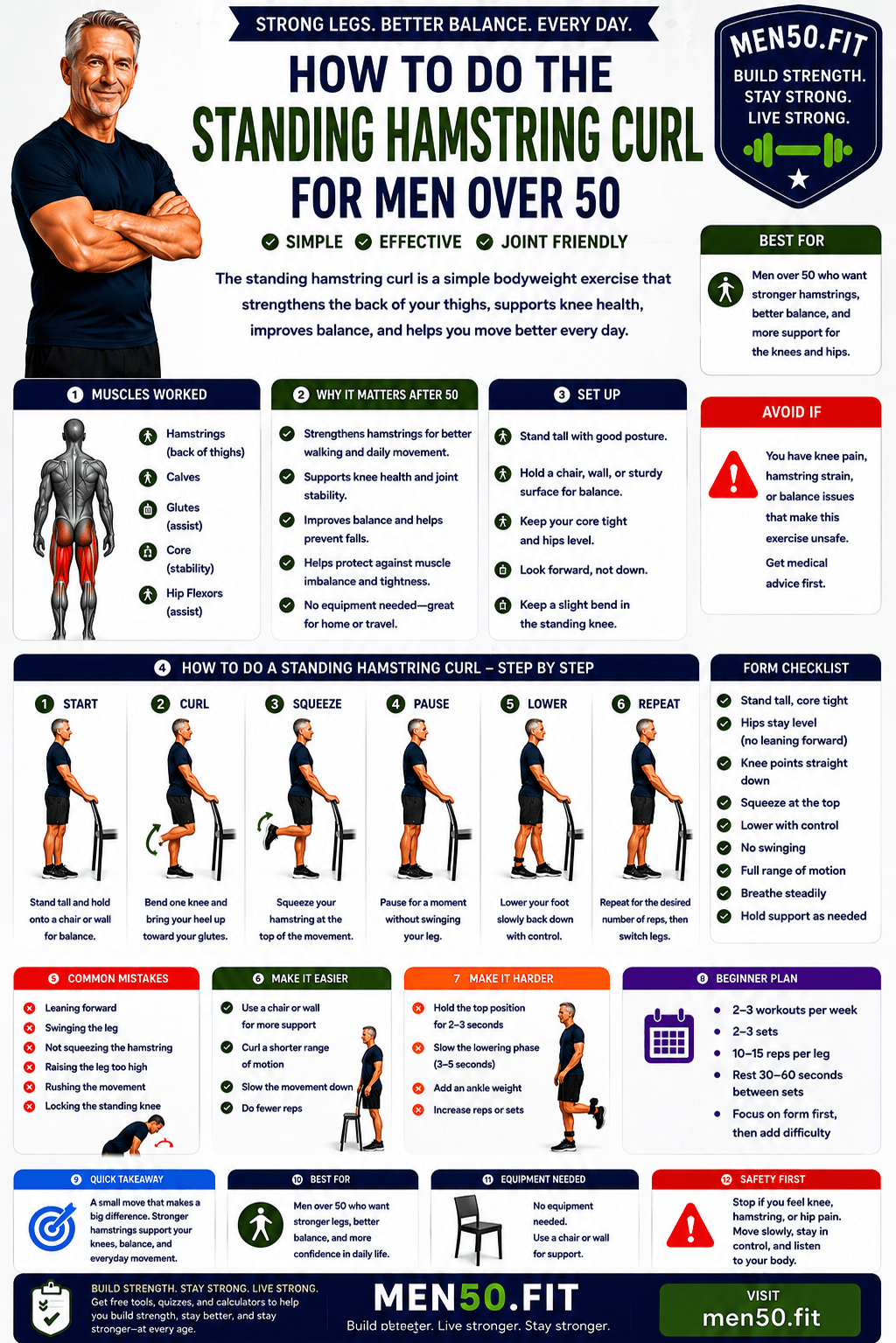
How to Perform the Standing Hamstring Curl
Set up first:
- Stand tall with good posture, feet hip-width apart.
- Hold a chair, wall, or sturdy surface for balance with one or both hands.
- Keep your core tight and hips level.
- Look forward, not down.
- Keep a slight bend in the standing knee — don’t lock it straight.
Then the movement:
- Start. Stand tall, holding your chair or wall for balance. Standing knee slightly bent. Both feet flat on the floor.
- Curl. Bend one knee and bring your heel up toward your glutes. Lead with the heel. Take 1–2 seconds to curl.
- Squeeze. Squeeze your hamstring actively at the top of the movement. The heel should be near your glutes — but not slamming into them.
- Pause. Pause for a moment at the top without swinging your leg. Feel the hamstring contract on the back of your thigh.
- Lower. Lower your foot slowly back down with control. Take 2–3 seconds on the way down. Don’t let the leg drop — controlled descent every rep.
- Repeat. Complete the reps on one leg, then switch. Maintain clean form on every rep — quality over quantity.
The cue that matters most: lead with your heel toward your glutes, and keep your hips level and pointing forward. Most men compensate by tilting the hips backward or leaning the torso forward to “help” the heel come up. The hips should stay perfectly level, the torso upright, and the only thing moving is the lower leg.
Why the Standing Hamstring Curl Matters After 50
To understand why this exercise matters, you need to understand what the hamstrings actually do. The hamstrings are three muscles (biceps femoris, semitendinosus, semimembranosus) running along the back of the thigh — from the sit bone of the pelvis down to the knee. Because they cross both the hip and the knee, they have two distinct functions:
| Function | What It Does | Trained By |
|---|---|---|
| Hip extension | Drives the leg backward (or the pelvis forward) | Romanian deadlift, hip hinge, glute bridge |
| Knee flexion | Bends the knee (pulls the heel toward the glutes) | Hamstring curl |
Most men over 50 only train the first function. That’s a problem for three specific reasons:
1. Knee health. The hamstrings act as a balance force to the quadriceps at the knee joint. When the quads are strong but the hamstrings (specifically the knee-flexion function) are weak, the knee joint gets overloaded in extension. This imbalance is associated with anterior knee pain, patellar issues, and accelerated wear of the knee joint. Most men over 50 have stronger quads than hamstrings in knee flexion — usually because they walk and stand a lot (which trains quads) but never directly load the hamstrings in knee flexion.
2. Hamstring strain prevention. The hamstrings are one of the most commonly strained muscle groups in men over 50, particularly during sudden movements like reaching for something dropped on the floor or stepping unexpectedly. Direct knee-flexion strength provides reactive capacity — the ability of the hamstring to contract quickly under sudden load. Without this training, the hamstring is essentially “long and weak” — extensible but not strong in its shortened position.
3. Walking and balance mechanics. Every step you take involves a knee flexion phase as the foot lifts off the ground. Stronger hamstrings in knee flexion produce a more efficient stride, better balance during single-leg phases of walking, and more reactive strength when you need to catch yourself. This contributes to fall prevention — the standing hamstring curl is a CDC STEADI-relevant exercise that most fall prevention programmes overlook.
The Equipment Advantage
The bodyweight version of this exercise has a unique value proposition: it requires nothing. No dumbbells, no bands, no bench. A chair or wall for balance is helpful but not always necessary. This makes it one of the few hamstring exercises that genuinely works:
- In a hotel room while travelling
- During a quick break at the office
- On a small outdoor walking path
- For older men with no home gym setup
- As a daily mini-dose between proper workouts
For most exercises in this matrix, “no equipment needed” usually comes with a significant trade-off in effectiveness. The standing hamstring curl is one of the few where bodyweight is genuinely sufficient for meaningful training.
The Balance Bonus
There’s also a balance training benefit built into this exercise. Every rep is performed standing on one leg while the other leg curls. That’s automatic balance practice while training the hamstrings. For men over 50 specifically, this is significant because both balance and hamstring strength decline with age, and falls are a major risk. The standing hamstring curl trains both simultaneously — getting two adaptations from one exercise.
Sets and Reps
This exercise rewards consistency more than load. Daily light practice produces measurable results in 4–6 weeks.
| Stage | Variation | Sets × Reps per Leg | Frequency |
|---|---|---|---|
| Beginner | Bodyweight, full chair support | 2 × 8–10 | 2–3× per week |
| Novice | Bodyweight, light support | 2–3 × 10–15 | 2–3× per week |
| Intermediate | Bodyweight + pause at top + slow lowering | 3 × 10–15 | 2–3× per week |
| Advanced | Ankle weight (2–5 lbs) | 3 × 10–15 | 2–3× per week |
Rest 30–60 seconds between sets. Pick a variation where the last 2–3 reps still feel clearly challenging at clean tempo — heel coming up smoothly, hips level, no swinging.
Daily mini-doses also work well. One set of 10–15 per leg every morning while making coffee adds up to real hamstring strength over weeks. The standing hamstring curl tolerates daily frequency at bodyweight load — and the balance benefit comes from frequency, not heavy loading.
Common Mistakes
The six errors that turn a useful exercise into a back or hip flexor strain:
- Leaning forward. The single most common mistake. As the heel comes up, the torso wants to lean forward to “help” the hamstring contract. This shifts work to the lower back and reduces hamstring engagement. Keep the torso upright and hips level throughout every rep.
- Swinging the leg. Quick, momentum-driven reps use elastic recoil instead of hamstring strength. Curl slowly, pause at the top, lower slowly. The slow tempo is the exercise.
- Not squeezing the hamstring. Going through the motion without actively contracting the hamstring at the top wastes the rep. Squeeze hard at the top — feel the muscle on the back of your thigh actively work.
- Raising the leg too high. Above a certain point — usually when the heel is near the glute — the hamstring can’t shorten further and the hip flexor takes over to lift the leg higher. Stop when the heel is near the glute. Going higher recruits the wrong muscles.
- Rushing the movement. Quick reps look productive but train little. Use 1–2 seconds up, brief pause, 2–3 seconds down. The slow tempo is what builds hamstring strength.
- Locking the standing knee. As fatigue sets in, the standing leg wants to lock straight to bear the load passively. Locked knees put stress on the joint and reduce balance demand. Keep a slight bend in the standing knee throughout.
Make It Easier or Harder
If standard standing hamstring curls are too challenging:
- Use a chair or wall for more support — both hands on the chair removes balance demand entirely.
- Curl a shorter range of motion — bring the heel only 70–80% of the way up while building strength.
- Slow the movement down even more — sometimes slower can feel easier because momentum disappears.
- Do fewer reps — start with 2 sets of 6–8 per leg and build up.
To make it harder once form is solid:
- Hold the top position for 2–3 seconds with hamstring squeezed and heel near glutes.
- Slow the lowering phase to 3–5 seconds per rep — significantly more demanding than it sounds.
- Add an ankle weight — 2–3 lbs (1 kg) is plenty to start. Most men over 50 stay at 2–5 lbs (1–2 kg) long-term.
- Increase reps or sets — extend to 3 sets of 15–20 per leg before adding load.
- Reduce support — use only one hand on the chair, then fingertips, then no support at all (full balance challenge).
For variety, try the prone hamstring curl (lying face down, curl the heel toward the glute) once a week — same muscle, different position. Useful for men with balance concerns who can’t safely do the standing version.
Safety Note
Avoid the standing hamstring curl if you have knee pain, current hamstring strain, or balance issues that make standing on one leg unsafe. Get medical advice first if any apply.
If you feel sharp pain in your knee, hamstring, or hip, stop. Mild muscular fatigue in the hamstring is normal; sharp pain is not. Adjust your range of motion, reduce the load, or switch to the prone variation.
The standing knee takes static load throughout the exercise. If you have knee arthritis or any current knee condition, do the exercise with full chair support (both hands on the chair) to reduce demand on the standing leg, or use the prone variation instead.
For men with significant balance issues, do this exercise between two sturdy surfaces (like a chair on each side, or in a doorway where you can touch both walls). The exercise should never feel unstable — fall risk is the priority.
Build Your Personal Training Plan
The standing hamstring curl is one piece of a complete lower-body and balance programme. Get a personalised exercise plan based on your current strength, mobility, and any limitations.
Take the Free Fitness Profiler →
FAQs
Standing hamstring curl vs Romanian deadlift — which is better?
They train different functions of the same muscle. The Romanian deadlift trains the hamstrings in hip extension — driving the legs backward (or the pelvis forward). The standing hamstring curl trains them in knee flexion — bending the knee. The hamstrings do both jobs in daily life, and a complete programme should train both. Most men over 50 are heavily biased toward hip-extension work (deadlifts, bridges, hip hinges) and never train knee flexion. Adding 2–3 sets of standing hamstring curls per week fills the gap. Neither exercise is “better” — they’re complementary. Do both.
Why train the hamstrings two different ways?
Because the hamstrings have two distinct functions that require different training stimuli. Hip extension (RDL/hinge work) trains the hamstrings as part of the posterior chain in a long-muscle position. Knee flexion (hamstring curls) trains them in a shortened position with the knee bending. Studies on hamstring strain prevention show that exercises in BOTH positions are needed for full hamstring health — neither alone provides complete coverage. Men who only train hip extension tend to have hamstrings that are strong when long but weak when short. Men who only train knee flexion (rare in real-world training) have the opposite problem. Train both.
How is this different from the glute bridge?
Different patterns, different primary work. The glute bridge trains the glutes primarily, with hamstrings as secondary, in a hip-extension pattern. The standing hamstring curl trains the hamstrings primarily, via knee flexion. The glute bridge is a hip-dominant compound exercise; the hamstring curl is a knee-dominant isolation exercise. Both have their place. For comprehensive lower-body work, the glute bridge handles glute and hamstring hip-extension work, while the hamstring curl fills the knee-flexion gap.
Can I do this exercise every day?
Yes — at bodyweight load. The hamstrings respond well to frequent practice at low-to-moderate intensity. One set of 10–15 per leg every morning while making coffee or brushing your teeth is a sustainable habit that builds hamstring strength over weeks. Heavier work (with ankle weights) needs 48 hours of recovery — limit that to 2–3 days per week. Many men over 50 benefit from doing bodyweight curls daily plus 2 weighted sessions per week.
Do I really need to hold a chair?
For most men over 50, yes — at least with a fingertip touch. The standing leg has to bear weight while balancing AND lifting the other leg, which is genuinely challenging for the balance system. Holding a chair or wall removes the failure mode (falling sideways) while still allowing the hamstring training. As you build balance over weeks, you can progress from full grip → light grip → fingertips → no support. The progression is part of the exercise. Don’t skip the support to look tough — the exercise is just as effective with chair support, and the safety margin matters.
References
- American College of Sports Medicine. Resistance Training for Older Adults Position Stand. acsm.org
- Centers for Disease Control and Prevention. STEADI: Stopping Elderly Accidents, Deaths & Injuries. cdc.gov
- National Institute on Aging. Exercise & Physical Activity: Your Everyday Guide. nia.nih.gov
Disclaimer: This article is for educational purposes only and is not medical advice. Consult a qualified healthcare professional before starting any new exercise programme, especially if you have existing knee, hamstring, or hip conditions.