

The wide push-up shifts the emphasis from balanced chest-triceps work (the standard floor push-up) toward the chest as the dominant muscle. By widening the hand position beyond shoulder-width, the pectorals do more of the work and the triceps does less. But here’s the critical caveat for men over 50: the classic “wide push-up” with elbows flared straight out at 90 degrees is one of the most common causes of shoulder pain in older men. The shoulder-safe version keeps the elbows at 45 degrees even with the wider hand placement — same elbow angle as the standard push-up, just with wider hands. That single technical adjustment is the entire difference between a useful chest exercise and a shoulder problem waiting to happen.
Part of the Build Muscle After 50 pillar — strength training for men over 50.
Key Takeaways
- The wide push-up emphasises the chest more than the standard floor push-up, which balances chest and triceps work.
- Critical safety point: keep elbows at 45 degrees even with wide hand placement. Elbows flared out at 90 degrees (the “T-shape”) is one of the most common causes of shoulder pain in men over 50.
- Programming: 2–4 sets of 6–15 reps, 2–3 times per week. Rest 45–90 seconds between sets.
- Wide hands, strong core, and full range of motion build a powerful chest. Control each rep and keep your body in a straight line.
- Completes the three-grip push-up framework: wide (chest), standard (balanced), close-grip (triceps). Each works the same muscles in different ratios.
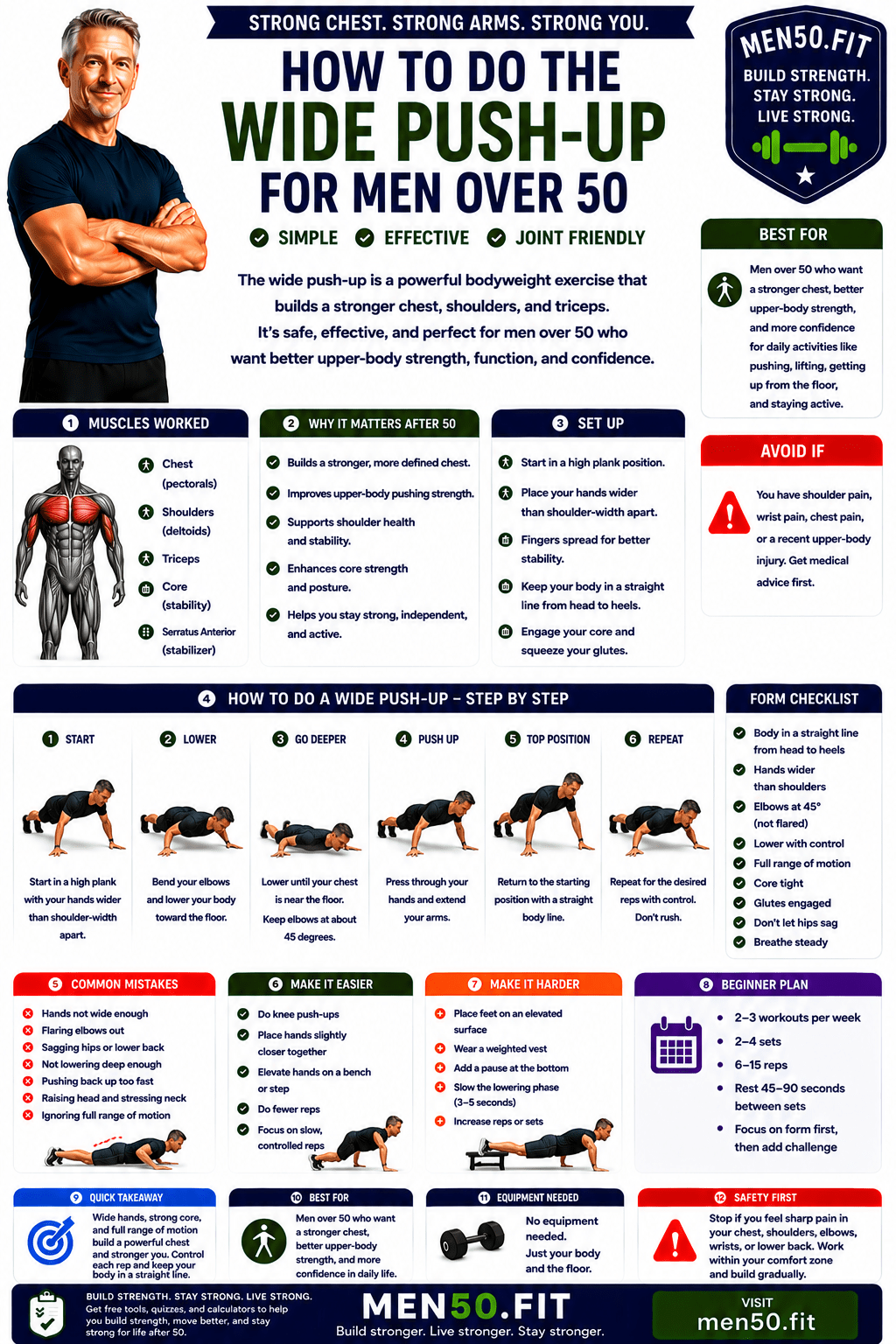
How to Perform the Wide Push-Up
Set up first:
- Start in a high plank position on the floor.
- Place your hands wider than shoulder-width — typically about 1.5x shoulder-width. Fingers spread for stability.
- Body in a straight line from head to heels.
- Core tight, glutes squeezed.
- Neck neutral — eyes on the floor about 6 inches ahead of your hands.
Then the movement:
- Start. High plank position with hands wider than shoulders. Body straight from head to heels. Core engaged, glutes tight.
- Lower. Bend your elbows and lower your body toward the floor. Keep elbows at 45 degrees — they should make an arrow shape pointing back toward your feet, not flare out to the sides at 90 degrees. Take 2–3 seconds to lower.
- Go deeper. Lower until your chest is near the floor — about 2–3 inches from contact. Maintain the 45-degree elbow angle throughout the descent.
- Push up. Press through your hands and extend your arms back to the starting position. Take 1–2 seconds to press up. Don’t lock the elbows fully at the top.
- Top position. Return to the starting plank position with a straight body line. Don’t rush — pause briefly before the next rep.
- Repeat. Maintain clean form on every rep. Quality over speed always.
The cue that matters most: elbows at 45 degrees, even with wide hands. Most men intuitively think “wider hands = wider elbows,” and they flare the elbows out to 90 degrees from the body. This is wrong and dangerous. The hands are wider; the elbows still angle back toward the feet at 45 degrees. The shoulder-safe version keeps the elbow angle the same as a standard push-up — only the hand position changes.
Why the Wide Push-Up Matters After 50
The chest is one of the largest muscles in the upper body, and direct chest training matters for several reasons relevant to men over 50: pushing strength for daily tasks (opening doors, lifting items overhead, getting up from the floor), upper-body balance with the back (chest weakness contributes to the forward-rounded posture pattern), and visible upper-body strength (chest development is part of looking strong, not just being strong).
Most push-up variations train the chest as part of a coordinated team with the triceps and front delts. The wide push-up shifts the ratio:
| Push-Up Variation | Primary Muscle | Secondary |
|---|---|---|
| Wide Push-Up (this article) | Chest (pectorals) | Triceps, front delts |
| Floor Push-Up | Chest + triceps (balanced) | Front delts |
| Close-Grip Push-Up | Triceps | Chest, front delts |
For men who want more chest emphasis in their bodyweight pressing, the wide push-up is the answer. Combined with the standard floor push-up (balanced) and the close-grip push-up (triceps), you get three different muscle emphases from the same basic movement.
The Three-Grip Push-Up Framework
This article completes a framework that mirrors the arm training trilogy in the matrix. Just like men over 50 benefit from rotating through three different grip widths for biceps/forearm work — supinated, neutral, pronated — they benefit from rotating through three different hand widths for push-ups:
| Hand Position | Push-Up Type | Emphasis |
|---|---|---|
| Wide | Wide Push-Up (this article) | Chest |
| Shoulder-width | Floor Push-Up | Balanced |
| Narrow | Close-Grip Push-Up | Triceps |
For complete bodyweight pressing development, rotating through all three across a training week (or month) gives the most comprehensive stimulus.
The Shoulder Safety Issue
The wide push-up has a reputation among older lifters for causing shoulder pain — and for good reason. The standard fitness-magazine wide push-up uses elbows flared at 90 degrees from the body (the “T-shape”), which places significant load on the anterior shoulder joint in a position that the rotator cuff struggles to stabilise. This is mechanically the worst position for the front of the shoulder, and the most common cause of impingement-style pain in push-up variations.
The solution is simple: keep elbows at 45 degrees. The hands are wider than the standard push-up, but the elbows still angle backward toward the feet. This:
- Keeps the shoulder joint in a more stable, less impingement-prone position
- Still recruits the chest more than the standard push-up (because the wider hand position creates more shoulder horizontal abduction)
- Eliminates the front-of-shoulder pain that flared elbows cause
This is the difference between a shoulder-friendly chest exercise and a shoulder problem. For men over 50, the 45-degree elbow angle is non-negotiable.
The Push-Up Capacity Connection
Like every push-up variation in the matrix, the wide push-up contributes to the push-up capacity that Yang and colleagues (2019, JAMA Network Open) identified as a marker of cardiovascular health. Including chest-emphasis work alongside standard and triceps-emphasis push-ups builds more comprehensive pressing capacity.
Sets and Reps
Programming is essentially identical to standard floor push-ups. The wide variation is similar difficulty but slightly more shoulder-demanding.
| Stage | Variation | Sets × Reps | Frequency |
|---|---|---|---|
| Beginner | Wide knee push-up | 2 × 8–10 | 2× per week |
| Novice | Wide floor push-up, partial range | 2–3 × 8–12 | 2–3× per week |
| Intermediate | Wide floor push-up, full range | 3 × 8–15 | 2–3× per week |
| Advanced | Wide push-up + slow lowering + pause | 3–4 × 8–15 | 2–3× per week |
Rest 45–90 seconds between sets. Pick a number of reps where the last 1–2 reps still maintain clean form — body straight, elbows at 45 degrees (not flared), controlled tempo, full range.
A practical note: most men over 50 can do approximately the same number of wide push-ups as standard floor push-ups — maybe 1–2 fewer reps. If you can do 12 standard floor push-ups, expect to manage 10–12 wide push-ups. Significantly fewer reps usually means your elbows are flaring out (compromising the shoulders) — check form before assuming it’s a strength issue.
Common Mistakes
The seven errors that turn a useful chest exercise into a shoulder problem:
- Hands not wide enough. If the hands are only slightly wider than shoulder-width, the exercise isn’t actually a wide push-up — it’s just a slightly-too-wide standard push-up. Hands should be about 1.5x shoulder-width for the chest emphasis to work.
- Flaring elbows out. The single most dangerous mistake, and the most common cause of wide push-up shoulder pain. Elbows flared straight out at 90 degrees from the body (the “T-shape”) loads the front of the shoulder in an impingement-prone position. Elbows at 45 degrees — pointing back toward your feet, not out to the sides.
- Sagging hips or lower back. As fatigue sets in, the body wants to break the plank to find easier mechanical positions. The hips drop, the lower back sags. Squeeze the glutes and brace the core throughout every rep.
- Not lowering deep enough. Stopping with the chest 6 inches above the floor skips the productive range. Lower until the chest is 2–3 inches from the floor, then press back up with control.
- Pushing back up too fast. Quick reps use elastic recoil from the chest bouncing off the bottom position. Press up under control — 1–2 seconds up, no bouncing.
- Raising head and stressing neck. Looking up during the rep hyperextends the cervical spine. Keep the neck neutral — eyes on the floor about 6 inches ahead of your hands.
- Ignoring full range of motion. Half-reps that don’t fully extend the arms at the top or don’t bring the chest low enough at the bottom skip part of the working range. Full range every rep.
Make It Easier or Harder
If standard wide push-ups are too challenging:
- Do knee push-ups with wide hand placement — same chest-emphasis pattern with reduced bodyweight load.
- Place hands slightly closer together (closer to standard width) — easier on the shoulders while still being chest-focused.
- Elevate hands on a bench or step — reduces total bodyweight load. Wide hand position with hands on a sturdy bench is significantly easier than on the floor.
- Do fewer reps — start with 2 sets of 6–8 and build up.
- Focus on slow, controlled reps — clean tempo with reduced volume trains the pattern properly.
To make it harder once form is solid:
- Place feet on an elevated surface (bench, step, or low chair) — significantly more chest demand.
- Wear a weighted vest — adds load without compromising form (provided form is already solid).
- Add a pause at the bottom for 1–2 seconds with the chest near the floor.
- Slow the lowering phase to 3–5 seconds per rep — significantly more demanding than it sounds.
- Increase reps or sets — extend to 15–20 reps per set before adding load.
For variety, try the wide-then-narrow superset — 8 wide push-ups immediately followed by 8 close-grip push-ups — hits both ends of the chest-triceps emphasis spectrum in one set. Useful for advanced training variety.
Safety Note
The elbow position is the safety issue. Avoid the wide push-up if you can’t maintain the 45-degree elbow angle — if your elbows want to flare out to 90 degrees, drop back to standard floor push-ups until the pattern is reliable.
Avoid the wide push-up if you have shoulder pain, wrist pain, chest pain, or a recent upper-body injury. Get medical advice first.
Shoulder pain during the wide push-up almost always means the elbows are flaring out. Fix the elbow angle first. If pain persists at the 45-degree angle, drop back to the standard floor push-up (slightly less shoulder-demanding) or work on the close-grip variation instead.
Wrist pain is common in any floor-based push-up. Solutions: push-up handles (which keep wrists neutral), making fists and pushing on the knuckles with a mat for padding, or switching to incline variations.
Lower back pain during the rep usually means the core isn’t bracing enough — the hips sag and the lumbar spine takes the load. Squeeze the glutes hard, brace the core. If you can’t maintain a straight body line, the wide push-up is too hard right now — drop back to knee or incline variations.
If you feel sharp pain anywhere during the rep, stop. Mild muscular fatigue is normal; sharp joint pain is not.
Build Your Personal Training Plan
The wide push-up is one piece of a complete upper body programme. Get a personalised exercise plan based on your current strength, goals, and any limitations.
Take the Free Fitness Profiler →
FAQs
Wide push-up vs standard push-up — what’s the difference?
Hand position. The standard floor push-up uses hands at shoulder-width. The wide push-up uses hands about 1.5x shoulder-width — significantly wider. This shifts the muscle emphasis: the wider hand position creates more shoulder horizontal abduction, which means the chest does more of the work and the triceps does less. The elbow angle should stay the same in both — 45 degrees, pointing back toward the feet. Most men over 50 can do similar rep counts in both variations, but the wide version is slightly more shoulder-demanding.
Wide push-up vs close-grip push-up — which is better?
They’re complementary, not competitive. The wide push-up emphasises the chest (with triceps assisting). The close-grip push-up emphasises the triceps (with chest assisting). For complete bodyweight pressing development, rotating through both — plus the standard floor push-up (balanced) — gives the most comprehensive stimulus. A practical week: standard push-ups on day 1, wide push-ups on day 2, close-grip on day 3. Or rotate weekly. Neither is “better” — they train different ratios of the same muscle group.
How wide should my hands be?
About 1.5x shoulder-width is the sweet spot. Significantly wider doesn’t add chest emphasis — it just increases shoulder load and makes the form harder to maintain. A practical test: in the wide position with your arms extended (top of the push-up), your hands should be roughly 2 inches past where the standard push-up width would put them. If you have to consciously think about widening your stance, you’re probably right. If your hands are out near your knees (extreme wide), the position is too wide and the shoulders take excessive load.
Why do my shoulders hurt during wide push-ups?
Almost always because the elbows are flaring out at 90 degrees instead of staying at 45 degrees. The classic “T-shape” position (elbows flared straight out to the sides) loads the front of the shoulder joint in an impingement-prone position — this is the standard cause of wide push-up shoulder pain in men over 50. The fix: actively keep the elbows angling back toward your feet, not out to the sides. The hands are wider; the elbows are still at 45 degrees. If you can’t maintain this elbow angle, the exercise isn’t safe for you right now — drop back to standard floor push-ups, work on shoulder mobility (wall angels, doorway chest stretches), and rebuild.
Should I include wide push-ups in my routine?
Only if your shoulders tolerate them with proper form. For men with healthy shoulders, wide push-ups are a useful chest-emphasis variation to rotate in alongside standard floor push-ups and close-grip push-ups. For men with any shoulder history (impingement, rotator cuff issues, anterior pain), the wide push-up is the most demanding push-up variation on the shoulder joint — even with proper 45-degree elbows. Consider skipping it entirely and getting chest emphasis from the dumbbell chest fly on floor or dumbbell floor press instead — both are more shoulder-friendly chest options.
References
- Yang J, Christophi CA, Farioli A, et al. Association Between Push-up Exercise Capacity and Future Cardiovascular Events Among Active Adult Men. JAMA Network Open. 2019;2(2):e188341.
- American College of Sports Medicine. Resistance Training for Older Adults Position Stand. acsm.org
- National Institute on Aging. Sarcopenia and Muscle Strength in Older Adults. nia.nih.gov
Disclaimer: This article is for educational purposes only and is not medical advice. Consult a qualified healthcare professional before starting any new exercise programme, especially if you have existing shoulder, wrist, chest, or back conditions.