
The single-leg stand is two things at once: a training exercise and a longevity test. In 2022, researchers led by Claudio Gil Araújo published a study in the British Journal of Sports Medicine showing that adults aged 51–75 who couldn’t stand on one leg for 10 seconds had an 84% higher all-cause mortality risk over the following 7 years than those who could. That single number turned what most men dismissed as a children’s playground skill into one of the most predictive markers of healthspan ever found in a clinical setting. The good news: it’s also one of the easiest things to train.
Part of the Build Muscle After 50 pillar — strength training for men over 50.
Key Takeaways
- The 10-second single-leg stand test predicts longevity. Adults 51–75 who failed had 84% higher all-cause mortality over 7 years (Araújo et al., 2022).
- The exercise trains ankle stabilisers, hip abductors, deep core, and the nervous system’s ability to coordinate them — the systems that prevent falls.
- Programming: 2–3 holds per side, 10–30 seconds each, 3–5 days per week. Daily is fine; balance responds to frequent practice.
- Always practice near a wall or chair. The exercise is safe; the floor is hard. The right support setup turns “could fall” into “can’t fall.”
- Quality of balance matters more than length of hold. A wobbly 30 seconds is worth less than a steady 15 seconds.
How to Perform the Single-Leg Stand
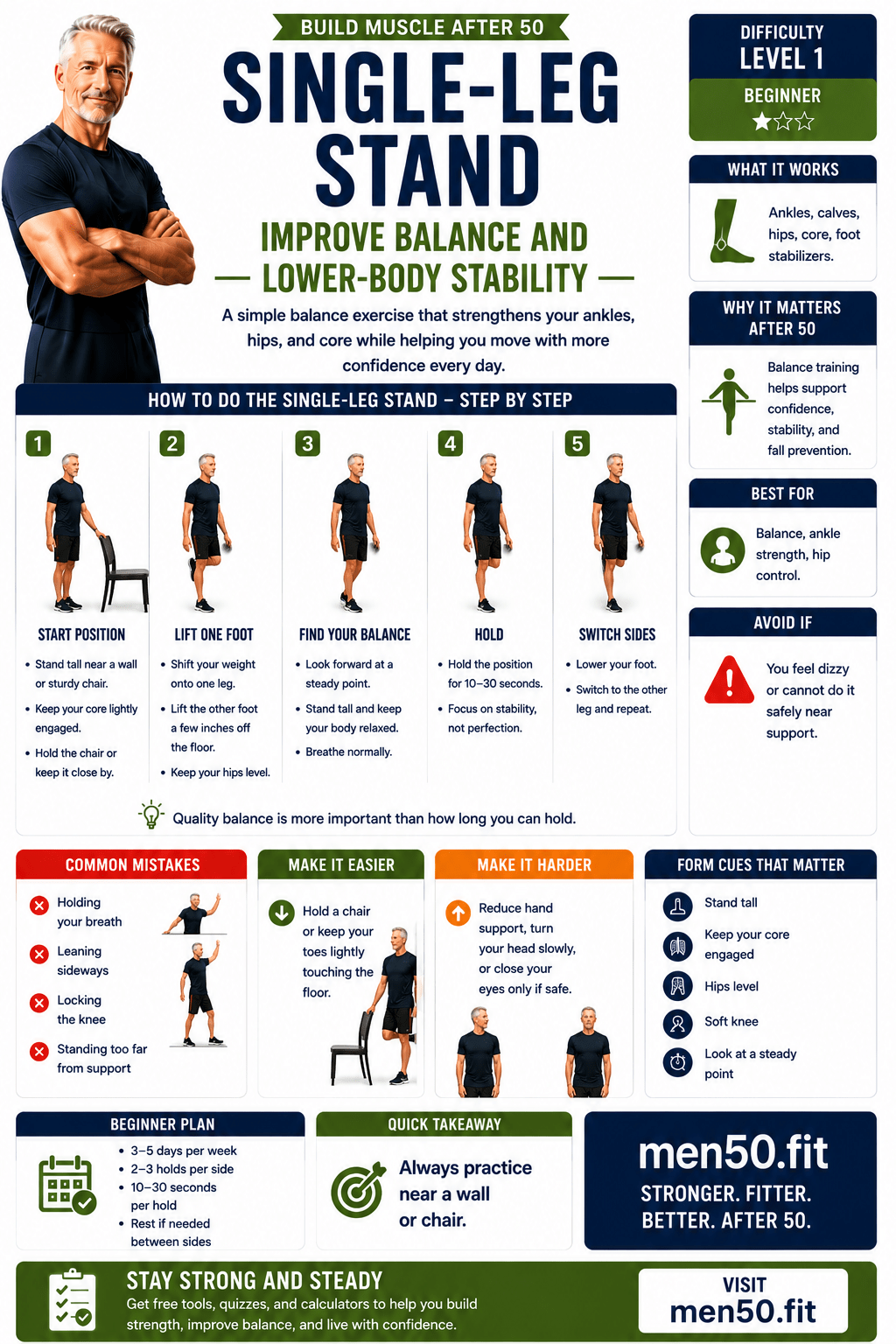
- Start position. Stand tall near a wall or sturdy chair, feet hip-width apart. Keep your core lightly engaged. Hold the chair or wall lightly with one hand at first — or just keep it within easy reach.
- Lift one foot. Shift your weight onto one leg and lift the other foot a few inches off the floor. Keep your hips level — don’t let the lifted-leg side hike up or drop.
- Find your balance. Look forward at a fixed point on the wall, not at your feet. Stand tall and keep your body relaxed. Breathe normally — don’t hold your breath.
- Hold. Maintain the position for 10–30 seconds. Focus on stability, not perfection. Small corrections are normal; staying upright is the goal.
- Switch sides. Lower your foot, briefly reset, and repeat on the other leg. Most men find one side noticeably steadier than the other — that’s normal and worth knowing.
The cue that matters most: quality balance is more important than how long you can hold. A 15-second hold where your body stays calm and centred is more useful than a 30-second hold full of wobbling and arm flapping.
Why the Single-Leg Stand Matters After 50
Falls are the leading cause of injury-related death in men over 65, and the underlying cause of most falls isn’t weakness — it’s loss of balance. The ankle stabilisers (peroneals, tibialis posterior), hip abductors (gluteus medius), and proprioceptive feedback from the feet all decline after 50 if they’re not actively trained. Most daily life happens on two legs, so these systems quietly atrophy until they’re needed in a transition moment — stepping off a kerb, climbing onto a stool, or catching yourself when you trip on a rug. By then, the deficit is already there.
The Araújo team’s 2022 study was striking precisely because it was simple. They asked 1,702 adults aged 51–75 to stand on one leg for 10 seconds without support. Over the following 7 years, those who failed had 84% higher all-cause mortality than those who succeeded. The relationship held even after adjusting for age, sex, body mass index, and various health conditions. The single-leg stand isn’t measuring balance in isolation — it’s measuring an integrated function of neurological coordination, lower-body strength, vestibular function, and proprioception. A 50-year-old who can stand on one leg for 30 seconds with eyes open and 10 seconds with eyes closed has a meaningfully different physiological status from one who can barely manage 5 seconds.
The encouraging part: balance responds to practice faster than almost any other physical capacity. Most men over 50 who train single-leg balance daily for 4–6 weeks see substantial measurable improvement. The nervous system relearns the coordination patterns quickly — you’re not building new tissue, you’re sharpening signal pathways that already exist.
Sets and Reps
Balance is a use-it-or-lose-it skill. Daily short doses beat occasional long sessions.
| Stage | Hold Length per Leg | Holds per Side | Frequency | Variation |
|---|---|---|---|---|
| Beginner | 10–15 seconds | 2 | 3–5× per week | Hand on chair or wall for support |
| Novice | 15–30 seconds | 2–3 | 4–5× per week | Fingertip support, then no support |
| Intermediate | 30–45 seconds | 2–3 | Daily | No support, eyes open |
| Advanced | 30–60 seconds | 2–3 | Daily | Eyes closed (only with safe support nearby) |
Rest if needed between sides. Add the single-leg stand to existing daily habits — brushing teeth, waiting for the kettle, on phone calls. The kitchen counter or bathroom sink is the perfect built-in safety net.
Common Mistakes
The four errors that turn a useful exercise into a wasted one:
- Holding your breath. Most men instinctively hold their breath when concentrating on balance. This tenses the body and reduces small adjustments. Breathe naturally — even slow, audible breathing helps.
- Leaning sideways. When you lift one foot, the other hip wants to hike up to compensate. Keep both hips level — imagine a glass of water sitting on top of the lifted-leg hip. Drop that hip down toward neutral.
- Locking the knee. Standing with the supporting knee locked out reduces the ability to make micro-adjustments. Keep a soft knee — slightly bent, springy, ready to respond.
- Standing too far from support. If you’re going to fall, you want to be able to catch the wall or chair fast. Stand close to support, especially when starting out or attempting harder variations.
Make It Easier or Harder
If a basic unsupported hold is too challenging, hold a chair, wall, or kitchen counter with one hand or even both hands. You can also leave the toes of the lifted foot lightly touching the floor — this is still balance work, with much less demand on the stabilisers.
To make it harder once basic form is solid:
- Reduce hand support — full hand to fingertips to one finger to nothing.
- Turn your head slowly side to side or up and down while holding the position. This challenges vestibular balance.
- Close your eyes — but only with safe support immediately nearby. The eyes-closed version is significantly harder because it removes visual input, forcing the proprioceptive and vestibular systems to do all the balance work alone.
- Stand on a folded towel or thin cushion to introduce an unstable surface.
- Add small movements with the lifted leg — slow front-to-back swings, side swings, or knee circles.
Don’t combine variations until each one is mastered separately. Closing the eyes while standing on a cushion is advanced-level work and not recommended until you can comfortably hold the basic eyes-closed version on a flat floor for 30 seconds with no support contact.
Safety Note
Always practice near a wall, sturdy chair, or counter — particularly when starting out or progressing to harder variations. The exercise itself is safe; the consequence of an unprotected fall onto a hard floor is not.
Men with inner ear issues, vertigo, recent lower-limb injuries, or neurological conditions affecting balance (Parkinson’s, peripheral neuropathy, vestibular disorders) should speak with a doctor or physiotherapist before starting balance training. Even without any of these, stop immediately if you feel dizzy, lightheaded, or off-centre in a way that isn’t normal balance challenge.
If you can’t hold the basic unsupported single-leg stand for at least 5 seconds, that’s useful information — train it twice a day at whatever support level you need, and consider talking to a physio about a broader fall-prevention assessment.
Build Your Personal Training Plan
The single-leg stand is one piece of a complete balance and lower-body programme. Get a personalised exercise plan based on your current capacity, goals, and any limitations.
Take the Free Fitness Profiler →
FAQs
What does it mean if I can’t stand on one leg for 10 seconds?
It means you’re below the median for your age group — and according to the Araújo 2022 study, statistically at higher mortality risk over the next several years. But it’s not a death sentence; it’s a signal to train. Most men who can’t hit 10 seconds at the start can get there within 3–6 weeks of daily practice. The bigger concern is the 1–2 second threshold — if you genuinely can’t balance on one leg for more than a few seconds, talk to a physiotherapist about a proper fall risk assessment.
Should I practice with eyes closed?
Eventually, yes — but only when you have safe support immediately available, and only after you can hold the eyes-open version for 30+ seconds with no support contact. The eyes-closed version removes the visual input most adults rely on heavily for balance, which is why it’s a much harder test. It’s also more revealing of the proprioceptive system’s actual function. Start with eyes-closed for 5 seconds, work up to 10, then 30.
Why is balance so much worse in the morning?
Several reasons. The vestibular system needs a few minutes after waking to fully calibrate, joint stiffness reduces small ankle and hip corrections, and blood pressure regulation (which affects balance through cerebral blood flow) takes time to settle from lying to standing. None of this is a problem — but it’s why some doctors recommend taking 30–60 seconds after standing up before walking, particularly first thing in the morning, especially for older men on blood pressure medication.
How quickly can I improve my balance?
Faster than you’d expect. Balance is largely a neural skill — the nervous system rebuilding coordination patterns — rather than a muscular one. Most men over 50 see meaningful improvement within 2–3 weeks of daily practice (1–2 short sessions per day). Hitting the 10-second unsupported threshold from a starting point of 3–5 seconds usually takes 3–6 weeks.
Can balance training really prevent falls?
Yes, and the evidence is strong. A 2019 Cochrane systematic review found that exercise programmes including balance training reduced fall rates in older adults by roughly 24%. The single-leg stand alone won’t deliver all of that benefit, but combined with strength work (the step-up and calf raise particularly) it forms the core of every clinically validated fall-prevention programme.
References
- Araújo CG, de Souza E Silva CG, Laukkanen JA, et al. Successful 10-second one-legged stance performance predicts survival in middle-aged and older individuals. British Journal of Sports Medicine. 2022;56(17):975-980.
- Sherrington C, Fairhall NJ, Wallbank GK, et al. Exercise for preventing falls in older people living in the community. Cochrane Database of Systematic Reviews. 2019;(1):CD012424.
- Centers for Disease Control and Prevention. Older Adult Falls: A Growing Danger. cdc.gov
Disclaimer: This article is for educational purposes only and is not medical advice. Consult a qualified healthcare professional before starting any new exercise programme, especially if you have existing balance, neurological, or lower-limb conditions.