
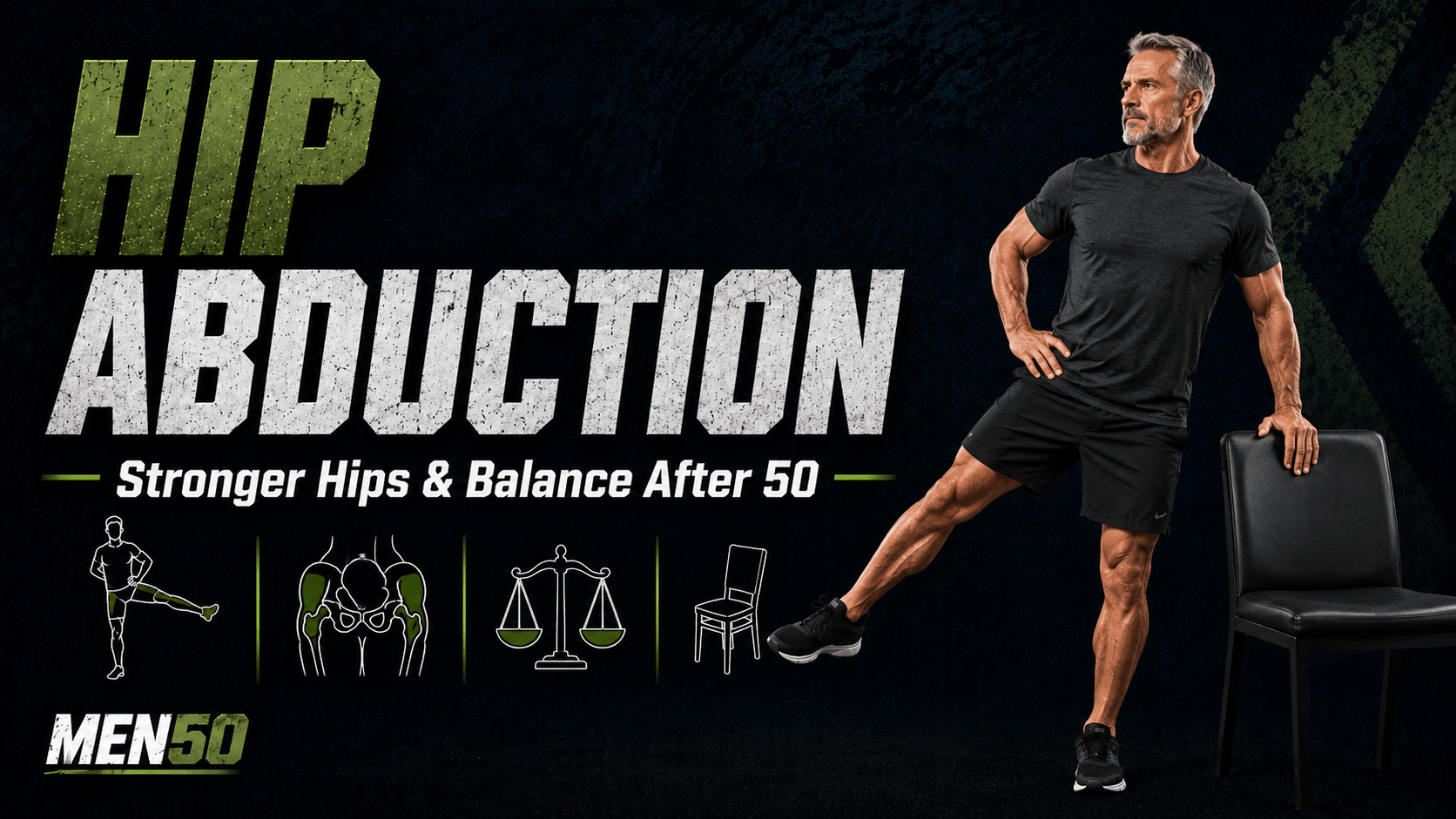
The standing hip abduction is one of the most underrated exercises in fall prevention. It directly trains the gluteus medius — the muscle on the side of your hip that stops your pelvis from dropping every time you take a step. When this muscle is weak (as it commonly is in men over 50), the consequences show up as a wobbly walking pattern, knees that drift inward, lower back compensation, and increased fall risk. The exercise itself is simple: stand next to a chair, lift one leg out to the side, lower with control. The benefits are anything but simple.
Part of the Build Muscle After 50 pillar — strength training for men over 50.
Key Takeaways
- The standing hip abduction trains the gluteus medius — the side-hip muscle that controls pelvic stability during walking and single-leg stance.
- Weak glute medius is one of the most common causes of fall risk, knee pain, and lower back compensation in men over 50.
- Programming: 2–3 sets of 10–15 reps per leg, 2–3 times per week. Rest 30–60 seconds between sets.
- Lift from your hip, not your low back. The single most important cue. Leaning sideways turns the exercise into a lower-back compensation move.
- This is the side-glute companion to the glute bridge (which trains the rear glutes). Together they cover the full glute training picture.
How to Perform the Standing Hip Abduction
Set up first:
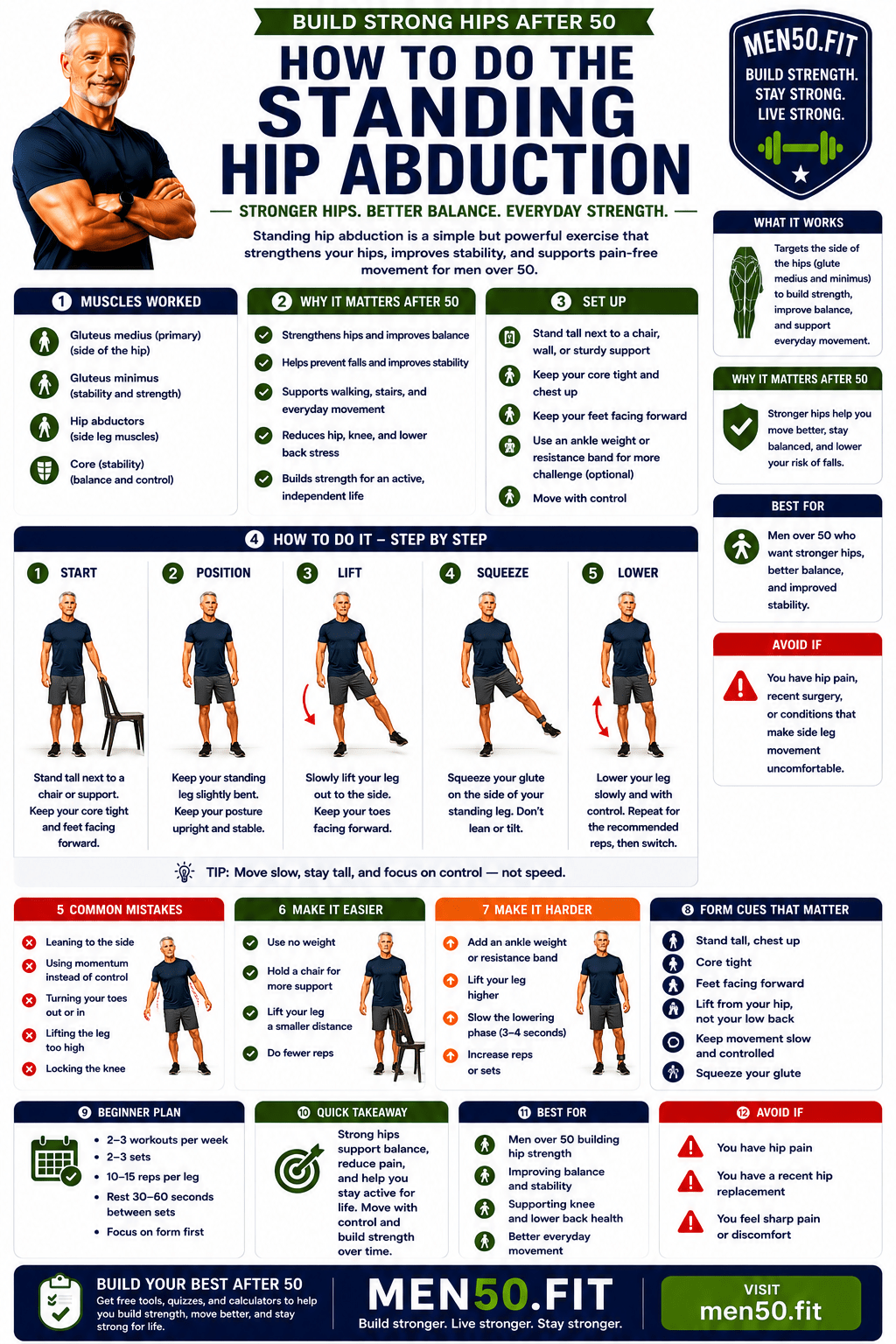
- Stand tall next to a chair, wall, or sturdy support — hold it lightly with one hand for balance.
- Core tight, chest up, posture upright.
- Feet facing forward (toes straight ahead, not turned out or in).
- Optional: ankle weight or resistance band around your ankles for more challenge.
Then the movement:
- Start. Stand tall next to a support. Hold it with one hand. Feet hip-width apart, facing forward. Core engaged, chest up.
- Position. Shift your weight slightly onto your standing leg, keeping that knee slightly bent (not locked). Stay upright — don’t lean to either side.
- Lift. Slowly lift your other leg out to the side, keeping the toes pointed forward (not turned out). Lift from the hip — your torso should stay still. Don’t lean sideways to “help” lift the leg.
- Squeeze. Pause at the top with the leg lifted to a comfortable height (usually 30–45 degrees from vertical). Squeeze the glute on the side of your standing leg as well as the moving leg. Don’t tilt or lean.
- Lower. Lower the leg slowly and with control back to the start. Take 2–3 seconds on the way down. Complete the reps on one side, then switch.
The cue that matters most: lift from your hip, not your low back. If you find yourself leaning sideways to bring the leg higher, the leg is going up because of lateral spinal flexion — not because the glute medius is working. Reduce the lift height until you can stay perfectly vertical.
Why the Standing Hip Abduction Matters After 50
Walking is a series of single-leg stances. Each time your foot lifts off the ground to take a step, the muscles on the side of the opposite hip — the gluteus medius and minimus — have to fire hard enough to stop your pelvis from dropping toward the unsupported side. When these muscles are strong, the pelvis stays level and the walk looks smooth. When they’re weak, the pelvis drops with each step — physiotherapists call this Trendelenburg gait. The walk looks wobbly, the hips work harder, and small forces that should be absorbed by the hip get transferred up to the lower back and down to the knee.
The consequences of weak gluteus medius are everywhere in the men-over-50 demographic:
- Increased fall risk. A weak glute medius means worse single-leg stability — directly relevant to balance and falls. The single-leg stand test reveals this weakness clearly.
- Knee valgus (knees caving inward during squats, stairs, or walking). The glute medius is the primary muscle that pulls the femur outward to track the knee over the toes. Weak glute medius = knees drift inward = patellar tracking issues and ITB irritation.
- Lower back compensation. When the hip can’t stabilise the pelvis, the lumbar spine takes over, working harder than it should during every walking step.
- Hip pain on the side of the affected hip. The gluteus medius tendon, when weak and overworked, becomes a common site of pain in adults over 50 (so-called “greater trochanteric pain syndrome”).
The standing hip abduction directly trains this weakness. Done consistently for 4–8 weeks, most men over 50 see improvements in single-leg stability, walking confidence, and reduced low-grade hip or lower back ache from compensation patterns. Pair it with the glute bridge (which trains the gluteus maximus) for complete glute development. The two muscles work as a team: glute max for hip extension power, glute medius for pelvic stability.
Sets and Reps
This exercise rewards consistency more than load. The glute medius is a stability muscle — it responds well to frequent, light-to-moderate work.
| Stage | Variation | Sets × Reps per Leg | Frequency |
|---|---|---|---|
| Beginner | Bodyweight, hand on chair for support | 2 × 10–12 | 2–3× per week |
| Novice | Bodyweight, no support | 2–3 × 10–15 | 2–3× per week |
| Intermediate | Ankle weight (2–5 lbs) | 3 × 10–15 | 2–3× per week |
| Advanced | Resistance band around ankles or heavier ankle weight | 3 × 12–15 | 2–3× per week |
Rest 30–60 seconds between sets. Quality of glute engagement matters more than volume. Most men over 50 see better results from clean, controlled bodyweight reps than from heavier loaded reps with leaning and lower-back compensation.
Daily mini-doses also work. One set of 10–12 per leg every morning, with a hand on the bathroom sink for balance, is a sustainable habit that adds up to real glute medius strength over months. This exercise tolerates daily frequency at low load — unlike heavier compound work.
Common Mistakes
The five errors that turn a great hip exercise into a lower-back exercise:
- Leaning to the side. The most common mistake. When the glute medius isn’t strong enough to lift the leg, the body leans sideways to “throw” the leg up. The lower back takes the work the hip should be doing. Stay perfectly vertical — even if it means lifting the leg only a few inches at first.
- Using momentum instead of control. Swinging the leg up and letting gravity drop it down skips both the concentric and eccentric work. Lift slowly (1–2 seconds), pause briefly, lower slowly (2–3 seconds). The slow tempo is the exercise.
- Turning your toes out or in. Rotating the foot changes which muscles work. Toes turned out shifts work to the hip flexor and front of the hip; toes turned in shifts work away from the glute medius entirely. Keep the toes pointed straight ahead throughout.
- Lifting the leg too high. Going higher than about 45 degrees from vertical requires leaning sideways and stops training the glute medius effectively. The top 30–45 degrees is where the glute medius does its work. Higher just shrugs and tilts.
- Locking the knee. Standing with the supporting knee locked out reduces stability and makes the balance demand harder than it needs to be. Keep a soft knee — slightly bent, springy, ready to balance.
Make It Easier or Harder
If standard hip abductions are too challenging:
- Use no weight — bodyweight alone is genuinely challenging for the glute medius when done with clean form.
- Hold a chair or counter for more support — full hand support, then fingertip support, then no support as you progress.
- Lift the leg a smaller distance — 20–30 degrees instead of 45. Build range as glute strength improves.
- Do fewer reps — start with 2 sets of 8 reps if 10 is too many.
To make it harder once form is solid:
- Add an ankle weight — 2–3 lbs (1 kg) is plenty to start. Many men over 50 stay at 2–5 lbs (1–2 kg) long term and still progress.
- Lift the leg higher — only if you can maintain a perfectly vertical torso at the higher range.
- Slow the lowering phase to 3–4 seconds per rep.
- Use a resistance band around the ankles — adds variable resistance that gets harder at the top of the lift.
- Increase reps or sets — 3 sets of 15 reps per leg with bodyweight is more useful than 2 sets of 8 with poor form and ankle weights.
For variety, try side-lying hip abductions (lying on your side, lifting the top leg) as a daily warm-up — same muscle, different position, removes the balance demand.
Safety Note
Avoid the standing hip abduction if you have current hip pain, a recent hip replacement (movement restrictions apply for several weeks/months post-surgery — get clearance from your surgeon), or sharp pain in the hip, knee, or lower back during the movement.
If you feel pain on the side of the hip (where the glute medius tendon attaches), the muscle may be irritated rather than weak. Drop range of motion, remove any added load, and reduce the rep count. If pain persists for more than a week of light training, see a physiotherapist — greater trochanteric pain syndrome can become chronic if pushed through.
Always use a chair, wall, or sturdy support nearby when starting out. The exercise is safe; the floor is hard if you lose balance unexpectedly.
Build Your Personal Training Plan
The standing hip abduction is one piece of a complete lower-body and balance programme. Get a personalised exercise plan based on your current strength, mobility, and any limitations.
Take the Free Fitness Profiler →
FAQs
Why is the gluteus medius so important?
The gluteus medius is the muscle that stabilises your pelvis during every single-leg moment — which is most of walking. When it’s strong, the pelvis stays level as you step, the knees track properly over the toes, and the lower back doesn’t have to compensate. When it’s weak, the pelvis drops on each step (Trendelenburg gait), the knees drift inward, and the lower back works overtime. Most men over 50 have weakness here without knowing it, and most age-related hip, knee, and lower-back issues trace back at least partly to this muscle.
Standing hip abduction vs glute bridge — do I need both?
Yes, both, because they train different glute muscles. The glute bridge trains the gluteus maximus — the large rear glute responsible for hip extension (standing up, climbing stairs, walking power). The standing hip abduction trains the gluteus medius — the side glute responsible for pelvic stability. Both are commonly weak after 50. A complete glute routine includes both, plus the single-leg stand for integrated balance work.
How do I know if I have weak side glutes?
Three quick signals. First, try a single-leg stand — if you can’t hold it for 10+ seconds without your hip dropping or wobbling significantly, the glute medius is probably weak. Second, watch yourself walk in a long mirror or video — if your hips visibly drop side to side with each step, that’s Trendelenburg gait. Third, do a bodyweight standing hip abduction — if you can’t lift the leg even 20 degrees without leaning to the opposite side, the muscle is weak. Most men over 50 fail at least one of these tests.
Why does my back hurt during this exercise?
Almost always because you’re leaning sideways instead of lifting from the hip. The glute medius needs to do the work of moving the leg; if it’s too weak, your body recruits the quadratus lumborum (a lower-back muscle) to hike the hip up instead. The fix: reduce the height of the lift dramatically — even just 10–15 degrees — until you can keep your torso perfectly vertical. As the glute medius gets stronger over 2–4 weeks, the leg will lift higher without back compensation.
Can I do this exercise every day?
Yes — at light load and moderate volume. The glute medius is a postural/stability muscle that responds well to frequent practice. One set of 10–12 per leg with bodyweight every morning is a great habit. Heavier work (with ankle weights or bands) needs 48 hours of recovery, so limit that to 2–3 days per week with rest days between.
References
- American College of Sports Medicine. Resistance Training for Older Adults Position Stand. acsm.org
- Centers for Disease Control and Prevention. STEADI: Stopping Elderly Accidents, Deaths & Injuries. cdc.gov
- National Institute on Aging. Exercise & Physical Activity: Your Everyday Guide. nia.nih.gov
Disclaimer: This article is for educational purposes only and is not medical advice. Consult a qualified healthcare professional before starting any new exercise programme, especially if you have existing hip, knee, or back conditions.