
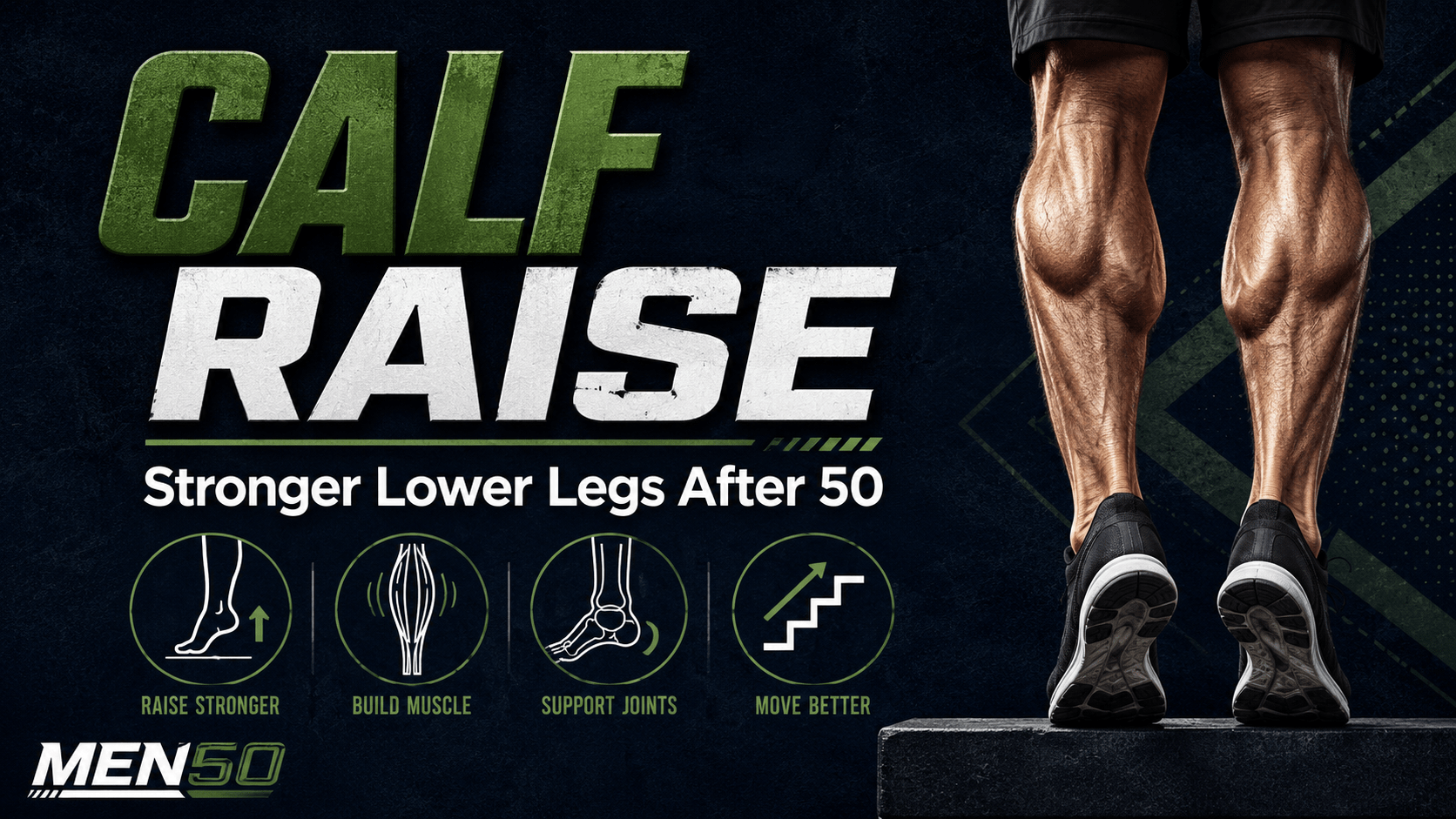
The calf raise is one of the simplest yet most underrated exercises a man over 50 can do. It builds lower leg strength, improves ankle stability, supports the Achilles tendon, and helps the calf muscles do their secondary job — pumping blood back up the legs. It needs no equipment, takes five minutes, and can be done while waiting for the kettle to boil.
Part of the Build Muscle After 50 pillar — strength training for men over 50.
Key Takeaways
- The calf muscles act as a “second heart” — pumping blood from the lower legs back toward the heart with each contraction.
- The lowering phase is where most of the strengthening happens. Aim for a slow 2–3 second descent on every rep.
- Programming: 2–4 sets of 10–20 reps, 3–4 days per week. Light support (chair or wall) is for balance, not weight-bearing.
- Heavy slow eccentric calf raises are the standard physio protocol for Achilles tendinopathy — but start flat-ground, not on a step.
- Progress in this order: flat ground → step (greater range) → single-leg → paused reps → weighted.
How to Perform the Calf Raise
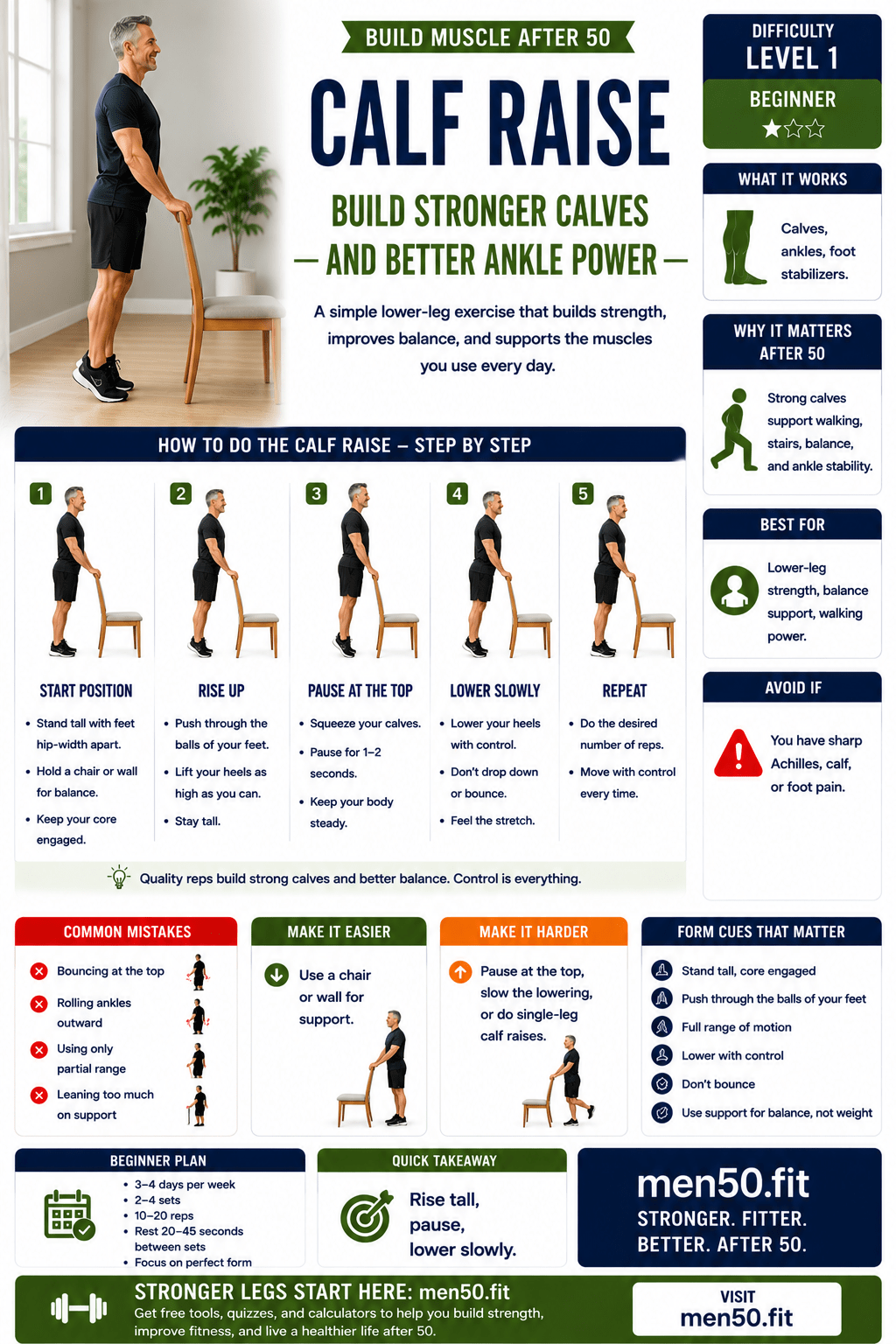
- Start position. Stand tall with feet hip-width apart, toes pointing forward. Hold a chair back or wall lightly with one hand — for balance, not to take your bodyweight. Core engaged, knees straight but not locked.
- Rise up. Push through the balls of your feet and lift your heels as high as you can. Stay tall — don’t lean forward into the support.
- Pause at the top. Hold for 1–2 seconds and squeeze the calves. This is where you actually build the muscle.
- Lower slowly. Take 2–3 seconds to lower the heels back to the floor. Don’t drop down or bounce. Feel a gentle stretch through the calf at the bottom.
- Repeat. Complete your reps with the same controlled tempo throughout. If the last 3–4 reps look different from the first, the set is too long.
Quality reps build strong calves and better balance. Control is everything. Five clean reps build more strength than fifteen bouncing ones.
Why the Calf Raise Matters After 50
The calf muscles — the gastrocnemius and soleus — do more than push you off the floor when you walk. They function as a peripheral muscle pump, contracting against the deep veins of the lower leg to push blood back up toward the heart. This is why long flights and long sitting sessions cause swollen ankles: the calves stop pumping, blood pools in the lower legs. Stronger, more active calves move blood better, which is one of several reasons why men with stronger lower bodies tend to maintain better circulation as they age.
The calves also load the Achilles tendon directly. The Achilles is one of the most common sites of overuse injury in men over 50, particularly in those who increased activity after a sedentary stretch (returning to running, taking up tennis, getting a dog that needs walking twice a day). Heavy slow eccentric calf raises — long descents under load — are the standard physiotherapy treatment for chronic Achilles tendinopathy. The protocol was first published by Alfredson and colleagues in 1998 and has been validated repeatedly since. The same movement pattern, done preventively at moderate load, helps the tendon stay resilient before problems start.
Strong calves also reduce ankle sprain risk, improve push-off power during walking, and contribute meaningfully to stair-climbing endurance — all things that quietly decline after 50 if you don’t train for them.
Sets and Reps
Build the calves like any other muscle: consistent volume, progressive overload, controlled tempo.
| Stage | Variation | Sets × Reps | Frequency | Load |
|---|---|---|---|---|
| Beginner | Both legs, flat ground | 2–3 × 10–15 | 3× per week | Bodyweight, chair for balance |
| Novice | Both legs, flat ground, 2–3 second lowering | 3 × 12–20 | 3–4× per week | Bodyweight |
| Intermediate | Both legs on a step (greater range) | 3 × 12–20 | 3–4× per week | Bodyweight |
| Advanced | Single-leg, on a step | 3 × 10–15 per leg | 3–4× per week | Bodyweight, then light dumbbell |
Rest 20–45 seconds between sets. The calves recover faster than larger muscles, which is why calf raises tolerate higher frequency than most exercises.
Common Mistakes
The four errors that turn a great exercise into a wasted one:
- Bouncing at the top. Using the springiness of the Achilles to bounce up and down trains nothing and stresses the tendon. Pause at the top, lower slowly, full reset at the bottom.
- Rolling the ankles outward. Some men shift their weight onto the outside edges of their feet as they rise. This recruits the wrong muscles and stresses the ankle. Push straight up through the balls of the feet with the big toe pressing down lightly.
- Using only partial range. Half a calf raise builds half a calf. Rise as high as you can, lower as far as you safely can. Range of motion drives the strengthening response.
- Leaning on the support. A wall or chair is for balance, not to take your bodyweight. If you need to lean on it to complete the rep, the version you’re doing is too hard — drop to fewer reps or wait until you’re stronger.
Make It Easier or Harder
If standing calf raises feel unstable, use a chair or wall for two-hand support and reduce the range until your ankles feel solid. This is the right starting point for most men who haven’t trained their lower legs in a while.
To progress past basic calf raises, in order: add a 2-second pause at the top of each rep, then slow the lowering to 3–4 seconds, then move to a step (toes on edge, heels free to drop below) for greater range, then progress to single-leg calf raises. Only add dumbbells (held at your sides) once you can do 15+ clean single-leg reps per leg.
Safety Note
If you have an existing Achilles tendinopathy, start on flat ground only and avoid the step variation until the tendon can tolerate progressive load. The Alfredson protocol exists for a reason — it works — but it’s intended to be supervised by a physio who can adjust load and progression based on response. Self-prescribing heavy step-based eccentric work on an already-irritated Achilles can make things worse before they get better.
Avoid bouncing at any phase of the movement — control the descent every single rep. If you experience calf cramping, check your hydration, electrolytes, and reduce reps per set until the cramps stop. If you feel sharp pain in the Achilles, foot arch, or calf muscle, stop and assess.
Build Your Personal Training Plan
The calf raise is one piece of a complete lower-body programme. Get a personalised exercise plan based on your current strength, goals, and any limitations.
Take the Free Fitness Profiler →
FAQs
How many calf raises should I do per day?
The calves can be trained 3–4 days per week without overdoing it. A reasonable daily-ish target is 2–4 sets of 10–20 reps with a controlled tempo. Daily calf raises (lower volume — say 2 sets of 15) are also fine and a good habit to attach to a routine like brushing your teeth.
Why do my calves cramp during calf raises?
Three common causes: dehydration, low sodium or magnesium, or doing too many reps before your calves are conditioned for the volume. Drink water through the day, eat enough sodium and potassium (don’t fear salt with regular meals), and back off to 2 sets of 10 reps for a week before building back up. Persistent cramping with no obvious cause is worth mentioning to your doctor.
Are calf raises good for Achilles tendinitis?
Yes — heavy slow eccentric calf raises are the standard physio treatment for chronic Achilles tendinopathy. The key word is slow. Long 3–4 second lowering phases under load are what rebuild tendon tissue. But during an acute flare-up, when the tendon is hot and painful, start with flat-ground bodyweight calf raises only and get a physio’s guidance before adding load or moving to step variations.
Should I do calf raises on a step or flat ground?
Flat ground for beginners and anyone with an irritable Achilles. The step version gives more range of motion and a deeper stretch at the bottom, which makes it more effective for advanced lifters and for the Alfredson protocol. Most men benefit from spending 4–6 weeks on flat ground before progressing to the step version.
Can calf raises help with balance?
Yes — particularly the single-leg version. Strong calves and ankles are foundational to balance because they make the constant small corrections that keep you upright on uneven ground. Pair calf raises with the Single-Leg Stand for a complete lower-leg stability routine.
References
- Alfredson H, Pietilä T, Jonsson P, Lorentzon R. Heavy-load eccentric calf muscle training for the treatment of chronic Achilles tendinosis. American Journal of Sports Medicine. 1998;26(3):360-366.
- National Institute on Aging. Exercise & Physical Activity: Your Everyday Guide. nia.nih.gov
- American College of Sports Medicine. Resistance Training for Older Adults Position Stand. acsm.org
Disclaimer: This article is for educational purposes only and is not medical advice. Consult a qualified healthcare professional before starting any new exercise programme, especially if you have existing Achilles, calf, foot, or balance conditions.