
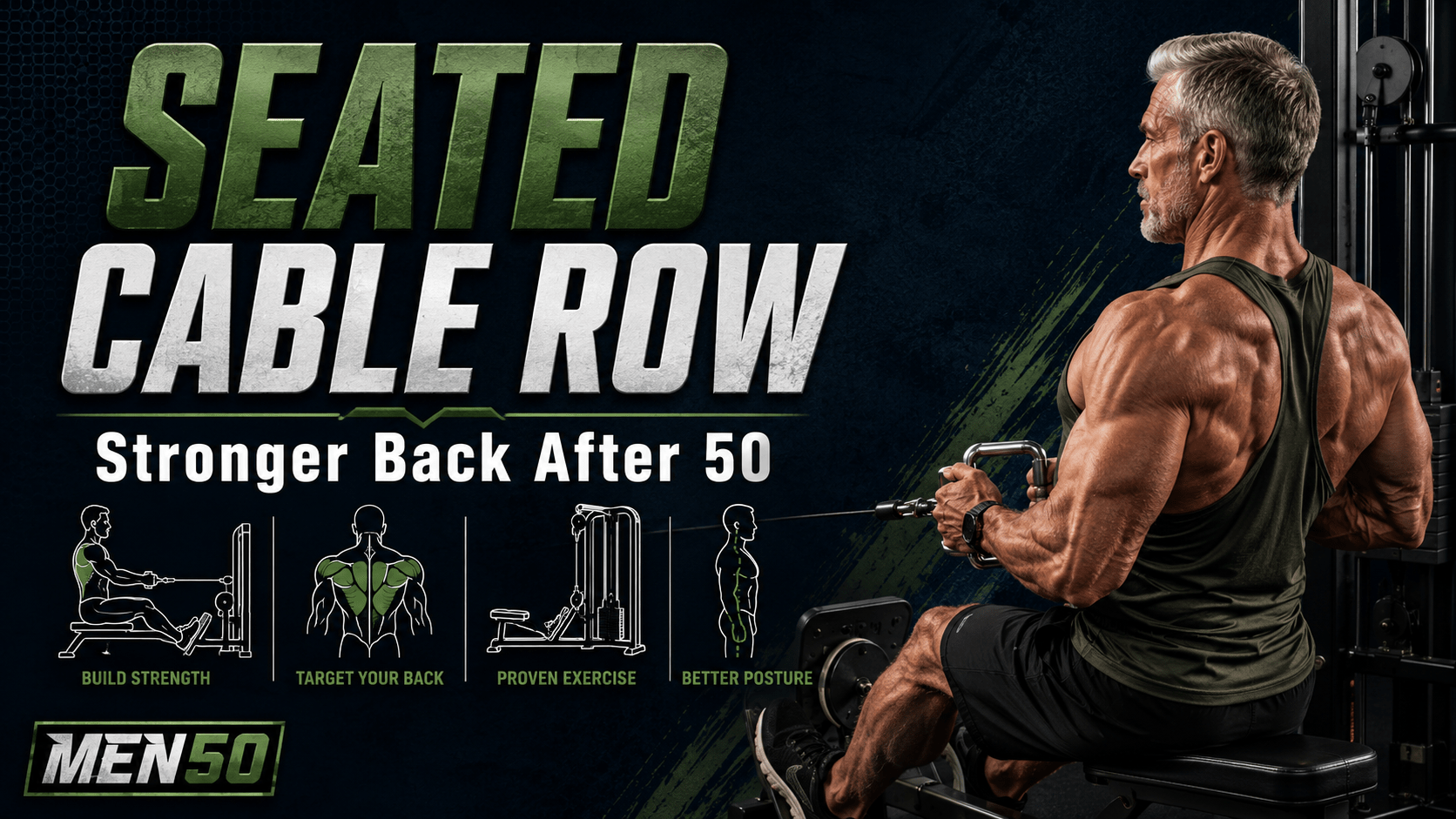
The seated cable row is the gym-machine version of horizontal pulling — and for many men over 50, it’s the best back exercise in any gym. The seated position with foot platform support takes the lower-back bracing demand almost entirely out of the equation, which means you can focus all your energy on the lats, upper back, and rear shoulders. The cable provides constant tension throughout the rep — no dead spots like dumbbells, no variable resistance like bands. And the weight stack allows precise progressive overload that’s harder to achieve with bodyweight or band-based pulling. For men over 50 with gym access, this exercise belongs in the rotation.
Part of the Build Muscle After 50 pillar — strength training for men over 50.
Key Takeaways
- The seated cable row trains the same muscles as the dumbbell row variations (lats, rhomboids, traps, rear delts, biceps, core) — but with lower-back support and constant cable tension.
- The seated position with foot platform support makes it back-friendly — better tolerated by men with lower-back history than bent-over variations.
- Programming: 2–4 sets of 8–12 reps, 2–3 times per week. Rest 60–90 seconds between sets.
- Pull with your back, not your arms. Squeeze your shoulder blades and control every rep for the best results.
- This is the horizontal pulling counterpart to the lat pulldown (vertical pulling). Most men over 50 with gym access should do both.
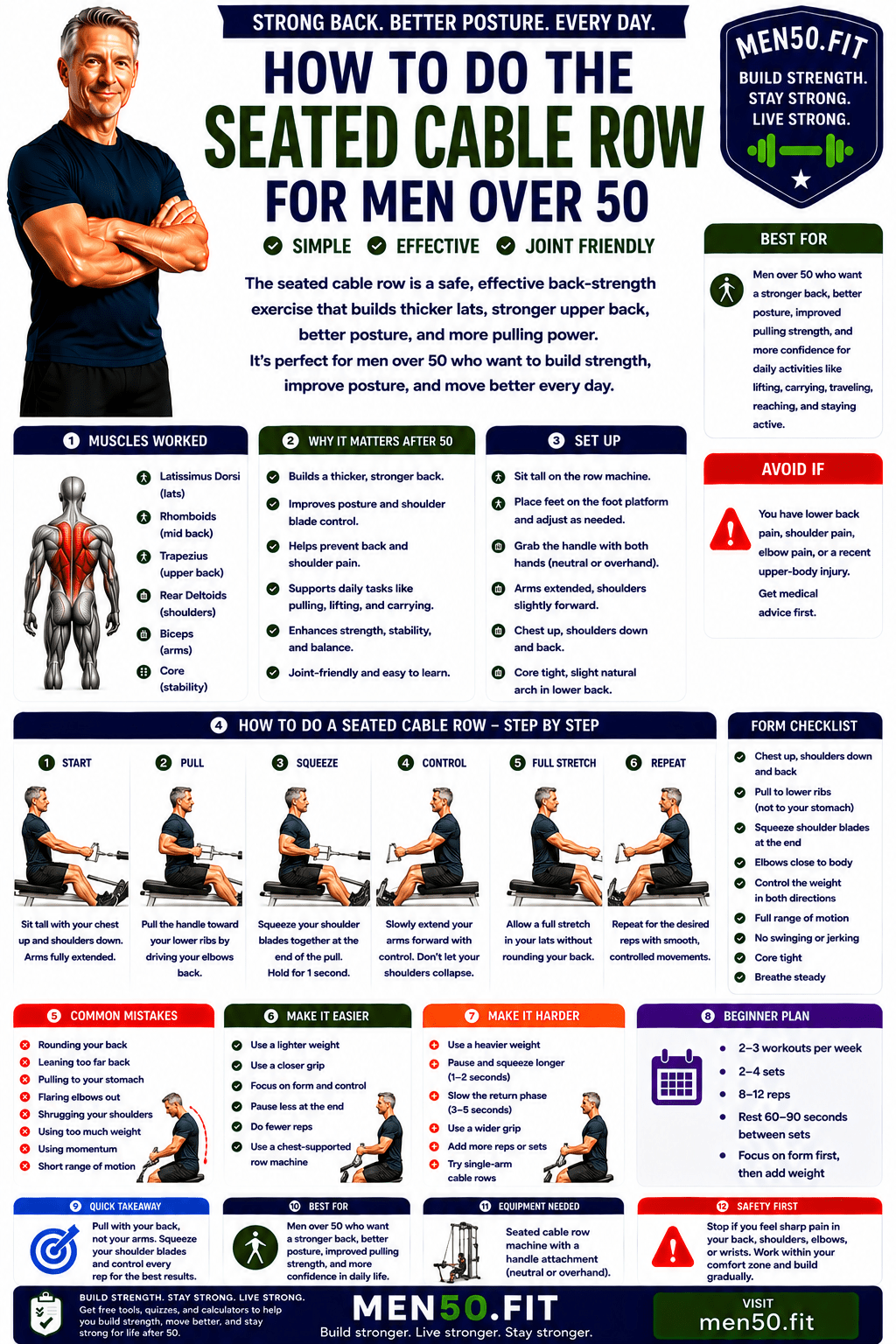
How to Perform the Seated Cable Row
Set up first:
- Sit tall on the cable row machine.
- Place feet on the foot platform and adjust position so your knees are slightly bent at the bottom of the rep (arms fully extended).
- Grab the handle with both hands — neutral grip (palms facing each other, V-handle attachment) is most common and shoulder-friendly. Overhand grip is also valid.
- Arms extended, shoulders slightly forward (the bottom of the stretch).
- Sit tall: chest up, shoulders down and back, slight natural arch in lower back.
- Core engaged.
Then the movement:
- Start. Sit tall with chest up and shoulders down. Arms fully extended in front of you holding the handle.
- Pull. Pull the handle toward your lower ribs (not your stomach, not your chest) by driving your elbows back. Lead with the elbows, not the hands. Take 1–2 seconds to pull.
- Squeeze. Squeeze your shoulder blades together at the end of the pull. Hold for 1 second. Feel the upper back and lats actively work.
- Control. Slowly extend your arms forward with control. Take 2–3 seconds on the return. Don’t let your shoulders collapse forward as the handle returns — the shoulders stay back through most of the return, then a controlled forward stretch happens at the very end.
- Full stretch. Allow a full stretch in your lats without rounding your back. The shoulders go slightly forward into the lat stretch position; the lower back stays neutral.
- Repeat. Smooth, controlled movements throughout. Maintain seated position with a flat back on every rep.
The cue that matters most: pull to your lower ribs, with elbows leading the movement. Pulling to the stomach is too low and rounds the shoulders forward. Pulling to the chest is too high and shifts work to the upper traps. Lower ribs is the sweet spot — the position where the lats and rhomboids do the work cleanly.
Why the Seated Cable Row Matters After 50
The back is one of the most under-trained muscle groups in men over 50, and the consequences — rounded shoulders, weak pulling capacity, increased shoulder injury risk, chronic upper-back tightness — affect daily life and longevity. Czech physiotherapist Vladimir Janda’s upper crossed syndrome describes the pattern: tight chest, weak upper back, weak rear shoulders, weak external rotators. Back training is the strength-building half of fixing it (the doorway chest stretch is the lengthening half).
The seated cable row trains the entire back posterior chain efficiently:
| Muscle | Role |
|---|---|
| Latissimus dorsi (lats) | Primary mover — pulls the upper arm backward |
| Rhomboids | Pull the shoulder blades together — postural correction |
| Trapezius (mid + lower) | Stabilise the shoulder blades during pulling |
| Rear deltoids | Shoulder extension, balancing front delt dominance |
| Biceps | Assists by bending the elbow (secondary) |
| Core | Resists rotation and forward bending during the pull |
Why the Seated Cable Row Specifically
The seated cable row solves problems other rowing variations have:
1. Lower-back support. Unlike the bent-over dumbbell row — which requires holding a hinged position throughout each set — the seated cable row puts you in a supported position with feet braced against the platform. The lower back stays in a relatively neutral, supported position rather than bearing sustained hinged load. For men over 50 with any lower-back history, this is significantly more sustainable.
2. Constant tension. Cable resistance doesn’t vary throughout the rep the way dumbbell rows do (where gravity changes the lever arm). The lats are under tension throughout the entire range of motion — no dead spots, no easy phases. This is why many lifters feel cable rows produce more lat “burn” than equivalent dumbbell work even at lower loads.
3. Precise progressive overload. The weight stack allows precise small increments (typically 5–10 lbs at a time). Compare to dumbbells, where you often have to jump 5 lbs per hand (10 lbs total per rep) at a time — which is often too much progress for the back muscles. The cable machine lets you progress in smaller steps that the back can actually absorb.
4. Heavier loading possible. Most men over 50 can load the seated cable row heavier than any dumbbell row variation. The supported position, constant tension, and bilateral grip combine to allow significant progressive overload over months — which is essential for actual strength building rather than just maintenance.
The Horizontal Pulling Matrix — Now Complete
This article completes the five-piece horizontal pulling cluster at every equipment level:
| Exercise | Setup | Best For |
|---|---|---|
| Bent-Over Dumbbell Row | Standing, hinged, both arms | Compound back work, full-body bracing |
| One-Arm Dumbbell Row | Knee on bench, single arm | Asymmetry correction, heavier per-arm loading |
| Chest-Supported Dumbbell Row | Chest on incline bench, both arms | Back-friendly, ego-free form |
| Resistance Band Row | Standing or seated, band | Home/travel, no dumbbells |
| Seated Cable Row (this article) | Seated, cable machine | Back-friendly heavy loading, gym option |
Combined with the vertical pulling matrix (lat pulldown, band lat pulldown) and the postural cluster (band pull-apart, band face pull, reverse fly, scaption raise), the back/shoulder posture training in the matrix is now the most comprehensive in any fitness content for men over 50.
Sets and Reps
Progressive loading is the goal. The seated cable row tolerates this particularly well because the machine controls the resistance precisely.
| Stage | Sets × Reps | Frequency | Load Guide |
|---|---|---|---|
| Beginner | 2 × 8–10 | 2× per week | Light (40–60 lbs / 18–27 kg) |
| Novice | 2–3 × 8–12 | 2–3× per week | Working (60–90 lbs / 27–41 kg) |
| Intermediate | 3 × 8–12 | 2–3× per week | Moderate (90–130 lbs / 41–59 kg) |
| Advanced | 3–4 × 8–12 | 2–3× per week | Moderate-heavy + pause + slow return |
Rest 60–90 seconds between sets. Pick a weight where the last 2–3 reps feel clearly challenging but you can complete them with: back flat, no rounding, no excessive lean, elbows leading, full range of motion.
A practical note on load: most men over 50 progress significantly over 6–12 months. A starting load of 60 lbs often becomes 100+ lbs within a year of consistent training. The machine’s precise resistance control makes this progression visible and motivating. Don’t try to match other gym-goers — pick the load that lets you complete the rep range with clean form, and progress from there.
Common Mistakes
The eight errors that turn a great back exercise into a back or shoulder problem:
- Rounding your back. The single most dangerous mistake. As the handle returns to the start position, the lower back wants to round forward to stretch into the lats. Keep the lower back relatively neutral — chest up, slight arch maintained. The lat stretch comes from the shoulders moving forward, not from the spine flexing.
- Leaning too far back. Some backward lean during the pull is natural (5–10 degrees from vertical), but extreme lean turns the row into a different exercise that uses momentum. Stay relatively upright — torso at about 80–90 degrees from horizontal throughout.
- Pulling to your stomach. Pulling too low rounds the shoulders forward and shifts work away from the lats. Pull to the lower ribs, not the stomach.
- Flaring elbows out. If the elbows drift out to 90 degrees from the body, work shifts to the rear delts and upper traps instead of the lats. Keep elbows close to the body, driving back and slightly downward.
- Shrugging your shoulders. As you pull, the upper traps want to hike the shoulders toward the ears. This recruits the wrong muscles. Pin shoulders down and back before each pull.
- Using too much weight. Heavy weight forces compensation — body swing, momentum, half reps, shoulder shrug. Drop a size if form breaks down.
- Using momentum. Rocking back and forth to launch the weight uses elastic recoil and torso movement instead of back strength. Stay still in the torso; the arms do the work.
- Short range of motion. Not fully extending the arms at the front skips the lat stretch. Not pulling the handle all the way to the lower ribs skips the squeeze. Full range every rep.
Make It Easier or Harder
If standard seated cable rows are too challenging:
- Use a lighter weight — 30–50 lbs (14–23 kg) is fine for beginners.
- Use a closer grip — narrower hand position reduces shoulder demand.
- Focus on form and control — clean reps with lighter weight train the pattern.
- Pause less at the end — reduces the total time under tension per rep.
- Do fewer reps — start with 2 sets of 6–8 and build up.
- Use a chest-supported row machine if your gym has one — same fundamental movement with even more lower-back support.
To make it harder once form is solid:
- Use a heavier weight — but only when the lighter weight feels easy with clean form. The cable row tolerates progressive overload well over months.
- Pause and squeeze longer at the end of the pull — 2–3 seconds with shoulder blades squeezed.
- Slow the return phase to 3–5 seconds per rep — significantly more demanding.
- Use a wider grip — wider hand position increases upper-back and rear-delt emphasis (use a straight bar attachment).
- Add more reps or sets — extend to 12–15 reps before adding weight.
- Try single-arm cable rows with a D-handle attachment — exposes left-right asymmetry, similar to the one-arm dumbbell row.
For variety, try the wide-grip seated cable row (with a straight bar attachment, hands wider than shoulder-width) once a week — emphasises the upper back and rear delts more than the standard neutral-grip version.
Safety Note
Avoid the seated cable row if you have lower back pain, shoulder pain, elbow pain, or a recent upper-body injury. Get medical advice first.
Lower back pain during this exercise usually means the back is rounding at the end of the return phase, or the body is leaning forward too far during the return. Keep the back neutral and let the shoulders move forward into the stretch (not the spine flexing). If pain persists, drop back to the chest-supported row for back work instead.
Shoulder pain during the pull is usually caused by the elbows flaring out at 90 degrees (compromising shoulder position) or the shoulders shrugging up. Correct elbow path (elbows close to body) and shoulder position (pinned down and back) before continuing.
Wrist pain can occur with the overhand grip. Solutions: switch to neutral grip (V-handle), use lifting straps if grip strength is the limiting factor, or check that wrists stay neutral throughout the rep (not bending under load).
Knee pain can occur if the feet aren’t braced correctly on the foot platform. Adjust your foot position so the knees are slightly bent at the bottom of the rep — neither locked straight nor bent at extreme angles.
Don’t release the handle suddenly at the end of a set. Control the return all the way back to the rack position — many gym injuries happen when men let the cable snap back to the start.
If you feel sharp pain anywhere during the rep, stop. Mild muscular fatigue in the back is normal; sharp joint pain is not.
Build Your Personal Training Plan
The seated cable row is one piece of a complete upper body programme. Get a personalised exercise plan based on your current strength, goals, and any limitations.
Take the Free Fitness Profiler →
FAQs
Seated cable row vs dumbbell rows — which is better?
For most men over 50 with gym access, the seated cable row has three real advantages over dumbbell variations: constant tension throughout the rep, lower-back support (the seat and foot platform), and precise progressive overload (small weight stack increments). The bent-over dumbbell row requires sustained lower-back bracing through every set, which can become the limiting factor for men with back history. The one-arm dumbbell row is great for asymmetry correction but loads only one side per set. Most men over 50 benefit from rotating among them — cable rows for heavier loading and back-friendly work, dumbbell rows for variety and home compatibility. Neither is “better” — they’re complementary at different stages of a programme.
What grip should I use (neutral, overhand, close, wide)?
For most men over 50, the neutral grip (V-handle, palms facing each other) is the default — most shoulder-friendly, most balanced muscle recruitment, easiest on the wrists and elbows. The overhand grip (straight bar, palms down) shifts slightly more emphasis to the upper back and rear delts. Close-grip (hands together) emphasises the lower lats. Wide-grip (hands wider than shoulders) emphasises the upper back. Rotate grips across different sessions for comprehensive development — the neutral grip 2x per week, the overhand or wide grip occasionally for variety. If you only do one grip, make it the neutral grip.
Pull to my stomach or my ribs?
Pull to your lower ribs. Pulling to the stomach is too low — it rounds the shoulders forward and shifts work away from the lats and upper back. Pulling to the chest is too high — it recruits the upper traps and front delts inappropriately. Lower ribs is the sweet spot where the lats and rhomboids do the work cleanly. A practical reference: the handle should end up about 1–2 inches below the bottom of your sternum (breastbone) at the peak of the pull.
Should I lean back during the rep?
Slight lean is normal; excessive lean is wrong. Some backward movement during the pull (5–10 degrees from vertical) happens naturally and isn’t a problem. But significant leaning — using torso swing to generate momentum — turns the cable row into a different exercise that uses body weight more than back strength. Stay relatively upright throughout the pull, with the back doing the work. If you find yourself leaning back significantly to complete reps, the weight is too heavy.
How heavy should the weight be?
Heavy enough that the last 2–3 reps feel clearly challenging, but light enough that you can complete the set with: back relatively neutral (no excessive lean), elbows close to the body, full range of motion, no body swing. For most men over 50 starting out, 40–60 lbs (18–27 kg) on the weight stack. After 3–6 months of training, many progress to 60–100 lbs (27–45 kg). Advanced lifters often work in the 100–130 lb (45–59 kg) range. The cable row tolerates significant progressive overload over years — most men over 50 progress meaningfully if they’re consistent. Don’t try to match other gym-goers’ weights; pick the load that lets you complete the rep range with clean form.
References
- Janda V. Muscles, Central Nervous Motor Regulation and Back Problems. In: Korr IM (ed). The Neurobiologic Mechanisms in Manipulative Therapy. Plenum Press; 1978. (Upper Crossed Syndrome framework.)
- Kibler WB, Sciascia A. Current concepts: scapular dyskinesis. British Journal of Sports Medicine. 2010;44(5):300-305.
- American College of Sports Medicine. Resistance Training for Older Adults Position Stand. acsm.org
Disclaimer: This article is for educational purposes only and is not medical advice. Consult a qualified healthcare professional before starting any new exercise programme, especially if you have existing back, shoulder, or elbow conditions.