
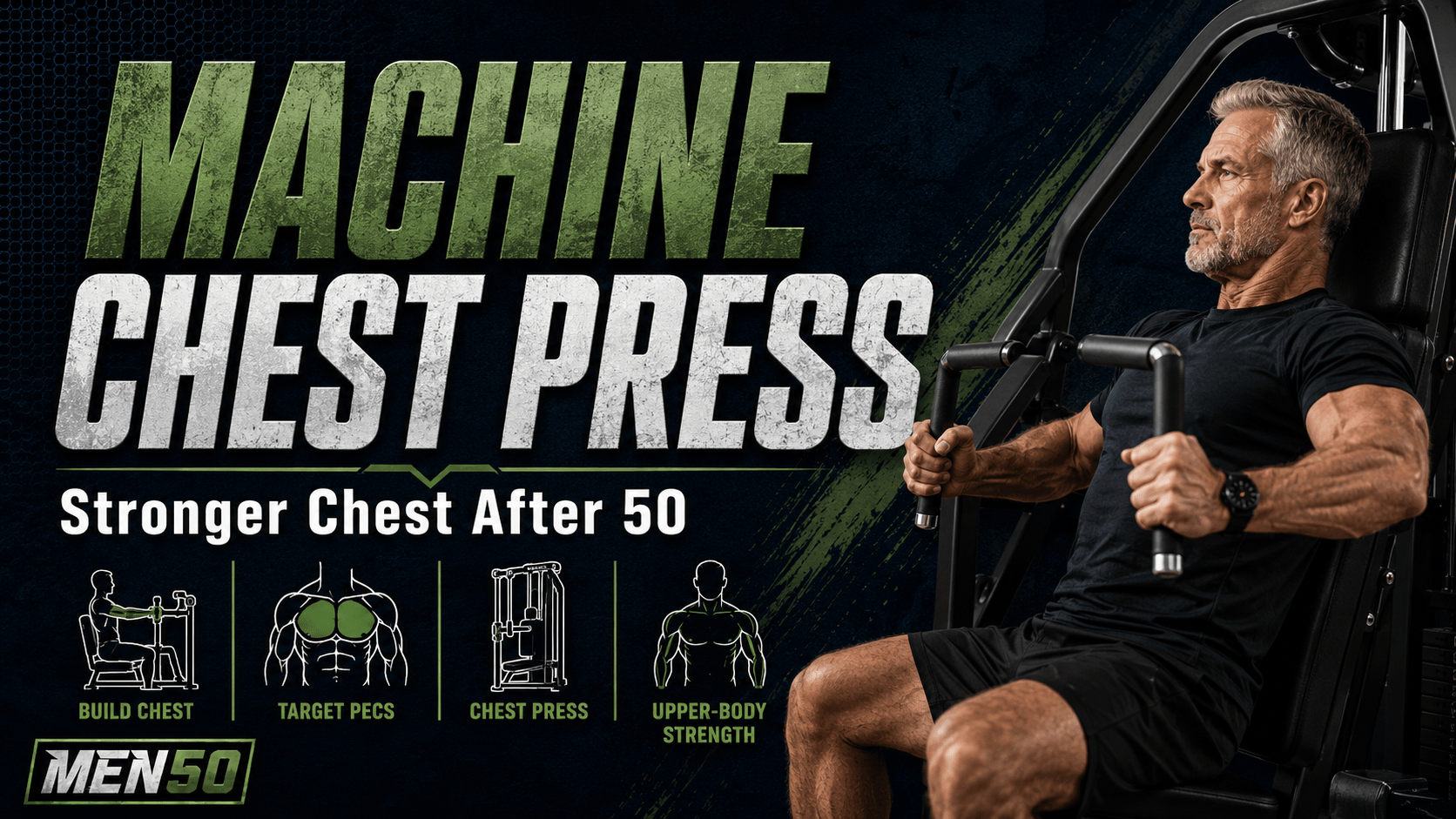
The machine chest press is one of the most under-appreciated exercises for men over 50. The machine industry has spent decades being dismissed by serious lifters in favour of free weights — but for the men-over-50 demographic specifically, the machine chest press has real advantages: a guided movement path that doesn’t require shoulder stabilisation, precise progressive overload via the weight stack, built-in back support, and a fixed elbow position that keeps shoulders in their safest range. For men over 50 with any shoulder history — and that’s a lot of men — the machine chest press is often the safer chest exercise than the alternatives.
Part of the Build Muscle After 50 pillar — strength training for men over 50.
Key Takeaways
- The machine chest press trains the same muscles as the floor push-up, dumbbell floor press, and resistance band chest press — but with a guided movement path and back support.
- The machine’s fixed movement plane is joint-friendlier than free weights for many men over 50 because the rotator cuff doesn’t have to stabilise the weight.
- Programming: 2–4 sets of 8–12 reps, 2–3 times per week. Rest 60–90 seconds between sets.
- Press forward, not upward. Keep elbows slightly below shoulder height. Don’t lock out at the top. These three cues prevent the most common machine chest press problems.
- This is the gym-machine version of horizontal pressing — completing the comprehensive pressing matrix at every equipment level.
How to Perform the Machine Chest Press
Set up first:
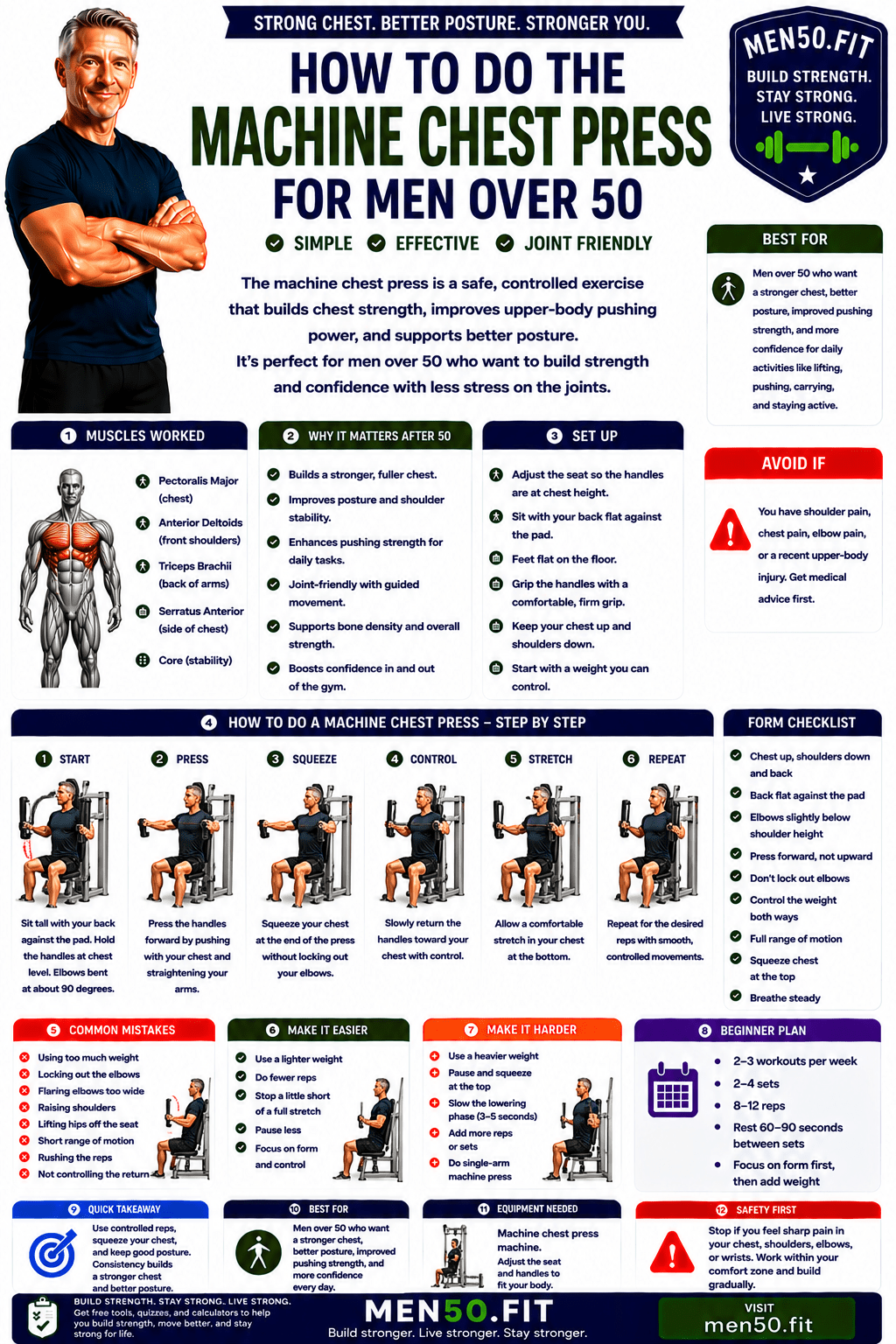
- Adjust the seat so the handles are at chest height — not above your shoulders, not at your stomach. The handles should be roughly level with your sternum (breastbone).
- Sit with your back flat against the pad — chest up, shoulders down and back, slight natural arch in the lower back.
- Feet flat on the floor (or on the foot platform if the machine has one). Knees roughly at 90 degrees.
- Grip the handles with a comfortable firm grip — wrist neutral, in line with the forearm.
- Start with a weight you can control.
Then the movement:
- Start. Sit tall with back against the pad. Hold the handles at chest level. Elbows bent at about 90 degrees, slightly below shoulder height.
- Press. Press the handles forward by pushing with your chest and straightening your arms. Take 1–2 seconds to press. Press forward, not upward. The handles travel horizontally away from your chest.
- Squeeze. Squeeze your chest at the end of the press without locking out your elbows. Keep a slight elbow bend at the top — locking out shifts work to the elbow joint and reduces chest engagement.
- Control. Slowly return the handles toward your chest with control. Take 2–3 seconds on the return. Don’t let the weight stack slam back — control every rep.
- Stretch. Allow a comfortable stretch in your chest at the bottom. Don’t go beyond comfortable — if the stretch feels uncomfortable in the front of your shoulder, you’ve gone too far.
- Repeat. Smooth, controlled movements throughout. Maintain seated position with back flat against the pad.
The cue that matters most: press forward, not upward, with elbows slightly below shoulder height. Most chest press machines are designed with the handles at a slight downward angle — this is the correct path. Pushing upward (toward the ceiling) rather than forward (away from your chest) puts the shoulders in the impingement-prone position that’s the most common cause of chest press shoulder pain. Press the handles toward the wall in front of you, not toward the ceiling.
Why the Machine Chest Press Matters After 50
The chest press is one of the foundational upper-body pushing patterns. Every overhead and forward pushing motion in daily life — pushing a door, lifting a box onto a shelf, getting up from the floor, pushing yourself up from a chair — uses the same coordinated chest-triceps-front-delt pattern that the chest press trains. Chest pressing capacity declines significantly after 50 if not trained directly, and the loss shows up first as these tasks becoming surprisingly hard.
The machine chest press trains this pattern with specific advantages over free-weight alternatives:
1. Guided Movement Path
Free-weight chest exercises (dumbbell floor press, floor push-up, bench press) require the body to control the path of the weight through space. This stabilisation work uses the rotator cuff and front shoulder stabilisers to keep the load on a clean path. For men over 50 with rotator cuff weakness or any shoulder issues, this stabilisation work can become the limiting factor — or worse, it can cause shoulder pain.
The machine chest press eliminates this entirely. The machine’s bar/lever system controls the path; you just produce the pressing force. This means:
- Less rotator cuff demand
- Reduced risk of form breakdown causing injury
- Easier to focus on the working muscles (chest, triceps, front delts)
- More forgiving when you’re tired or distracted
For men over 50 who want to train the chest pattern with less stabilisation demand, the machine version is genuinely the better choice. This isn’t a compromise; it’s a smart match between exercise and population.
2. Precise Progressive Overload
The weight stack allows precise increments — typically 5–10 lbs at a time. Compare to dumbbells (where you often have to jump 5 lbs per hand, meaning 10 lbs total per rep) or push-up progressions (where the jumps between variations are sometimes large). The machine’s small increments let you progress in steps the chest can actually absorb, which means consistent strength gains over months.
3. Back Support
The seat pad eliminates the lower-back demand that bodyweight push-ups create (where the plank position has to be braced through every rep). For men with any back history, this support makes the chest press sustainable in ways push-ups may not be.
4. Elbow-Position Safety
Most modern machine chest presses are designed with the handles at a position that keeps the elbows slightly below shoulder height — which is the safest position for the shoulder joint. This is the same principle as the scaption raise (working in the scapular plane rather than the frontal plane). The machine’s design enforces this position automatically, which means even men with limited shoulder mobility can train the chest safely.
Position in the Pressing Matrix
The machine chest press completes the comprehensive pressing matrix:
| Equipment | Bodyweight | Free Weight | Machine |
|---|---|---|---|
| Horizontal Press | Floor Push-Up + variations | Dumbbell Floor Press | Machine Chest Press (this article) |
| Vertical Press | Pike Push-Up | Dumbbell Shoulder Press | — |
| Chest Isolation | — | Dumbbell Chest Fly on Floor | — |
| Band-based | — | Resistance Band Chest Press | — |
Combined with the gym-machine pulling matrix (lat pulldown, seated cable row), men over 50 with gym access now have a complete machine-based upper body programme available.
Sets and Reps
Progressive loading is the goal. The machine chest press tolerates this particularly well.
| Stage | Sets × Reps | Frequency | Load Guide |
|---|---|---|---|
| Beginner | 2 × 8–10 | 2× per week | Light (30–50 lbs / 14–23 kg) |
| Novice | 2–3 × 8–12 | 2–3× per week | Working (50–80 lbs / 23–36 kg) |
| Intermediate | 3 × 8–12 | 2–3× per week | Moderate (80–120 lbs / 36–54 kg) |
| Advanced | 3–4 × 8–12 | 2–3× per week | Moderate-heavy + pause at top + slow return |
Rest 60–90 seconds between sets. Pick a weight where the last 2–3 reps feel clearly challenging but you can complete them with: back flat against the pad, elbows at the right height, no body movement, controlled tempo.
A practical note on load: most men over 50 progress significantly over 6–12 months. A starting load of 50 lbs often becomes 100+ lbs within a year of consistent training. Don’t try to match other gym-goers — pick the load that lets you complete the rep range with clean form and progress from there. Different chest press machines also vary in mechanical advantage; 80 lbs on one machine may feel like 100 lbs on another. Focus on your progress on a specific machine, not absolute weight comparisons.
Common Mistakes
The eight errors that turn a great chest exercise into a shoulder or elbow problem:
- Using too much weight. The most common mistake. Heavy weights force compensation — short range, hip lift, shoulder shrug, locked elbows. Drop a size if form breaks down.
- Locking out the elbows. Fully straightening the elbows at the top shifts load from the chest to the elbow joint and reduces chest engagement. Keep a slight elbow bend throughout — about 5–10 degrees from full extension.
- Flaring elbows too wide. If the elbows are at 90 degrees from your body (the “T-shape” position), the front of the shoulder takes excessive load. Elbows slightly below shoulder height, angled slightly downward from horizontal.
- Raising shoulders. As you press, the upper traps want to hike the shoulders toward the ears. Pin shoulders down and back before each press; keep them there throughout.
- Lifting hips off the seat. When the chest fatigues, the hips want to lift off the seat to recruit more leg drive. This is bench press cheating, and it shouldn’t happen on a machine. Hips stay on the seat for every rep.
- Short range of motion. Stopping the press without fully extending (within the elbow-bend limit) or not returning the handles to the start position skips part of the working range. Full range every rep.
- Rushing the reps. Quick bouncy reps use elastic recoil from the weight stack. Slow, controlled tempo — 1–2 seconds to press, brief pause, 2–3 seconds to return.
- Not controlling the return. Letting the weight stack snap back to the start position skips the eccentric phase, which is where significant strength gets built. Control the return on every rep.
Make It Easier or Harder
If standard machine chest presses are too challenging:
- Use a lighter weight — 20–30 lbs (9–14 kg) is fine for beginners.
- Do fewer reps — start with 2 sets of 6–8 and build up.
- Stop a little short of full stretch at the bottom — partial range while you build shoulder mobility.
- Pause less — reduces total time under tension per rep.
- Focus on form and control — clean reps with light weight train the pattern.
To make it harder once form is solid:
- Use a heavier weight — but only when the lighter weight feels easy with clean form.
- Pause and squeeze at the top for 1–2 seconds with chest contracted (no elbow lockout).
- Slow the lowering phase to 3–5 seconds per rep — significantly more demanding than it sounds.
- Add more reps or sets — extend to 12–15 reps before adding load.
- Do single-arm machine press — one handle at a time, exposes left-right asymmetry, adds anti-rotation core demand.
For variety, try the decline machine chest press (if your gym has one) once a week — emphasises the lower chest. Some men over 50 find the decline version more shoulder-friendly than the standard position.
Safety Note
Avoid the machine chest press if you have shoulder pain, chest pain, elbow pain, or a recent upper-body injury. Get medical advice first.
Shoulder pain during the press is usually caused by one of three things: (1) Elbows flared too wide (the “T-shape” position) — adjust the elbow angle. (2) Seat too low, putting handles above shoulder height — adjust the seat so handles are at chest level. (3) Locking out the elbows — keep a slight bend at the top. If pain persists with all three corrected, switch to the dumbbell floor press (more shoulder-friendly for many men).
Elbow pain is usually caused by locking out at the top. Keep the elbows slightly bent throughout — this protects the elbow joint from impact loading at full extension.
Lower back pain during the rep usually means the back is arching off the pad — typically when the weight is too heavy and the body recruits leg drive to push. Keep the back flat against the pad throughout; drop the weight if you can’t.
Don’t let the weight stack drop quickly at the end of a set. Control the handles all the way back to the start position — many gym injuries happen when the weight stack snaps back quickly and the body isn’t braced for the impact.
If you feel sharp pain anywhere during the rep, stop. Mild muscular fatigue in the chest is normal; sharp joint pain is not.
Build Your Personal Training Plan
The machine chest press is one piece of a complete upper body programme. Get a personalised exercise plan based on your current strength, goals, and any limitations.
Take the Free Fitness Profiler →
FAQs
Machine chest press vs dumbbell floor press — which is better?
For most men over 50, the answer depends on what you’re optimising for. The machine chest press has advantages: guided movement path (less shoulder stabilisation demand), back support, precise progressive overload, and fixed elbow position. The dumbbell floor press has advantages: trains stabilisation (which has functional carryover), allows independent left-right work, and doesn’t require gym access. For men with shoulder issues or limited mobility, the machine is generally the better choice. For men with healthy shoulders who want functional carryover, the dumbbell floor press is often better. Many men over 50 do both — machine work for primary chest training, dumbbell work for variety and stabilisation training.
Machine chest press vs barbell bench press — should I switch?
This depends on your situation. The barbell bench press is the classic strength-training chest exercise, but it has real risks for men over 50: the bar can come down on the chest if grip fails, the wide grip position can stress the shoulders, and the lying-flat position with heavy load can put the shoulders in vulnerable positions. For most men over 50, the machine chest press is genuinely safer — same fundamental pressing pattern, none of the bar-management risks. If you’ve been bench pressing for years and have no shoulder issues, no need to switch. If you’re starting chest training over 50, or you have any shoulder history, the machine is the better default. The strength carryover from machine to barbell (and vice versa) is significant, so you’re not losing much by choosing the machine.
How heavy should the weight be?
Heavy enough that the last 2–3 reps feel clearly challenging, but light enough that you can complete the set with: back flat against the pad, elbows at the right height, no hip lift, no shoulder shrug, controlled tempo. For most men over 50 starting out, 30–50 lbs (14–23 kg) on the weight stack is the right range. After 3–6 months of training, many progress to 50–80 lbs (23–36 kg). Advanced lifters often work in the 80–120 lb (36–54 kg) range. Don’t compare absolute weights between machines — different machine designs vary significantly in mechanical advantage. Focus on progressing the weight you use on a specific machine over time, not matching what other gym-goers are using.
Why does this hurt my shoulders?
Three most common causes. (1) Seat height wrong — if the handles are above shoulder height, the press becomes an awkward upward pushing motion that loads the front of the shoulder badly. Adjust the seat so handles are at chest level. (2) Elbows flaring too wide — even on a machine, you can let the elbows drift out to 90 degrees, which puts the shoulders in the impingement position. Keep elbows slightly below shoulder height. (3) Locking out the elbows — fully extending shifts load from the chest to the elbow and shoulder joints. Keep a slight elbow bend throughout. If pain persists after fixing these three, the machine may not be the right exercise for you — switch to the dumbbell floor press or resistance band chest press, or get a physiotherapist’s opinion on the shoulder.
Why shouldn’t I lock out my elbows?
Two reasons. (1) Joint protection — fully extending the elbows under load transfers the resistance from the chest muscles to the elbow joint itself. Over time, this contributes to elbow tendinopathy and joint stress, particularly in men over 50 whose tendons are less resilient than younger lifters’. (2) Muscle engagement — when the elbows lock out, the chest stops doing the work because the bones are now bearing the load directly. Keep a slight elbow bend (about 5–10 degrees from full extension) at the top of every rep. This keeps the chest under tension and protects the elbow joint.
References
- American College of Sports Medicine. Resistance Training for Older Adults Position Stand. acsm.org
- National Institute on Aging. Sarcopenia and Muscle Strength in Older Adults. nia.nih.gov
- Yang J, Christophi CA, Farioli A, et al. Association Between Push-up Exercise Capacity and Future Cardiovascular Events Among Active Adult Men. JAMA Network Open. 2019;2(2):e188341.
Disclaimer: This article is for educational purposes only and is not medical advice. Consult a qualified healthcare professional before starting any new exercise programme, especially if you have existing chest, shoulder, or elbow conditions.