
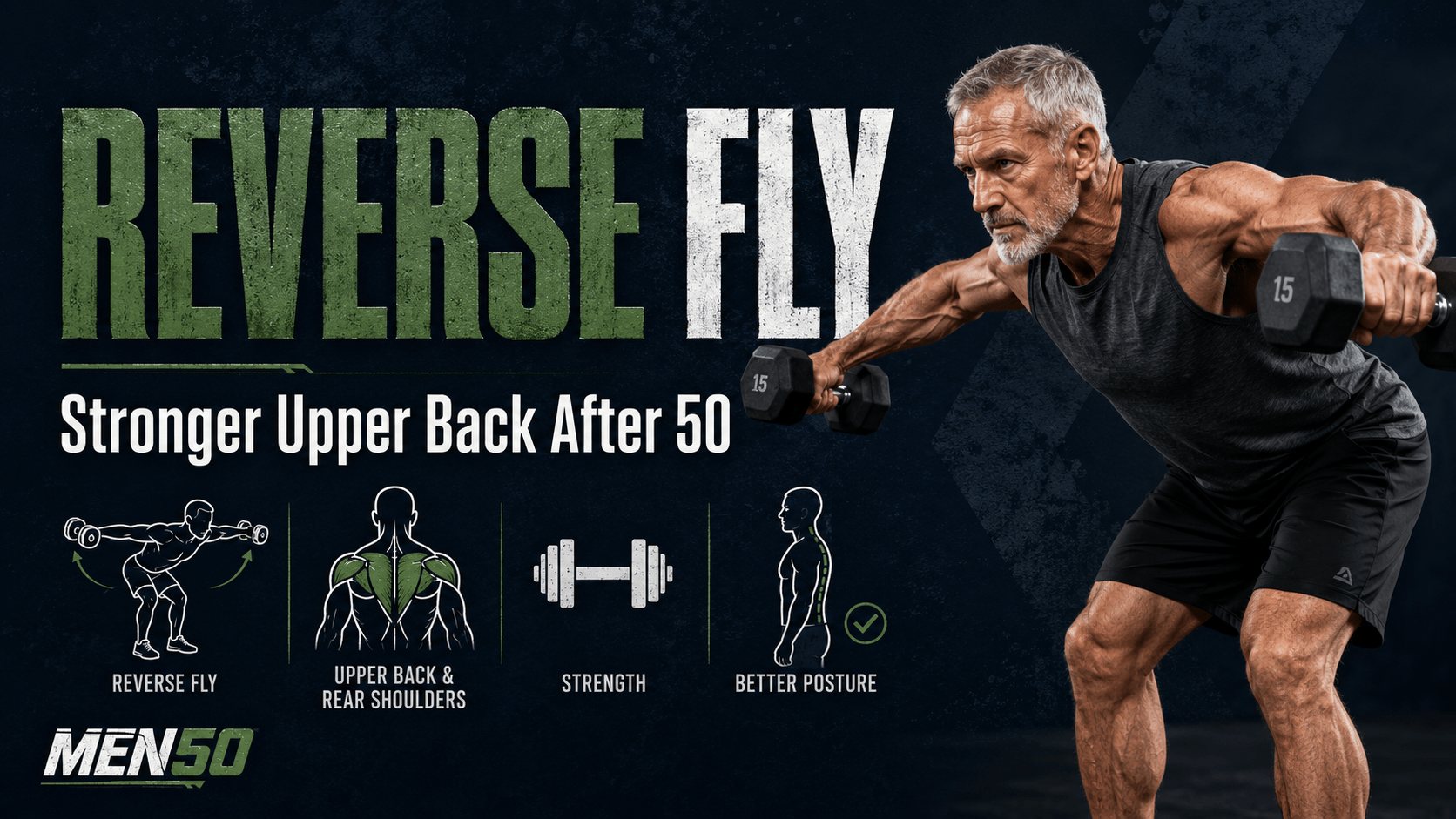
The reverse fly is one of the most efficient single exercises for training the entire posterior upper body — rear shoulders, upper back, and the rotator cuff external rotators that most men over 50 have never directly trained. It uses the same hinged-over position as the rear delt fly (these terms are often used interchangeably) but with a slightly broader emphasis on the full upper-back posterior chain. The exercise also works with dumbbells or resistance bands, which means it slots into either home gym setup. For men dealing with the rounded-shoulder, screen-time posture that defines most of modern life, this is foundational work.
Part of the Build Muscle After 50 pillar — strength training for men over 50.
Key Takeaways
- The reverse fly trains the rear deltoids, rhomboids, mid- and lower traps, infraspinatus and teres minor (rotator cuff), and the spinal erectors that hold the hinge position.
- This is one of the most comprehensive single exercises for Vladimir Janda’s upper crossed syndrome — the rounded-shoulder pattern that develops in men over 50 from sitting.
- Programming: 2–4 sets of 10–15 reps, 2–3 times per week. Rest 45–75 seconds between sets.
- Move with control, squeeze your shoulder blades, and focus on your rear delts and upper back. Strong posture starts with strong muscles.
- Works with both dumbbells and resistance bands — pick whichever you have available.
How to Perform the Reverse Fly
Set up first:
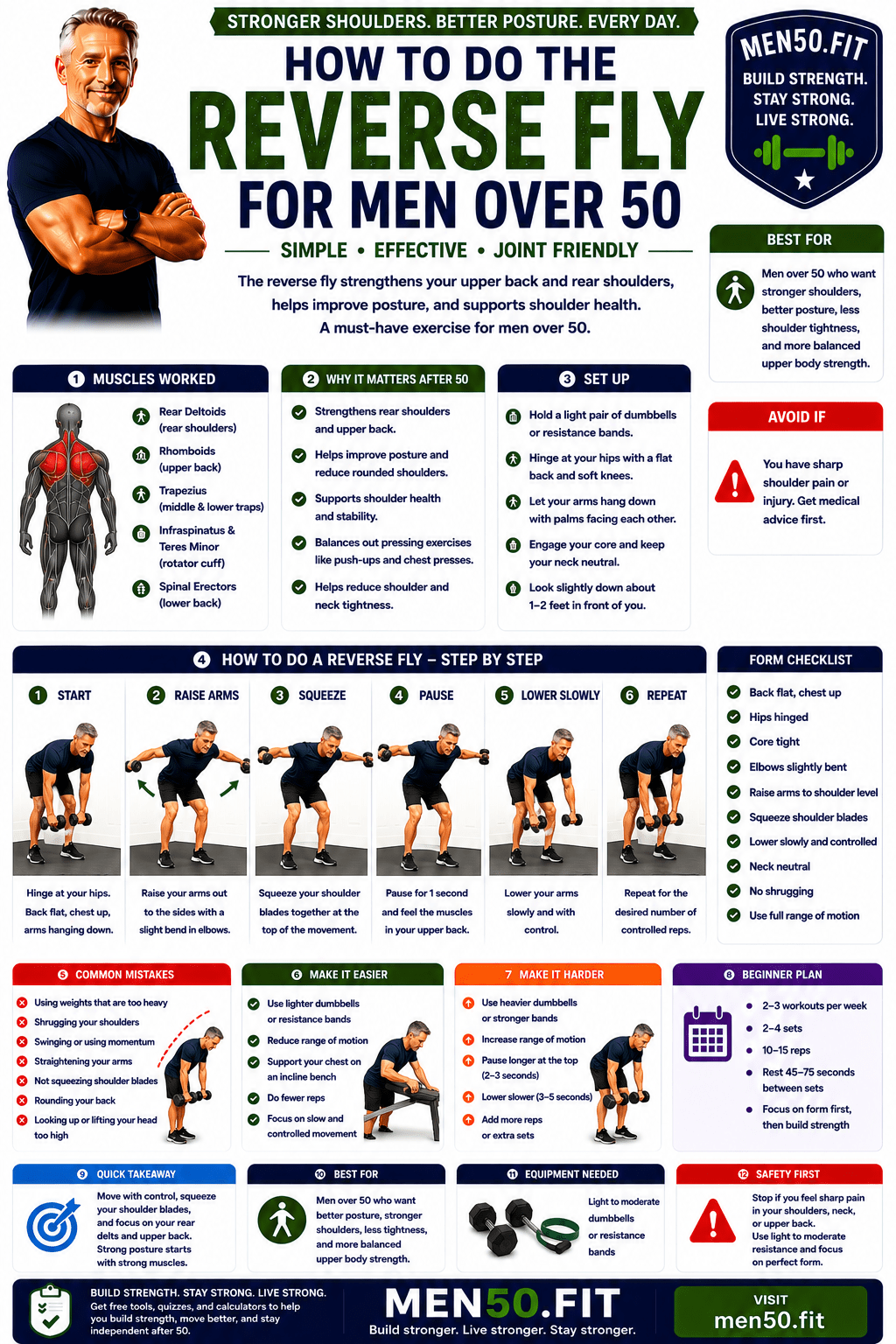
- Hold a light pair of dumbbells (or a resistance band looped under your feet) — palms facing each other.
- Hinge at your hips with a flat back, soft knees (slightly bent).
- Arms hang straight down toward the floor.
- Engage your core, keep your neck neutral.
- Look slightly down — about 1–2 feet in front of you on the floor.
Then the movement:
- Start. Hinged at the hips with back flat, chest up. Dumbbells hang straight down with palms facing each other. Slight bend in the elbows — this bend stays constant throughout.
- Raise arms. Raise your arms out to the sides with the slight bend maintained. Lead with your elbows; the dumbbells just along for the ride. Take 1–2 seconds to lift.
- Squeeze. At the top of the lift — when arms are roughly parallel to the floor at shoulder level — squeeze your shoulder blades together hard. Don’t shrug.
- Pause. Hold for 1 second at the top. Feel the muscles in your upper back actively working. Elbows still high, shoulders down.
- Lower slowly. Lower the dumbbells slowly and with control back to the starting position. Take 2–3 seconds on the way down. Don’t drop the weight.
- Repeat. Maintain clean form on every rep. Smooth, controlled, with the upper back genuinely doing the work.
The cue that matters most: lead with your elbows, not your hands. Same principle as the rear delt fly, band pull-apart, and band face pull. When you focus on elbows lifting outward, the rear delts and upper back do the work; when you focus on hands, the biceps and traps take over.
Why the Reverse Fly Matters After 50
Decades of forward-rounded posture from desk work, driving, and screen time create a predictable pattern in men over 50: tight chest, weak upper back, weak rear shoulders, weak external rotators of the rotator cuff. This is Czech physiotherapist Vladimir Janda’s upper crossed syndrome — the most common postural pattern in men over 50 — and the reverse fly is one of the most efficient single exercises for fixing it.
The exercise trains several muscle groups at once, all of them weak in the typical desk-job man over 50:
Rear deltoids — the back of the shoulder, which compound rowing exercises only train as a secondary muscle.
Rhomboids and mid/lower traps — the muscles between and below the shoulder blades that pull the scapula down and back toward healthy posture. Most men over 50 have weak mid and lower traps because daily life never loads them.
Infraspinatus and teres minor — two small rotator cuff muscles responsible for external rotation of the shoulder. Strong external rotators protect the shoulder joint from impingement and are particularly important for men over 50 who do any pressing work. The reverse fly trains them as a secondary muscle along with the rear delts.
Spinal erectors — the muscles along the spine that hold the hinge position against gravity. Holding the bent-over position itself trains these muscles isometrically through every rep.
The pattern matters because of push-pull balance. For every set of pressing work (floor press, push-ups, shoulder press) men over 50 should do at least an equivalent amount of upper-back pulling work. The reverse fly is one of the most efficient ways to do that. It hits the rear shoulders specifically (which compound rowing exercises miss), strengthens the postural muscles that hold the shoulders back, and trains the rotator cuff externally rotators that protect against shoulder injury.
There’s also a shoulder pain prevention angle. Weak external rotators are a primary contributor to shoulder impingement in men over 50. Pressing exercises (which most men do plenty of) tend to internally rotate the shoulder; without equivalent external rotation work, the imbalance accumulates and contributes to rotator cuff problems. The reverse fly is one of the simplest fixes.
Sets and Reps
This is a postural and corrective exercise — higher rep ranges with lighter weight work better than heavy load.
| Stage | Variation | Sets × Reps | Frequency |
|---|---|---|---|
| Beginner | Very light dumbbells, smaller range | 2 × 10–12 | 2× per week |
| Novice | Light dumbbells, full range | 2–3 × 10–15 | 2–3× per week |
| Intermediate | Light-to-moderate dumbbells, slow tempo | 3 × 12–15 | 2–3× per week |
| Advanced | Moderate dumbbells, pause at top + slow lowering | 3–4 × 10–15 | 2–3× per week |
Rest 45–75 seconds between sets. Pick a weight where the last 2–3 reps feel clearly challenging at clean tempo, with no swinging, rocking, or shrugging.
A practical starting load: most men over 50 should start with 5–10 lb (2–4.5 kg) dumbbells. Some progress to 12–15 lbs (5–7 kg) over months. Going heavier than that almost always means swinging the weight up rather than lifting it cleanly. If you’re using 20 lbs and feel like you’re crushing it, you’re almost certainly using too much body momentum.
Alternative — resistance band reverse fly: stand on the middle of a resistance band, hinge at the hips, hold one end of the band in each hand. Same movement, same muscles, scalable resistance by adjusting where you grip the band (shorter grip = more tension). This is an excellent home option if you don’t have light dumbbells.
Common Mistakes
The seven errors that turn a great posture exercise into a lower-back or trap exercise:
- Using weights that are too heavy. The single most common mistake. The rear delts and upper back are small muscles that look much weaker than ego suggests. Heavy weights force compensation — back rounding, shrugging, swinging. Drop a size and use control. Five pounds done properly beats fifteen pounds done badly.
- Shrugging your shoulders. As the arms rise, the upper traps want to lift the shoulders toward the ears. This recruits the wrong muscles. Pin the shoulders down before each rep and consciously keep them there.
- Swinging or using momentum. Using torso momentum to launch the dumbbells up turns the exercise into a swing. The rear delts barely fire. Stay still in the hinge; only the arms move.
- Straightening your arms. Letting the elbows fully extend turns the reverse fly into a reverse swing rather than a controlled lift. Keep the slight bend in the elbows throughout every rep — it stays constant from start to finish.
- Not squeezing shoulder blades. Rushing through the peak position without consciously squeezing the shoulder blades together skips the most productive moment of the rep. Pause briefly at the top and squeeze.
- Rounding your back. When the lower back rounds in the hinge position, the lumbar spine takes load it shouldn’t. Maintain a flat back throughout — chest up, core braced, hips hinged. If you can’t keep a flat back, hinge less or use the chest-supported version.
- Looking up or lifting your head too high. Looking up hyperextends the neck and breaks the neutral spine. Look slightly down at the floor about 1–2 feet ahead of you. Neck stays in line with spine.
Make It Easier or Harder
If standard reverse flys are too challenging:
- Use lighter dumbbells or a lighter resistance band — 2–5 lbs (1–2 kg) is fine to start.
- Reduce range of motion — lift the dumbbells only 70–80% of the way to parallel while you build strength.
- Support your chest on an incline bench — sit forward on a bench set to about 45 degrees, chest pressed against the pad. Removes lower-back demand entirely.
- Do fewer reps — start with 2 sets of 8 and build up.
- Focus on slow and controlled movement — clean reps with light weight train the right pattern.
To make reverse flys harder once form is solid:
- Use heavier dumbbells or stronger bands — but only when the lighter weight feels easy with clean form.
- Increase range of motion — lift to slightly above shoulder level if you can maintain form.
- Pause longer at the top for 2–3 seconds with shoulder blades squeezed.
- Lower slower to 3–5 seconds per rep — significantly more demanding than it sounds.
- Add more reps or extra sets — extend sets to 15–20 reps before adding weight.
For variety, try the chest-supported reverse fly (lying face down on an incline bench at 45 degrees) once a week — same exercise, zero lower-back demand, often produces a clearer connection with the rear delts.
Safety Note
Avoid the reverse fly if you have sharp shoulder pain or a current shoulder injury. The exercise places the shoulder in a position that can irritate existing impingement or rotator cuff irritation. Get medical advice first if either applies.
The bent-over hinge position can aggravate lower-back conditions even at light load. If you have current lower-back issues, use the chest-supported version on an incline bench — same exercise mechanics with no lower-back demand.
If you feel sharp pain in the shoulder, neck, or lower back during the movement, stop. Adjust the angle of your hinge, reduce the load, or switch to the supported version. The reverse fly should produce a feeling of “working” in the rear shoulders and upper back — not pain anywhere else.
Build Your Personal Training Plan
The reverse fly is one piece of a complete upper body programme. Get a personalised exercise plan based on your current strength, goals, and any limitations.
Take the Free Fitness Profiler →
FAQs
Reverse fly vs rear delt fly — same exercise?
In most usage, yes — they’re essentially the same movement and many coaches use the terms interchangeably. The very small distinctions some coaches make: “rear delt fly” tends to emphasise the rear deltoids specifically (a bodybuilding focus), while “reverse fly” tends to acknowledge the broader upper-back posterior chain (a more clinical or physiotherapy focus). The technique is the same: hinged-over position, arms out to the sides with a slight elbow bend, squeeze the shoulder blades at the top. If you’ve read the rear delt fly article, this is the same exercise with a slightly different name. Pick whichever name and emphasis works for you.
Dumbbells or resistance bands — which is better?
Both work well for this exercise. Dumbbells give you constant resistance throughout the rep, which makes it easier to track progress with specific weights. Resistance bands give variable resistance (harder at the top, easier at the bottom), which can feel more comfortable for some men and adds emphasis to the squeeze at the peak. Bands are also more portable and easier to scale by adjusting your grip on the band. If you have both available, alternate between them — variety has its own benefit. If you only have one, either is fine.
How heavy should the dumbbells be?
Lighter than your ego suggests. For most men over 50, 5–10 lbs (2–4.5 kg) per hand is the right starting range. Some men progress to 12–15 lbs (5–7 kg) over months. The right weight lets you complete the rep range with: flat back, no shrugging, no swinging, controlled tempo, and the rear delts and upper back genuinely doing the work. If you can rip through 15 reps without effort, the dumbbells are too light. If you have to rock or swing to lift, they’re too heavy.
Why do I feel this more in my upper back than my rear shoulders?
Probably not a problem. The reverse fly trains the rear delts and the upper back muscles (rhomboids, mid-traps) together — they all fire as a team to pull the arms outward. Feeling it in the upper back is normal and means you’re squeezing the shoulder blades together properly. If you feel it only in the upper back and never in the rear shoulders, try the cue “lead with the elbows, not the hands” — this usually brings more rear delt engagement. Some men have stronger upper back muscles than rear delts, in which case the upper back will dominate the work — that’s still useful training, it just means the rear delts will catch up over time.
How does this fit alongside band pull-aparts and face pulls?
All three exercises target similar muscles with slightly different emphases. Band pull-aparts are light, daily, postural work — done with arms in front of the body, easiest setup. Reverse flys are moderate-load, bent-over, focus on rear delts and upper back. Band face pulls add external rotation of the rotator cuff to the rear delt work. For comprehensive posterior shoulder development, including all three at different times of the week is ideal. If you can only pick one, the band face pull covers the most ground; reverse flys are the second-best pick.
References
- Janda V. Muscles, Central Nervous Motor Regulation and Back Problems. In: Korr IM (ed). The Neurobiologic Mechanisms in Manipulative Therapy. Plenum Press; 1978. (Upper Crossed Syndrome framework.)
- Kibler WB, Sciascia A. Current concepts: scapular dyskinesis. British Journal of Sports Medicine. 2010;44(5):300-305.
- American College of Sports Medicine. Resistance Training for Older Adults Position Stand. acsm.org
Disclaimer: This article is for educational purposes only and is not medical advice. Consult a qualified healthcare professional before starting any new exercise programme, especially if you have existing shoulder, back, or neck conditions.