
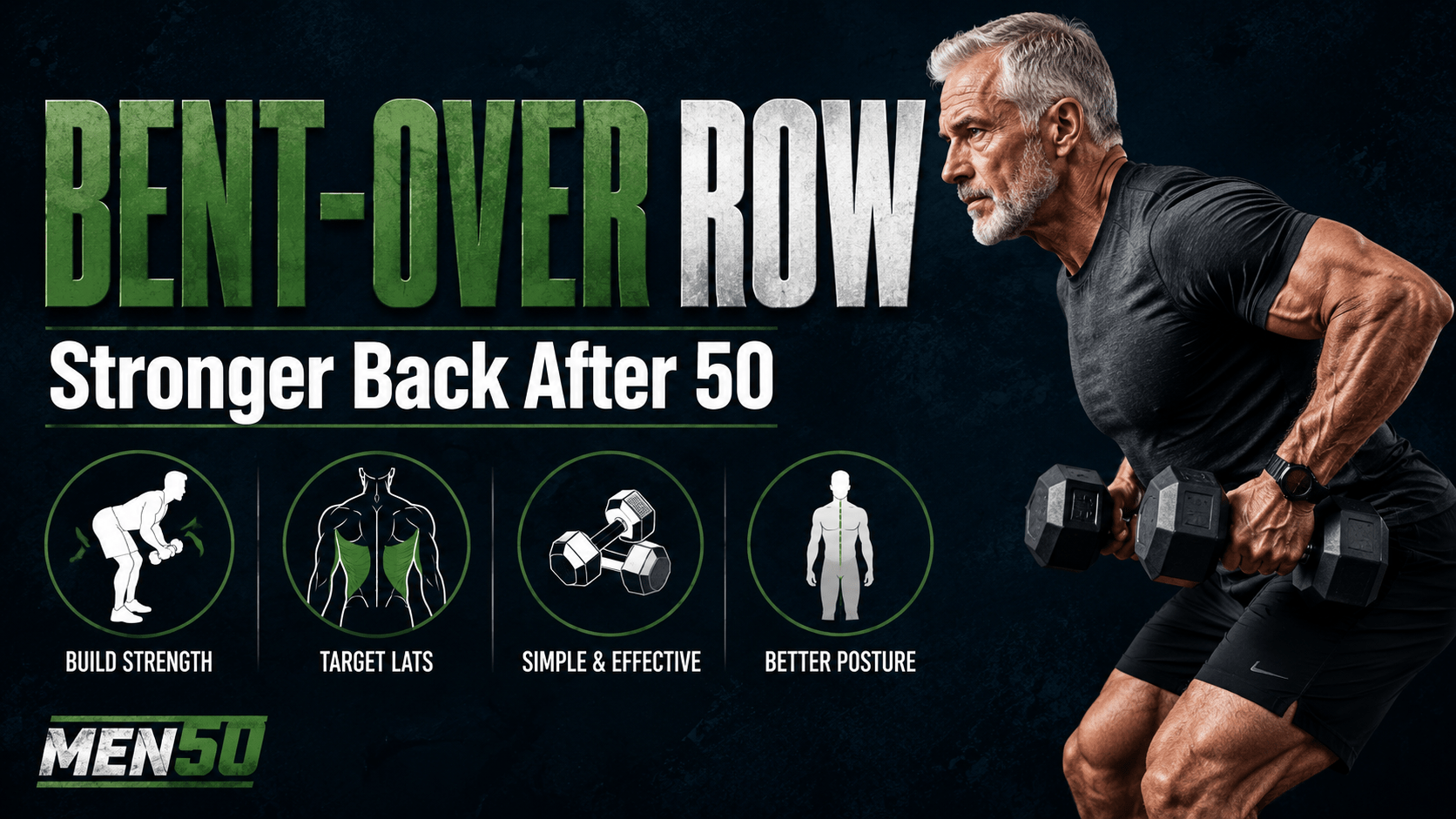
The bent-over dumbbell row is the foundational compound back exercise — and one of the most important pulling movements for men over 50 to learn well. It trains the entire upper back, lats, rear shoulders, and biceps in a single coordinated pattern, builds the postural pulling strength that fights forward-rounded shoulders, and demands real total-body bracing through every rep. For men over 50, it’s the exercise most directly responsible for the visibly strong-looking, upright back that signals a man takes his strength seriously.
Part of the Build Muscle After 50 pillar — strength training for men over 50.
Key Takeaways
- The bent-over dumbbell row trains the lats, rhomboids, traps, rear delts, biceps, and core — one of the most efficient compound back exercises in existence.
- This is the standing bilateral version (both arms working together) — the one-arm dumbbell row is the unilateral progression, the chest-supported row is the back-friendly version.
- Requires solid hip hinge form. If you haven’t mastered the hip hinge pattern with bodyweight, do that first.
- Programming: 2–4 sets of 8–12 reps, 2–3 times per week. Rest 60–90 seconds between sets.
- Pull with your elbows, squeeze your shoulder blades, and keep your back flat. Strong back muscles improve posture and make daily life easier.
How to Perform the Bent-Over Dumbbell Row
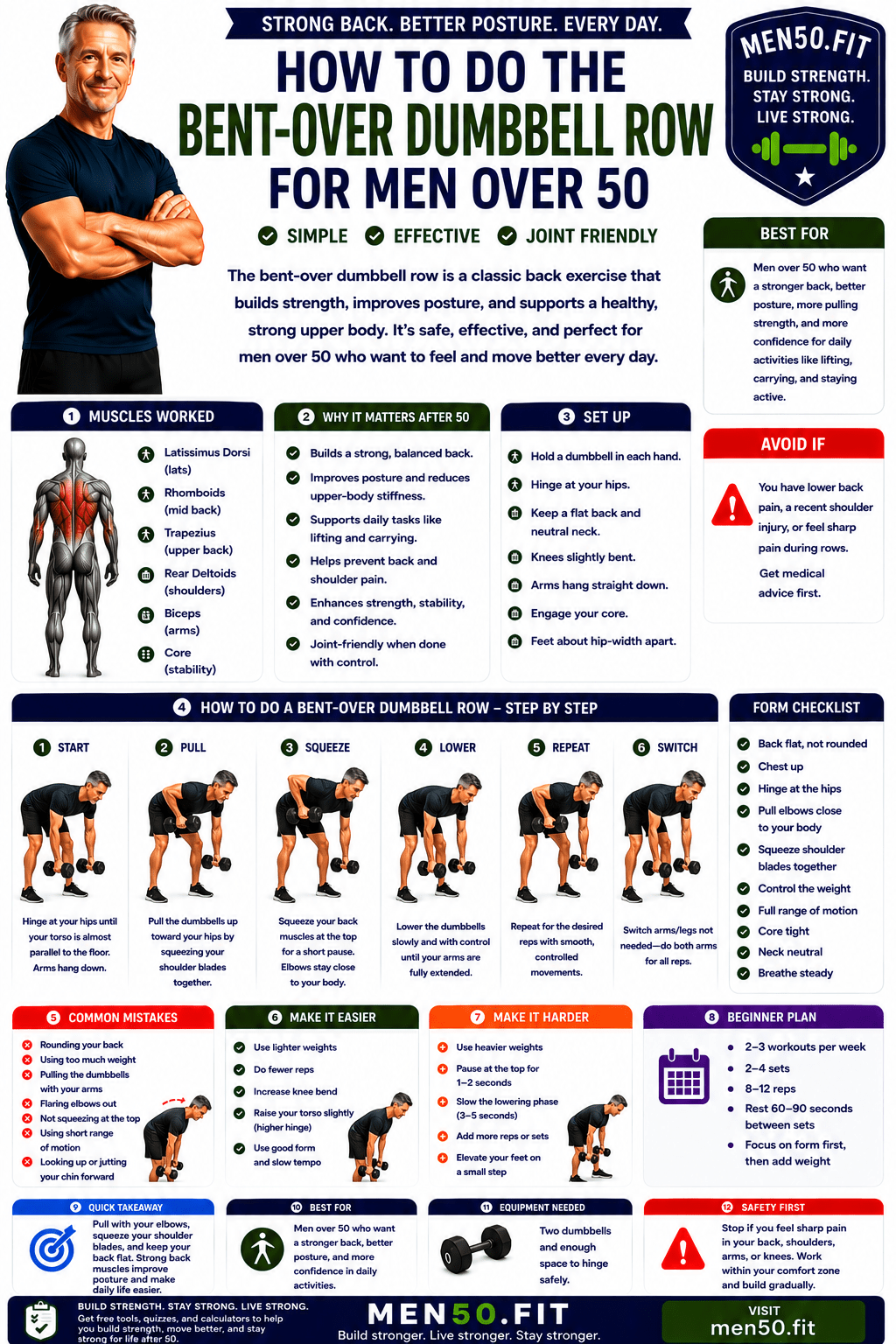
Set up first:
- Hold a dumbbell in each hand, palms facing each other (neutral grip) or palms facing back (pronated grip — either works).
- Hinge at your hips until your torso is at about 30–45 degrees from horizontal — roughly parallel to the floor for most men, slightly more upright for those with lower-back concerns.
- Keep a flat back and neutral neck — chest up, ribs tucked, eyes on the floor about 6 feet ahead.
- Knees slightly bent (about 10–15 degrees) — they stay in this position throughout.
- Arms hang straight down from your shoulders.
- Engage your core and feet about hip-width apart.
Then the movement:
- Start. Hinged at the hips, back flat, knees slightly bent, dumbbells hanging straight down from your shoulders. Core engaged, feet planted firmly.
- Pull. Pull both dumbbells up toward your hips (not your shoulders) by squeezing your shoulder blades together. Lead with the elbows, not the hands. Take 1–2 seconds to pull up.
- Squeeze. Squeeze your back muscles at the top for a short pause. The dumbbells should end near your hips, with your elbows higher than your back. Elbows stay close to your body — not flaring out to the sides.
- Lower. Lower the dumbbells slowly and with control until your arms are fully extended. Take 2–3 seconds on the way down. Don’t drop the weight — control every rep.
- Repeat. Smooth, controlled movements throughout. Maintain the hinged position with a flat back on every rep. Quality over weight.
- Switch arms/legs not needed — this is a bilateral exercise. Both arms work simultaneously for the full set.
The cue that matters most: pull with your back, not your arms. Most men intuitively focus on lifting the dumbbells, which recruits the biceps and makes the arms tire before the back does. Lead with the elbows toward the ceiling, and let the dumbbells follow. When the elbows do the leading, the lats and upper back do the work. When the hands do the leading, the biceps takes over.
Why the Bent-Over Dumbbell Row Matters After 50
The back is one of the most under-trained muscle groups in men over 50, and the consequences are visible everywhere: rounded shoulders from decades of desk work, forward head posture from screen time, weak pulling capacity, increased shoulder injury risk, and chronic upper-back tightness. Czech physiotherapist Vladimir Janda called this pattern upper crossed syndrome — tight chest, weak upper back, weak rear shoulders, weak external rotators. Back training is the strength-building half of fixing it (the doorway chest stretch is the lengthening half).
The bent-over dumbbell row is one of the most efficient single exercises for this correction. It trains:
| Muscle | Role |
|---|---|
| Latissimus dorsi (lats) | The large back muscle running from spine to upper arm — primary mover |
| Rhomboids | Pull the shoulder blades together — postural correction |
| Trapezius (mid + lower) | Stabilise the shoulder blades during pulling |
| Rear deltoids | Shoulder extension, balancing front delt dominance |
| Biceps | Assists by bending the elbow (secondary) |
| Core + spinal erectors | Brace the spine in the hinged position throughout |
That last muscle group matters more than most men realise. Holding the bent-over hinged position itself trains the core and spinal erectors through every rep — the row is essentially a hinge-position isometric for the lower back with active rowing on top. This is one of the reasons it’s such an efficient exercise (and also one of the reasons it’s harder than the chest-supported version).
Hip Hinge Is the Prerequisite
The most important technical point about this exercise: you can’t do it well without a solid hip hinge. The entire setup depends on hinging the hips back to angle the torso forward while keeping a flat back. If you haven’t mastered the hip hinge pattern with bodyweight first, the bent-over row turns into a back-rounding compensation exercise. Do bodyweight hip hinges for 2–4 weeks before attempting loaded bent-over rows — the time investment pays off because every loaded rowing exercise that follows depends on the same pattern.
Position in the Row Cluster
This exercise is the foundational compound row in the matrix. The other rowing variations serve different purposes:
| Exercise | Setup | Best For |
|---|---|---|
| Bent-Over Dumbbell Row (this article) | Standing, hinged, both arms | Compound back work, full-body bracing |
| One-Arm Dumbbell Row | Knee on bench, single arm | Asymmetry correction, heavier loading |
| Chest-Supported Dumbbell Row | Chest on incline bench, both arms | Back-friendly, ego-free form |
| Resistance Band Row | Standing or seated, band | Home/travel, no dumbbells |
Most men over 50 benefit from rotating among these. The bent-over version trains full-body bracing along with back strength. The chest-supported version reduces lower-back demand. The one-arm version exposes asymmetry. The band version covers no-equipment scenarios. No single rowing exercise is “best” — they’re complementary.
Sets and Reps
Progressive loading is the goal. The bent-over version is one of the few exercises where most men over 50 can build genuine pulling strength over months.
| Stage | Sets × Reps | Frequency | Load Guide |
|---|---|---|---|
| Beginner | 2 × 8–10 | 2× per week | Light (10–15 lbs / 4.5–7 kg per hand) |
| Novice | 2–3 × 8–12 | 2–3× per week | Working weight (15–25 lbs / 7–11 kg) |
| Intermediate | 3 × 8–12 | 2–3× per week | Moderate (25–35 lbs / 11–16 kg) |
| Advanced | 3–4 × 8–12 | 2–3× per week | Moderate-heavy + pause at top + slow lowering |
Rest 60–90 seconds between sets. Pick a weight where the last 2–3 reps feel clearly challenging but you can complete them with: back flat, no rounding, elbows close to the body, controlled tempo, hips and shoulders square (no twisting).
A practical note on load: most men over 50 use lighter dumbbells in the bilateral version than in the one-arm dumbbell row because both sides have to work simultaneously and the lower back is fully engaged in bracing. Don’t try to match your one-arm row weight — expect to use 20–30% less per hand in the bilateral version.
Common Mistakes
The seven errors that turn a great back exercise into a lower back or shoulder problem:
- Rounding your back. The single most dangerous mistake. As the back fatigues from holding the hinge, the lower back wants to round to make the lift easier. This puts the lumbar spine in a compromised loaded position — the most common mechanism for lifting-related back injuries. Keep the back flat throughout — chest up, core braced, hips hinged. If the back wants to round, the set is over.
- Using too much weight. Heavy weights force compensation — back rounding, biceps lifting, half reps, body swing. The back is a large muscle group that responds to controlled loading, not max-effort heaving. Drop a size if form breaks down.
- Pulling the dumbbells with your arms. The single most common technical error. When you focus on lifting the dumbbells with your arms, the biceps takes over and the back barely fires. Lead with the elbows toward the ceiling, not the hands lifting the weight.
- Flaring elbows out. If the elbows drift out to 90 degrees from your body, the work shifts to the rear delts and upper traps — not where you want it for a back-focused row. Keep elbows close to your body throughout, leading the pull toward the hip.
- Not squeezing at the top. Rushing through the top position without squeezing the shoulder blades together skips the most productive moment of the rep. Pause briefly at the top and squeeze.
- Using short range of motion. Half-reps that don’t bring the dumbbells fully up or don’t extend the arms fully at the bottom skip part of the working range. Use full range — full extension at the bottom, full pull to the hip at the top.
- Looking up or jutting your chin forward. Looking up during the row hyperextends the cervical spine. Look slightly ahead on the floor — neck stays in line with the spine throughout.
Make It Easier or Harder
If standard bent-over dumbbell rows are too challenging:
- Use lighter weights — 5–10 lbs (2–4.5 kg) per hand is fine for beginners.
- Do fewer reps — start with 2 sets of 6–8 and build up.
- Increase the knee bend slightly — more knee bend reduces the demand on the hamstrings and lower back (slight squat-row position).
- Raise your torso slightly (higher hinge — torso at 45–60 degrees from horizontal instead of parallel to the floor) — reduces lower-back demand significantly.
- Use good form with slow tempo — clean reps with light weight train the pattern properly.
If standing bent-over feels unsustainable because of lower-back fatigue, switch to the chest-supported row — same muscles, zero lower-back demand. The chest-supported version isn’t a regression; it’s a different tool for a different need.
To make it harder once form is solid:
- Use heavier weights — but only when the lighter weight feels easy with clean form.
- Pause at the top for 1–2 seconds with elbows high and shoulder blades squeezed.
- Slow the lowering phase to 3–5 seconds per rep — significantly more demanding than it sounds.
- Add more reps or sets — extend to 12–15 reps before adding weight.
- Elevate your feet on a small step — increases the depth of the hinge slightly. Subtle change but more lat stretch at the bottom.
For variety, try the bent-over neutral-grip row (palms facing each other) on alternating sessions — slightly more biceps recruitment but more wrist-friendly for some men.
Safety Note
Avoid the bent-over dumbbell row if you have lower back pain, recent shoulder injury, or sharp pain during rows. Get medical advice first.
Lower back pain during this exercise usually means: the back is rounding (most common cause), the weight is too heavy, the hinge position is too low (torso too parallel to the floor), or the core isn’t braced. The bent-over position itself places sustained load on the spinal erectors — for men with any history of lower back issues, the chest-supported row is usually a better option because the bench takes the lower-back demand out of the equation entirely.
Shoulder pain at the front of the shoulder usually means the dumbbells are too heavy or the arms are being allowed to hang too freely at the bottom. Control the descent; keep mild tension throughout.
Knee discomfort in the bent position can occur if the knees are locked straight (no bend) or bent too much (turning the position into a half-squat). The right knee bend is slight — about 10–15 degrees, just enough to take pressure off the hamstrings.
If you feel sharp pain anywhere during the rep, stop. Mild muscular fatigue in the back is normal; sharp joint pain is not.
Build Your Personal Training Plan
The bent-over dumbbell row is one piece of a complete upper body programme. Get a personalised exercise plan based on your current strength, goals, and any limitations.
Take the Free Fitness Profiler →
FAQs
Bent-over dumbbell row vs dumbbell row — same exercise?
Yes — they’re the same exercise with slightly different names. “Dumbbell row” is the broader term that covers any rowing variation with dumbbells (including one-arm, chest-supported, and standing). “Bent-over dumbbell row” specifies the standing bilateral version in the hinged-over position. When a fitness article or coach says “dumbbell row” without specifying, they usually mean this version — the classic bilateral bent-over row. If you’ve read the Dumbbell Row article, this article covers the same fundamental movement with deeper technical breakdown and updated cross-links to the other rowing variations now in the matrix.
Bent-over vs one-arm row — which is better?
Different exercises for different purposes. The bent-over bilateral version trains both sides simultaneously, requires more total-body bracing (and trains it), and works well as a single comprehensive back exercise. The one-arm dumbbell row uses bench support that eliminates lower-back demand, exposes left-right asymmetry, and allows heavier loading per arm. For most men over 50, doing both gives the best results — the bilateral version 1–2 times per week for compound back work, the one-arm version 1–2 times per week for asymmetry correction and heavier loading. If you can only pick one, the one-arm version is usually safer for back-conscious men because of the bench support.
How heavy should the dumbbells be?
Heavy enough that the last 2–3 reps feel clearly challenging, but light enough that you can complete the set with: back flat, no rounding, elbows close to the body, controlled tempo, no body swing. For most men over 50 starting out, 15–25 lbs (7–11 kg) per hand. After 3–6 months of training, many progress to 25–35 lbs (11–16 kg) per hand. Expect to use less weight in the bilateral version than the one-arm row — typically 20–30% less per hand because both sides are working simultaneously and the lower back is fully engaged in bracing.
Why does my lower back tire faster than my upper back?
This is a common and revealing experience. It means your spinal erectors and hip hinge endurance are the limiting factor, not your back pulling strength. Two solutions: (1) Practice the hip hinge pattern separately to build hinge endurance — 2–3 sets of 8–12 bodyweight hinges, daily if possible. (2) Use the chest-supported row for most of your rowing volume — same back muscles, zero lower-back demand. Drop the bent-over bilateral row in your weekly programme until your hinge endurance catches up; rotate the chest-supported row and one-arm row instead.
Should I do this if I have lower back issues?
Usually no, at least initially. The bent-over position places sustained load on the spinal erectors throughout every set — for men with any current or recent lower-back issues, this is often too demanding. Better choices: the chest-supported dumbbell row (bench takes lower-back demand entirely out of the equation), the one-arm dumbbell row (knee and hand on bench, much lower spinal load), or the resistance band row (seated or upright, no hinge required). Get clearance from a physiotherapist before returning to the bent-over version, and start with very light weight if you do.
References
- Janda V. Muscles, Central Nervous Motor Regulation and Back Problems. In: Korr IM (ed). The Neurobiologic Mechanisms in Manipulative Therapy. Plenum Press; 1978. (Upper Crossed Syndrome framework.)
- Kibler WB, Sciascia A. Current concepts: scapular dyskinesis. British Journal of Sports Medicine. 2010;44(5):300-305.
- McGill SM. Low Back Disorders: Evidence-Based Prevention and Rehabilitation. 3rd ed. Champaign, IL: Human Kinetics; 2016.
- American College of Sports Medicine. Resistance Training for Older Adults Position Stand. acsm.org
Disclaimer: This article is for educational purposes only and is not medical advice. Consult a qualified healthcare professional before starting any new exercise programme, especially if you have existing back, shoulder, or knee conditions.