
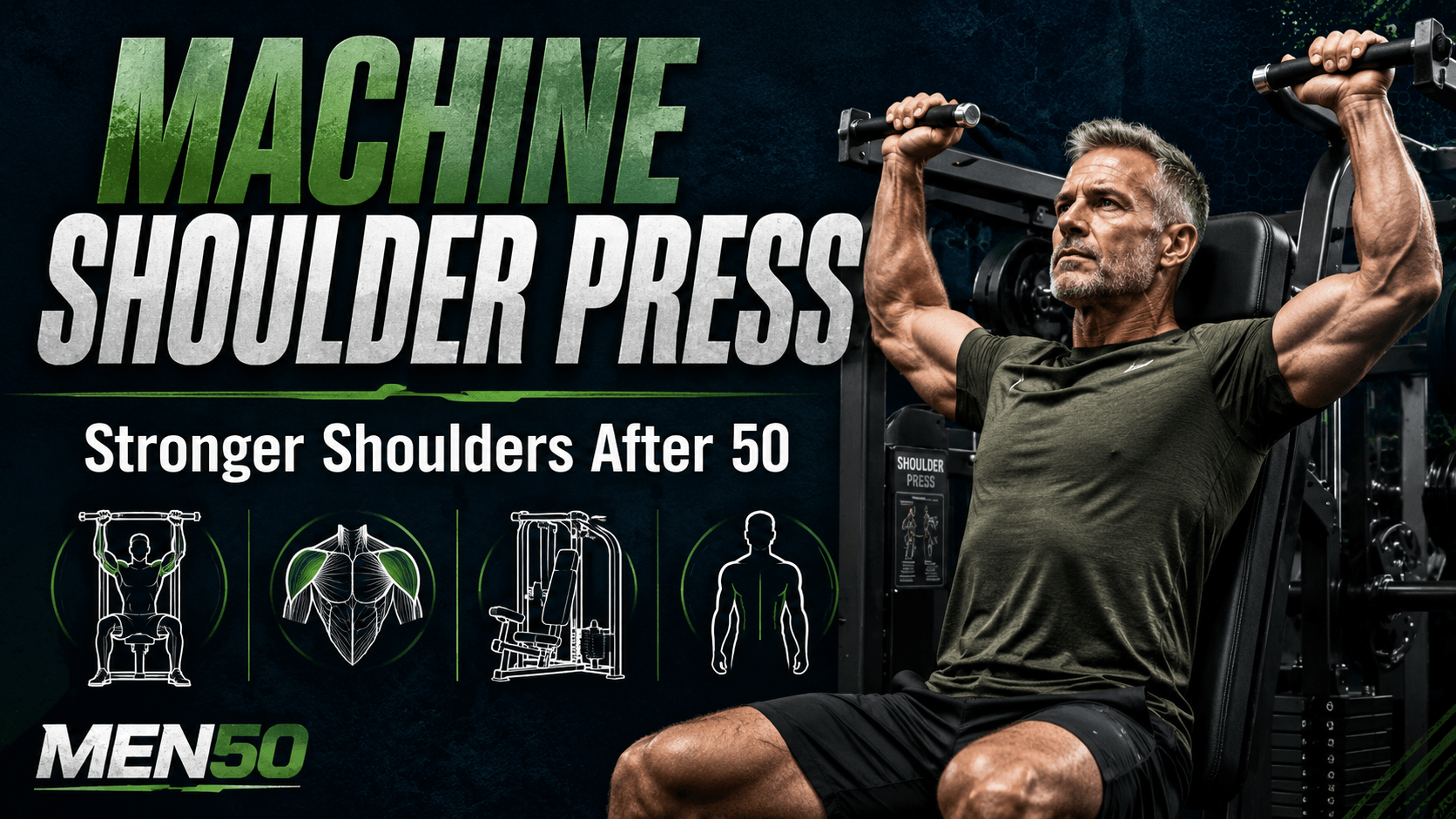
The machine shoulder press is the gym-machine version of vertical pressing — and for many men over 50, it’s the safer overhead exercise compared to dumbbell or barbell alternatives. Vertical pressing puts the shoulder joint in its most vulnerable position (overhead with load), and the rotator cuff has to stabilise the weight throughout the rep. The machine version takes that stabilisation work out of the equation: the bar or handles travel a fixed path, the back has full support, and the elbow position is constrained to keep the shoulders safer. For men over 50 with any shoulder history — and that’s most men over 50 — the machine shoulder press is often the smartest way to train overhead strength.
Part of the Build Muscle After 50 pillar — strength training for men over 50.
Key Takeaways
- The machine shoulder press trains the same muscles as the dumbbell shoulder press (deltoids, triceps, upper chest, upper back) — but with a guided movement path and back support.
- The machine’s fixed path is joint-friendlier than free weights for many men over 50 because the rotator cuff doesn’t have to balance a moving weight overhead.
- Programming: 2–4 sets of 8–12 reps, 2–3 times per week. Rest 60–90 seconds between sets.
- Press up with control, don’t lock out, lower slowly. Strong shoulders support better posture, more strength, and confidence.
- This completes the gym-machine cluster for men over 50 — seven exercises covering vertical and horizontal pressing/pulling and compound/isolation lower body.
How to Perform the Machine Shoulder Press
Set up first:
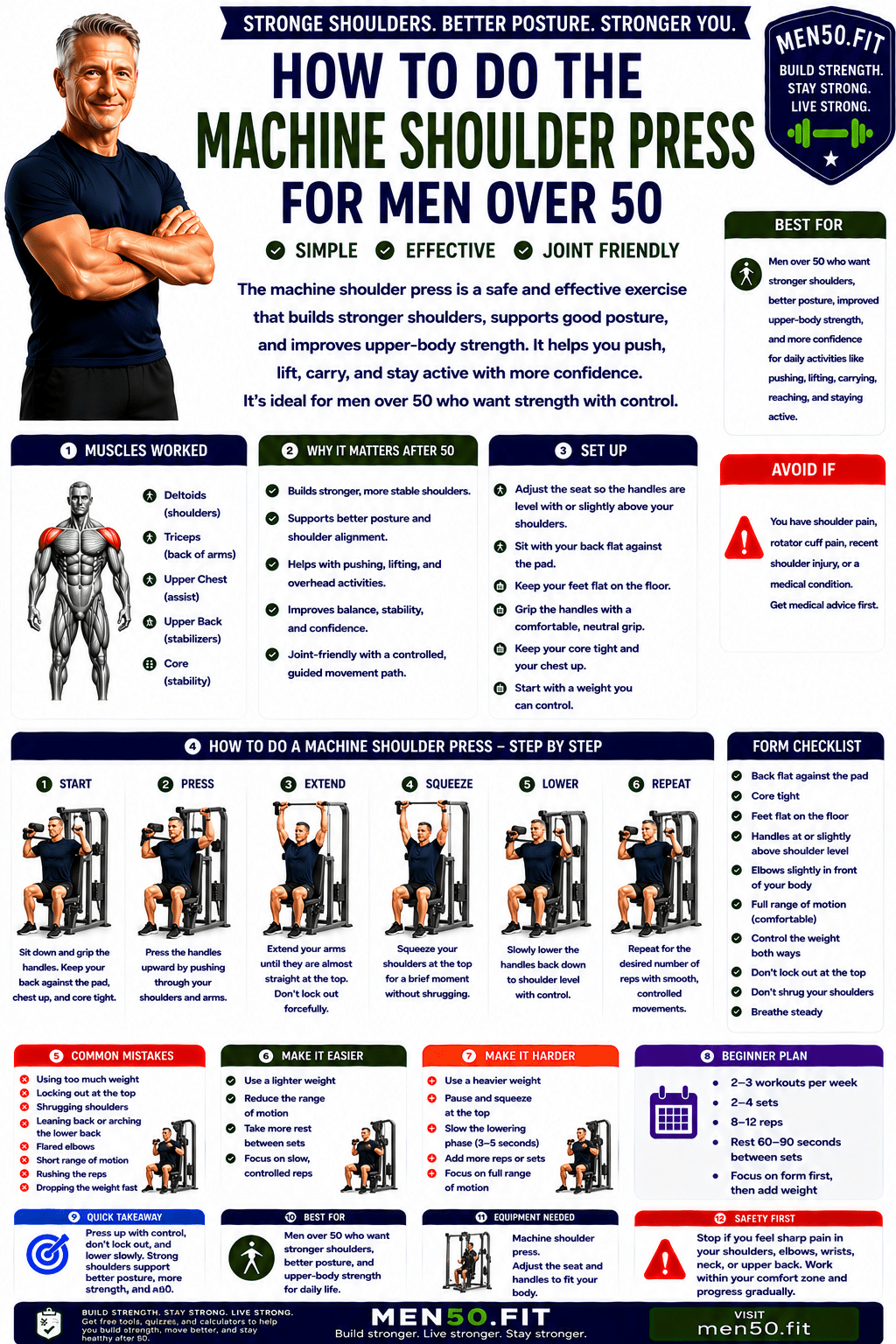
- Adjust the seat so the handles are level with or slightly above your shoulders — not way above, not way below. The starting position should put your elbows at about 90 degrees.
- Sit with your back flat against the pad — chest up, slight natural arch in the lower back, shoulders down.
- Feet flat on the floor (or on the foot rest if the machine has one).
- Grip the handles with a comfortable neutral grip (palms facing each other if the machine offers that option, or pronated grip if not). The neutral grip is most shoulder-friendly when available.
- Keep your core tight and chest up.
- Start with a weight you can control.
Then the movement:
- Start. Sit down and grip the handles. Keep your back against the pad, chest up, core tight. Handles at shoulder level, elbows bent at about 90 degrees, slightly in front of your body.
- Press. Press the handles upward by pushing through your shoulders and arms. Take 1–2 seconds to press. Press up, not back. The handles travel mostly vertically.
- Extend. Extend your arms until they are almost fully straight at the top. Don’t lock out forcefully — stop just before full elbow extension with a slight bend remaining.
- Squeeze. Squeeze your shoulders at the top for a brief moment without shrugging. Keep shoulders down; only the arms move up.
- Lower. Slowly lower the handles back down to shoulder level with control. Take 2–3 seconds on the way down. Don’t let the handles drop — control every rep.
- Repeat. Smooth, controlled movements throughout. Maintain seated position with back flat against the pad.
The cue that matters most: press up without shrugging — shoulders stay down, arms go up. Most men over 50 doing shoulder press intuitively shrug the upper traps toward the ears as they press. This shifts work from the deltoids to the traps and stresses the neck. Keep shoulders pinned down throughout the press — imagine the shoulder blades sliding down your back as the arms extend up. When the shoulders stay down, the deltoids do the work and the neck stays safe.
Why the Machine Shoulder Press Matters After 50
The overhead press is one of the foundational upper-body movement patterns. Daily life uses this pattern constantly: lifting a heavy bag onto a shelf, putting something into a high cupboard, reaching for items above your head, pulling clothes from a rack, putting a suitcase into an overhead bin. Overhead strength declines significantly after 50 if not trained — and the loss shows up first as these tasks becoming surprisingly hard.
The machine shoulder press trains this pattern with three specific advantages over free-weight alternatives:
1. Guided Movement Path
Free-weight overhead pressing (dumbbell shoulder press, barbell overhead press) requires the rotator cuff and shoulder stabilisers to control the weight’s path through space. With the weight overhead, any small loss of control can put significant load on vulnerable structures. The machine version eliminates this entirely — the machine’s lever system controls the path, and you just produce the pressing force.
For men over 50 with rotator cuff weakness, mild impingement, or any shoulder history, this stabilisation reduction is meaningful. The same press happens, but with less risk of form breakdown causing injury.
2. Back Support
The seat pad with backrest eliminates the lower-back demand that standing dumbbell or barbell overhead presses create. Standing overhead press requires significant core bracing through every rep to prevent the lower back from arching under load. For men with any back history, the seated machine version is significantly more sustainable.
3. Fixed Elbow Position
Most modern shoulder press machines are designed with the handles positioned so the elbows stay slightly in front of the body during the press — not directly out to the sides (the “T-shape” position). This is the safest shoulder position for overhead loading because it keeps the shoulder joint in the scapular plane (the plane of the shoulder blade) rather than the frontal plane (directly out to the sides). The scapular plane reduces impingement risk — the same principle as the scaption raise.
Position in the Vertical Pressing Matrix
The machine shoulder press completes the vertical pressing matrix at every equipment level:
| Equipment | Exercise |
|---|---|
| Bodyweight | Pike Push-Up |
| Dumbbell, seated | Seated Dumbbell Shoulder Press |
| Dumbbell, standing | Dumbbell Shoulder Press |
| Machine | Machine Shoulder Press (this article) |
For men over 50 with any equipment situation, there’s now a vertical pressing option that fits.
The Gym-Machine Cluster Is Now Complete
This article is the seventh and final piece of the gym-machine cluster — a complete machine-based upper-and-lower-body programme:
| Pattern | Machine Exercise |
|---|---|
| Vertical pulling | Lat Pulldown |
| Horizontal pulling | Seated Cable Row |
| Horizontal pressing | Machine Chest Press |
| Vertical pressing | Machine Shoulder Press (this article) |
| Chest isolation | Pec Deck |
| Compound lower body | Leg Press |
| Quad isolation | Leg Extension |
Seven joint-friendly, precisely loadable machine exercises covering every major movement pattern. For men over 50 with gym access who prefer machines — whether for joint protection, balance concerns, or simplicity — this cluster is now a complete training option. No barbell, no dumbbells, no balance challenges, no spotter required. Just guided progressive strength training.
Sets and Reps
Progressive loading is the goal. The machine shoulder press tolerates this particularly well because the machine controls the resistance precisely.
| Stage | Sets × Reps | Frequency | Load Guide |
|---|---|---|---|
| Beginner | 2 × 8–10 | 2× per week | Light (20–40 lbs / 9–18 kg) |
| Novice | 2–3 × 8–12 | 2–3× per week | Working (40–60 lbs / 18–27 kg) |
| Intermediate | 3 × 8–12 | 2–3× per week | Moderate (60–90 lbs / 27–41 kg) |
| Advanced | 3–4 × 8–12 | 2–3× per week | Moderate-heavy + pause at top + slow lowering |
Rest 60–90 seconds between sets. Pick a weight where the last 2–3 reps feel clearly challenging but you can complete them with: back flat against the pad, shoulders down (no shrugging), elbows slightly in front of body, no excessive arch, no lockout, controlled tempo.
A practical note on load: most men over 50 use significantly less weight on the machine shoulder press than on the machine chest press — typically 50–70% of the chest press weight for the same rep range. This is normal — the shoulders are smaller and weaker than the chest, and the overhead position is mechanically less favourable. If you press 80 lbs on the chest press, expect to press 40–60 lbs on the shoulder press. Don’t try to match your chest press weight — you’ll force compensation patterns.
Common Mistakes
The eight errors that turn a great shoulder exercise into a shoulder or neck problem:
- Using too much weight. The single most common mistake. Heavy weight forces compensation — back arching, shoulder shrugging, partial reps, locked-out lockouts. Drop a size if form breaks down.
- Locking out at the top. Fully straightening the elbows under load shifts force from the deltoids to the elbow joint and the cervical spine. Over time, this contributes to elbow and shoulder joint stress. Keep a slight elbow bend (5–10 degrees from full extension) at the top of every rep.
- Shrugging shoulders. The most damaging shoulder press mistake. As you press up, the upper traps want to hike the shoulders toward the ears. This shifts work from the deltoids to the traps and stresses the neck. Pin shoulders down and back before each press; keep them there throughout.
- Leaning back or arching the lower back. When the shoulders fatigue, the back wants to arch to recruit more chest and triceps. This puts the lower back in a vulnerable position under overhead load. Back stays flat against the pad for every rep.
- Flared elbows. If the elbows drift directly out to the sides (the “T-shape” position), the shoulders are forced into the impingement-prone frontal plane. Elbows slightly in front of the body, angled forward about 30 degrees from the sides.
- Short range of motion. Stopping the press before the arms are nearly straight (within the slight-bend limit), or not returning the handles all the way to shoulder level, skips part of the working range. Full range every rep within the comfortable shoulder range.
- Rushing the reps. Quick bouncy reps use elastic recoil from the weight stack. Slow controlled tempo — 1–2 seconds to press up, brief pause, 2–3 seconds to lower.
- Dropping the weight fast. Letting the weight stack snap back at the end of each rep skips the eccentric phase (where significant strength is built). Control the lowering all the way back to the starting position.
Make It Easier or Harder
If standard machine shoulder press reps are too challenging:
- Use a lighter weight — 15–25 lbs (7–11 kg) is fine for beginners.
- Reduce the range of motion — stop the press shorter of full extension while building strength.
- Take more rest between sets — 90–120 seconds.
- Focus on slow controlled reps — clean reps with light weight train the pattern.
To make it harder once form is solid:
- Use a heavier weight — but only when the lighter weight feels easy with clean form.
- Pause and squeeze at the top for 1–2 seconds with shoulders contracted (no shrug, no lockout).
- Slow the lowering phase to 3–5 seconds per rep — significantly more demanding.
- Add more reps or sets — extend to 12–15 reps before adding load.
- Focus on full range of motion — emphasise the bottom of the rep (where shoulders are stretched) by lowering with control all the way to shoulder level.
For variety, try the single-arm machine shoulder press once a week — one handle at a time, exposes left-right asymmetry similar to the one-arm dumbbell row and adds anti-rotation core demand. Use significantly lighter weight (~50% of bilateral) for the unilateral version.
Safety Note
Avoid the machine shoulder press if you have shoulder pain, rotator cuff pain, recent shoulder injury, or a relevant medical condition. Get medical advice first.
Shoulder pain during the press has three common causes. (1) Seat too low — if the handles start above your shoulders, the press becomes an awkward overhead movement from a vulnerable position. Adjust the seat so handles are at or just above shoulder level. (2) Elbows flared too wide — even on a machine, you can let the elbows drift out to the sides. Elbows slightly in front of body, not directly out to the sides. (3) Shrugging shoulders — keep shoulders pinned down throughout. If pain persists after fixing all three, the overhead press position may not be right for you currently — switch to the machine chest press (horizontal pressing is more shoulder-friendly) or work with a physiotherapist on shoulder mobility.
Neck pain during the rep usually means the upper traps are shrugging up as you press. Keep shoulders down — imagine the shoulder blades sliding down your back as the arms extend up. If neck pain persists, drop the weight first; if it continues, see a physiotherapist.
Lower back pain during the press usually means the back is arching off the pad to compensate for shoulder strength limits. Back stays flat against the pad throughout. If you can’t maintain contact, the weight is too heavy.
Elbow pain is usually caused by locking out at the top. Keep the elbows slightly bent throughout — this protects the elbow joint from impact loading at full extension.
Wrist pain can occur if the grip isn’t neutral. Most modern machines offer a neutral grip option (palms facing each other) — use it if available.
If you feel sharp pain anywhere during the rep, stop. Mild muscular fatigue in the shoulders is normal; sharp joint pain is not.
Build Your Personal Training Plan
The machine shoulder press is one piece of a complete upper body programme. Get a personalised exercise plan based on your current strength, goals, and any limitations.
Take the Free Fitness Profiler →
FAQs
Machine shoulder press vs dumbbell shoulder press — which is better?
For most men over 50, the answer depends on what you’re optimising for. The machine shoulder press has advantages: guided movement path (less rotator cuff stabilisation demand), back support, precise progressive overload, and fixed elbow position. The dumbbell shoulder press has advantages: trains stabilisation (which has functional carryover), allows independent left-right work, and doesn’t require gym access. For men with shoulder issues or limited rotator cuff strength, the machine is generally the better default. For men with healthy shoulders who want functional carryover, the dumbbell version is often better. Many men over 50 do both — machine work for primary shoulder training (heavier loads, more reps), dumbbell work for variety and stabilisation training. Neither is “better” — they serve different equipment situations and shoulder health stages.
Machine shoulder press vs barbell overhead press — should I switch?
This depends on your situation. The barbell overhead press is the classic strength-training shoulder exercise, but it has real risks for men over 50: it requires significant rotator cuff stability, the wide grip can stress the shoulders, and the standing position with heavy overhead load requires excellent core bracing throughout. For most men over 50, the machine shoulder press is genuinely safer — same fundamental pressing pattern, none of the bar-management or stabilisation risks. If you’ve been overhead pressing for years and have no shoulder issues, no need to switch. If you’re starting shoulder training over 50, or you have any shoulder history, the machine is the better default. The strength carryover between machine and barbell is significant, so you’re not losing much by choosing the machine.
How heavy should the weight be?
Heavy enough that the last 2–3 reps feel clearly challenging, but light enough that you can complete the set with: back flat against the pad, shoulders down (no shrugging), elbows slightly in front of body, no back arching, no lockout, controlled tempo. For most men over 50 starting out, 20–40 lbs (9–18 kg) on the weight stack. After 3–6 months of training, many progress to 40–60 lbs (18–27 kg). Advanced lifters often work in the 60–90 lb (27–41 kg) range. Expect to use 50–70% of your machine chest press weight — the shoulders are mechanically weaker than the chest in the pressing direction. Don’t try to match your chest press weight or compare to other gym-goers; pick the load that lets you complete the rep range with clean form.
Why does this hurt my shoulders?
Three most common causes. (1) Seat height wrong — if the handles are way above shoulder level at the start, the press becomes an awkward overhead movement from a vulnerable position. Adjust the seat so handles are at or just above shoulder height. (2) Elbows flaring out — even on a machine, you can let the elbows drift to the sides into the impingement-prone position. Elbows slightly in front of body, angled forward about 30 degrees from the sides. (3) Shrugging shoulders — letting the upper traps hike the shoulders toward the ears stresses the neck and shoulder. Pin shoulders down throughout. If pain persists after fixing these three, the overhead press position may not be right for your current shoulder health — switch to horizontal pressing (machine chest press, dumbbell floor press) for upper-body work and work on shoulder mobility separately.
What grip should I use?
Most modern machine shoulder presses offer two grip options: neutral (palms facing each other) and pronated (palms facing forward). The neutral grip is shoulder-friendlier for most men over 50 — it keeps the shoulders in a slightly externally-rotated position that reduces impingement risk. The pronated grip is the traditional shoulder press grip but puts more rotational demand on the shoulder. Default to the neutral grip if your machine offers it. If only pronated is available, that’s fine for most men — just keep the elbows slightly in front of the body (not directly out to the sides) to mitigate the shoulder position issue.
References
- Janda V. Muscles, Central Nervous Motor Regulation and Back Problems. In: Korr IM (ed). The Neurobiologic Mechanisms in Manipulative Therapy. Plenum Press; 1978. (Upper Crossed Syndrome framework.)
- Kibler WB, Sciascia A. Current concepts: scapular dyskinesis. British Journal of Sports Medicine. 2010;44(5):300-305.
- American College of Sports Medicine. Resistance Training for Older Adults Position Stand. acsm.org
Disclaimer: This article is for educational purposes only and is not medical advice. Consult a qualified healthcare professional before starting any new exercise programme, especially if you have existing shoulder, neck, or back conditions.