
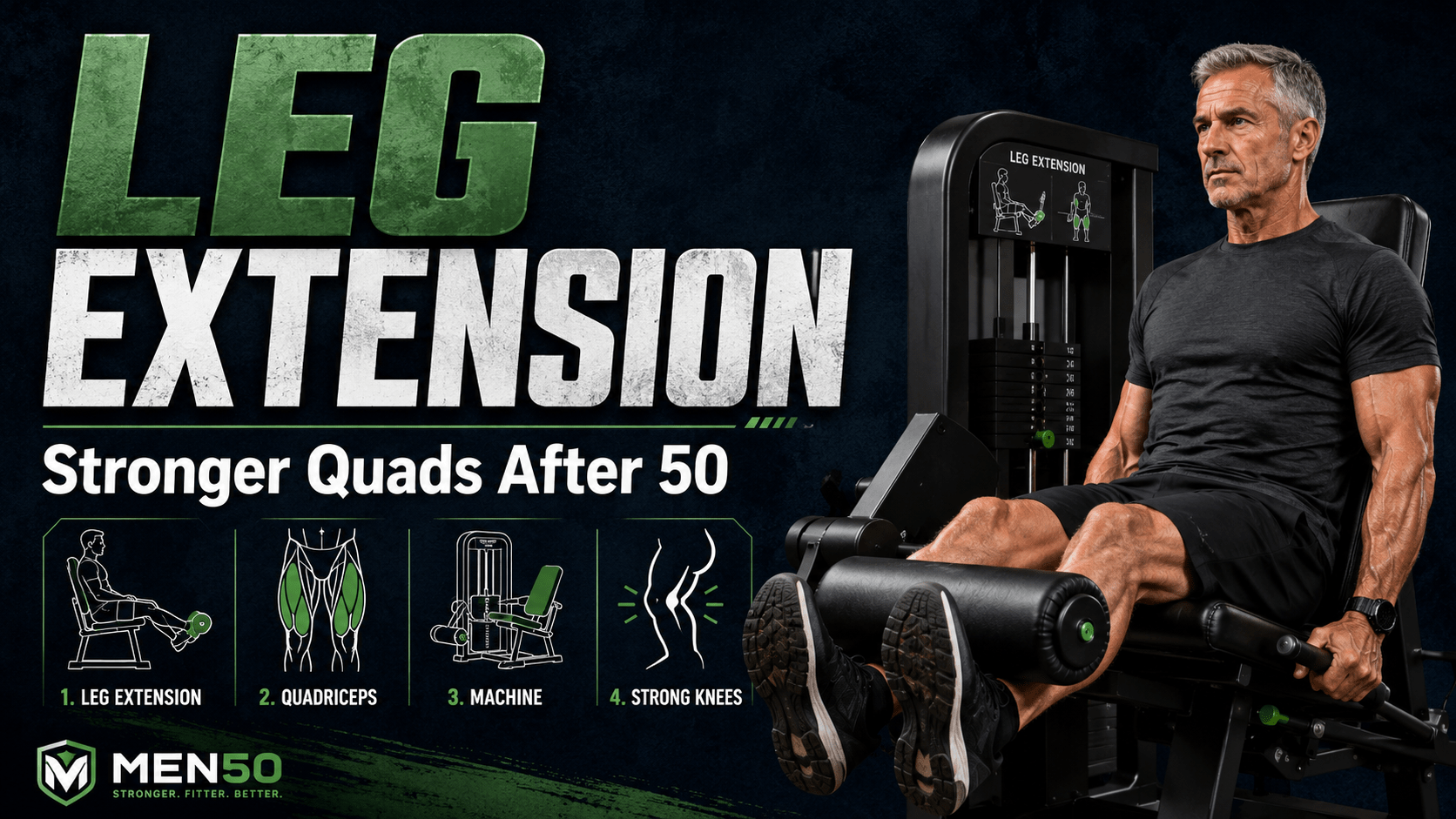
The leg extension is the gym-machine version of quadriceps isolation — and it sits in the same relationship to the leg press that the pec deck machine sits in to the machine chest press. Compound exercise pairs with isolation: the leg press trains the legs as a system (quads + glutes + hamstrings working together); the leg extension trains the quads in isolation, with no help from the other leg muscles. For men over 50 who want direct quadriceps development, knee-stabilising VMO work, or supplementary leg training that isolates the front of the thigh, the leg extension is the right tool — when used correctly.
Part of the Build Muscle After 50 pillar — strength training for men over 50.
Key Takeaways
- The leg extension is a quadriceps isolation exercise — only the knee joint moves, the quads do all the work without help from the glutes or hamstrings.
- It complements the leg press the same way the pec deck complements the machine chest press — compound + isolation pair.
- Programming: 2–4 sets of 8–12 reps, 2–3 times per week. Rest 60–90 seconds between sets.
- Use control, not ego. Squeeze your quads and move with purpose. Don’t lock out the knees, don’t swing, don’t let the weight slam.
- This is the sixth piece of the gym-machine cluster for men over 50 — and the second isolation machine alongside the pec deck.
How to Perform the Leg Extension
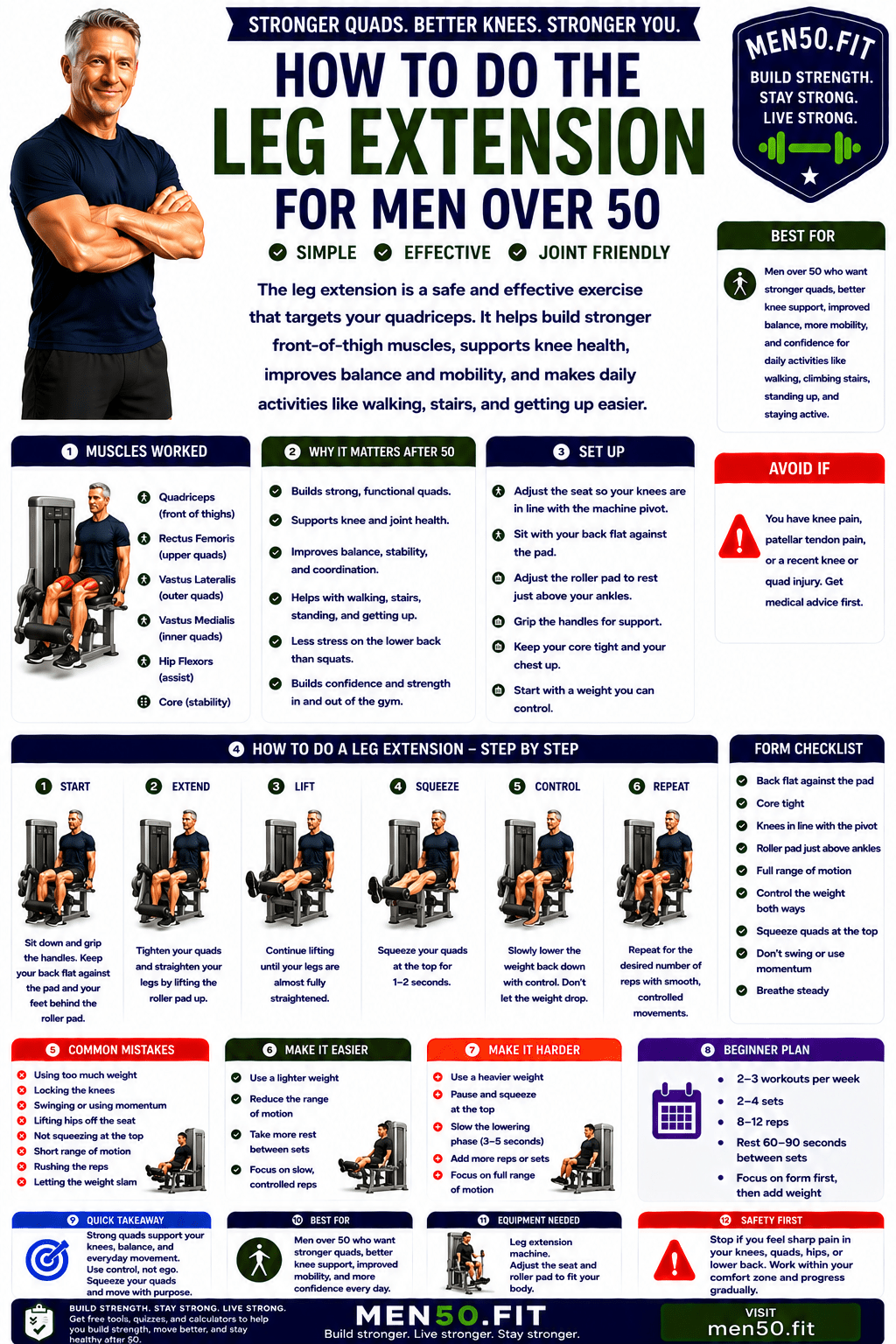
Set up first (machine fit matters here more than on most machines):
- Adjust the seat so your knees are in line with the machine’s pivot point — this is the critical setup detail. If the knee and pivot don’t align, the lever arm of the machine doesn’t match the lever arm of your leg, which puts uneven stress on the knee.
- Sit with your back flat against the pad — chest up, shoulders down.
- Adjust the roller pad to rest just above your ankles — not on the foot, not mid-shin, just above the ankle bone.
- Grip the handles on the seat for support and to keep your torso stable.
- Core tight, chest up.
- Start with a weight you can control — significantly lighter than you think.
Then the movement:
- Start. Sit down and grip the handles. Keep your back flat against the pad and your feet behind the roller pad. Knees bent at about 90 degrees.
- Extend. Tighten your quads and straighten your legs by lifting the roller pad up. Take 1–2 seconds to extend. Drive with the quads, not with momentum.
- Lift. Continue lifting until your legs are almost fully straightened — stop just short of full lockout.
- Squeeze. Squeeze your quads at the top for 1–2 seconds. Feel the front of the thighs actively working. This peak squeeze is where most of the productive work happens.
- Control. Slowly lower the weight back down with control. Take 2–3 seconds on the way down. Don’t let the weight drop — control every rep, especially the eccentric (lowering) phase.
- Repeat. Smooth, controlled movements throughout. Maintain seated position with back flat against the pad on every rep.
The cue that matters most: squeeze at the top, control the descent — both halves of the rep matter equally. Most men focus on the extension (lifting) and let the weight drop on the return. The lowering phase is where significant strength gets built and where the knee adapts to controlled loading. Slow controlled lowering trains the quads better than fast lifting with a dropped return.
Why the Leg Extension Matters After 50
The quadriceps is one of the most consequential muscle groups for men over 50. Quad strength directly supports:
- Stair climbing — descending stairs in particular requires significant eccentric quad strength
- Getting up from chairs/floor — the sit-to-stand pattern depends on quad capacity
- Knee stability — the quads (especially the VMO) stabilise the kneecap during walking and weight-bearing
- Walking gait — quad weakness shows up as a “stiff-legged” walk and reduced step length
- Fall prevention — quad strength is one of the most consistent predictors of fall risk in older adults
The leg extension trains the quad complex directly:
| Muscle | Role |
|---|---|
| Rectus femoris | Upper quad, the only quad that crosses the hip joint |
| Vastus lateralis | Outer thigh — largest of the quads |
| Vastus medialis (VMO) | Inner thigh — critical for kneecap tracking |
| Vastus intermedius | Deep quad under the rectus femoris |
Why the Leg Extension Specifically
The leg press trains the quads, but it trains them alongside the glutes and hamstrings — which means the stronger muscles often dominate and the quads get less direct work than you’d expect. The leg extension solves this with single-joint isolation: only the knee moves, only the quads work.
Three specific advantages for men over 50:
1. VMO training. The vastus medialis oblique (inner quad just above the knee) is critical for kneecap tracking — keeping the patella sliding correctly in its groove during knee bending. VMO weakness contributes to patellofemoral pain syndrome (“runner’s knee” or anterior knee pain). The leg extension is one of the few exercises that loads the VMO directly through its full range of motion. Squeezing hard at the top of the rep emphasises the VMO specifically.
2. Compound exercise can’t compensate. On compound exercises (squats, leg press), if your quads are weak relative to your glutes/hamstrings, the body recruits more glute/hamstring work to complete the rep. The quads stay relatively under-trained. Isolation eliminates this — the quads either complete the rep or you don’t.
3. Knee-friendly progression. When done correctly (not locked out, controlled tempo, knees aligned with pivot), the leg extension trains the quads with less compressive load on the knee than squat-pattern exercises. For men with mild patellofemoral irritation, the leg extension is often better tolerated than squats — it loads the quads without the deep knee bending of squat patterns.
The Compound + Isolation Pairs
The leg extension completes the second compound-isolation pair in the gym-machine cluster:
| Body Part | Compound Machine | Isolation Machine |
|---|---|---|
| Chest | Machine Chest Press | Pec Deck |
| Legs (quads) | Leg Press | Leg Extension (this article) |
Same training principle: compound first (when fresh, for primary strength), isolation second (when pre-fatigued, for direct muscle emphasis).
Position in the Gym-Machine Cluster
The leg extension becomes the sixth piece of the gym-machine cluster for men over 50:
| Pattern | Machine Exercise |
|---|---|
| Vertical pulling | Lat Pulldown |
| Horizontal pulling | Seated Cable Row |
| Horizontal pressing | Machine Chest Press |
| Chest isolation | Pec Deck |
| Compound lower body | Leg Press |
| Quad isolation | Leg Extension (this article) |
Six joint-friendly, precisely loadable machine exercises forming a complete machine-based upper-and-lower-body programme.
Sets and Reps
The leg extension is an isolation exercise — moderate to higher rep ranges work better than heavy loading.
| Stage | Sets × Reps | Frequency | Load Guide |
|---|---|---|---|
| Beginner | 2 × 10–12 | 2× per week | Light (20–40 lbs / 9–18 kg) |
| Novice | 2–3 × 10–12 | 2–3× per week | Working (40–70 lbs / 18–32 kg) |
| Intermediate | 3 × 8–12 | 2–3× per week | Moderate (70–100 lbs / 32–45 kg) |
| Advanced | 3–4 × 8–12 | 2–3× per week | Moderate-heavy + pause at top + slow lowering |
Rest 60–90 seconds between sets. Pick a weight where the last 2–3 reps feel clearly challenging but you can complete them with: back flat, hips on the seat, no swinging, no lockout, controlled tempo both directions.
A practical note: most men over 50 use less weight on the leg extension than on most machines — typically 25–40% of their leg press weight for the same rep range. This is normal — isolation exercises load smaller muscle groups directly without help from larger assistant muscles. If you leg press 200 lbs, you’ll probably leg extend 50–80 lbs. Don’t try to match your leg press weight — you’ll force compensation patterns and stress your knees.
Common Mistakes
The eight errors that turn a useful quad exercise into a knee problem:
- Using too much weight. The most dangerous mistake on this specific machine. Heavy weight forces compensation — hip lift, swinging, locked knees, half reps. Drop a size if form breaks down. This exercise punishes ego loading with knee irritation.
- Locking the knees. Fully extending the knees at the top under load shifts force from the muscles directly into the knee joint. Over time, this contributes to patellofemoral irritation and joint stress. Stop just before full lockout — about 5–10 degrees of knee bend remaining at the top.
- Swinging or using momentum. Kicking the legs up using torso swing or hip drive bypasses the quads and uses elastic recoil. Stay still in the torso; only the lower legs move.
- Lifting hips off the seat. When the quads fatigue, the body wants to recruit hip flexors by lifting the hips off the seat. This puts the lower back in a vulnerable position. Hips stay on the seat for every rep.
- Not squeezing at the top. Rushing through the top of the rep skips the most productive contraction. Pause briefly at the top with quads fully squeezed — this is where the VMO gets most of its training.
- Short range of motion. Lifting only halfway, or stopping the lowering before the knees return to about 90 degrees, skips significant working range. Full range — start at 90 degrees, finish near (but not at) full extension, lower back to 90 degrees.
- Rushing the reps. Quick bouncy reps use elastic recoil instead of quad contraction. Slow controlled tempo — 1–2 seconds up, brief pause, 2–3 seconds down.
- Letting the weight slam. Dropping the weight at the end of each rep skips the eccentric phase (where most strength is built) and slams the knee into the bent position under load. Control the lowering all the way back to the start.
Make It Easier or Harder
If standard leg extension reps are too challenging:
- Use a lighter weight — 15–25 lbs (7–11 kg) is fine for beginners.
- Reduce the range of motion — start the lift from a higher starting position (knees less bent) while you build strength.
- Take more rest — 90–120 seconds between sets.
- Focus on slow controlled reps — clean reps with light weight train the pattern.
To make it harder once form is solid:
- Use a heavier weight — but only when the lighter weight feels easy with clean form.
- Pause and squeeze at the top for 2–3 seconds with quads fully contracted (no lockout).
- Slow the lowering phase to 3–5 seconds per rep — significantly more demanding than it sounds, and where most strength is built.
- Add more reps or sets — extend to 12–15 reps before adding load.
- Focus on full range of motion — emphasise the bottom of the range (where the quads are stretched) by lowering smoothly all the way back to the start.
For variety, try the single-leg extension once a week — one leg at a time, exposes left-right asymmetry similar to other unilateral exercises. Use significantly lighter weight (~40–50% of bilateral) and follow all the same form principles. The single-leg version is particularly useful for VMO emphasis because it eliminates compensation between sides.
Safety Note
Avoid the leg extension if you have knee pain, patellar tendon pain, or a recent knee or quad injury. Get medical advice first.
Knee pain during the leg extension has three common causes. (1) Knees not aligned with the machine pivot — adjust the seat so the knee joint aligns with the machine’s rotation point. This is the most common cause of leg extension knee pain. (2) Locking out at the top — keep the slight knee bend throughout. (3) Too much weight — drop a size if pain occurs. If pain persists after fixing all three, the leg extension may not be the right exercise for you right now — switch to closed-chain quad work (squats, leg press, step-ups) or get a physiotherapist’s opinion on the knee.
Patellofemoral pain (pain at the front of the kneecap during the rep) deserves particular attention. The leg extension can either help or hurt patellofemoral irritation depending on technique. The protective factors: keep the slight knee bend at the top, control the lowering phase, squeeze the VMO actively, use moderate (not heavy) load. The risk factors: locking out under load, dropping the weight, using too much load. If you have a history of patellofemoral pain, start with very light weight and very controlled tempo — and if pain occurs, stop and reassess.
Patellar tendinopathy (pain at the tendon just below the kneecap) generally responds well to eccentric loading — and the slow-lowering version of the leg extension is similar to evidence-supported rehab protocols. But work with a physiotherapist for the initial loading if you have a diagnosed tendinopathy.
Lower back discomfort during the rep usually means the hips are lifting off the seat. Hips stay on the seat. If you can’t keep them down, the weight is too heavy.
Don’t let the weight stack slam down at the end of a set. Control the lowering all the way back to the rack position.
If you feel sharp pain anywhere during the rep, stop. Mild muscular fatigue in the quads is normal; sharp knee pain is not.
Build Your Personal Training Plan
The leg extension is one piece of a complete lower-body programme. Get a personalised exercise plan based on your current strength, goals, and any limitations.
Take the Free Fitness Profiler →
FAQs
Leg extension vs leg press — which is better?
Different exercises that train quads differently. The leg press is a compound exercise — the quads work together with the glutes and hamstrings. The leg extension is an isolation exercise — only the quads work, no glutes or hamstrings involved. For overall leg strength and function, the leg press is the more important exercise — it trains the legs the way they actually work in daily life (as a coordinated system). The leg extension is supplementary — useful for direct quad emphasis, VMO training, and as a finishing exercise after compound work. Most men over 50 should do the leg press first (when fresh) and add the leg extension afterward (when the quads are pre-fatigued, for direct isolation work). If you only do one, do the leg press.
Is the leg extension bad for the knees?
This is a more nuanced question than the internet usually treats it. The leg extension has been controversial because the open-chain motion (foot moving freely through space) creates a longer lever arm at the knee than closed-chain exercises like squats. Done badly — heavy load, locked-out top, dropped lowering, knees misaligned with pivot — it can stress the patellofemoral joint and cause knee irritation. Done well — moderate load, slight knee bend at top, controlled lowering, knees aligned with pivot — it’s a useful and knee-friendly quad exercise. Research on patients with mild patellofemoral pain has shown the leg extension can be part of rehabilitation when done correctly. For most men over 50 with healthy knees, the leg extension is fine in moderation as a supplement to compound work. For men with significant knee issues, consult a physiotherapist before adding it.
How heavy should the weight be?
Lighter than your leg press weight, lighter than your ego suggests. For most men over 50 starting out, 20–40 lbs (9–18 kg) on the weight stack. After 3–6 months of training, many progress to 40–70 lbs (18–32 kg). Advanced lifters often work in the 70–100 lb (32–45 kg) range. The right weight lets you complete the rep range with: back flat, hips on the seat, no swinging, no lockout, controlled tempo both directions. Expect to use 25–40% of your leg press weight — the isolation pattern doesn’t have the glutes and hamstrings to help, so the same weight feels significantly heavier. That’s normal. If you press 200 lbs but try to extend 100, you’ll force compensation patterns.
Should I do this if I have knee issues?
It depends on the issue. For mild patellofemoral pain (anterior knee pain not associated with structural damage), the leg extension can be part of the solution when done with light weight, slow tempo, and proper form — squeezing the VMO at the top is specifically protective. For patellar tendinopathy (pain at the tendon below the kneecap), slow-eccentric leg extensions are similar to evidence-supported rehab protocols, but work with a physiotherapist for initial loading. For meniscus tears, ligament issues, or arthritis flare-ups, skip the leg extension entirely and use closed-chain alternatives (squats, step-ups, leg press) or get cleared by a physiotherapist first. The general principle: if a specific weight or range causes sharp knee pain, stop. Don’t train through joint pain on the leg extension.
What’s the VMO and why does it matter?
The VMO (vastus medialis oblique) is the inner-thigh portion of the quadriceps — the teardrop-shaped muscle just above the inner side of the kneecap. It’s responsible for stabilising the kneecap’s tracking as the knee bends and straightens — keeping the patella sliding correctly in its groove rather than drifting to the outside. VMO weakness contributes to patellofemoral pain syndrome (“runner’s knee,” anterior knee pain) because a weak VMO allows the kneecap to track laterally and irritate the surrounding cartilage. The leg extension — particularly the terminal extension part (the last 30 degrees of straightening) and the peak squeeze at the top — loads the VMO directly. For men over 50 with mild anterior knee pain or who want to prevent it, the leg extension can be specifically useful as a VMO-strengthening exercise. Squeeze hard at the top of every rep to emphasise the VMO.
References
- American College of Sports Medicine. Resistance Training for Older Adults Position Stand. acsm.org
- National Institute on Aging. Sarcopenia and Muscle Strength in Older Adults. nia.nih.gov
- Escamilla RF, Macleod TD, Wilk KE, Paulos L, Andrews JR. Cruciate ligament loading during common knee rehabilitation exercises. Proceedings of the Institution of Mechanical Engineers, Part H: Journal of Engineering in Medicine. 2012;226(9):670-680.
Disclaimer: This article is for educational purposes only and is not medical advice. Consult a qualified healthcare professional before starting any new exercise programme, especially if you have existing knee or quadriceps conditions.