
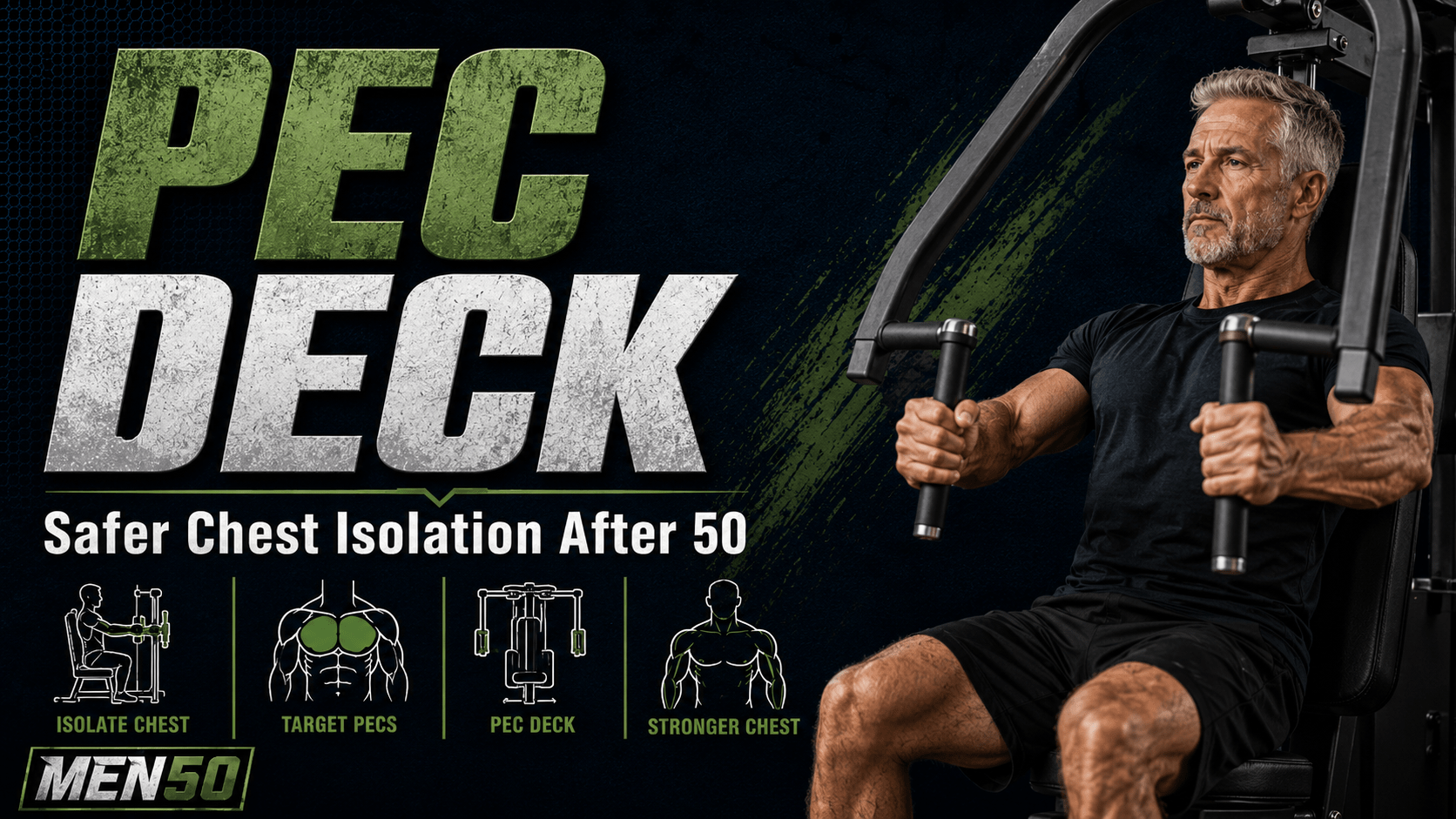
The pec deck machine is the gym-machine version of chest isolation — the seated equivalent of the dumbbell chest fly on floor. For men over 50, the machine version has a specific advantage that matters: the guided movement path prevents the over-stretching that causes shoulder pain in free-weight chest flys. The machine controls how far the arms can open, the seat supports the back, and the weight stack lets you progress in precise small increments. It’s not a compromise for men who “can’t handle free weights” — it’s often the better tool for the job of isolating the chest without irritating the shoulders.
Part of the Build Muscle After 50 pillar — strength training for men over 50.
Key Takeaways
- The pec deck is a chest isolation exercise — only the shoulder joint moves, the elbows stay at a constant angle. The chest does all the work without help from the triceps.
- The machine’s guided movement path prevents over-stretching the front of the shoulder, which is the most common cause of shoulder pain in free-weight chest flys.
- Programming: 2–4 sets of 8–15 reps, 2–3 times per week. Rest 60–90 seconds between sets.
- Use control, not ego. Squeeze your chest, keep your shoulders down, and move with smooth steady reps.
- This is the fourth and final piece of the gym-machine cluster for men over 50, completing a comprehensive machine-based upper body programme.
How to Perform the Pec Deck Machine
Set up first:
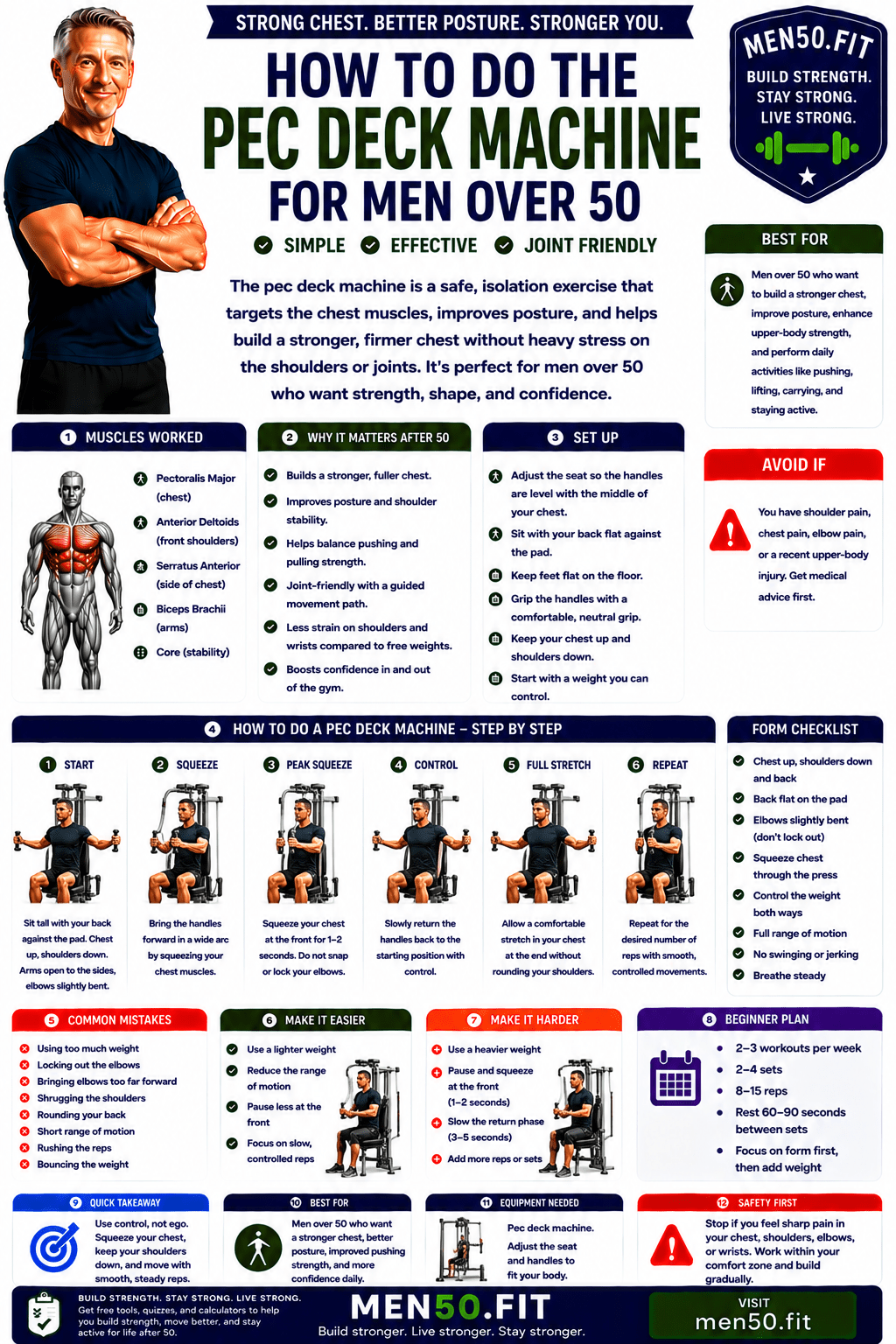
- Adjust the seat so the handles are level with the middle of your chest — not higher, not lower.
- Sit with your back flat against the pad — chest up, shoulders down and back.
- Feet flat on the floor, knees at about 90 degrees.
- Grip the handles with a comfortable neutral grip (palms facing each other if the machine has that option, or whatever grip the machine’s design uses).
- Start with a weight you can control.
Then the movement:
- Start. Sit tall with back flat against the pad. Arms open to the sides, elbows slightly bent at about 90 degrees (or whatever angle the machine’s pads or handles place them in). Chest up, shoulders down.
- Squeeze. Bring the handles forward in a wide arc by squeezing your chest muscles. Take 1–2 seconds to bring the handles together. Lead with the chest contraction, not the arms.
- Peak squeeze. Squeeze your chest at the front of the movement for 1–2 seconds. The handles meet (or nearly meet) in front of your chest. Do not snap or lock your elbows — keep the slight bend throughout.
- Control. Slowly return the handles back to the starting position with control. Take 2–3 seconds on the return. Don’t let the weight stack snap back — control every rep.
- Full stretch. Allow a comfortable stretch in your chest at the end of the return without rounding your shoulders forward. If the stretch feels uncomfortable or pinching in the front of the shoulder, you’ve gone too far back.
- Repeat. Smooth, controlled movements throughout. Maintain seated position with back flat against the pad.
The cue that matters most: squeeze with your chest, not pull with your arms. Most men intuitively focus on bringing the handles together by using their arms, which recruits the front delts and biceps instead of the chest. Think “press your chest muscles together” — the chest contraction does the work, and the arms just transmit the force to the handles. When the chest leads, the chest develops. When the arms lead, you’re doing a different exercise.
Why the Pec Deck Machine Matters After 50
The chest needs both compound work (pressing exercises that involve the triceps and front delts) and isolation work (chest-only exercises) for complete development. The pressing exercises in the matrix — push-ups, dumbbell floor press, machine chest press — handle the compound work. Isolation work specifically targets the chest in a single-joint pattern, where only the shoulder joint moves and the elbows stay at a fixed angle.
There are two chest isolation options in the matrix:
| Exercise | Equipment | Setup |
|---|---|---|
| Dumbbell Chest Fly on Floor | Dumbbells | Lying on floor, arms open out to sides |
| Pec Deck Machine (this article) | Gym machine | Seated, arms close in front of chest |
Both train the same fundamental pattern. The pec deck has specific advantages that matter for men over 50:
1. Guided Movement Path Prevents Over-Stretching
The biggest risk in free-weight chest flys for men over 50 is over-stretching the front of the shoulder. With dumbbells, the arms can drop below the level of the torso, which stretches the anterior shoulder capsule under load — a position the rotator cuff struggles to stabilise, especially in men with reduced shoulder mobility. This is why I recommended the floor variation of the dumbbell chest fly (the floor stops the arms at torso level). The pec deck takes this a step further: the machine’s hardware physically limits how far back the arms can go. You can’t over-stretch even if you try. This makes the pec deck particularly safe for men with any shoulder history.
2. Constant Tension
The cable resistance is constant throughout the rep — no dead spots like dumbbells (where gravity changes the lever arm). The chest is under tension throughout the entire range of motion. This makes the pec deck effective at building chest development even at moderate loads.
3. Precise Progressive Overload
The weight stack allows precise small increments — typically 5–10 lbs at a time. For isolation exercises specifically, small increments matter because the chest fibres respond best to gradual loading; jumping load in larger increments often causes form breakdown.
4. Back Support
The seat pad keeps the lower back in a supported neutral position. This eliminates the lower-back demand that bodyweight or lying chest exercises sometimes create.
Position in the Matrix — Completing the Gym Cluster
This article completes the gym-machine cluster for men over 50:
| Pattern | Machine Exercise |
|---|---|
| Vertical pulling | Lat Pulldown |
| Horizontal pulling | Seated Cable Row |
| Horizontal pressing | Machine Chest Press |
| Chest isolation | Pec Deck Machine (this article) |
Four machine exercises that together provide a complete machine-based upper-body programme — joint-friendly, precisely loadable, beginner-accessible. For men over 50 with gym access who want guided, progressive training, this cluster is the foundation. Add the lower-body machine exercises (most gyms have leg press, leg extension, leg curl), and you have a complete machine-based programme that requires no balance, no coordination demand, no spotter, and minimal injury risk.
Sets and Reps
The pec deck is an isolation exercise — moderate to higher rep ranges work better than heavy loading.
| Stage | Sets × Reps | Frequency | Load Guide |
|---|---|---|---|
| Beginner | 2 × 10–12 | 2× per week | Light (20–40 lbs / 9–18 kg) |
| Novice | 2–3 × 10–15 | 2–3× per week | Working (40–60 lbs / 18–27 kg) |
| Intermediate | 3 × 10–15 | 2–3× per week | Moderate (60–90 lbs / 27–41 kg) |
| Advanced | 3–4 × 10–15 | 2–3× per week | Moderate-heavy + pause + slow return |
Rest 60–90 seconds between sets. Pick a weight where the last 2–3 reps feel clearly challenging but you can complete them with: back flat against the pad, elbows slightly bent, no shoulder shrugging, no body movement, full but controlled range of motion.
A practical note: most men over 50 use less weight on the pec deck than the machine chest press — typically 50–70% of their machine press weight for the same rep range. This is normal — isolation exercises load smaller, weaker muscles directly without help from larger assistant muscles. If you press 80 lbs on the chest press, you’ll probably fly 40–60 lbs on the pec deck. Don’t try to match your press weight — you’ll force compensation patterns.
Common Mistakes
The eight errors that turn a great isolation exercise into a shoulder problem:
- Using too much weight. The single most common mistake — and the most dangerous on this specific exercise. Heavy weights force compensation: bringing the elbows too far forward, locking out, shrugging shoulders, half reps. Drop a size if form breaks down.
- Locking out the elbows. Fully straightening the elbows shifts work from chest to elbow joint and reduces chest engagement. Keep a slight elbow bend (5–10 degrees from full extension) throughout every rep.
- Bringing elbows too far forward. Crossing the arms past the midline of your body doesn’t add chest work — it just stresses the front of the shoulder. Stop when the handles meet (or nearly meet) in front of your chest. Beyond that point, you’re just stressing the shoulder.
- Shrugging the shoulders. As you squeeze, the upper traps want to hike the shoulders toward the ears. Pin shoulders down and back before each rep; keep them there throughout.
- Rounding your back. When fatigued, the body wants to round the upper back forward to recruit more muscles. Keep your back flat against the pad — chest up, shoulders back.
- Short range of motion. Not allowing a comfortable stretch at the back of the movement (or stopping the squeeze short of full chest contraction) skips part of the working range. Full range every rep, within the comfortable shoulder range.
- Rushing the reps. Quick bouncy reps use elastic recoil instead of chest contraction. Slow controlled tempo — 1–2 seconds to squeeze, brief pause, 2–3 seconds to return.
- Bouncing the weight. Letting the weight stack snap back at the end of each rep skips the eccentric phase. Control the return all the way back.
Make It Easier or Harder
If standard pec deck reps are too challenging:
- Use a lighter weight — 10–20 lbs (5–9 kg) is fine for beginners.
- Reduce the range of motion — go partially back at the stretch position while you build shoulder mobility.
- Pause less at the front — reduces total time under tension per rep.
- Focus on slow controlled reps — clean reps with light weight train the pattern.
To make it harder once form is solid:
- Use a heavier weight — but only when the lighter weight feels easy with clean form.
- Pause and squeeze at the front for 1–2 seconds with chest fully contracted (elbows slightly bent).
- Slow the return phase to 3–5 seconds per rep — significantly more demanding than it sounds.
- Add more reps or sets — extend to 15–20 reps before adding load.
For variety, try the single-arm pec deck once a week — one handle at a time, exposes left-right asymmetry, adds anti-rotation core demand similar to the one-arm dumbbell row.
Safety Note
Avoid the pec deck if you have shoulder pain, chest pain, elbow pain, or a recent upper-body injury. Get medical advice first.
Shoulder pain during the pec deck is usually one of three things: (1) Elbows too far back at the stretch position — the machine should physically limit this, but if your seat is too far back, the stretch position may be too deep. Adjust the seat. (2) Locking out at the front — keep the slight elbow bend throughout. (3) Shrugging shoulders — keep shoulders pinned down. If pain persists after fixing all three, the pec deck may not be the right exercise for you right now — switch to the dumbbell chest fly on floor (with shorter range to keep elbows above floor level) or skip isolation entirely and use pressing exercises for chest training.
Chest discomfort (not muscular fatigue) during the rep is uncommon but warrants attention. If you feel sharp pain in the chest itself, stop and get medical advice — chest pain can indicate cardiac issues that need ruling out.
Elbow pain is usually caused by locking out at the front of the movement. Keep the elbows slightly bent throughout.
Wrist pain can occur if the grip isn’t neutral. The pec deck handles should sit comfortably in your hand without bending the wrist. If the machine forces an awkward wrist angle, that machine may not fit your body — try a different machine model if available.
If you feel sharp pain anywhere during the rep, stop. Mild muscular fatigue in the chest is normal; sharp joint pain is not.
Build Your Personal Training Plan
The pec deck machine is one piece of a complete upper body programme. Get a personalised exercise plan based on your current strength, goals, and any limitations.
Take the Free Fitness Profiler →
FAQs
Pec deck vs dumbbell chest fly — which is better?
For men over 50, the pec deck is usually the safer choice. The machine’s guided movement path physically prevents the over-stretching that causes shoulder pain in free-weight chest flys. The dumbbell chest fly on floor addresses this by using the floor as a stopping point — but the pec deck takes it further with mechanical hardware limits. For men with healthy shoulders, both are fine; for men with any shoulder history, the pec deck is the safer default. Many men over 50 do both: pec deck for primary chest isolation work, dumbbell fly for variety or home training. Neither is “better” overall — they serve different equipment situations and risk tolerances.
Pec deck vs machine chest press — when to use which?
Different exercises that train chest differently. The machine chest press is a compound exercise — the elbows bend and extend, and the chest works together with the triceps and front delts. The pec deck is an isolation exercise — only the shoulder joint moves, and the chest does all the work. Most men over 50 benefit from both in a complete chest programme: chest press for primary compound chest and pressing strength, pec deck for direct chest emphasis and isolation work. A simple programme: chest press first (when you’re fresh), pec deck second (when the chest is pre-fatigued from compound work). Or split them across different days. Neither is “better” — they complement each other.
How heavy should the weight be?
Lighter than your chest press weight. For most men over 50 starting out, 20–40 lbs (9–18 kg) on the weight stack. After 3–6 months of training, many progress to 40–60 lbs (18–27 kg). Advanced lifters often work in the 60–90 lb (27–41 kg) range. The right weight lets you complete the rep range with: back flat, elbows slightly bent (no lockout), no shrugging, no body movement, controlled tempo. Expect to use 50–70% of your machine chest press weight — the isolation pattern doesn’t have the triceps and front delts to help, so the same weight feels significantly heavier. That’s normal.
Why is the pec deck considered “safer” for shoulders?
Three specific reasons. (1) Range limit — the machine physically prevents the arms from going too far back at the stretch position, which protects the front shoulder from the over-stretched-under-load position that causes most chest-fly shoulder pain. (2) Fixed elbow angle — the machine’s design keeps the elbows at a consistent angle, preventing the flaring/changing-angle issues that occur with free-weight flys. (3) No stabilisation demand — the machine controls the movement path, so the rotator cuff doesn’t have to stabilise a moving weight. These three combine to make the pec deck one of the most shoulder-friendly chest exercises in any gym — particularly valuable for men over 50 with any history of rotator cuff issues or shoulder impingement.
Should I do this if I have shoulder issues?
It depends on the type of issue. For chronic rotator cuff irritation or shoulder impingement, the pec deck is often better tolerated than free-weight chest exercises because of the guided path and range limits. Many men over 50 with mild shoulder issues can use the pec deck when they can’t use dumbbell flys or bench press. For acute shoulder pain or recent injuries, skip the pec deck (and all chest exercises) until cleared by a physiotherapist. For chronic shoulder pain that doesn’t respond to gentle exercise, get a proper diagnosis before trying to train through it. The pec deck is shoulder-friendlier than most alternatives but still puts the shoulder under load — don’t push through real pain.
References
- American College of Sports Medicine. Resistance Training for Older Adults Position Stand. acsm.org
- Kibler WB, Sciascia A. Current concepts: scapular dyskinesis. British Journal of Sports Medicine. 2010;44(5):300-305.
- National Institute on Aging. Sarcopenia and Muscle Strength in Older Adults. nia.nih.gov
Disclaimer: This article is for educational purposes only and is not medical advice. Consult a qualified healthcare professional before starting any new exercise programme, especially if you have existing chest, shoulder, or elbow conditions.