
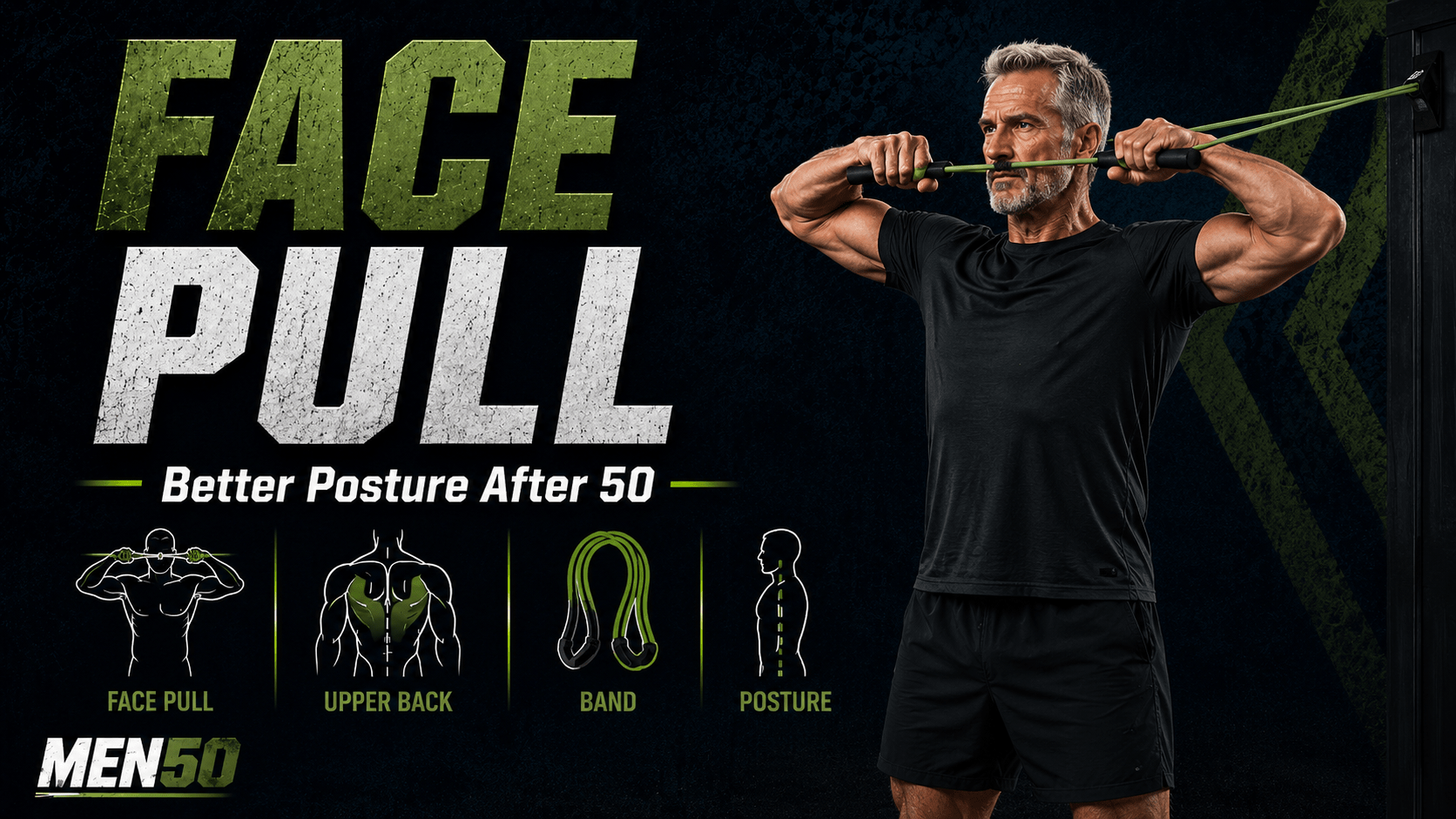
The band face pull might be the most important exercise in this entire matrix for men over 50 who spend hours sitting at desks or looking at screens. It does something almost no other exercise does: it trains the rear deltoids, the external rotators of the rotator cuff, and the muscles that control scapular position — all in a single movement. That triple-duty action makes it uniquely effective for correcting the forward-rounded posture, weak rear shoulders, and stiff upper back that develop over decades of office work. If you only had time to add one new exercise to your routine, this would be a strong contender.
Part of the Build Muscle After 50 pillar — strength training for men over 50.
Key Takeaways
- The band face pull trains rear deltoids, rhomboids, mid- and lower traps, rotator cuff stabilisers, and biceps — five postural muscle groups in one exercise.
- It’s the most direct corrective for Vladimir Janda’s upper crossed syndrome — the rounded-shoulder, forward-head posture that develops in men over 50 from desk work.
- Programming: 2–4 sets of 12–15 reps, 2–3 times per week. Rest 45–60 seconds between sets.
- Lead with your elbows, squeeze your shoulder blades, and control the band. Strong rear shoulders mean better posture, less pain, more strength.
- This exercise completes the 6-piece band-based home training system — pair with band pull-apart, resistance band row, band lat pulldown, resistance band chest press, and band triceps pressdown for comprehensive upper-body coverage.
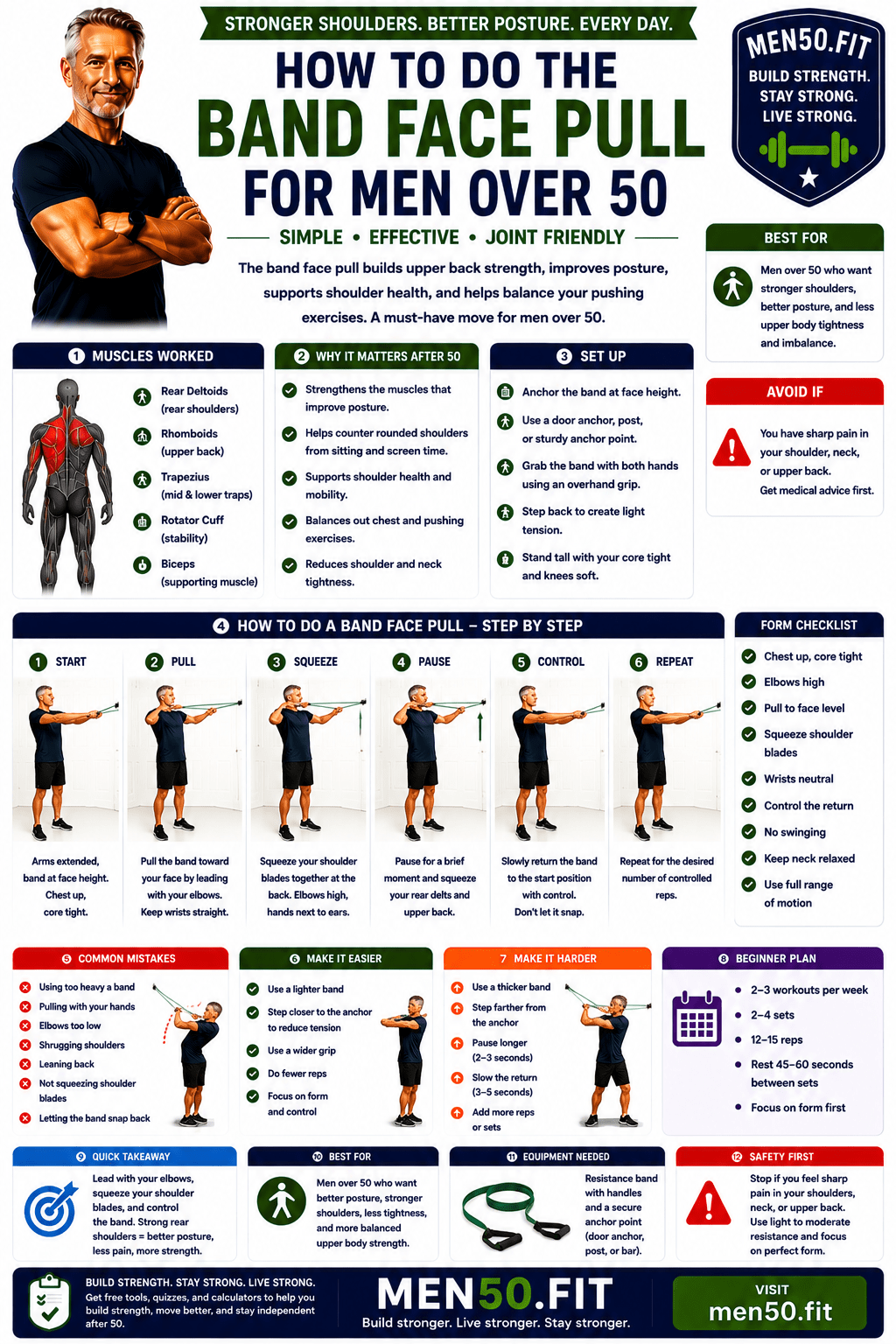
How to Perform the Band Face Pull
Set up first:
- Anchor the band securely at face height — a door anchor (door closed and locked), a sturdy post, or a wall hook designed for resistance training.
- Grab the band with both hands using an overhand grip (palms facing the floor).
- Step back to create light tension at the starting position.
- Stand tall with your core tight, chest up, knees soft.
Then the movement:
- Start. Arms extended at face height, band held in both hands, chest up, core tight. There should be tension in the band — not slack.
- Pull. Pull the band toward your face by leading with your elbows. Your elbows should rise outward and upward as you pull — like you’re trying to make a “W” shape with your arms. Keep wrists straight throughout.
- Squeeze. At the end of the pull, the band is near your face, elbows are high and out wide, hands are next to your ears. Squeeze your shoulder blades together hard and hold for a beat.
- Pause. Pause briefly at the peak of the contraction. This is where the postural muscles do their most useful work.
- Control. Slowly return the band to the start position with control. Take 2–3 seconds on the return. Don’t let it snap back — the band wants to spring back, and resisting that snap is where most of the strength gets built.
- Repeat. Maintain clean form on every rep. Smooth, controlled, with elbows leading and shoulder blades squeezing.
The cue that matters most: lead with your elbows, not your hands. The hands just go along for the ride. If you focus on the hands, the biceps take over and the rear delts barely fire. Focus on driving the elbows outward and upward, and the right muscles do the work.
Why the Band Face Pull Matters After 50
Most men over 50 carry decades of postural damage from sitting. Hours per day with the head forward, shoulders rounded, and arms in front of the body shorten the chest and front-shoulder muscles while lengthening and weakening the upper back, rear shoulders, and external rotators of the rotator cuff. Czech physiotherapist Vladimir Janda named this pattern upper crossed syndrome, and it’s the most common postural pattern in men over 50.
The face pull is uniquely effective for fixing upper crossed syndrome because it trains all three weak components at once:
1. Rear deltoids — the back-of-the-shoulder muscles that compound rows train only as a secondary muscle. The face pull, like the rear delt fly, trains them directly. But unlike the rear delt fly, the face pull adds two more dimensions.
2. External rotation of the rotator cuff — when your elbows rise outward and upward during the face pull, your shoulder rotates externally (the same motion as turning a doorknob outward). This trains the infraspinatus and teres minor, two small rotator cuff muscles responsible for holding the shoulder joint stable and protecting it from impingement. Weak external rotators are one of the most common causes of shoulder problems in men over 50, and almost no other exercise trains them effectively.
3. Scapular retraction and depression — the squeeze-the-shoulder-blades-together motion at the peak of each rep trains the mid and lower traps, the muscles that pull the shoulder blades down and back into healthy position. Most men over 50 have weak mid and lower traps because daily life doesn’t load them at all.
That combination — rear delts + external rotation + scapular control — in a single movement is what makes the face pull more comprehensive than any other rear-shoulder exercise. The rear delt fly trains rear delts well but doesn’t include external rotation or much scapular work. The band pull-apart trains the upper back well but at a different angle. The face pull covers all the angles.
There’s also a shoulder pain prevention angle. The external rotators trained by the face pull are the same muscles that protect against rotator cuff impingement during pressing exercises. Men who include face pulls in their routine typically have fewer shoulder problems with floor press, push-ups, shoulder press, and other compound pressing work. For every set of pressing you do, face pulls (and other pulling work) keep the shoulder healthy.
Sets and Reps
The face pull is a postural and corrective exercise — higher rep ranges work better than heavy weight.
| Stage | Variation | Sets × Reps | Frequency |
|---|---|---|---|
| Beginner | Light band, step close to anchor | 2 × 10–12 | 2× per week |
| Novice | Light or medium band, standard distance | 3 × 12–15 | 2–3× per week |
| Intermediate | Medium band, slow return | 3 × 12–15 | 2–3× per week |
| Advanced | Heavier band, pause at peak contraction | 3–4 × 12–15 | 2–3× per week |
Rest 45–60 seconds between sets. Pick a band tension where the last 2–3 reps feel clearly challenging at clean tempo with elbows high, shoulder blades squeezing, and no swinging.
A practical note: most men over 50 should stay in the light-to-moderate band range long-term and continue making progress through tempo variations (slower return, longer pause). Heavy face pulls usually mean compensation patterns — shrugging, leaning back, momentum. The face pull isn’t where to chase heavy resistance. Save that for compound pulling.
Daily mini-doses also work well for this exercise. One set of 12–15 with a light band, done as a desk break twice a day, is a sustainable habit that builds real postural strength over months. The face pull tolerates daily frequency at light load.
Common Mistakes
The seven errors that turn the best posture exercise into a wasted one:
- Using too heavy a band. The single most common mistake. Heavy bands force compensation — shrugging, leaning back, jerking the band, pulling with the hands. Drop a size. A light band done properly trains all three muscle groups; a heavy band done with momentum trains none.
- Pulling with your hands. Focusing on moving the hands recruits the biceps as the primary mover. The rear delts and rotator cuff barely engage. Lead with the elbows — drive them up and out wide. The hands just follow.
- Elbows too low. If the elbows finish below shoulder height at the peak of the pull, you’ve turned the face pull into a high row — different exercise. The elbows should be at or slightly above shoulder height at the end of the pull, hands by the ears.
- Shrugging shoulders. As the band comes toward your face, the upper traps want to lift the shoulders toward the ears. Pin the shoulders down before each rep and consciously keep them there. Neck stays relaxed.
- Leaning back. Some men lean their entire torso back to “help” pull the band. Stay upright; only the arms move. If you have to lean, the band is too heavy or you’re too far from the anchor.
- Not squeezing shoulder blades. Rushing through the peak position without consciously squeezing the shoulder blades together skips the most productive moment of the rep. Pause at the top, squeeze hard, feel the upper back work.
- Letting the band snap back. The return phase is where significant strength gets built. Take 2–3 seconds on the way back. Don’t let the band rip your hands back to the start.
Make It Easier or Harder
If standard face pulls are too challenging:
- Use a lighter band — most band kits include several tensions.
- Step closer to the anchor to reduce the starting tension.
- Use a wider grip — easier to control than a narrow grip for most men.
- Do fewer reps — start with 2 sets of 8–10 and build up.
- Focus on form and control — slow, deliberate reps with light tension train the right pattern.
To make face pulls harder once form is solid:
- Use a thicker band — but only when the lighter band feels easy with clean form. Most men over 50 never need more than a medium band for this exercise.
- Step farther from the anchor — adds tension without changing equipment.
- Pause longer at the peak for 2–3 seconds with elbows high and shoulder blades squeezed.
- Slow the return to 3–5 seconds per rep — significantly more demanding than it sounds.
- Add more reps or sets — extend sets to 15–20 reps before adding tension.
For variety, try the single-arm face pull (one handle, one hand) occasionally — exposes left-right imbalances and adds a core anti-rotation challenge.
Safety Note
Anchor safety is critical. A band snapping free under tension while you’re pulling toward your face can hit your eyes or face directly — this exercise has the highest face-injury risk of any band exercise. Use a proper door anchor with the door closed and locked from the opposite side, or a sturdy post/hook rated for resistance training. Inspect bands regularly for nicks or wear. If the anchor situation isn’t safe, do rear delt flys with dumbbells instead.
If you feel sharp pain in your shoulder, neck, or upper back during the movement, stop. Most face pull pain comes from too-heavy band tension or shrugging. Drop tension first, check for shrugging second, reduce range third. If pain persists, the issue is likely an existing condition that needs professional assessment — consult a physiotherapist.
The face pull is generally one of the safest band exercises, but men with recent shoulder surgery or acute rotator cuff injury should get clearance before starting. The external rotation component, while usually corrective, can occasionally aggravate severely irritated tissue.
Build Your Personal Training Plan
The band face pull is one piece of a complete upper body programme. Get a personalised exercise plan based on your current strength, goals, and any limitations.
Take the Free Fitness Profiler →
FAQs
Band face pull vs rear delt fly — what’s the difference?
Both target the rear shoulders, but they cover different territory. The rear delt fly is a pure isolation exercise — it trains the rear deltoids and that’s mostly it. The face pull trains rear deltoids plus the rotator cuff external rotators plus the scapular control muscles — three jobs in one. For comprehensive posture and shoulder health, the face pull is more efficient. Many men over 50 do face pulls 2–3 times per week and rear delt flys once a week for additional direct rear delt work. If you can only do one, the face pull covers more ground.
What anchor point works best?
The best options are: a door anchor with the door closed and locked from the opposite side (use the side that opens away from you, so band tension pulls the door more firmly closed); a sturdy post that won’t move; or a wall-mounted hook designed for resistance training. The anchor should be at face height — eye level when you’re standing. If your anchor is too high, the elbows end up too low and the exercise becomes a high row. If too low, the elbows can’t get above shoulder height at the peak.
How do I know if I’m doing this right?
Three checks. You feel it in the upper back and rear shoulders — not in the biceps, not in the neck/upper traps, not in the lower back. The elbows finish high — at or slightly above shoulder height at the peak. You can pause at the peak and consciously squeeze your shoulder blades together — if you can’t pause without losing balance or feeling like the band is going to rip you forward, the band is too heavy or you’re too far from the anchor. If all three check out, you’re doing it right.
Why am I shrugging my shoulders during this exercise?
Two common causes. Band tension too high — when the load exceeds what the rear delts and rotator cuff can handle, the upper traps recruit to help, which causes the shoulders to rise toward the ears. Habitual desk posture — many men over 50 sit with shoulders shrugged most of the day, and the body automatically does the same thing under any load. The fix: drop band tension significantly (sometimes to the lightest band in your set), do the exercise in front of a mirror, and consciously pin the shoulders down before each rep. With practice, the shrugging pattern goes away — and so does a lot of the neck tightness that comes with it.
Can I do face pulls every day?
Yes, with light tension. The face pull is one of the few exercises that genuinely tolerates daily frequency because: (1) it uses small postural muscles that respond well to frequent practice; (2) light band tension doesn’t accumulate much fatigue; (3) the corrective pattern benefits from regular reinforcement. One set of 12–15 with a light band, done twice a day as a desk break, is a sustainable habit. Heavier face pull sessions (3 sets to near-failure) need the standard 48 hours of recovery.
References
- Janda V. Muscles, Central Nervous Motor Regulation and Back Problems. In: Korr IM (ed). The Neurobiologic Mechanisms in Manipulative Therapy. Plenum Press; 1978. (Upper Crossed Syndrome framework.)
- Kibler WB, Sciascia A. Current concepts: scapular dyskinesis. British Journal of Sports Medicine. 2010;44(5):300-305.
- American College of Sports Medicine. Resistance Training for Older Adults Position Stand. acsm.org
Disclaimer: This article is for educational purposes only and is not medical advice. Consult a qualified healthcare professional before starting any new exercise programme, especially if you have existing shoulder, neck, or back conditions.