
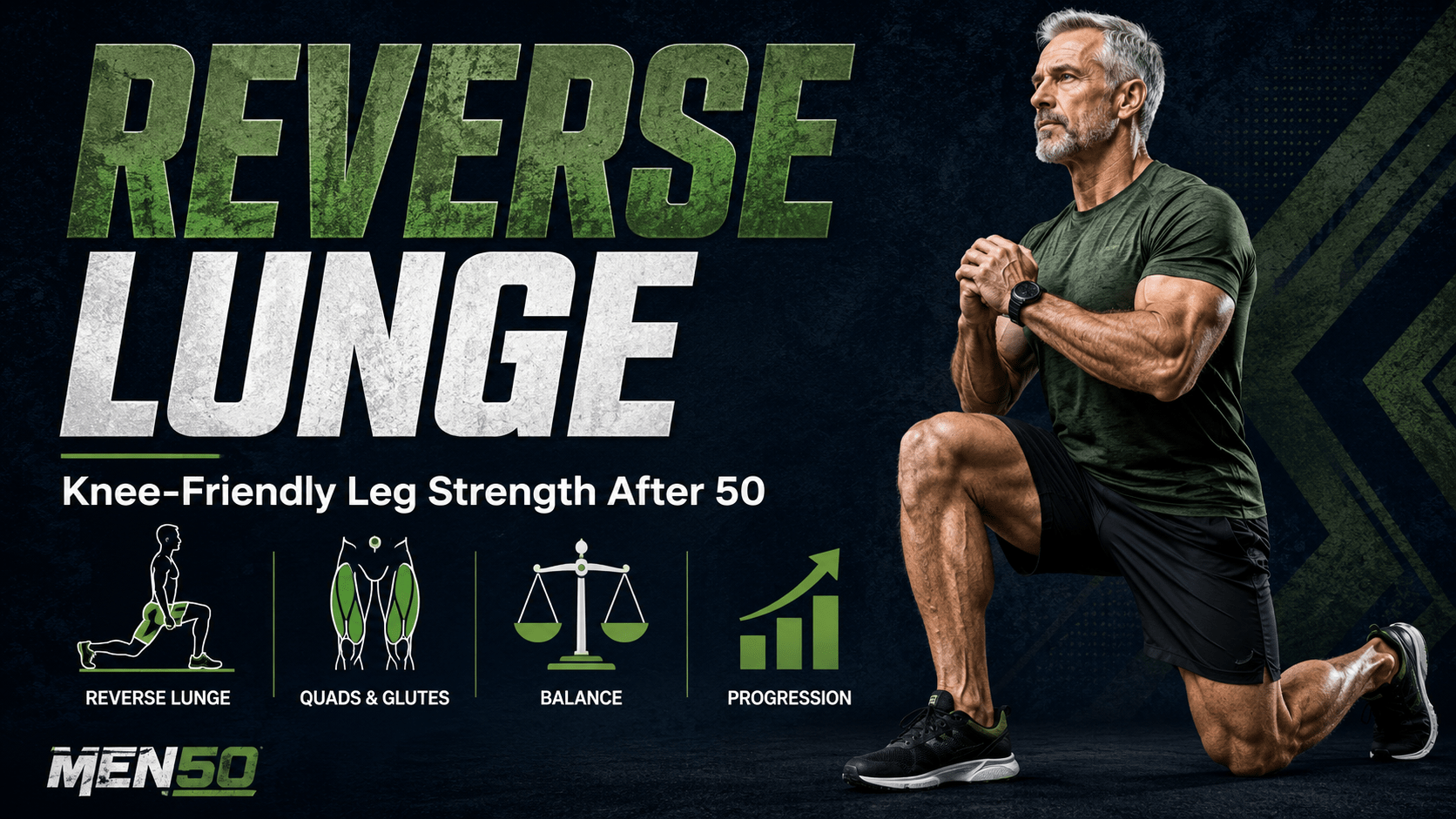
The reverse lunge is the knee-friendly cousin of the forward lunge — and for men over 50, it’s almost always the better choice. By stepping backward instead of forward, you eliminate most of the impact and forward-knee shear that makes the standard forward lunge so problematic for ageing knees. You still get all the benefits: single-leg strength, balance, hip and glute work, real-world carryover to walking and stair climbing. You just don’t have to absorb your bodyweight into a stepping-forward motion that knees over 50 increasingly resent. If you’ve tried lunges and they hurt, this is the version that probably won’t.
Part of the Build Muscle After 50 pillar — strength training for men over 50.
Key Takeaways
- The reverse lunge trains the quads, glutes, hamstrings, calves, and core — with significantly less knee impact than the forward lunge.
- This is the first major loaded single-leg exercise in the matrix. Single-leg strength is one of the most important fall-prevention markers after 50.
- Programming: 2–4 sets of 6–12 reps per leg, 2–3 times per week. Rest 45–75 seconds between sets.
- Step back, lower with control, and push through your front heel. The whole technique in one sentence.
- Pairs with the step-up, single-leg stand, and standing hip abduction to form a complete single-leg/balance training system.
How to Perform the Reverse Lunge
Set up first:
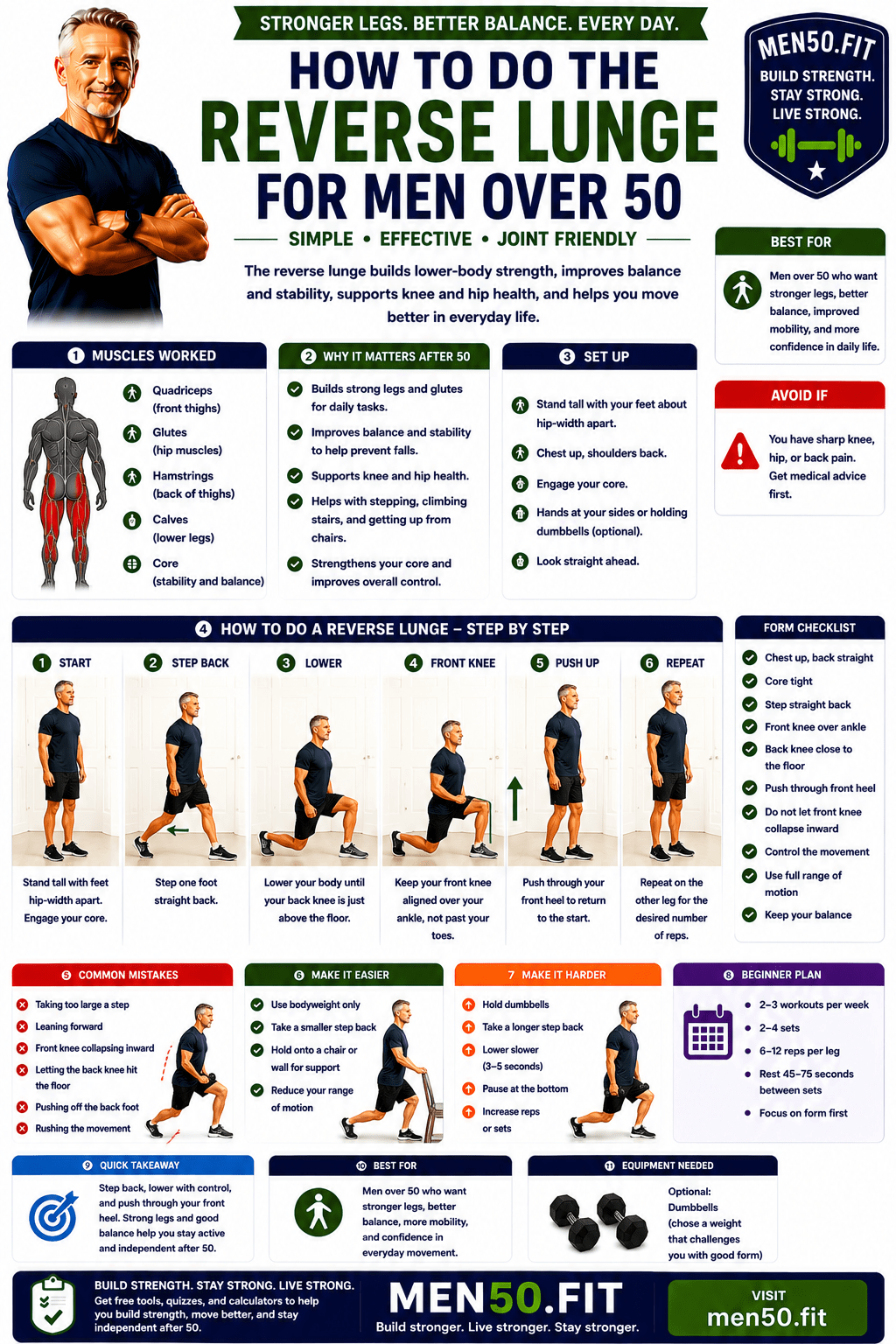
- Stand tall with your feet about hip-width apart.
- Chest up, shoulders back, core engaged.
- Hands at your sides, or holding dumbbells if you want to add load.
- Look straight ahead — eyes forward, not down at your feet.
Then the movement:
- Start. Stand tall with feet hip-width apart. Core engaged. Chest up, looking forward.
- Step back. Take a controlled step straight back with one foot. Land on the ball of the back foot — heel stays lifted. Keep the front foot planted firmly.
- Lower. Lower your body straight down until your back knee is just above the floor. Take 2–3 seconds on the way down. The front knee bends to about 90 degrees.
- Front knee. Keep your front knee aligned over your ankle, not past your toes. The knee should track straight forward, not collapse inward.
- Push up. Push through your front heel to return to standing. Drive up smoothly. Don’t push off the back foot — the work is done by the front leg.
- Repeat. Complete the reps on one side, then switch. Maintain clean form on every rep.
The cue that matters most: step back, lower with control, and push through your front heel. The front heel drive is what trains the right muscles — push from the toes and the calves take over instead of the glutes and quads.
Why the Reverse Lunge Matters After 50
The reverse lunge is the first major single-leg strength exercise with real loading potential in the matrix. That matters more than it sounds. Walking is a series of single-leg stances — every step you take, one leg supports your entire bodyweight while the other swings forward. Stair climbing is the same. Getting up from a chair, especially a low one, often becomes a single-leg push when you’re slightly off-centre. After 50, single-leg strength is one of the strongest predictors of fall risk and functional independence in men.
Bilateral exercises (the bodyweight squat, goblet squat, Romanian deadlift) train the legs as a pair — both legs working together. They’re efficient and build raw strength. But they let the stronger leg compensate for the weaker one, which means left-right asymmetries that develop quietly over decades don’t get fixed. Single-leg exercises expose these imbalances and train each leg individually to its current capacity.
Single-leg work also trains the gluteus medius — the side-hip muscle that stabilises the pelvis during single-leg stance. The same muscle we covered in detail in the standing hip abduction article. The reverse lunge trains it in a functional, dynamic pattern — closer to how it works during walking — than the isolation-style hip abduction does.
Why reverse rather than forward? The biomechanics are genuinely different:
Forward lunge — you step forward, the front knee decelerates your forward momentum, and the front knee absorbs significant shear stress as you brake to a stop. The forward step is also harder to control — many men step too far or land too hard, increasing the impact load. For men over 50, this is the version that produces knee pain most often.
Reverse lunge — your front foot stays planted; only the back foot moves. The back leg lowers into position rather than catching you. The front knee doesn’t have to absorb forward momentum because there isn’t any. The descent is controlled by the muscles, not by impact. Research comparing the two has consistently shown lower peak knee forces in the reverse lunge.
For most men over 50, the reverse lunge does the same job as the forward lunge with significantly less knee stress. There’s almost no good reason to choose the forward lunge unless you’re already doing reverse lunges comfortably and want to add a more advanced variation.
Sets and Reps
Quality reps on each leg matter more than chasing high numbers. Single-leg work is more fatiguing than it looks.
| Stage | Variation | Sets × Reps per Leg | Frequency |
|---|---|---|---|
| Beginner | Bodyweight, hand on chair for balance | 2 × 6–8 | 2× per week |
| Novice | Bodyweight, unsupported | 2–3 × 8–10 | 2–3× per week |
| Intermediate | Bodyweight, slow lowering (3 sec) | 3 × 8–12 | 2–3× per week |
| Advanced | Holding dumbbells (10–25 lbs per hand) | 3 × 8–12 | 2–3× per week |
Rest 45–75 seconds between sets (longer between legs is fine). Pick a load and rep range where the last 2–3 reps on each side feel clearly challenging but you can complete them with: front knee tracking over ankle, controlled lowering, no leaning forward, and a clean push-through-the-heel drive back to standing.
A practical starting load: most men over 50 should master bodyweight reverse lunges for at least 3–4 weeks before adding dumbbells. When you can do 3 sets of 10 clean bodyweight reps per leg, start with 10–15 lb (4.5–7 kg) dumbbells per hand. After 3–6 months of consistent training, many men progress to 20–30 lbs (9–14 kg) per hand. There’s no rush — clean form with bodyweight builds more strength than heavy dumbbells with form breakdown.
Common Mistakes
The six errors that turn a great single-leg exercise into a knee problem:
- Taking too large a step. A step that’s too long puts the back leg under more strain than the muscles can manage and turns the lunge into a near-splits position. Step back a comfortable distance — about your own leg length — and adjust based on how the knee bend feels. Front knee at about 90 degrees is the target.
- Leaning forward. Tilting the torso forward shifts work away from the front leg’s glutes and quads and onto the lower back. Keep the chest up, torso roughly vertical throughout the rep. A small forward lean is normal; folding at the hips is not.
- Front knee collapsing inward. Common when the glutes (particularly the glute medius) are weak. As you push up, the front knee wants to drift toward the centreline. Keep it tracking straight over the ankle — don’t let it cave. If it caves consistently, add standing hip abduction and glute bridges to your routine for glute strength.
- Letting the back knee hit the floor. Slamming the knee into the floor at the bottom of each rep is rough on the joint and stops you from getting full benefit from the descent. Lower until the knee is just above the floor — about an inch or two — and reverse the motion smoothly.
- Pushing off the back foot. The front leg should do the work. If you push off the back toe to help you up, the back leg’s calf takes load it shouldn’t and the front leg trains less. Drive through the front heel — the back leg just steps back to standing.
- Rushing the movement. Quick reps use momentum and bounce; controlled reps build strength. Take 2–3 seconds on the way down, brief pause at the bottom, 1–2 seconds up. The slow tempo is the exercise.
Make It Easier or Harder
If standard reverse lunges are too challenging:
- Use bodyweight only — strength is built from where you are. Most men over 50 should master bodyweight before adding dumbbells.
- Take a smaller step back — reduces the depth and the balance demand. Build range over weeks.
- Hold onto a chair or wall for support — light support with one hand removes the balance demand entirely and lets you focus on the leg work. Aim to need less support over time.
- Reduce your range of motion — only lower halfway down while you build strength.
To make reverse lunges harder once form is solid:
- Hold dumbbells — start with 10–15 lbs per hand. Don’t progress past 30–35 lbs per hand without solid form.
- Take a longer step back — increases the range of motion at the front knee and the stretch in the back hip flexor.
- Lower slower to 3–5 seconds per rep — significantly more demanding.
- Pause at the bottom for 1–2 seconds with the back knee just above the floor.
- Increase reps or sets — many men over 50 progress better through volume than through heavier load.
For variety once standard form is solid, try alternating reverse lunges (right leg, then left, then right) — adds a balance challenge between reps and lets you maintain focus on form one side at a time.
Safety Note
Avoid the reverse lunge if you have sharp knee, hip, or back pain during the movement. Get medical advice first if any of these apply.
The reverse lunge is gentler than the forward lunge for knee issues, but it’s not pain-free for everyone. If the front knee hurts, check: (1) Is the knee tracking over the ankle, not collapsing inward? (2) Is the knee going past the toes? (3) Are you pushing through the heel, not the toes? Fixing these usually resolves mild knee discomfort. If pain persists, drop to a smaller step back or temporarily switch to step-ups or chair squats while you build the strength to manage lunges.
If you have balance concerns or are recovering from a fall, use a chair or wall for support every time. There’s no shame in needing the support — using it lets you train safely while you build the balance to drop it.
Make sure the floor is non-slip. Lunges in socks on a polished floor are how lower legs end up sliding into positions they shouldn’t.
Build Your Personal Training Plan
The reverse lunge is one piece of a complete lower-body programme. Get a personalised exercise plan based on your current strength, mobility, and any limitations.
Take the Free Fitness Profiler →
FAQs
Reverse lunge vs forward lunge — which is better?
For most men over 50, the reverse lunge is almost always the better choice. The forward lunge requires the front knee to absorb the forward momentum of stepping forward, which produces higher peak knee forces and more shear stress on the joint. The reverse lunge keeps the front foot planted and lowers the back leg into position — controlled descent rather than impact deceleration. Research comparing the two has consistently shown lower knee loading in the reverse lunge. Unless you’re already comfortable with reverse lunges and want a more advanced variation, the reverse version does the same job with less knee stress.
How heavy should the dumbbells be?
For most men over 50 starting loaded reverse lunges, 10–15 lbs (4.5–7 kg) per hand. After 3–6 months of training, many men progress to 20–30 lbs (9–14 kg) per hand. The right weight lets you complete 6–12 reps per leg with clean form — controlled lowering, knee tracking over ankle, no forward lean, smooth push through the heel. Bodyweight first for at least 3–4 weeks; don’t rush to add load before the pattern is solid. Most men over 50 don’t need to go above 30 lbs per hand for years.
Why does my knee hurt during lunges?
Three common causes — all addressable. Knee collapsing inward as you push up means weak glutes (particularly glute medius). The fix: drive the knee out, and add standing hip abduction and glute bridges. Knee going past the toes at the bottom — usually because your step back is too short. Take a longer step. Pushing through the toes instead of the heel means the quads and calves work harder than they should and the knee takes more load. Drive through the front heel. If pain persists after fixing all three, drop to a smaller range, switch to step-ups, or see a physiotherapist.
Should I alternate legs or do all reps on one side first?
Both work; they train slightly different things. All reps on one side, then switch lets the working leg get more cumulative fatigue — useful for building strength. Alternating legs (right, left, right, left) adds a balance challenge between reps and keeps fatigue more even. Most men benefit from doing both in rotation — alternating one workout, single-side the next. If one leg is clearly weaker, do the weaker side first; you’ll bring more energy to it.
Can I do reverse lunges every day?
Better not to. Reverse lunges are a moderate-to-high intensity compound exercise that loads the legs significantly — they need 48 hours of recovery between sessions. 2–3 times per week is the sweet spot. If you want to train legs more often, alternate reverse lunge days with lower-intensity work like sit-to-stands, glute bridges, or single-leg stands on the off days.
References
- American College of Sports Medicine. Resistance Training for Older Adults Position Stand. acsm.org
- Centers for Disease Control and Prevention. STEADI: Stopping Elderly Accidents, Deaths & Injuries. cdc.gov
- National Institute on Aging. Exercise & Physical Activity: Your Everyday Guide. nia.nih.gov
Disclaimer: This article is for educational purposes only and is not medical advice. Consult a qualified healthcare professional before starting any new exercise programme, especially if you have existing knee, hip, or back conditions.