
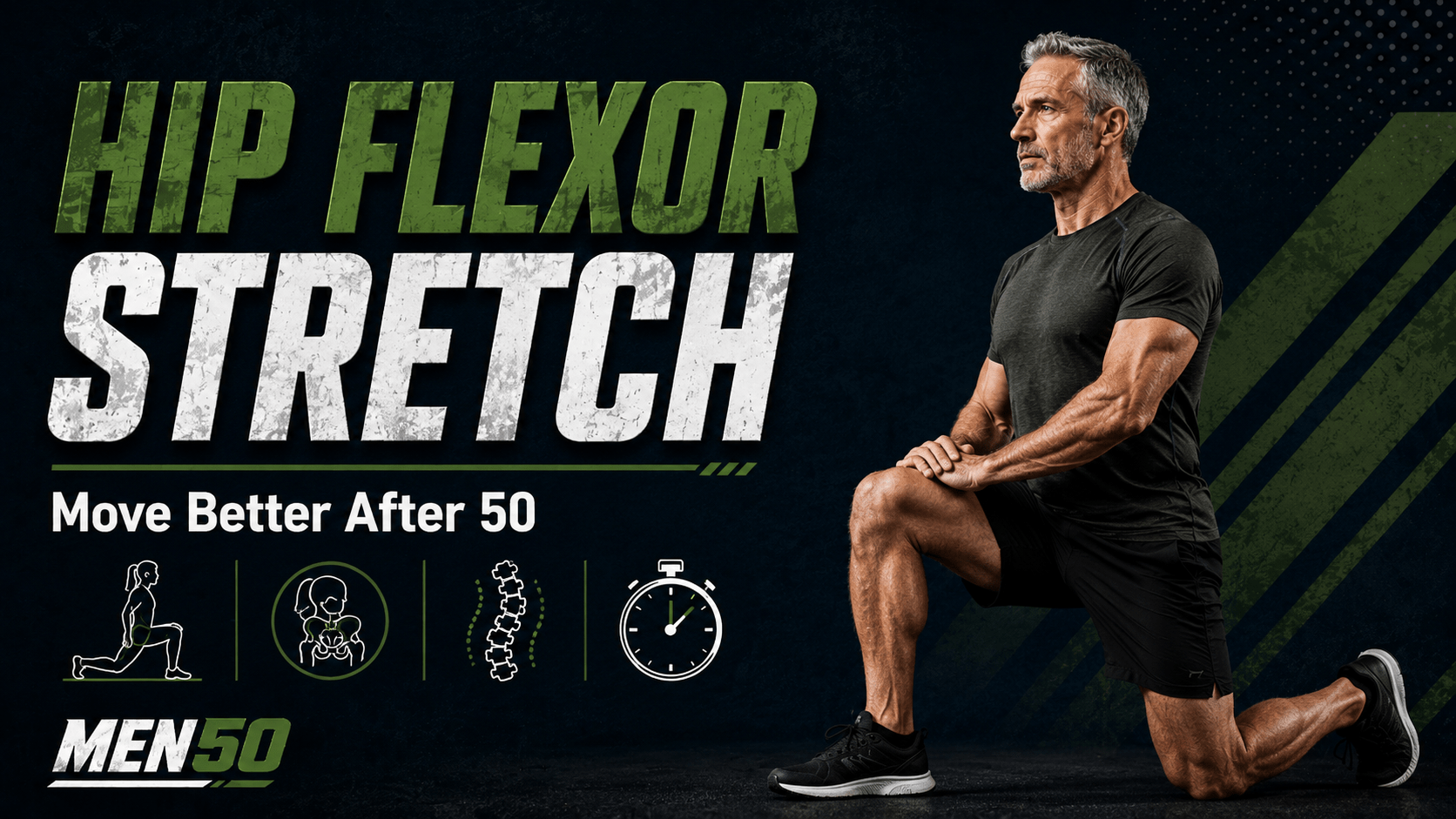
Tight hip flexors are one of the most common — and most overlooked — drivers of lower back pain in men over 50. The kneeling hip flexor stretch directly targets the psoas and iliacus, two muscles that shorten after decades of sitting and quietly compress your lumbar spine all day long. A few minutes of daily stretching can take pressure off the lower back, improve your walking stride, and restore the hip extension you need to climb stairs, get out of a chair, or play sport without stiffness.
Part of the Build Muscle After 50 pillar — strength training for men over 50.
Key Takeaways
- Tight hip flexors pull the pelvis into anterior tilt, which compresses the lumbar spine and contributes to chronic lower back ache.
- The half-kneeling stretch is the most effective version. Tuck the pelvis under and squeeze the back-leg glute to make it work properly.
- Programming: 2 holds per side, 20–40 seconds each, daily — particularly after long sitting bouts or before lower-body training.
- Stretch with control, not force. You should feel a steady pull in the front of the hip, not pain.
- Tight hip flexors also switch the glutes off, which is why “weak glutes” and “tight hip flexors” almost always show up together.
How to Perform the Hip Flexor Stretch
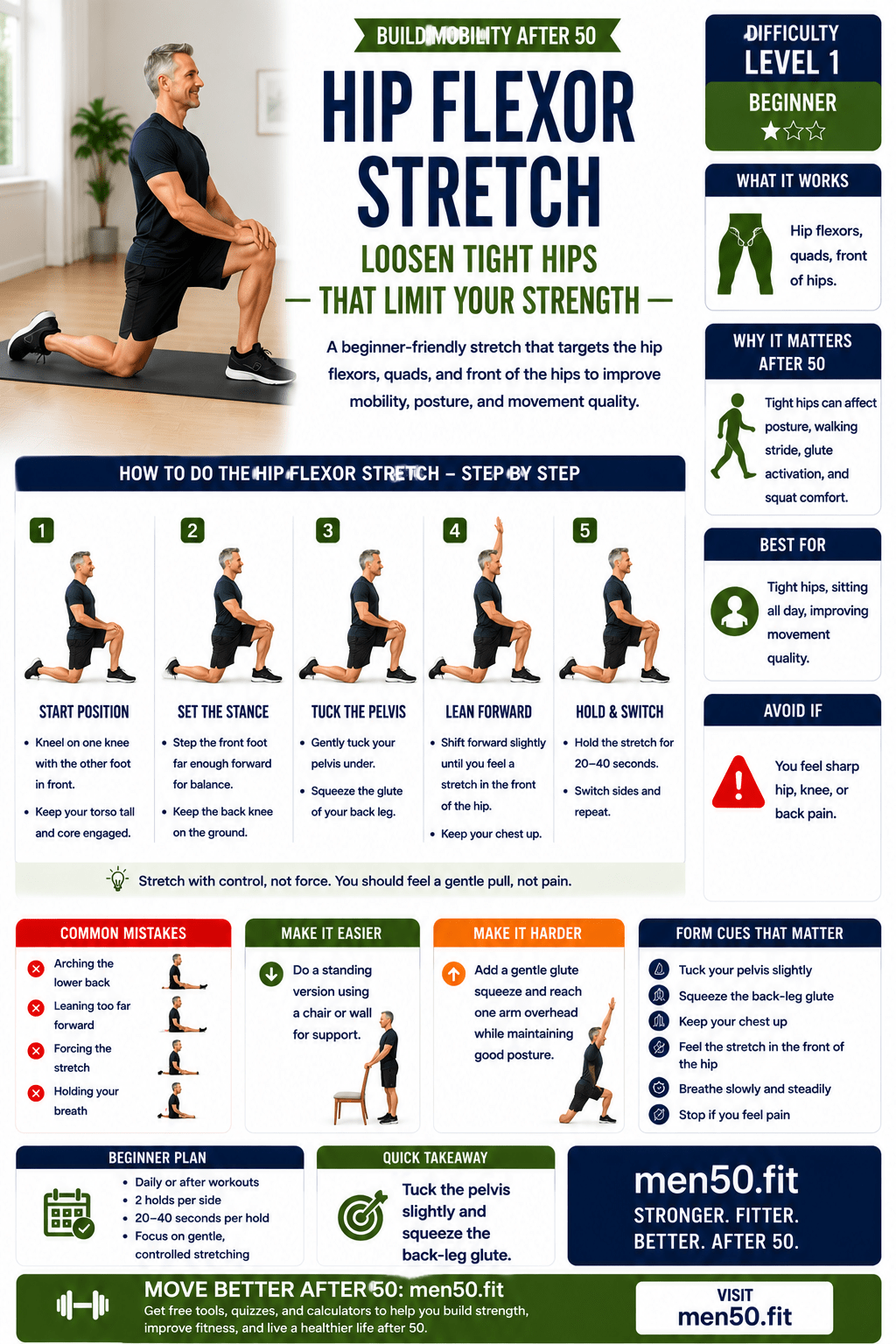
- Start position. Kneel on one knee with the other foot flat on the floor in front of you, knee directly above the ankle. Place a folded towel under the back knee if the floor is hard. Keep your torso tall and your core lightly engaged.
- Set the stance. Step the front foot far enough forward that you have a stable base. Back knee stays planted on the floor.
- Tuck the pelvis. Gently tuck your pelvis under — imagine pulling your beltline up toward your ribs. Squeeze the glute of your back leg. This is the move that actually lengthens the hip flexors. If you skip this step, you’re just leaning forward.
- Lean forward slightly. Shift forward just enough to feel a stretch in the front of the back hip and thigh. Chest stays up. You should feel a steady pull, not pain.
- Hold and switch. Hold for 20–40 seconds, breathing slowly. Release, switch sides, repeat. Do 2 holds per side total.
The pelvic tuck and back-glute squeeze are the difference between a hip flexor stretch that works and one that just makes you feel like you stretched. Without them, the lower back compensates by arching, which is the exact thing you’re trying to fix.
Why the Hip Flexor Stretch Matters After 50
The psoas and iliacus — the two main hip flexors — run from the front of your spine and pelvis down to the top of your thigh bone. Sit for hours every day and these muscles shorten and tighten in the seated position. Stand up, and they pull the front of your pelvis down, which forces the lower back into an exaggerated arch. The lumbar discs and vertebrae take the compression.
This is the most common reason men over 50 feel a low, persistent ache in the lower back after long drives, flights, or desk sessions. It’s also why standing up after sitting feels stiff for the first few steps — the hip flexors are essentially still in “seated mode” until they lengthen out.
There’s a second, less obvious consequence. When the hip flexors are tight, the brain inhibits the glutes — the body won’t let two opposing muscle groups fire at full strength against each other. Weak glutes show up as slower walking pace, reduced stair-climbing power, and lower back doing the work the glutes should be doing. Stretching the hip flexors often unlocks glute strength gains within a few weeks, without any extra glute work.
A reasonable daily routine for a man over 50 with sedentary work is 2 minutes of hip flexor stretching, 7 days a week. It’s one of the highest-return mobility investments you can make.
Sets and Reps
Daily, not occasional. The hip flexors tighten back up within hours of sitting, so consistent short doses beat occasional long sessions.
| When to Do It | Holds Per Side | Duration | Frequency |
|---|---|---|---|
| Morning routine | 2 | 20–30 seconds | Daily |
| After long sitting | 1–2 | 30–40 seconds | As needed |
| Before lower-body training | 2 | 20–30 seconds | Every training session |
| Evening (best for relaxation) | 2 | 30–40 seconds | 3–5× per week |
You don’t need to do all of these every day. Pick the routine that fits your schedule and stay consistent. Two minutes of stretching done five days a week beats ten minutes done once.
Common Mistakes
The four errors that turn a great stretch into back pain or wasted time:
- Arching the lower back. The most common mistake by far. If you lean forward without tucking the pelvis, the lower back arches and you stretch nothing useful. Tuck the pelvis under first, then lean.
- Leaning too far forward. More range isn’t better. Lean only far enough to feel a steady pull in the front of the back hip. Forcing depth shifts the stretch onto the lower back.
- Forcing the stretch. Stretching is a nervous-system conversation — the muscle releases when it feels safe, not when you pull harder. Gentle and sustained beats deep and brief every single time.
- Holding your breath. Tense muscles don’t release. Slow nasal breathing — 4 seconds in, 4 seconds out — helps the hip flexor let go faster than any pulling can.
Make It Easier or Harder
If kneeling on the floor is uncomfortable or you have knee issues, do the standing version. Stand next to a chair or wall, place one foot back about a stride length, tuck the pelvis under, and shift the hips forward. Same principles, no kneeling required.
To make the stretch deeper once basic form is solid, reach the same-side arm overhead (the arm on the back-leg side) and lean slightly toward the front leg. This extends the stretch up through the psoas attachment on the lower spine and into the side body. Keep the pelvis tucked — losing pelvic position to chase more range defeats the purpose.
Safety Note
Use a folded towel or thin pillow under the back knee if the floor is hard. Never force the stretch — a sustained gentle hold is both more effective and safer than pushing into a deeper position quickly. If you feel sharp pain in the hip, knee, or lower back, stop immediately. If you have an acute hip flexor strain, groin injury, or recent hip surgery, get clearance from a physiotherapist before doing this stretch.
Build Your Personal Training Plan
The hip flexor stretch is one piece of a complete mobility and strength programme. Get a personalised plan based on your current movement quality, goals, and any limitations.
Take the Free Fitness Profiler →
FAQs
How long does it take to loosen tight hip flexors?
Most men feel a noticeable difference in hip mobility within 1–2 weeks of daily stretching. Reductions in lower back stiffness usually follow within 3–4 weeks. Lasting change — where your hips stay loose between sessions — typically takes 6–8 weeks of consistent work, plus addressing the underlying cause (which is almost always too much sitting).
Why do my hip flexors get tight after 50?
Decades of sitting is the main cause — in chairs, cars, and on sofas. The hip flexors spend most of the day in a shortened position and gradually adapt to that as their resting length. After 50, the issue compounds because muscle tissue becomes less elastic with age, so the same amount of sitting produces more tightness than it did at 30.
Is the hip flexor stretch safe for lower back pain?
For most men with non-specific lower back pain, yes — it’s one of the most commonly prescribed stretches by physiotherapists for exactly this reason. Tight hip flexors are a major contributor to lower back compression. That said, if your back pain is sharp, follows an injury, or radiates down a leg, see a physio before adding any new stretches. Pair this stretch with the dead bug exercise for a more complete back-protection routine.
Should I stretch before or after my workout?
Both work, for different reasons. Before lower-body training, a 20–30 second stretch per side improves hip mobility for squats, lunges, and step-ups without reducing strength. After workouts or sitting bouts, a longer 30–40 second hold is better for restoring resting length. Don’t do long static stretches (40+ seconds) immediately before heavy strength training — they can temporarily reduce power output.
Can tight hip flexors cause knee pain?
Yes, indirectly. Tight hip flexors pull the pelvis into anterior tilt, which can rotate the thigh bone slightly inward at the hip. This changes how the kneecap tracks during walking and squatting, which over time causes irritation under the kneecap. Stretching the hip flexors often resolves persistent low-grade knee discomfort that no amount of knee-specific work fixes.
References
- National Institute of Arthritis and Musculoskeletal and Skin Diseases. Back Pain in Adults. niams.nih.gov
- American College of Sports Medicine. Flexibility and Stretching Position Stand. acsm.org
- Centers for Disease Control and Prevention. Sedentary Behavior and Health. cdc.gov
Disclaimer: This article is for educational purposes only and is not medical advice. Consult a qualified healthcare professional before starting any new stretching or exercise programme, especially if you have existing hip, knee, or back conditions.