
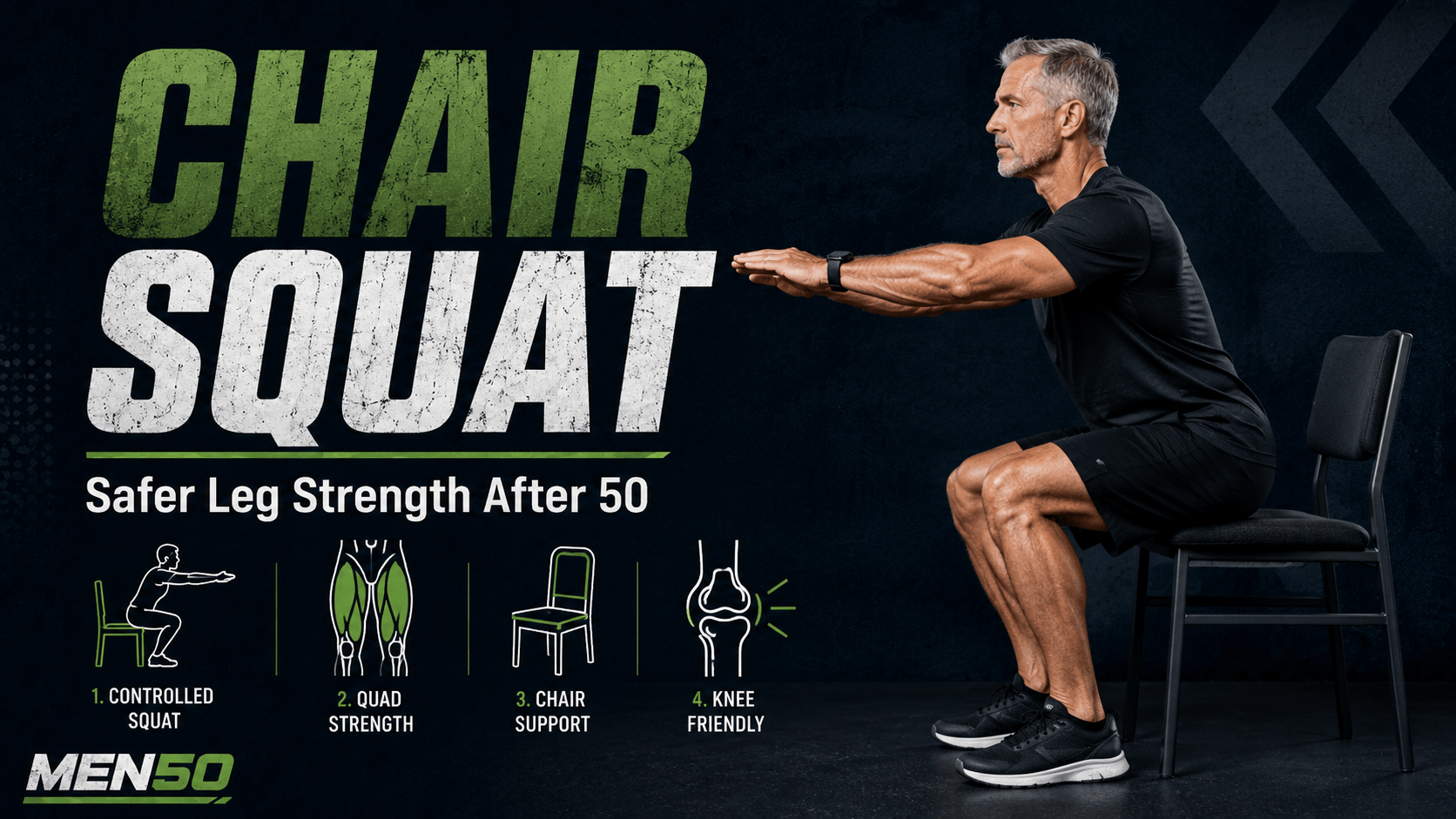
The chair squat is the smartest entry point into squat training for any man over 50. It builds the same lower-body strength as a regular squat, but with a built-in safety net: a sturdy chair behind you that gives a clear depth target, removes the fear of falling backward, and lets you bail out safely if you lose balance. It’s also the cleanest path to a bodyweight squat — master the chair, then phase the chair out.
Part of the Build Muscle After 50 pillar — strength training for men over 50.
Key Takeaways
- The chair squat builds quad, glute, hamstring, and core strength with a clear depth target and a built-in safety net.
- Tap the chair, don’t collapse into it. Lightly touching the seat is the goal — sitting and resting turns it into a different exercise.
- Programming: 3 sets of 8–12 reps, 2–3 workouts per week. Earn the unsupported bodyweight squat by clean reps, not by counting weeks.
- Push hips back first, then bend the knees. The hip hinge protects the knees and recruits the glutes.
- This is a different exercise from the sit-to-stand — that one starts seated, this one stays standing. Both belong in your matrix; serve different purposes.
How to Perform the Chair Squat
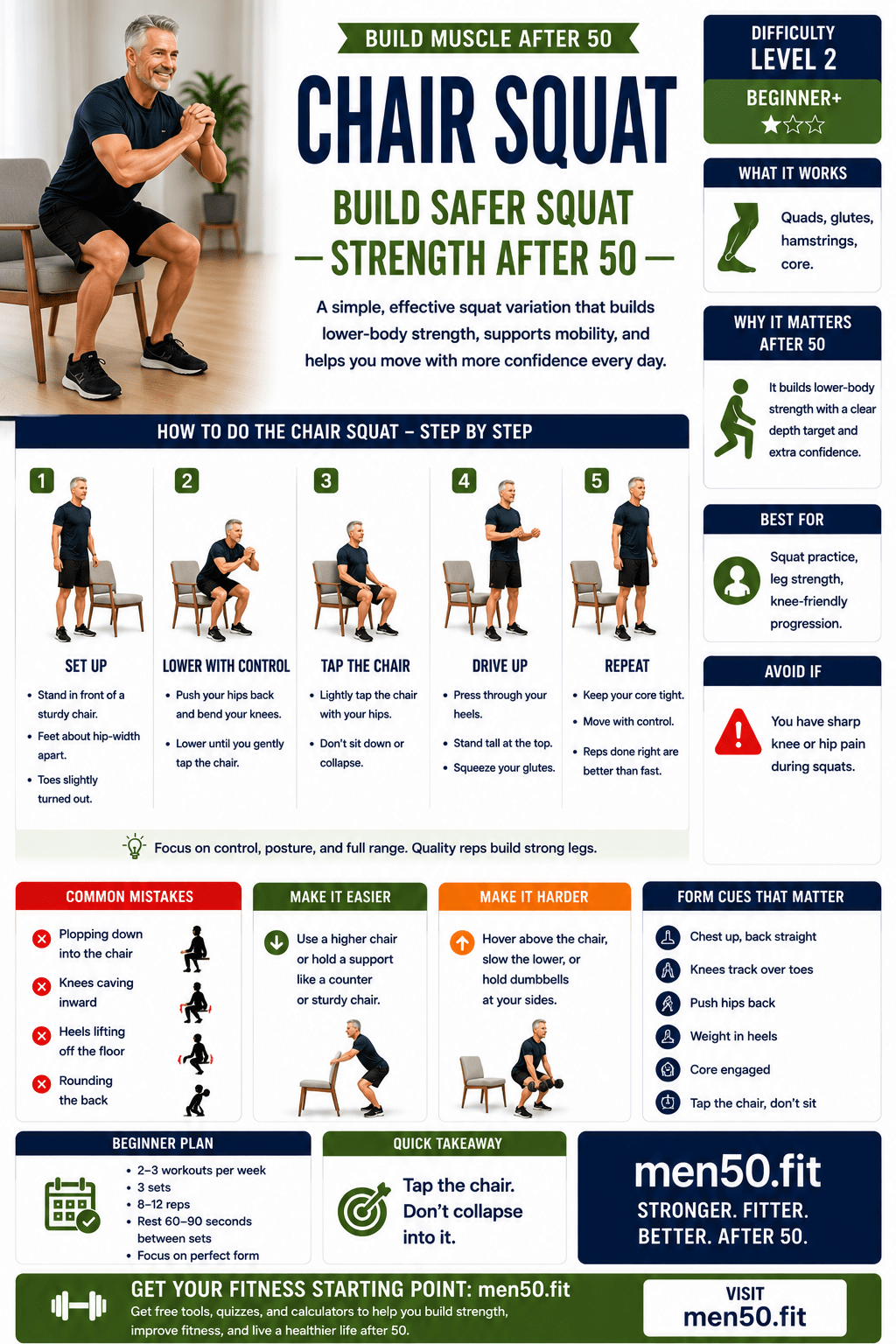
- Set up. Stand in front of a sturdy chair, feet hip-width apart, toes turned slightly outward (about 10–15 degrees). The chair should be solid and stable — no rolling office chairs.
- Lower with control. Push your hips back like you’re closing a car door with your backside, then bend the knees to lower toward the chair. Arms forward or hands clasped at the chest for counterbalance. Take 2–3 seconds on the way down.
- Tap the chair. Lightly tap the seat with your glutes. Don’t sit down. Don’t collapse the last few inches. The point of contact is a checkpoint, not a rest stop.
- Drive up. Press firmly through your heels (not your toes) and stand back up. Squeeze your glutes at the top. Stand tall — chest up, hips fully forward.
- Repeat. Move with control. Quality reps build strong legs. Five clean chair squats build more strength than fifteen sloppy ones.
The single most important cue: tap the chair, don’t collapse into it. If you sit down completely and rest between reps, you’ve turned the chair squat into a sit-to-stand — a useful exercise, but a different one.
Why the Chair Squat Matters After 50
The ability to lower yourself toward the floor and stand back up under control is one of the most fundamental markers of functional independence. After 50, the quadriceps and glutes lose strength faster than smaller muscle groups — particularly if you spend most of the day sitting — and the loss shows up as needing to push off the arms of a chair, hesitating before climbing stairs, or struggling to get up from the floor.
Research on the Sitting-Rising Test by Brito and colleagues (published in the European Journal of Preventive Cardiology in 2014) found that the ability to lower to the floor and stand back up without using the hands or knees was a powerful predictor of all-cause mortality in adults aged 51–80. The test isn’t perfect, but the underlying mechanism is sound: men who maintain the leg strength, balance, and mobility to perform this kind of movement tend to maintain everything else for longer too.
The chair squat rebuilds exactly this pattern. It targets the quads (which extend the knee), the glutes (which extend the hip), the hamstrings (which support the back of the knee and hip), and the core (which keeps the torso upright through the movement). It also has a built-in safety mechanism: if you lose balance, you simply sit down on the chair. That confidence factor matters — most men over 50 who avoid squats avoid them because of fear of falling, not because of weakness.
It’s also the logical step before the unsupported bodyweight squat, full step-ups, and any loaded squat variation. Earn the chair squat first.
Sets and Reps
Build clean reps before adding difficulty. The squat pattern rewards patience.
| Stage | Variation | Sets × Reps | Frequency | Chair Height |
|---|---|---|---|---|
| Beginner | Tap-the-chair, support if needed | 2 × 8–10 | 2× per week | Standard kitchen chair (knee height) |
| Novice | Tap-the-chair, no support | 3 × 10–12 | 2–3× per week | Standard chair |
| Intermediate | Hover above chair (2 inches), 2-second pause | 3 × 8–12 | 2–3× per week | Standard chair |
| Progression | Bodyweight squat, no chair | 3 × 10–15 | 2–3× per week | N/A |
| Advanced | Goblet squat (dumbbell at chest) | 3 × 8–12 | 2–3× per week | N/A |
Rest 60–90 seconds between sets. When you can do 3 sets of 12 chair squats with a controlled 2-second descent and a clean stand-up — no hand support, no sitting down — you’ve earned the unsupported bodyweight squat.
Common Mistakes
The four errors that turn a great exercise into a knee or back problem:
- Plopping down into the chair. Letting yourself drop the last few inches removes the hardest, most useful part of the movement. The lowering phase is where the legs actually work. Stay in control all the way down — tap, don’t collapse.
- Knees caving inward. Common in men with weaker glutes. As you stand up, drive your knees outward to track over your second and third toes. If they still cave, use a lighter version (higher chair) or pause the rep at the bottom and reset.
- Heels lifting off the floor. Means your ankle mobility is limiting depth or you’re shifting your weight forward. Push the weight back into your heels and drive up from there. If heels still come up, you may need ankle mobility work alongside the squat practice.
- Rounding the back. The lower back curling forward at the bottom is the body’s way of compensating for weak glutes or limited hip mobility. Keep the chest up and the core engaged. If the round shows up only at the bottom, reduce range — sit slightly higher.
Make It Easier or Harder
If standard chair squats are too challenging, use a higher chair (or stack a folded towel or cushion on the seat) to reduce the range of motion. You can also hold a kitchen counter or sturdy second chair in front of you with one or both hands for balance and load-sharing. There’s no shame in starting with full support — strength is built from where you are.
To make it harder once form is clean: hover 1–2 inches above the chair instead of tapping it, slow the lowering phase to 3–4 seconds, or add a 1–2 second pause at the bottom. The next progression is the bodyweight squat without the chair, then the goblet squat holding a dumbbell at chest height.
Safety Note
Use a chair that is the right height — your hips should be at roughly knee height when you tap it. A chair that’s too low forces excessive knee bend before your strength can support it; a chair that’s too high reduces the range of motion below useful levels.
Don’t let your knees cave inward as you stand up — press them outward to align with your toes. Men with significant knee arthritis should choose a higher surface to start, reduce the range of motion, and avoid grinding through pain. Sharp knee or hip pain during squats is a sign to stop and reassess form or seek a physiotherapist’s input, not to push through.
Make sure the chair is on a non-slip surface and won’t slide backward if you brush it. A chair against a wall removes that risk entirely.
Build Your Personal Training Plan
The chair squat is one piece of a complete lower-body programme. Get a personalised exercise plan based on your current strength, mobility, and any limitations.
Take the Free Fitness Profiler →
FAQs
What’s the difference between a chair squat and a sit-to-stand?
The chair squat taps the chair lightly without sitting; the sit-to-stand actually starts seated and stands up from a resting position. The chair squat is a continuous strength exercise — load is maintained through every rep. The sit-to-stand resets the muscles between reps and trains the “rising from rest” pattern specifically. Both are useful and they serve different purposes; most men benefit from including both at different stages.
How do I know when I’m ready to squat without a chair?
When you can complete 3 sets of 12 chair squats with: a controlled 2-second descent, a light tap with no collapse, no hand or counter support, knees tracking over toes throughout, and a clean stand-up at the top. Hit that consistently for 2–3 sessions in a row and you’ve earned the unsupported bodyweight squat. Keep the chair in the room behind you for the first few sessions as a safety net while you learn the new pattern.
Should my knees go past my toes during a chair squat?
A small amount of knee travel past the toes is normal and not harmful for most men — biomechanics research has been clear on this for years. The bigger problem is the opposite: men who try to keep their knees behind their toes often end up rounding the lower back and dumping load onto the spine. Push the hips back first, let the knees track naturally over the toes, and don’t worry about a small amount of forward travel.
What chair height should I use?
The standard rule: your hips should be at roughly knee height when you tap the chair. A typical kitchen or dining chair (around 18 inches / 46 cm seat height) suits most men. If you can’t squat to that depth comfortably, start with a higher chair (or a cushion on a standard chair) and lower it progressively. If standard depth feels easy, you’re ready to hover above the chair or move to a lower box.
Can chair squats help with knee pain?
Often, yes — counterintuitively. Strong quads and glutes support the knee joint and reduce the load on the cartilage and ligaments. The chair squat is one of the gentler ways to build that strength because the range of motion is limited and the safety net is built in. But “knee pain” covers a lot of conditions — if you have a specific diagnosis (meniscus tear, arthritis flare, ligament injury), get clearance from a physio or sports doctor about the right starting depth.
References
- de Brito LBB, Ricardo DR, de Araújo DSMS, et al. Ability to sit and rise from the floor as a predictor of all-cause mortality. European Journal of Preventive Cardiology. 2014;21(7):892-898.
- American College of Sports Medicine. Resistance Training for Older Adults Position Stand. acsm.org
- National Institute on Aging. Exercise & Physical Activity: Your Everyday Guide. nia.nih.gov
Disclaimer: This article is for educational purposes only and is not medical advice. Consult a qualified healthcare professional before starting any new exercise programme, especially if you have existing knee, hip, or back conditions.